
The Aftermath: The Expiration of New START and What It Means For Us All
The last remaining agreement limiting U.S. and Russian nuclear weapons has now expired. For the first time since 1972, there is no treaty-bound cap on strategic nuclear weapons.
On February 5th, Axios reported that following overnight negotiations between the two sides, there remains a possibility for the two countries to continue observing the central limits after the Treaty’s expiry, although it did not state whether such an arrangement would include verification, and also noted that it had not been agreed to by either President.
If the two sides cannot reach an agreement, we face a world of heightened nuclear competition fueled by worst-case planning and nuclear expansion, fewer transparency mechanisms, and deepening mistrust among nations with the world’s most powerful weapons. Addressing these challenges in the new nuclear era will require creative and nontraditional approaches to risk reduction and arms control.
How did we get here?
Even if the two sides manage to negotiate a last-minute band-aid arrangement, the fact that we have no long-term arms control solution ready to take New START’s place is the culmination of years of breakdown in diplomacy and arms control efforts. New START entered into force on February 5th, 2011, with a 10-year duration and the option to extend it for five additional years. Leading up to the treaty’s original expiration date in 2021, there was serious concern that the United States and Russia would not come to an agreement on extension. For the first three years of his first administration, President Donald Trump engaged in few constructive arms control discussions with Russia. Then, in the final months of 2020, he proposed a short-term extension contingent on Russia agreeing to new verification measures and a warhead freeze, which Russia rejected. At the 11th hour, just two weeks after his inauguration, President Joe Biden agreed to a full five-year extension of the treaty with Russian President Vladimir Putin.
The shaky status of New START further deteriorated in early 2023 when Putin announced that Russia was “suspending” its participation in the treaty, stipulating that resumption would require the United States to end its support for Ukraine, and that arms control talks would also have to involve France and the United Kingdom. As part of its suspension, Russia halted its exchanges of data, notifications, and telemetry information, and the United States subsequently followed suit with reciprocal countermeasures.
It is important to note that although the United States found Russia’s actions to constitute noncompliance with the treaty’s requirements, successive State Department reports following Russia’s suspension assessed that “Russia did not engage in any large-scale activity above the Treaty limits.” The 2024 compliance report, however, stated that “Russia was probably close to the deployed warhead limit during much of the year and may have exceeded the deployed warhead limit by a small number during portions of 2024.”
Ultimately, over years of growing tensions and mistrust between the two countries, the United States and Russia have barely managed to see New START through to its expiration, much less engage in talks for a new treaty to take its place. In September 2025, the Kremlin stated that “Russia is prepared to continue observing the treaty’s central quantitative restrictions for one year after February 5, 2026,” without verification. President Trump told a reporter that the proposal “sounds like a good idea to me,” but apparently did not respond to the proposal before the treaty’s deadline expired.
In addition to the worsening U.S.-Russia relationship, funding cuts at the U.S. Department of State, the Defense Nuclear Nonproliferation office at the NNSA, and the Office of the Director of National Intelligence mean less investment in and capacity for executing a follow-on agreement, even if the political environment allowed for it.
What could this mean for nuclear forces?
New START placed limits on the number of strategic nuclear weapons that each country could possess and deploy: each side could deploy up to 1,550 warheads and 700 launchers, and could possess up to 800 deployed and non-deployed launchers. Incorporating a limit on non-deployed launchers was intended to prevent either country from “breaking out” or quickly expanding deployed numbers beyond the treaty limits.
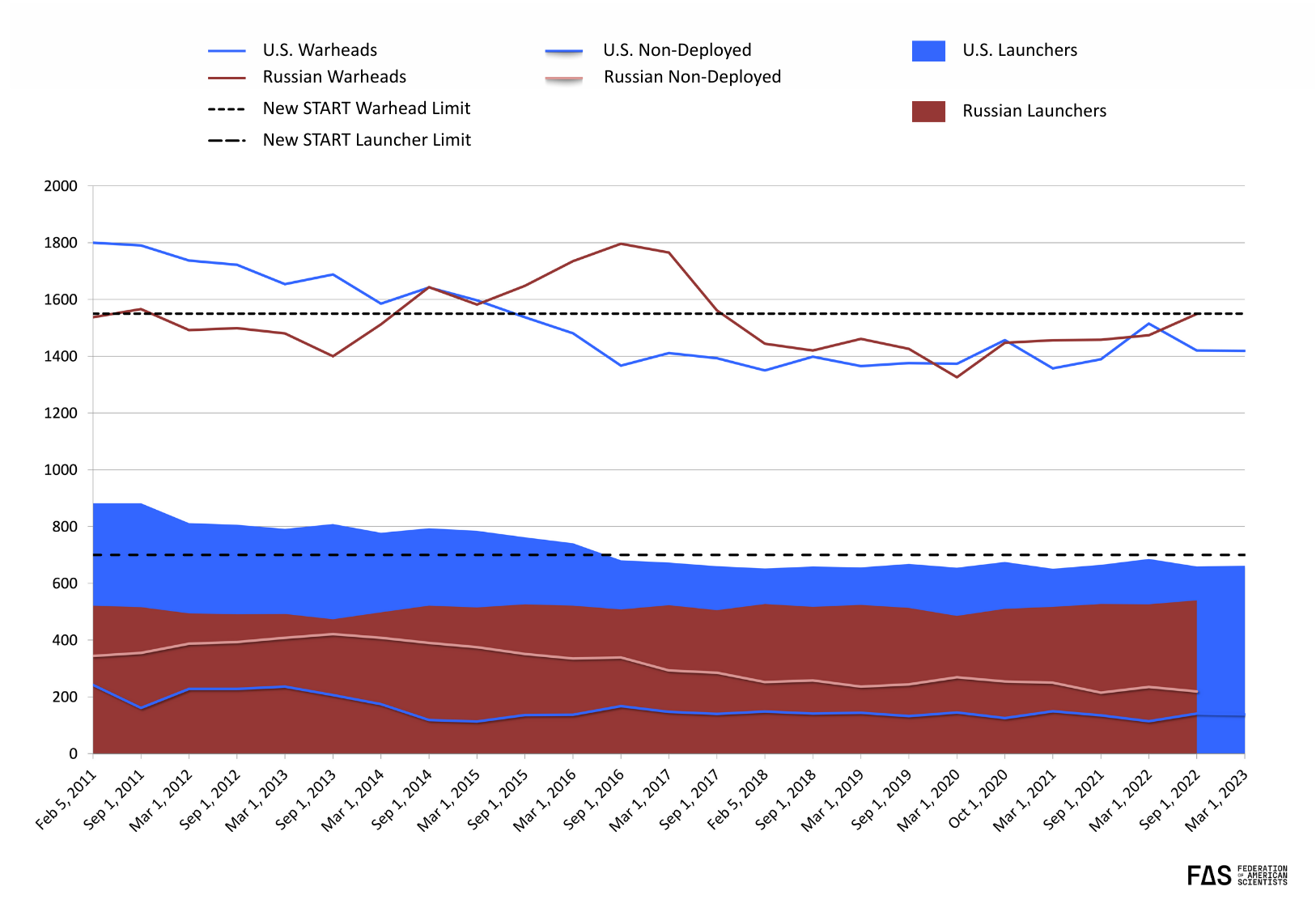
Over the past 15 years, the treaty restraints and respective modernization plans resulted in significant force reductions in Russia and the United States. Both countries have meticulously planned their respective nuclear modernization programs based on the assumption that neither will exceed the force levels currently dictated by New START. In the absence of an official agreement following New START’s expiration, however, both countries will likely default to mutual distrust and worst-case thinking about how their arsenals will grow in the future. This is a serious concern, considering both countries possess significant warhead upload capacity that would allow them to increase their deployed nuclear forces relatively quickly.
This kind of thinking has already been displayed by members of the House Armed Services Committee who, in 2023, called Biden’s agreement to extend New START “naive” and argued that Russia “cannot be trusted,” saying “if these agreements cannot be enforced, then they do nothing to enhance U.S. security, and serve only to undermine it.” Defense hawks in Congress and outside argued instead for upgrades and expansions to the U.S. nuclear force; the bipartisan Congressional Commission on the U.S. Strategic Posture in late-2023 recommended a broad range of options to expand the U.S. nuclear arsenal. The Biden administration also appeared to lay the groundwork for potential options to expand its deployed nuclear force following the end of New START: in June 2024, Pranay Vaddi, Special Assistant to the President and Senior Director for Arms Control, Disarmament, and Nonproliferation at the National Security Council, stated that “Absent a change in the trajectory of adversary arsenals, we may reach a point in the coming years where an increase from current deployed numbers is required. And we need to be fully prepared to execute if the President makes that decision—if he makes that decision.” The Biden administration’s Nuclear Employment Strategy published in 2024, however, did not direct an increase of U.S. deployed nuclear forces, effectively leaving that decision to the Trump administration.
If the United States decided to increase its deployed strategic forces, there are measures it could take to rapidly upload reserve warheads, while other options will take more time. For example, all 400 deployed U.S. ICBMs currently only carry a single warhead, but about half of them use the Mk21A reentry vehicle that could be uploaded to carry three warheads each if necessary. An additional 50 “warm” ICBM silos could also be reloaded with missiles, though this process would likely take several years. With these potential additions in mind, the U.S. ICBM force could possibly double from 400 warheads to up to a maximum of 800 warheads. In any case, executing such an upload across the entirety of the ICBM force would require significant resources, manpower, and time—none of which the United States has in excess, given existing constraints on its already-delayed nuclear modernization program.
Increasing the warhead loading on U.S. ballistic missile submarines could be done faster than uploading the ICBM force. Each missile on the submarines currently carries an average of four or five warheads, a number that can be increased to eight. Doing so could theoretically add 800 to 900 warheads to the submarine force, but loading each missiles with the maximum number of warheads onto each missile (and by extension, each submarine) would dramatically limit the submarine force’s targeting flexibility, as war planners will not want to lock themselves into a situation in which submarine crews would be forced to fire the maximum number of warheads, rather than having a range of more limited options at their disposal. As a result, executing an upload across the submarine force could more realistically result in an increase of approximately 400 to 500 additional warheads. Doing so would take many months, given that each ballistic missile submarine would have to return to port on a rotating schedule in order to load the additional warheads. In addition, the United States has the option to reopen the four launch tubes on each ballistic missile submarine that had been converted to non-nuclear status for New START compliance, and the July 2025 “One Big Beautiful Bill Act” provided $62 million for conversion activities to take place after March 1st, 2026; however, doing so would need to overcome significant internal opposition and would likely take several months, if not years, to complete.
The quickest way for the United States to increase deployed nuclear warheads would be to load nuclear cruise missiles and bombs onto its long-range B-2 and B-52 bombers. The bombers were taken off alert and their nuclear weapons placed in storage in 1992, but hundreds of the weapons are stored at the bomber bases and could be loaded within days or weeks; additional weapons could be brought in from central storage depots. Up to 800 nuclear weapons are estimated to be available for the bombers. Yet loading live nuclear weapons onto bombers would significantly increase the vulnerability of the weapons to accidents and terrorist attacks.
Russia also has a significant warhead upload capacity, particularly for its ICBMs, but is subject to similar constraints as the United States. Several of Russia’s existing ICBMs are thought to have been downloaded to a smaller number of warheads than their maximum capacities in order to meet the New START force limits. As a result, without the limits imposed by New START, Russia’s ICBM force could potentially increase by approximately 400 warheads.
Warheads on missiles onboard some of Russia’s SSBNs are also thought to have been reduced to a lower number to meet New START limits. Without treaty limitations, the number of deployed warheads could potentially be increased by 200-300 warheads, perhaps more in the future, although this number could be tempered by a desire for increased targeting flexibility, in a similar manner to the United States.
While also uncertain, Russian bombers could be loaded relatively quickly with hundreds of nuclear weapons, similarly to the United States.
Ultimately, if both countries chose to upload their delivery systems to accommodate the maximum number of possible warheads, both sets of arsenals could nearly double in size. While a maximum upload is highly unlikely, it is possible we will see immediate measures taken to upload certain systems, followed by gradual increases in other areas over the next few years. While defense hawks in Russia and the United States claim that more nuclear weapons are needed for national security, doing so would inevitably result in each country being targeted by hundreds of additional nuclear weapons.
Moreover, without the transparency and predictability that resulted from the verification regime and regular data exchanges stipulated under New START, nuclear uncertainty—and potentially confusion and misunderstandings—will increase. Russian and U.S. planners will rely more on worst-case scenarios in their nuclear programs, and both countries are likely to invest more in what they perceive will demonstrate resolve and increase their overall security, including nonstrategic nuclear forces, conventional forces, cyber and AI capabilities, and missile defense. These moves could also trigger reactions in other nuclear-armed states, possibly leading to an increase in their nuclear forces and the role they play in their military strategies. China has already decided to increase its nuclear arsenal to better be able to counter what it perceives is a growing threat from other military powers; Beijing rejects numerical limits on its nuclear arsenal and increasing U.S. and Russian nuclear arsenal will make it harder to change its mind.
Re-imagining the future: The end of fully “compartmentalized” arms control?
The future of arms control is certainly not dead, but it is likely entering a new era. For decades, the United States and Russia pursued arms control negotiations in isolation from other security issues, emphasizing that the unique destructiveness of nuclear weapons requires that the topic be segregated. Although such negotiations were never completely disentangled from politics or other geopolitical events—as demonstrated, for example, by the refusal of the U.S. Senate to ratify SALT II after the Soviet invasion of Afghanistan—this approach was largely successful as a framework for arms control during and immediately after the Cold War.
This fully compartmentalized approach, however, is likely no longer an option in a post-New START world. Russia has made it clear through both its actions—particularly its suspension of its treaty obligations primarily due to U.S. support for Ukraine—and its rhetoric that it will no longer engage in arms control negotiations absent a broader reboot of U.S.-Russia relations. And officials in the United States increasingly argue that bilateral nuclear limits on U.S. and Russian nuclear arsenals do not take into account the growing Chinese nuclear arsenal.
On February 3rd, Deputy Foreign Minister Ryabkov stated that in order to engage in strategic stability dialogue, “We need far-reaching shifts, changes for the better in the US approach to relations with us as a whole.” On numerous prior occasions, he had critiqued the United States’ approach to arms control: in 2023, he told TASS that Moscow cannot “discuss arms control issues in the mode of so-called compartmentalization, which means singling out from the whole range of issues some pressing ones which are of interest to the United States, and pushing to oblivion or taking off the table other points that are theoretically as important to Russia as those of interest to the Americans.”
It would appear that China thinks about arms control in a similar way. In 2024, China suspended strategic stability talks with the United States in response to U.S. arms sales to Taiwan and increased trade restrictions on China. A spokesperson from China’s Ministry of Foreign Affairs emphasized that in order to bring China to the table, the United States “must respect China’s core interests and create [the] necessary conditions for dialogue and exchange.” On February 5th, Chinese Foreign Ministry spokesperson Lin Jian reiterated that “China’s nuclear strength is by no means at the same level with that of the U.S. or Russia. Thus, China will not take part in nuclear disarmament negotiations for the time-being.” Even if it were possible to change China’s opposition to numerical limits on nuclear forces and join the arms control process, it is not clear what the United States would actually be willing to limit or give up in return for Chinese concessions. One such possibility would be the more ambitious and fantastical elements of Golden Dome, as a multi-layered, space-based missile shield is fundamentally incompatible with the idea of accepted mutual vulnerability.
Re-imagining the future: verification without on-site inspections?
Traditional nuclear arms control, including New START, relies on the availability of on-site inspections to verify compliance. Absent a significant shift in geopolitical relations, however, it is implausible to imagine some combination of American, Russian, or Chinese inspectors roaming around each other’s territories anytime in the near future. As a result, the next generation of arms control agreements faces a clear challenge: how can countries verify that the other remains in compliance when the political reality prohibits on-site inspections?
Traditionally, countries have used “National Technical Means”—a term used to describe classified means of data collection, such as remote sensing and telemetry intelligence—to verify compliance with arms control agreements. NTMs are used as a complement to other sources of verification, including on-site inspections, data exchanges and notifications, and the exchange of telemetric information. Despite on-site inspections and formal data exchange being preferable, NTMs can be very capable; for example, the U.S. assessment that Russia might briefly have exceeded the New START warhead limit was based on NTMs, not on-site verification.
Given the political implausibility of on-site inspections forming part of a future verification regime, one of the authors has recently co-authored a report with Igor Morić from Princeton’s Science & Global Security Program on the possibility of a future arms control arrangement based around “Cooperative Technical Means.” Under such an arrangement, it could be possible for states to use national or commercial remote sensing tools to monitor each other’s nuclear capabilities, verify the numbers of fixed and mobile ICBM and SLBM launchers, as well as track the number and location of their heavy bombers. For a more detailed explanation, the full report can be accessed here.
What Now?
As Axios’ reporting indicates, everything could change in a day, for better or for worse. Countries could take unilateral measures to either exercise restraint or refuse cooperation. Specifically, it is important that each side refrain from significant increases in its nuclear arsenal regardless of whether a new arrangement is concluded; such steps will almost inevitably increase the competition dynamic that would result in an arms race.
It is also imperative that the United States and Russia commit to engaging in arms control as a means of reducing the risk of nuclear use, whether intentional or by accident or misinterpretation. The United States, in particular, should reinvest in and reprioritize diplomacy and nonproliferation to prepare for and signal an intention to re-engage in arms control dialogues.
While new technology and creative approaches offer potential solutions to issues plaguing past arms control arrangements, progress will still require political will and motivation from both sides.
Here at FAS, we will continue to track the nuclear force status and modernization programs across the nine nuclear-armed states, paying close attention to cost and schedule overruns that relentlessly plague many of these efforts. In an era where nuclear transparency and access to reliable, public information are declining, we believe our work is more critical now than ever before.
Additional work from us on this topic:
- After Seven Years of Implementation, New START Treaty Enters Into Effect
- If Arms Control Collapses, US and Russian Strategic Nuclear Arsenals Could Double In Size
- Inspections Without Inspectors: A Path Forward for Nuclear Arms Control Verification with “Cooperative Technical Means”
- The Long View: Strategic Arms Control After the New START Treaty
- 2025 Russia Nuclear Notebook
- 2025 United States Nuclear Notebook
- For all Nuclear Notebooks, see here
The Nuclear Information Project is currently supported with generous contributions from the Carnegie Corporation of New York, the New-Land Foundation, Ploughshares, the Prospect Hill Foundation, and individual donors.
The last remaining agreement limiting U.S. and Russian nuclear weapons has now expired. For the first time since 1972, there is no treaty-bound cap on strategic nuclear weapons.
The Pentagon’s new report provides additional context and useful perspectives on events in China that took place over the past year.
Successful NC3 modernization must do more than update hardware and software: it must integrate emerging technologies in ways that enhance resilience, ensure meaningful human control, and preserve strategic stability.
The FY2026 National Defense Authorization Act (NDAA) paints a picture of a Congress that is working to both protect and accelerate nuclear modernization programs while simultaneously lacking trust in the Pentagon and the Department of Energy to execute them.