New Article: Russian Nuclear Forces, 2011
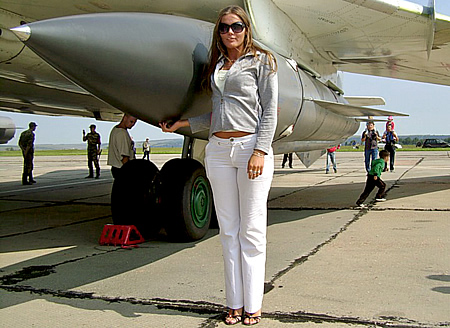 |
| Russia has 3,700-5,400 nonstrategic nuclear weapons, including the old dual-capable AS-4 Kitchen air-launched missile seen here under the wings of a Tu-22 Backfire bomber at an unknown airbase. All Russian nonstrategic warheads are in central storage. Image: web |
.
By Hans M. Kristensen
The latest Nuclear Notebook in the Bulletin of the Atomic Scientists with our updated estimate of Russian nuclear forces is now available via Sage Publications: http://bos.sagepub.com/content/67/3/67.full.pdf+html.
We estimate that Russia currently has nearly 2,430 strategic warheads assigned to operational strategic missiles and bombers, although most of the bomber weapons are probably in central storage. Another 3,700-5,400 nonstrategic warheads are in central storage, of which an estimated 2,080 can be delivered by nonstrategic aircraft, naval vessels and short-range missiles. Another 3,000 warheads are thought to be awaiting dismantlement, for a total inventory of some 11,000 nuclear warheads.
See also: US Nuclear Forces, 2011 | US Tactical Nuclear Weapons in Europe, 2011 | Nonstrategic Nuclear Weapons After the Presidential Nuclear Initiatives (Brief 2011)
This publication was made possible by a grant from Carnegie Corporation of New York and Ploughshares Fund. The statements made and views expressed are solely the responsibility of the author.
It is difficult to assess from photos whether the Sentinel missile is longer or wider overall than the Minuteman, but the Sentinel clearly has a thicker second stage, which could potentially contribute to the missile’s extended range.
This is not the first time Google has agreed to censor imagery at the behest of governments, but be warned: obfuscation at this broad level poses a direct threat to the public’s ability to monitor and scrutinize government operations.
As humans expand our geographic reach, encroach on untouched natural territories, and interact more with animal populations, we will encounter novel zoonotic diseases that threaten the human body. The sooner we act to address these risks, the better.
“One thing became increasingly clear: AI doesn’t simply introduce a new category of risk. It changes the speed, scale, complexity, and interaction of risks that already exist.”