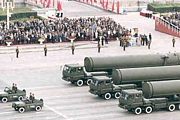
 The Chinese nuclear stockpile appears to be only half as big as previously thought, according to a new overview published in the Bulletin of the Atomic Scientists. Up to 130 warheads may be deployed out of a total stockpile of some 200 warheads. Several new weapon systems are under development which the Pentagon says could increase the arsenal in the future, but past US intelligence projections have proven highly inflated and inaccurate. The new overview will be followed by a more detailed report published by the Federation of American Scientists and the Natural Resources Defense Council this spring.
See also: Chinese Nuclear Submarine Cave Discovered
It is difficult to assess from photos whether the Sentinel missile is longer or wider overall than the Minuteman, but the Sentinel clearly has a thicker second stage, which could potentially contribute to the missile’s extended range.
This is not the first time Google has agreed to censor imagery at the behest of governments, but be warned: obfuscation at this broad level poses a direct threat to the public’s ability to monitor and scrutinize government operations.
As humans expand our geographic reach, encroach on untouched natural territories, and interact more with animal populations, we will encounter novel zoonotic diseases that threaten the human body. The sooner we act to address these risks, the better.
“One thing became increasingly clear: AI doesn’t simply introduce a new category of risk. It changes the speed, scale, complexity, and interaction of risks that already exist.”