What can we learn from visual comparison of the Sentinel and Minuteman III ICBM?
The Sentinel intercontinental ballistic missile program reached a new milestone on September 14 with the vertical assembly of an inert missile at Vandenberg Space Force Base, California. Northrop Grumman released a photo from the event, providing the first public image of the fully assembled missile.
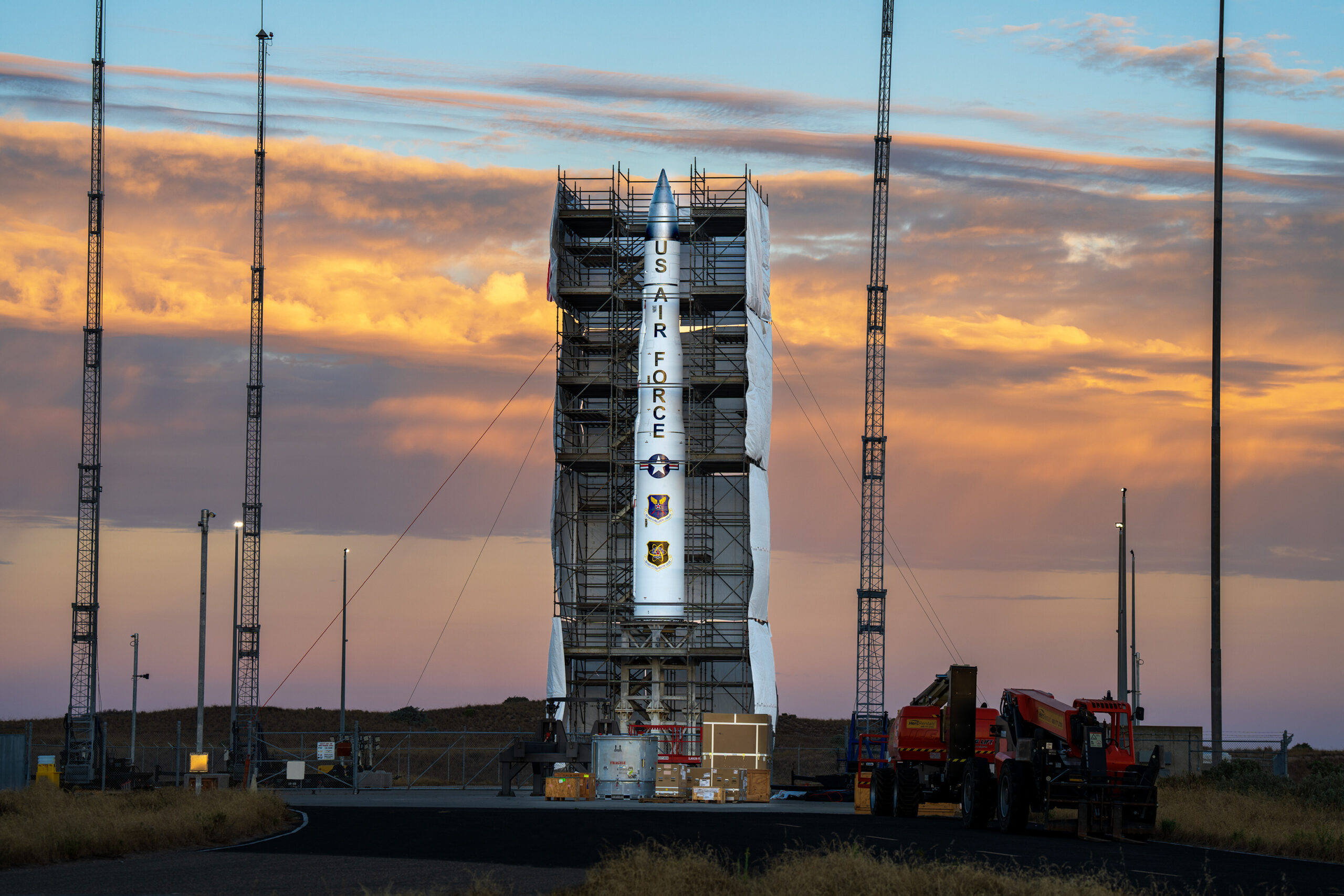
The vertical integration test, conducted by the U.S. Air Force and Northrop Grumman, included the stacking and full integration of all missile stages, propulsion elements, shroud and subcomponents. The missile’s precise dimensions and specs have not been publicly released, but a visual comparison between the new LGM-35A Sentinel ICBM and the currently-deployed LGM-30G Minuteman III appears to confirm the relatively larger size of the new missile that has been described.
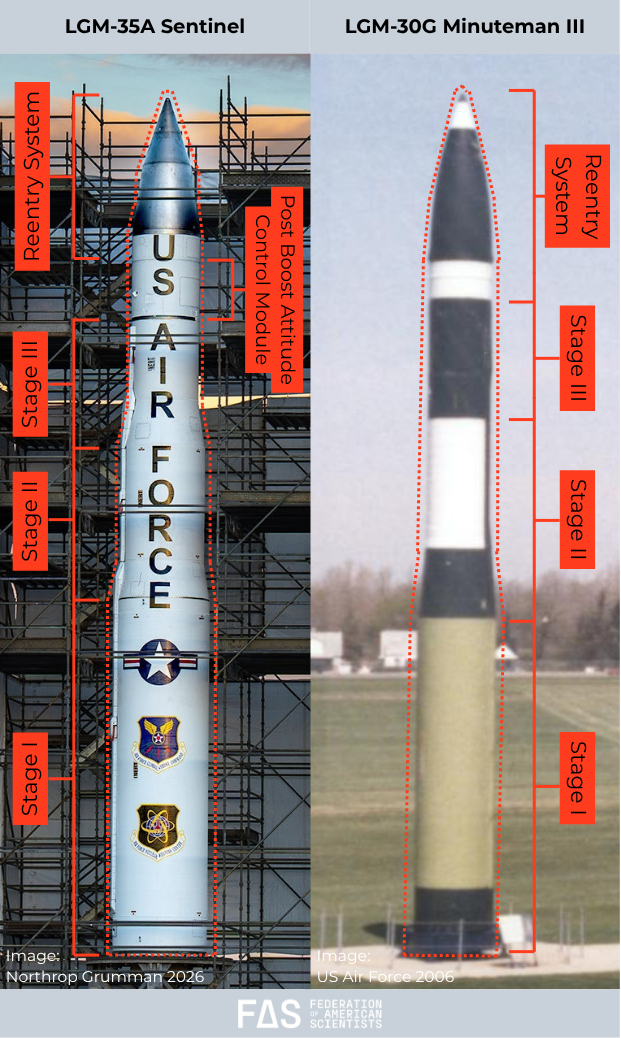
It is difficult to assess from these images whether the Sentinel missile is longer or wider overall than the Minuteman, but the Sentinel clearly has a thicker second stage, which could potentially contribute to the missile’s extended range.
The Air Force has not yet specified how many reentry vehicles the Sentinel ICBM will be capable of delivering. The Air Force’s stated plan has been to deploy Sentinel missiles with a single W87-1 warhead, but various reports and statements by Air Force officials have indicated that Sentinel will be capable of carrying multiple warheads. Minuteman III ICBMs configured for the Mk12A reentry vehicle with the W78 warhead can carry up to three reentry vehicles each, while Minuteman III ICBMs configured for the larger Mk21A reentry vehicle with the W87 warhead can carry a single warhead each (see image below). Under normal circumstances, all Minuteman III ICBMs are deployed with only one warhead each for a total of 400 warheads; if the Mk12A/W78 part of the force is uploaded to three warheads each, the 400 deployed ICBMs could carry up to 800 warheads.
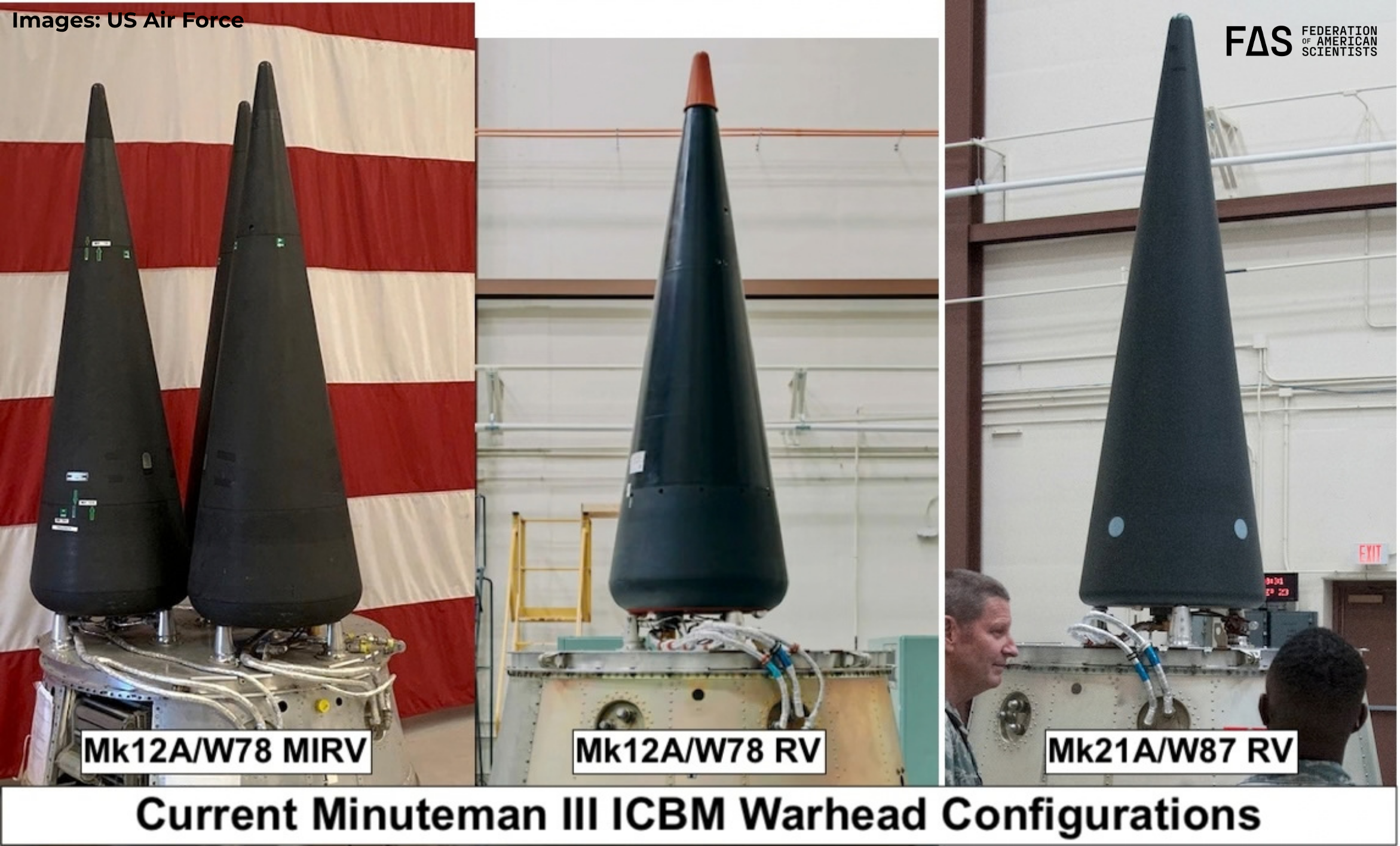
The Sentinel ICBM is designed to carry the Mk21A reentry vehicle, which is longer and wider than the Mk12A. So unless the Sentinel RV bus is wider than the Minuteman III RV bus, it seems likely that the Sentinel will only be capable of carrying one or two Mk21A reentry vehicles. Digital mockups of a Sentinel missile from a 2020 unclassified presentation by the Air Force Nuclear Weapons Center show the missile’s payload section as containing two reentry vehicles (see image below). Although Air Force officials have declined to specify how many warheads a Sentinel missile will be able to carry, the comparison of images of the Sentinel and the Minuteman III above combined with the digital mockup from the Air Force briefing indicate the Sentinel ICBM might be designed to carry up to two MIRV each.
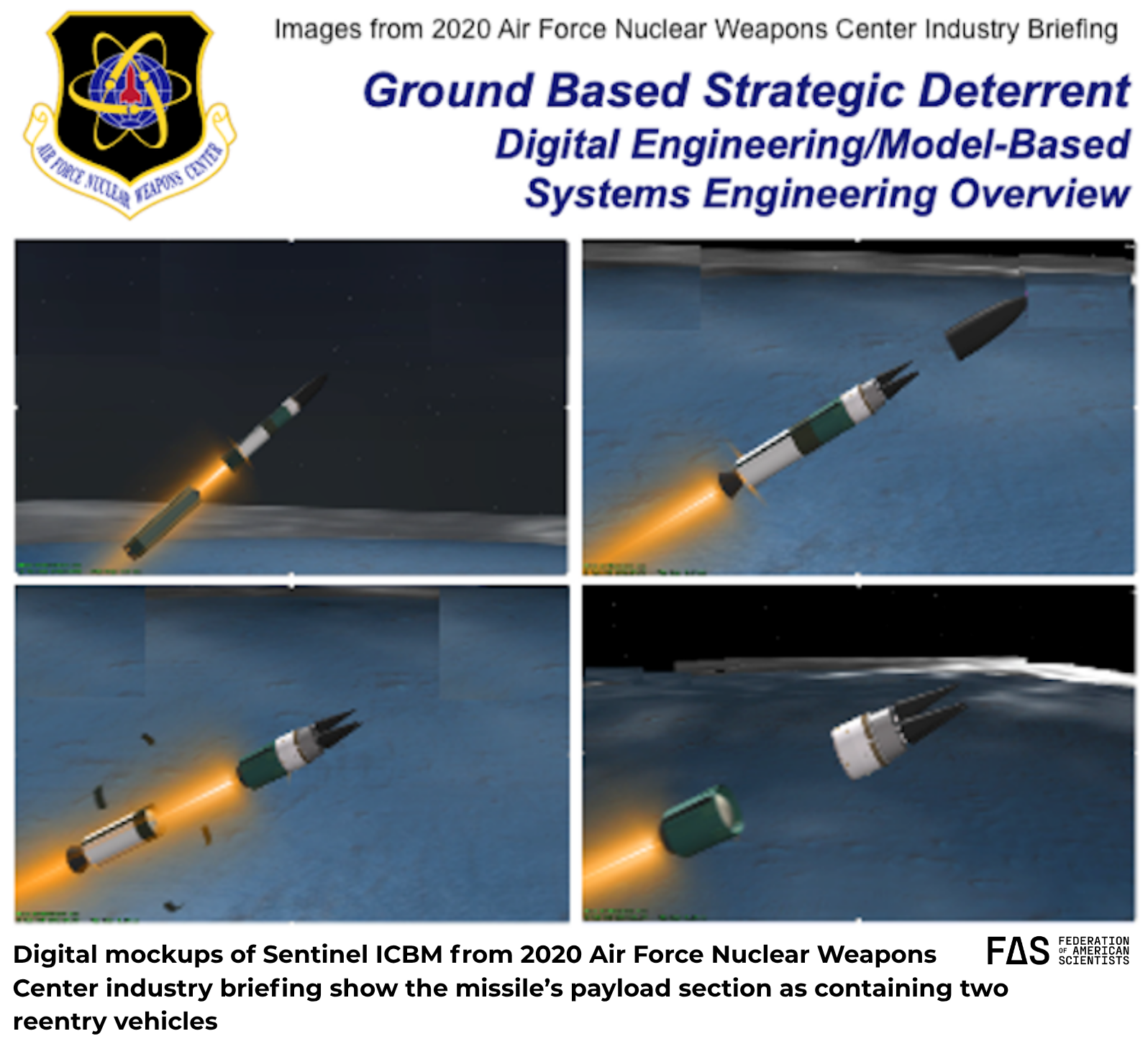
If the Sentinel ICBMs will be able to carry up to two warheads each, that would mean the planned force of 400 deployed missiles would be capable of delivering up to 800 warheads. That is roughly the same number of warheads we estimate the current Minuteman III is capable of delivering.
The Nuclear Information Project research for this article was made possible with generous support from the Andrew Carnegie Foundation, the New-Land Foundation, Ploughshares, the Prospect Hill Foundation, and individual donors.
Nuclear Experts from the Federation of American Scientists Call for More Transparency from the Defense Department with Its Decision to Certify the Sentinel ICBM Program
The Air Force’s flawed assumptions, processes, and estimation methodologies have led to unprecedented cost overruns
Washington, D.C. – July 9, 2024 – The Federation of American Scientists (FAS) stands with fellow scientists and peer organizations critiquing the Biden administration’s decision to certify the Sentinel ICBM program, despite it being 81% over budget and two to three years behind schedule. This program does not improve American safety or global peace efforts, and is an unnecessary financial burden on taxpayers.
The Pentagon’s review of the Sentinel came after the projected cost of the project rose by 37 percent, to $131 billion––requiring a re-evaluation of the program and a consideration of possible alternatives under the Nunn-McCurdy Act. Recent reporting from Bloomberg indicates that the Sentinel’s costs are now estimated to rise to $141 billion. This represents an 81 percent increase from the Pentagon’s own estimate in 2020.
“You can be for nuclear weapons modernization and think this program is both in trouble and needs a serious re-examination. At 81% over budget and $140 billion and climbing, we owe it to consider real alternatives and get modernization right,” says Jon Wolfsthal, Director of Global Risk at FAS.
In its justification decision, the Pentagon suggested that the Nunn-McCurdy review team considered “‘four to five different options,’ including extending the aging Minuteman III missiles in 2070, ‘hybrid options of different ground facilities, mobile versus fixed,’ and others.” However, the Pentagon’s stated justifications for continuing the program, its timelines, and its funding are all questioned by the FAS team.
Associate Director for FAS’ Nuclear Information Project, Matt Korda, asks: “Where does the year 2070 come from? The Air Force previously referred to the year 2075 in its program documentation, and as far as I know, neither year is codified in any official policy documents like the National Defense Strategy or the Nuclear Posture Review. Yet these benchmarks have enormous bearing on cost estimates, and can be purposely selected to tip the scales and make some options look more palatable than others.” Korda wrote a detailed report in 2021 showing how changes in these cost benchmarks would have indicated that alternatives to the Sentinel––such as life-extending the current fleet of Minuteman III ICBMs––would very likely have been cheaper than building an entirely brand-new weapon system.
Director of FAS’s Nuclear Information Project, Hans Kristensen, is more pointed in his criticism: “Despite massively escalating cost projection, having sold the new Sentinel ICBM program to Congress based on unrealistic cost, the Pentagon says go ahead anyway.”
Kristensen and Korda are leading researchers on the global stockpile of nuclear weapons. Along with their colleagues, Senior Research Associates Eliana Johns and Mackenzie Knight, they produce and distribute, in conjunction with the Bulletin of the Atomic Scientists, the Nuclear Notebook, detailed reports on the status of nuclear weapons worldwide.
Knight was among the first to identify Sentinel’s extreme cost overruns and raise public awareness of this issue. In March she wrote what should happen next:
Secretary Austin’s likely certification of the Sentinel program should be open to public interrogation, and Congress must thoroughly examine whether every requirement is met before allowing the program to continue. Congress should ask the Government Accountability Office and Congressional Budget Office to conduct independent reviews to interrogate the Pentagon’s justification for Sentinel and ensure hawk-eyed scrutiny of the program’s next steps.
The Hill, March 1, 2024
She adds now: “The Sentinel program being allowed to continue despite an 81% cost increase sets a dangerous precedent. Whether the program is flawed, necessary, or not, Congress and the administration should not allow ostensibly limitless spending on nuclear weapons programs. How much is too much?”
More than 700 scientists, including ten Nobel laureates and 23 members of the National Academies, have signed a letter calling for President Biden and Congress to cancel the program, led by the Union of Concerned Scientists.
###
ABOUT FAS
The Federation of American Scientists (FAS) works to advance progress on a broad suite of contemporary issues where science, technology, and innovation policy can deliver dramatic progress, and seeks to ensure that scientific and technical expertise have a seat at the policymaking table. Established in 1945 by scientists in response to the atomic bomb, FAS continues to work on behalf of a safer, more equitable, and more peaceful world. More information at fas.org.