Divine Strake Explosion Delayed Again, Possibly Moved
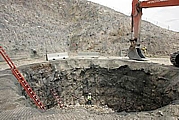 Update (February 22, 2007): DTRA announces that Divine Strake has been canceled.
The controversial Divine Strake explosion has been delayed again, this time “at least several months into calendar year 2007,” according to a statement distributed in Congress by the Defense Threat Reduction Agency. “We have stood down the experiment site and the workforce that was preparing the site for the experiment,” DTRA said.
The delay comes after DTRA told Senator Orrin Hatch (UT) that it will “look into the possibility of other locations” for conducting the Divine Strake test.
Divine Strake was initially scheduled to take place on June 2, 2006, but disclosure that the experiment was in fact intended to calibrate the use of low-yield nuclear weapons against underground targets, combined with lawsuits from local communities, caused the government to withdraw its “no impact” environmental assessment shortly before the scheduled test and delay it until September 2006.
Although DTRA has repeatedly stated that the experiment did not pose an environmental hazard, the agency now says that it is “developing a plan that would permit the conduct of the DIVINE STRAKE experiment if it is determined that the experiment can be conducted safely, is in compliance with NEPA, and there is a favorable court ruling.”
The decision to possibly move the test to another location is especially interesting because the current site was “carefully chosen” so that it “simulates the characteristics of important potential, global adversaries,” according to the DOE’s environmental assessment: “As a number of potential adversarial military targets are based in similar limestones, [Divine Strake] needed to be sited in a similar geological setting to actual military targets.” Previous high-explosive tests have been conducted at the White Sands Missile Range in New Mexico and at Misers Bluff at Planet Ranch in Arizona. We’ll see what Senator Pete Domenici from New Mexico and Jon Kyl from Arizona say about that.
The DTRA statement is not available on the web sites of DTRA, NNSA, or the Nevada Test Site. A search for Divine Strake on DTRA’s site gave “no results.” An on-line Divine Strake briefing previously posted on the DTRA web site has also been removed.
More Information On Divine Strake
As humans expand our geographic reach, encroach on untouched natural territories, and interact more with animal populations, we will encounter novel zoonotic diseases that threaten the human body. The sooner we act to address these risks, the better.
“One thing became increasingly clear: AI doesn’t simply introduce a new category of risk. It changes the speed, scale, complexity, and interaction of risks that already exist.”
In the current environment of declining trust and magnifying strategic competition, banning debris-creating tests is a concrete step towards stability that favors interests of all states seeking to conduct space activities.
Google’s motto famously used to be “don’t be evil.” However, its latest feature has just made being evil a whole lot easier.