NATO Nuclear Posture Moving North; New Satellite Images Show Extent of New Construction at RAF Lakenheath
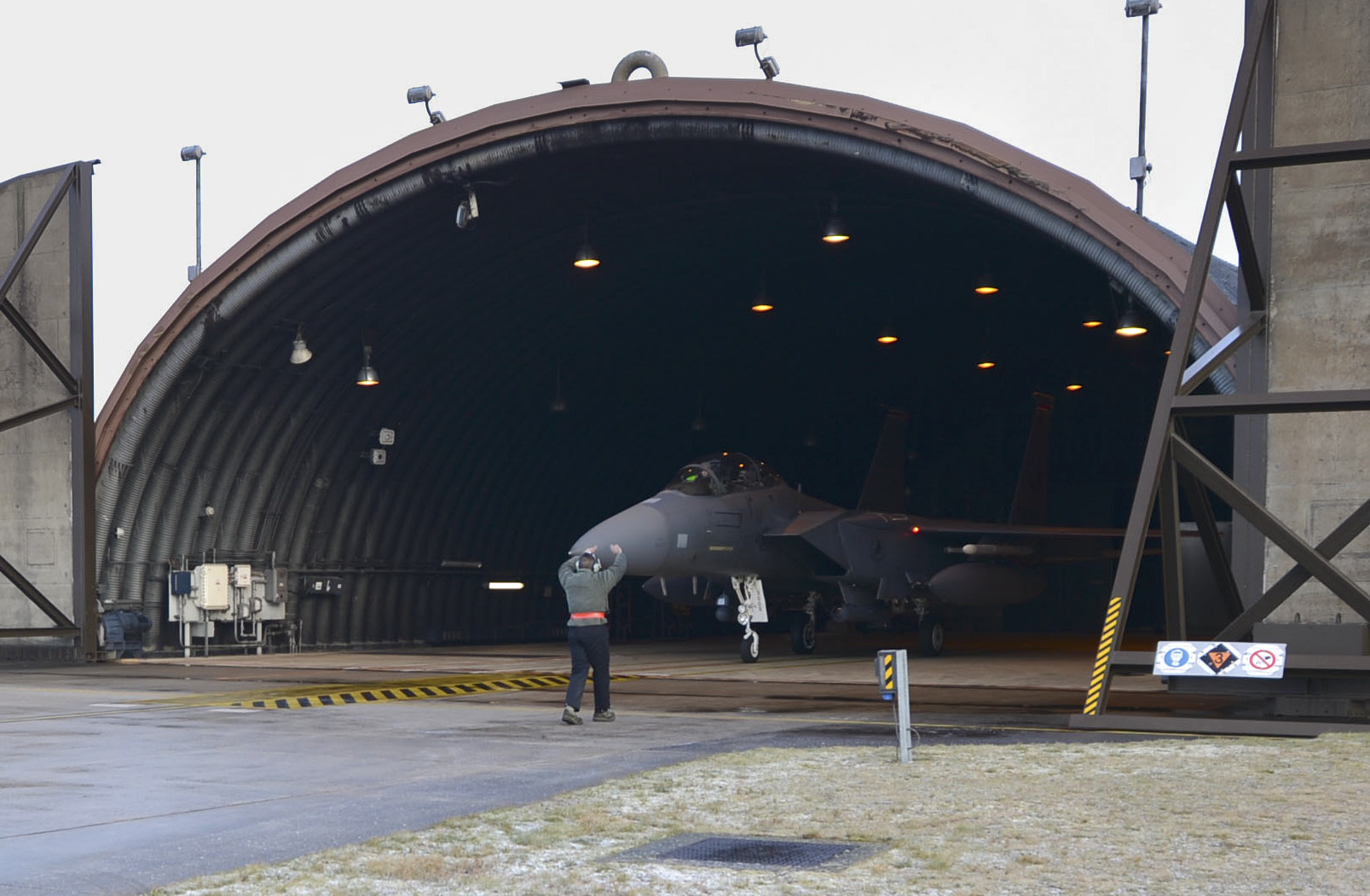
As many as 22 protective aircraft shelters with underground nuclear weapons storage vaults are being reactivated at RAF Lakenheath in the largest nuclear enhancement of NATO’s northern flank since the end of the Cold War. The image shows a U.S. Air Force F-15E fighter-bomber inside a shelter with a nuclear storage vault to the left. Image: U.S. Air Force.
The infrastructure supporting NATO’s nuclear strike mission is shifting north to include significantly more active nuclear weapons storage shelters than in the southern part of the Alliance. The shift is visible on new satellite images showing the full extent of construction of security fencing around 22 nuclear-capable aircraft shelters at Royal Air Force (RAF) Lakenheath, the home of the U.S. Air Force 48th Fighter Wing.
The northern nuclear focus will increase further when the United Kingdom buys 12 U.S. F-35A fighter-bombers for deployment at RAF Marham as a new part of NATO’s dual-capable aircraft nuclear sharing mission, as announced in 2025.
Satellite Images Show Full Lakenheath Expansion
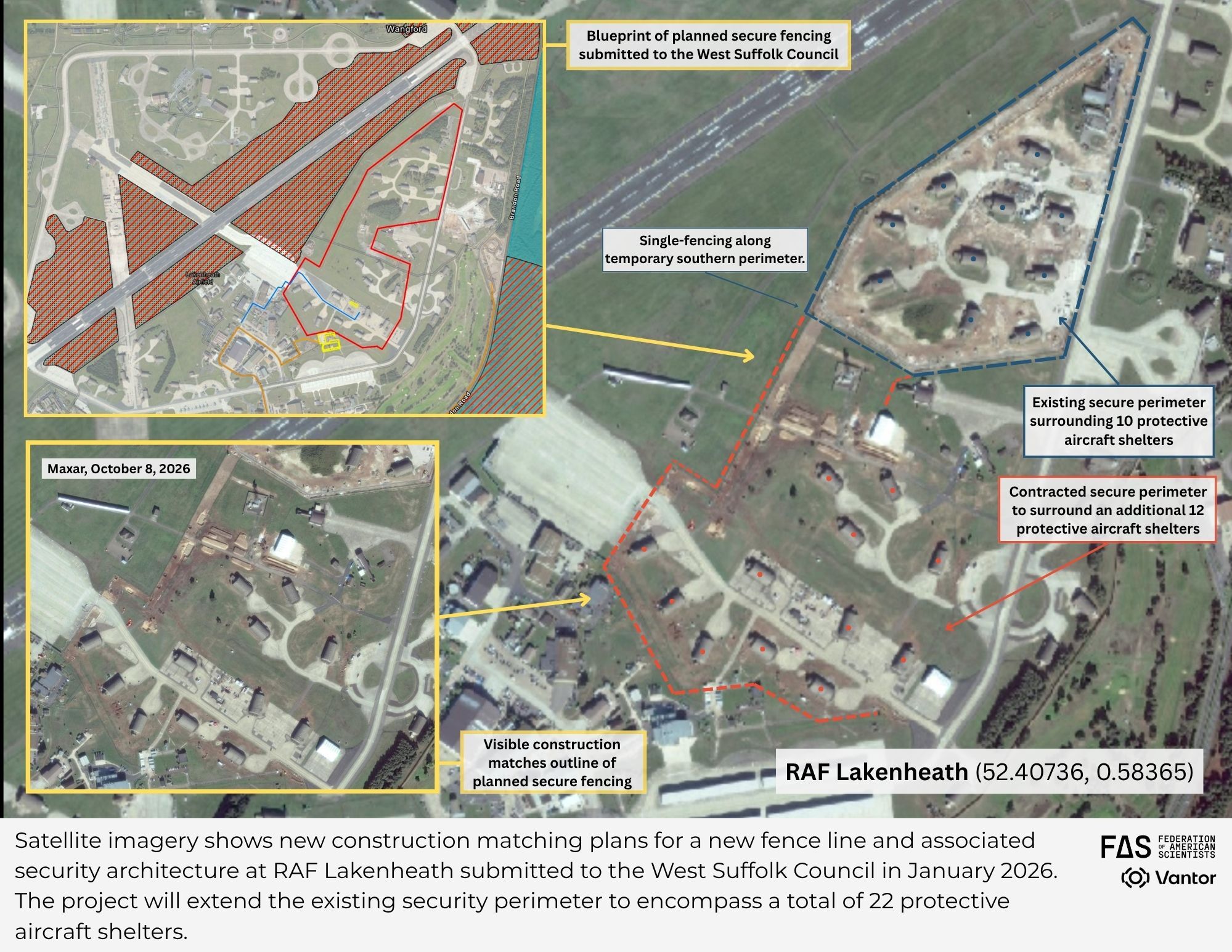
Recent satellite imagery from Vantor shows new construction of a larger security perimeter around more protective aircraft shelters at Royal Air Force (RAF) Base Lakenheath. The larger perimeter matches planning documents published by the U.S. Air Force (USAF) and U.K. government. RAF Lakenheath has been upgrading since 2022 when it was added to the list of USAF nuclear facilities in Europe. The purpose is to reactivate a nuclear weapons mission for the USAF’s 48th Fighter Wing at the base in response to increased tension with Russia.
The new construction will expand an existing security perimeter that has been under construction around 10 protective aircraft shelters to surround an additional 12 for a total of 22 shelters. Each shelter inside the perimeter is equipped with an underground vault for storage of U.S. B61-12 nuclear gravity bombs for delivery by the F-15E and F-35A jets at the base.
The construction visible on the satellite images matches a blueprint submitted by the UK Defense Infrastructure Organization (DIO) to the West Suffolk Council supporting a January 2026 application for a “fence line and additional security infrastructure” at RAF Lakenheath (see figure 1). According to further supporting documents, the fence line will be supported by “patrol and convoy roads, the installation of active and passive vehicle barriers, gatehouses, duct banks, turnstiles, camera towers, lighting and electrical enclosures for each loop comprising of new transformer, main LV distribution and standby generator.”
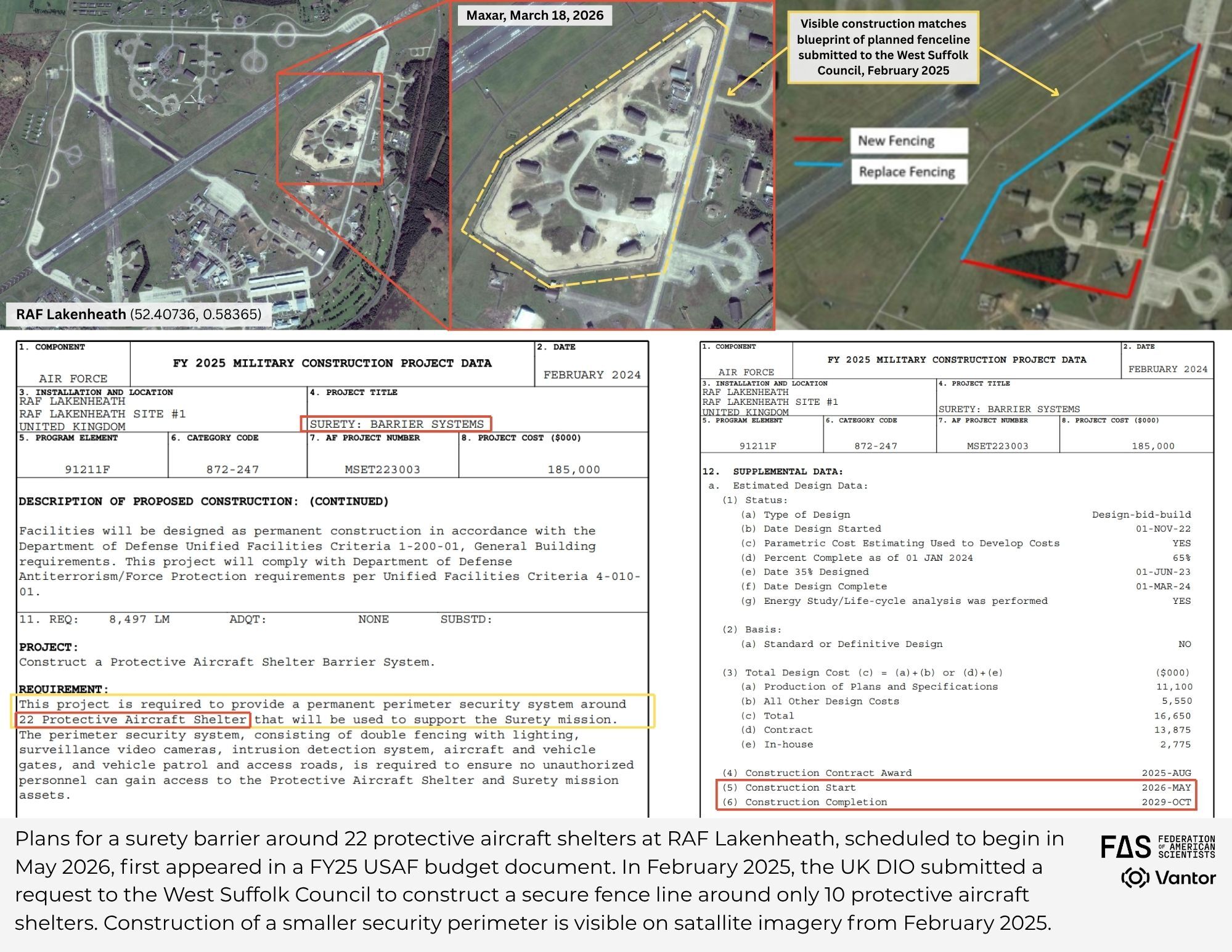
Once completed, the expanded security perimeter will conform with plans for a “Surety Barrier System” at RAF Lakenheath, first revealed in the FY25 U.S. Air Force Military Construction budget submitted to Congress in February 2024. The proposal describes plans to “provide a permanent perimeter security system around 22 Protective Aircraft Shelter that will be used to support the Surety mission.”
The project’s association with the “Surety mission” links it to the suspected redeployment of US nuclear weapons to RAF Lakenheath, a development that will reinstate a USAF nuclear mission in the United Kingdom for the first time since 2008 and contribute to an ongoing series of upgrades across Europe. Without this barrier and associated security infrastructure, according to the USAF documents, “Royal Air Force Lakenheath will not be able to accommodate the Surety mission beddown,” which would “impede mission capability, readiness, and contingency support to ongoing and future operations within the designated European Area of Responsibility.” Construction was scheduled to start in May 2026 and finish in October 2029.
Until now, construction at RAF Lakenheath only showed a partial fulfilment of this directive. In February 2025, the DIO submitted an urgent request to the West Suffolk Council for an “additional apron area at the Yankee Taxiway” and “security fencing around the development area.” A supporting blueprint shows plans to erect security fencing around a small area encompassing 10 protective aircraft shelters – notably fewer than the 22 described by the USAF. Indeed, construction of a security perimeter around 10 protective aircraft shelters matching the DIO blueprint is visible on satellite imagery from February 2025. At the time, assuming this perimeter was the Surety Barrier System described in the FY25 MILCON budget, it was unclear why construction began more than a year ahead of schedule and would surround significantly fewer protective aircraft shelters than the current plan. (see figure 2).
New information now suggests that this initial perimeter – the Yankee perimeter – is not formally associated with the Surety Barrier project, despite clearly aligning with and contributing to it. Curiously, a USAF MILCON Status Report from September 2026 maintains that construction of the Surety Barrier System at RAF Lakenheath began in May 2026, not February 2025. There is also no mention of the Yankee perimeter in any MILCON documents preceding FY25, suggesting the decision to temporarily section off 10 protective aircraft shelters was made after plans for a security area around 22 were finalized. It is unclear why or how approval for a smaller, preliminary security barrier more than a year ahead of schedule was granted or why this project does not appear in USAF documents.
Closer inspection of the satellite images indicate that the preliminary security perimeter around the first 10 shelters – and detailed in the FY25 MILCON budget to include “double fencing, surveillance video, intrusion detection, aircraft and vehicle gates, and access roads” – is either missing or incomplete. A temporary fenceline will probably be removed when the expanded secure perimeter is completed. The USAF now estimates construction of the Surety Barrier System will end in November 2028, almost a year ahead of schedule. This accelerated timeline can likely be explained by progress – however rudimentary – on the Yankee perimeter, despite uncertainty about how the two projects relate.
Confirmation that the construction of the security perimeter and associated security infrastructure at RAF Lakenheath are still ongoing once again raises questions about whether U.S. nuclear weapons have already been deployed to the base. It is widely reported that two USAF C-17 flights in July 2025 delivered B61-12 bombs to RAF Lakenheath. But according to the FY25 MILCON budget, RAF Lakenheath “lacks the physical security measures needed to protect Surety assets within the Protective Aircraft Shelters from unauthorized access, theft, damage, sabotage, or unauthorized use.” Since the bombs were not already present at the RAF Lakenheath in 2025, it is unclear why the USAF would be allowed to deploy the nuclear weapons before the necessary security infrastructure is completed; the satellite images show continued extensive construction at and around the aircraft shelters by commercial companies.
The Bigger Nuclear Picture
The addition of RAF Lakenheath to the list of USAF nuclear bases in Europe and the preparation of an extensive security perimeter around 22 aircraft shelters for potential storage of nuclear bombs suggests that RAF Lakenheath could soon become the largest USAF nuclear weapons storage site in Europe. When completed, RAF Lakenheath’s nuclear security perimeter will include one shelter more than the security perimeter at Incirlik Air Base in Turkey, the largest storage site in Europe for the past two decades.
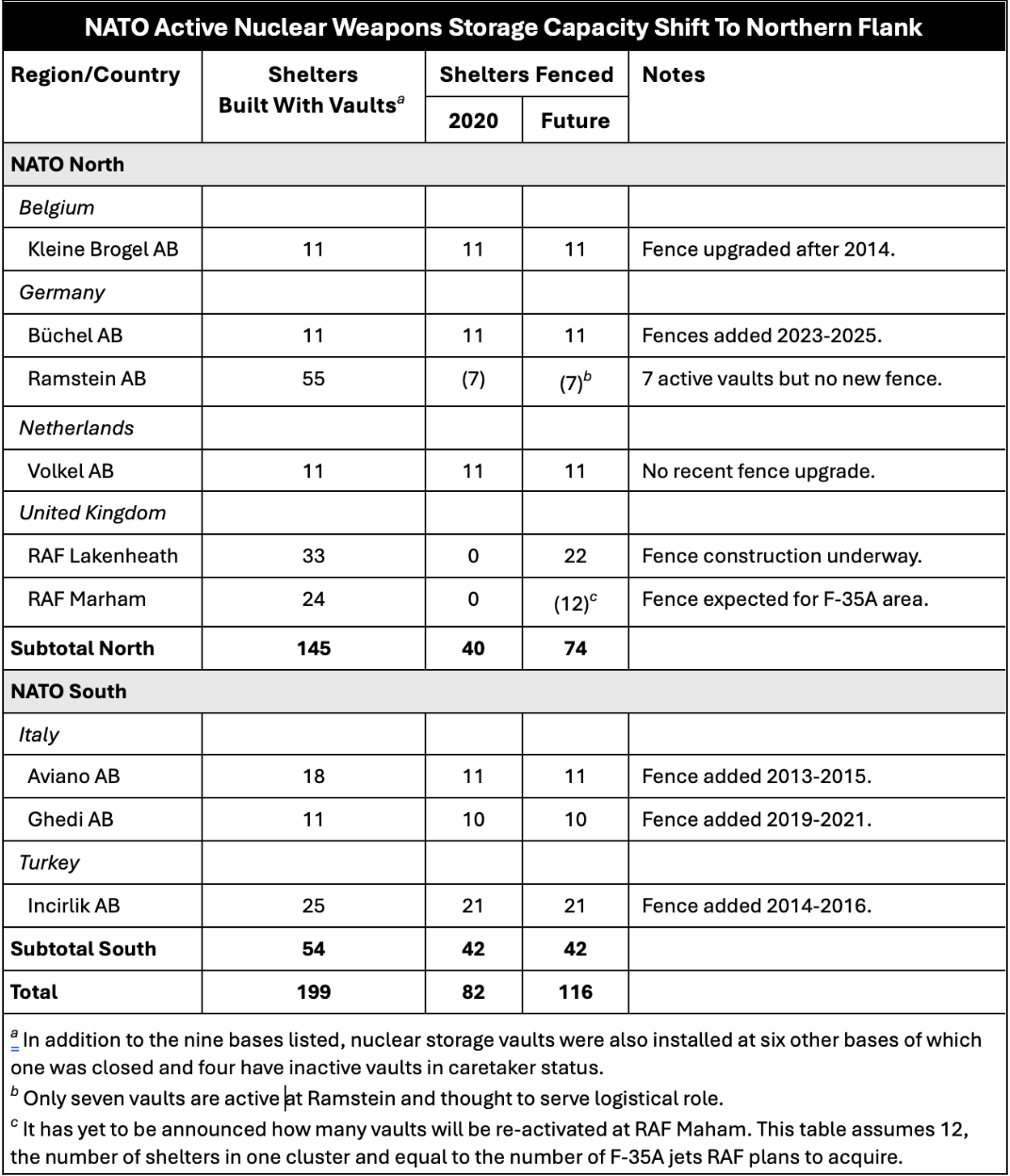
The large number of nuclear shelters being reactivated at RAF Lakenheath means that the number of active nuclear shelters on bases in Northern Europe will once again dominate NATO’s nuclear posture. Once construction is completed, RAF Lakenheath will be able to regularly host US nuclear weapons and receive nuclear weapons from more vulnerable European bases in a crisis. In addition, the RAF nuclear sharing mission planned for RAF Marham sometime in the 2030s will further add to NATO’s new northern nuclear focus. If nuclear storage vaults at RAF Marham are also reactivated, the number of active nuclear storage shelters on NATO’s northern flank could nearly double compared with 2020 (see table below).
These developments follow several years of increased U.S. strategic bomber operations in Europe and more visible strategic submarine operations. In addition, the United States is developing a new nuclear sea-launched cruise missile, some of which are intended for deployment on attack submarines operating in the European region. These posture shifts come in response to growing regional tensions and strategic volatility. They aim to provide the United States and NATO with operational flexibility, both by increasing the range of available options – nuclear and conventional alike – and diversifying where strategic capabilities can be based or moved to in a crisis.
European allies are also reforming their strategic and defensive postures. France’s new “forward deterrence” concept, announced by President Macron in March 2026, is intended to provide increased nuclear aircraft support to select allies. As of October, ten European allies have joined the French initiative: Belgium, Denmark, Finland, Germany, Greece, the Netherlands, Norway, Poland, Sweden, and the United Kingdom. While the level and form of each state’s involvement will vary, their interest underscores the growing emphasis on Northern Europe in NATO and nuclear planning. It also highlights the growing willingness of non-nuclear Northern European states to integrate their conventional assets with the regional nuclear posture. Nuclear-conventional integration in the alliance was on display this October first during NATO’s non-strategic nuclear exercise Steadfast Noon and second during the U.S. Strategic Command exercise Global Thunder, when three UK F-35B and three Norwegian F-35A fighter-bombers escorted a US B-52 strategic bomber for the first time in that exercise.
Combined, these developments mark the most significant enhancement of NATO’s nuclear posture in Europe since the end of the Cold War and appears to be mainly a direct reaction to Russia’s invasions of Ukraine and the resulting growing tension between East and West.
The Nuclear Information Project research for this article was made possible with generous support from the Andrew Carnegie Foundation, the New-Land Foundation, the Prospect Hill Foundation, and individual donors.
Confirmation that the construction of the security perimeter and associated security infrastructure at RAF Lakenheath are still ongoing once again raises questions about whether U.S. nuclear weapons have already been deployed to the base.
It is difficult to assess from photos whether the Sentinel missile is longer or wider overall than the Minuteman, but the Sentinel clearly has a thicker second stage, which could potentially contribute to the missile’s extended range.
This is not the first time Google has agreed to censor imagery at the behest of governments, but be warned: obfuscation at this broad level poses a direct threat to the public’s ability to monitor and scrutinize government operations.
As humans expand our geographic reach, encroach on untouched natural territories, and interact more with animal populations, we will encounter novel zoonotic diseases that threaten the human body. The sooner we act to address these risks, the better.