 |
|
No preemptive nuclear options, according to Secretary of State Hillary Clinton. |
By Hans M. Kristensen
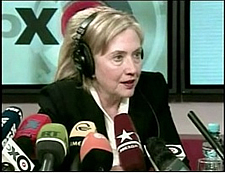
During an interview with Ekho Moskvy Radio last week, Secretary of State Hillary Rodham Clinton was asked if “the American [nuclear] doctrine incorporate[s] preemptive nuclear strikes against an aggressor?”
The Secretary’s answer was: “No, no.”
Ahem….
Secretary Clinton’s denial that U.S. nuclear doctrine incorporates preemptive strike options is at odds with numerous statements made by U.S. government officials over the past eight years, who have sought to give precisely the opposite impression; that the nuclear doctrine does indeed also contains preemptive options. An draft revision of U.S. nuclear doctrine in 2005 revealed such options.
So unless the U.S. has changed its nuclear doctrine since the Bush administration, then the Secretary’s denial is, well, at odds with the doctrine.
The confusion could of course be academic; that Secretary Clinton is under the impression that the doctrine includes preventive, no preemptive, strike options. Or perhaps she simply doesn’t know, yet believes that preemptive nuclear strike options should not be part of U.S. nuclear doctrine. It is of course important that the U.S. Secretary of State knows what U.S. nuclear policy is, since she is in charge of negotiations with Russia about the START Follow-On treaty and laying the groundwork for a subsequent and more substantial treaty and nuclear relationship.
The context of her denial was an Izvestia interview with Nikolai Patrushev, Secretary of Russia’s Security Council, about Russia’s ongoing review of its nuclear doctrine. Mr. Patrushev reportedly said: “In situations critical to national security, a nuclear strike, including a preventative one, against an aggressor is not ruled out.”
Russia’s current doctrine already allows preemptive strikes, something the Kremlin says it needs because of Russian inferior conventional forces. Whether the new revision will change or reaffirm preemptive options remains to be seen.
Background: Counterproliferation and US Nuclear Strategy (2009); Global Strike Chronology (2006); Doctrine for Joint Nuclear Operations (2005)
This publication was made possible by a grant from Carnegie Corporation of New York and Ploughshares Fund. The statements made and views expressed are solely the responsibility of the author.
It is difficult to assess from photos whether the Sentinel missile is longer or wider overall than the Minuteman, but the Sentinel clearly has a thicker second stage, which could potentially contribute to the missile’s extended range.
This is not the first time Google has agreed to censor imagery at the behest of governments, but be warned: obfuscation at this broad level poses a direct threat to the public’s ability to monitor and scrutinize government operations.
As humans expand our geographic reach, encroach on untouched natural territories, and interact more with animal populations, we will encounter novel zoonotic diseases that threaten the human body. The sooner we act to address these risks, the better.
“One thing became increasingly clear: AI doesn’t simply introduce a new category of risk. It changes the speed, scale, complexity, and interaction of risks that already exist.”