The U.S. Air Force plans to spend more than $1 billion on developing a guided tailkit to increase the accuracy of the B61 nuclear bomb.
The cost is detailed (to some extent) in the Air Force’s budget request for FY2014, which shows development and engineering through FY2014 and full-scaled production starting in FY2015.
The annual costs increase by nearly 200 percent from $67.9 million in FY2014 to more than $200 million in FY2015. The high cost level will be retained for three years until the project decreases after production ceases in FY2018. Some additional funding is needed after that to complete the integration and certification on (see graph).
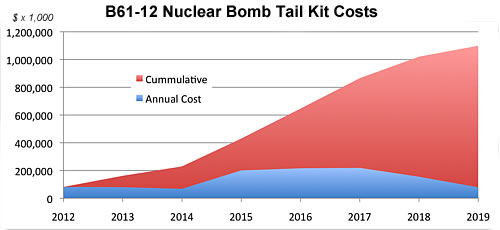
Production of the guided tailkit is intended to match completion of the first new B61-12 bomb in 2019, a program that is estimated to cost more than $10 billion. Although the number is a secret, it is thought that the U.S. plans to produce roughly 400 B61-12s.
The expensive guided tailkit is needed, advocates claim, to make it possible to use the 50-kiloton nuclear explosive package from the tactical B61-4 bomb in the new B61-12 against targets that today require the 360-kiloton strategic B61-7 bomb. By increasing accuracy, the B61-12 becomes more useable because it significantly reduces the amount of radioactive fallout created in an attack.
Once deployed in Europe, the B61-12 will also be able to hold at risk targets that the B61-3 and B61-4 bombs currently deployed in Belgium, Germany, Italy, Netherlands, and Turkey cannot target.
The B61-12 program will maintain compatibility on all five current B61-capable aircraft (B-2A, B-52H, F-16, F-15E and PA 200). In 2015, integration, design and testing will begin on the new stealthy F-35A Joint Strike Fighter. The Air Force budget request shows that B61-12 integration is scheduled for Block 4A and Block 4B aircraft in 2015-2021 with full operational capability in 2022 – three years after the first B61-12 is scheduled to be delivered (see table).

The combination of the new and more accurate guided B61-12 on the stealthy F-35A will significantly increase the capability of the U.S. non-strategic nuclear posture in Europe. This development is out of tune with U.S. and NATO pledges to reduce the role and reliance on nuclear weapons, and will make it a lot easier for hardliners in the Russian military to reject reductions of Russia’s larger inventory of non-strategic nuclear weapons.
This publication was made possible by a grant from the Ploughshares Fund. The statements made and views expressed are solely the responsibility of the author.
“One thing became increasingly clear: AI doesn’t simply introduce a new category of risk. It changes the speed, scale, complexity, and interaction of risks that already exist.”
In the current environment of declining trust and magnifying strategic competition, banning debris-creating tests is a concrete step towards stability that favors interests of all states seeking to conduct space activities.
Google’s motto famously used to be “don’t be evil.” However, its latest feature has just made being evil a whole lot easier.
The bootcamp brought together more than two dozen next-generation open-source practitioners from across the world.