Virginia Has an Energy Plan. Now It Needs the Tools to Deliver It.
Virginia has become ground zero for one of the country’s biggest energy questions: how do we keep the lights on as electricity demand surges, without sending costs soaring or locking in the energy system of the past?
Recently, Governor Spanberger’s administration offered its answer with the release of Virginia’s 2026 State Energy Plan.
The plan recognizes that Virginia needs to meet rapidly growing electricity demand while keeping energy affordable and reliable. It calls for deploying more of the lowest-cost, fastest-to-build resources available today—distributed, small resources and large batteries and solar farms—while preparing for longer-term clean firm resources. And it recognizes that Virginia can’t simply build its way out of growing demand: the commonwealth also needs to get more out of the grid it already has.
There’s a lot to like here. But a plan is a roadmap, not the road.
Now comes the harder part: implementation. Turning the plan’s ideas into lower bills, new clean energy projects, and a more flexible grid will depend on whether Virginia’s institutions—especially the State Corporation Commission (SCC) and Virginia Energy—have the tools and capacity to make it happen.
The plan gets the moment right
Virginia is at the frontlines of the impacts of demand growth on electricity bills, and Gov. Spanberger’s plan takes the right approach: pulling on the levers within state jurisdiction that can help deploy new low-cost electricity supply the fastest.
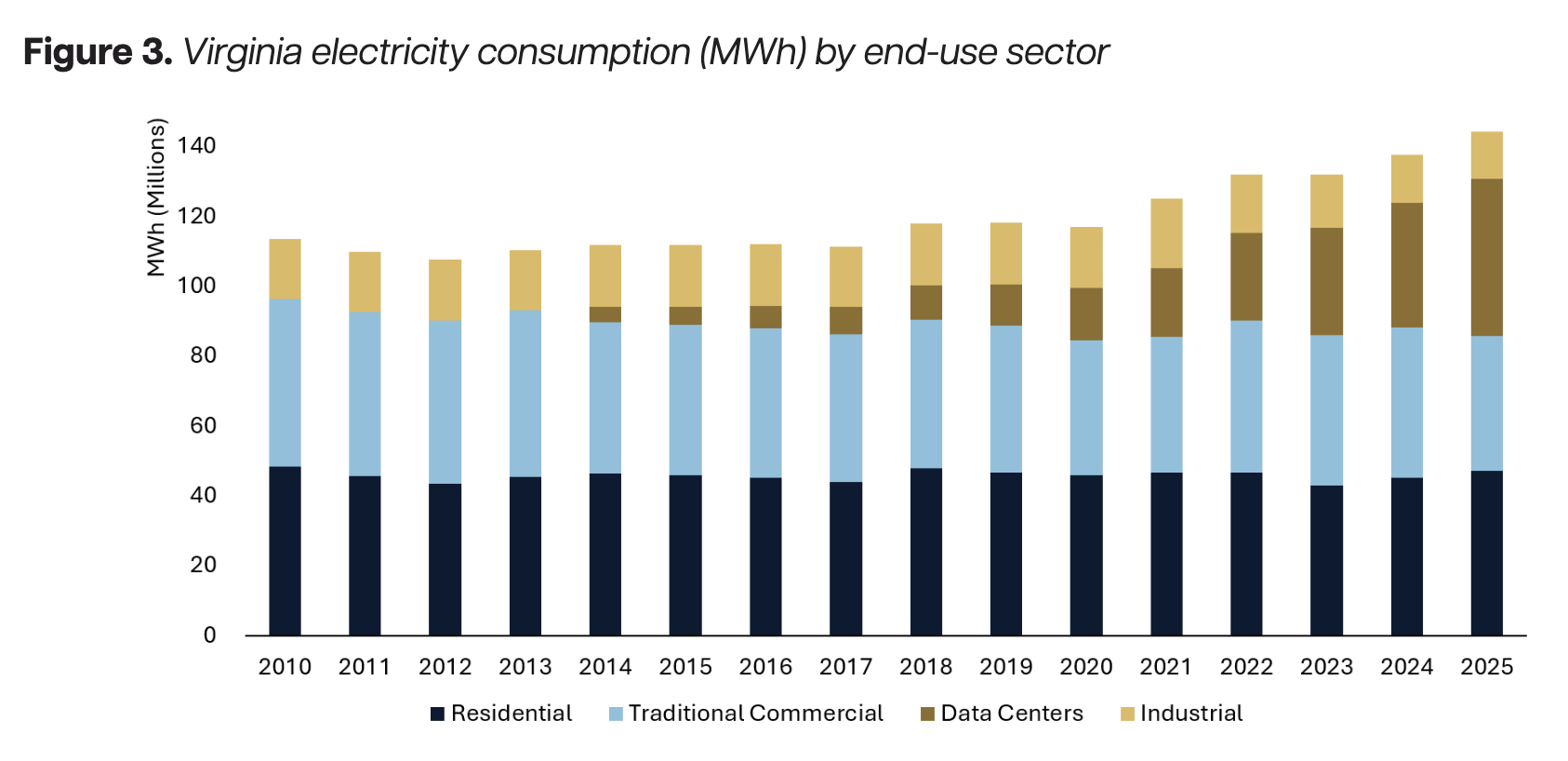
Demand from data centers was trivial a decade ago and now makes up nearly a third of Virginia’s energy use. The commonwealth’s peak electricity demand is expected to grow by 5 percent per year and total energy use by 7 percent per year. Because of the regional grid operator PJM’s inability to integrate new supply fast, rising demand has driven up bills in the region, including in Virginia.
The most encouraging part of Virginia’s energy plan is that it identifies the cheapest new supply that can come online fast and lays out the levers within state control to unlock this power. And excitingly, the report is rooted in the idea that the government needs more tools—and the ability to wield those tools more effectively—to pull those levers.
The plan leans heavily on adding distributed energy resources (DERs), which can add significant new power in a matter of months and whose deployment is fully in the state’s control without waiting for PJM. The plan’s modeling shows that greater deployment of these resources, often sited at homes and businesses, could reduce total system costs by 10 percent. That would require up to 12 GW of these resources online by 2050, a big task! The plan lays out good first steps to get there, including speeding up processes to permit these projects and connect them to the grid and developing state programs to properly compensate these resources for their benefits to the grid.
For bulk power, the plan includes creative approaches to get big batteries and solar projects online faster. That includes a clever state-led procurement mechanism and efforts to help site projects at locations with surplus interconnection capacity where projects could be built faster.
The plan also looks beyond building more infrastructure to using the existing grid more effectively, including through advanced transmission (ATTs) and grid-enhancing technologies (GETs).
Beyond getting new power on the system fast, the plan lays out creative approaches to other drivers of rising bills. Take utility financing. The plan calls for pursuing debt-to-equity reforms that could reduce costs for customers while keeping utilities financially capable of making the investments Virginia needs. It also calls for examining broader reforms to utility returns and cost allocation, shifting the focus from how much utilities build toward whether they are delivering reliability and other outcomes cost-effectively.
All told, this is an impressive document with many smart and implementable ideas, grounded in modeling that shows the commonwealth’s energy needs.
Not just power capacity, Virginia needs state capacity to deliver
Gov. Spanberger’s plan rightly identifies many areas where the state government plays an essential role in building new power and reducing bills. For the plan to be successful, state institutions will need the right capacity—people, tools, and processes—to deliver.
Implementation will not be easy. Several of the plan’s critical strategies challenge established utility business models. Greater grid utilization, for example, can reduce the need for some traditional capital investments. Expanded DERs and plug-in solar can change how customers produce and consume electricity and could avoid some utility spending that shareholders like. And utilities may see a state-led marketplace or procurement process as competing with their existing procurement function.
Many of the plan’s most promising ideas will by default flow through the SCC. The new ideas in the plan come on top of a big existing workload for the SCC, including implementation of new legislation and reviewing the pending acquisition of Dominion by NextEra. And as we and others have written before, regulators and public interest intervenors are already underwater compared to utility companies, who have immense regulatory capacity.
Today’s implementation model—running these new requirements through the SCC, with utilities filing proposals and the SCC reacting and approving—is not sufficient to get the best outcomes for Virginians.
That is precisely why it’s so important to embed implementation considerations upfront when designing policies and in parallel take steps to bolster state capacity for execution. The state must have a stronger role in implementation to find the path forward that best benefits Virginians.
So what can Virginia’s leaders do to ensure strong implementation?
Embed implementation in policy design
When designing the new legislation envisioned in the plan, Virginia leaders should keep implementation front of mind. A few specific examples:
Clear Proactive Roles and Responsibilities. For new state responsibilities, like the proposed state-led market mechanism to procure new bulk power resources, legislation should clearly delineate roles and responsibilities. For major new programs, policy should lean heavily on state agencies like Virginia Energy to conduct proactive planning and procurement work, as the SCC is not equipped for that kind of function.
Explicit, Specific Requirements for Data Sharing. For proposals that hinge on utility data, such as efforts to use surplus interconnection capacity or increase transparency of the capacity of the distribution grid to host DERs, new policy should include specific, explicit requirements for data granularity, frequency of update, and transparency. Without strong, specific statutory requirements, it is often difficult to make utility data sharing useful for planning and project development purposes.
Expand state capacity for execution
Virginia leaders should include state capacity solutions—funding, staffing, authorities, and process changes—as a core part of the strategy. Here are some examples of capacity solutions Virginia could adopt:
Increasing Coordination Between the SCC and State Agencies. PUCs in other states benefit from the data, analytical, and technical capacity at state agencies. For example, Kentucky’s energy office reviews utility-submitted IRPs and helps the PUC formulate data requests, easing capacity burdens at the PUC, and Minnesota’s Division of Energy resources within the Department of Commerce provides technical assistance and analysis to the PUC to inform its work in planning and policy implementation.
Virginia Energy has capacity that is going underutilized in utility regulation—the agency conducted in-house energy-system modeling to evaluate different pathways for meeting demand. The agency is now one of the few state energy offices in the country with that modeling capability. With policies to support more coordination, the SCC could leverage Virginia Energy’s analytical capacity to support more proactive planning and more informed oversight of utility modeling.
Direction to the SCC on a More Proactive Approach. The SCC traditionally operates reactively, evaluating utility filings and weighing them against evidence submitted by other intervenors. While this should remain the core function of the SCC, relying solely on utility-led proceedings limits the creativity and effectiveness of implementation.
Opening proactive investigations into under-explored topics (e.g., grid-enhancing technologies, surplus interconnection, distributed energy resource aggregation) can yield cost-saving solutions. The legislature could direct the SCC to open investigations into particular topics and solicit proposals from a wide range of stakeholders, not just utilities.
Dedicated Funding and Hiring Direction. This year’s budget provided additional funding for the SCC’s Department of Public Utility Regulation (about $400k per year for three new positions), but that is insufficient to handle the additional complex responsibilities that the SCC is shouldering. The legislature could support implementation by providing additional funding, with direction to hire staff focused on surplus interconnection, grid utilization, data center tariffs, and distributed energy resources.
The roadmap is only the beginning
Virginia has laid out a useful vision for navigating an unusually consequential moment for its energy system. The choices Virginia makes now will shape not just how it meets today’s electricity demand, but what its energy system—and its economy—looks like for decades to come. The plan sets the direction, but now Virginia has to build the capacity to get there.
Implementation will not be easy. Several of the plan’s critical strategies challenge established utility business models.
We won’t solve the cost-of-living crisis without improving the capacity of state public utility commissions to protect customers, find and implement new solutions to meet rising demand, and realign broken utility incentives.
Public service commissions should require utilities to quantify avoided healthcare costs, reduction in pollution exposure, and improvements in population health alongside traditional metrics.
California just took an important step toward making electric trucks more affordable and easier for businesses to buy.