New Climate Intervention Regulation in Alaska Takes Inspiration from Permitting That Already Works
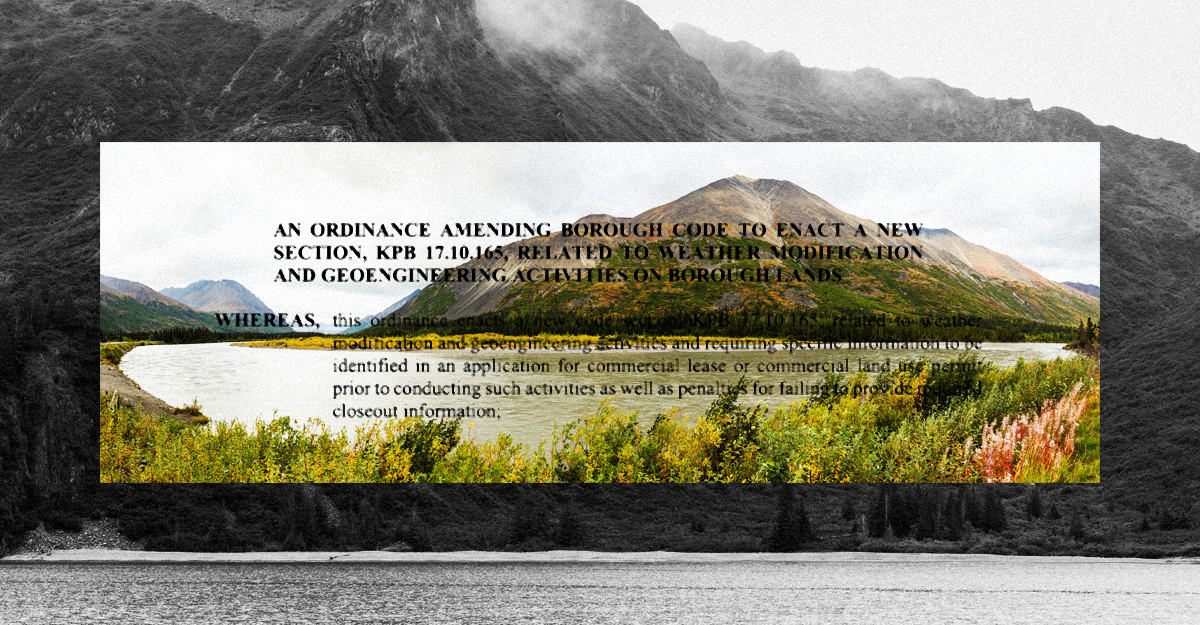
On October 20, a borough just shy of 60,000 Alaskans did something that no government in the world has done: it passed a law requiring permits to conduct climate interventions and weather modification. Academic debates around intervention oversight have dragged on for decades. Alaska’s Kenai Peninsula Borough just went and did it. The new law is a sensible approach that ensures community buy-in and provides oversight to reduce risk without stymying critical research. And now it’s the leading global model for how to get basic transparency into a growing area of research.
If the good people of the greater Soldotna area can figure this out, so can Congress.
How did they do it? By responding to a surprising experiment with deliberate policy. This past summer, a cloud-seeding company, Rainmaker, conducted tests in Homer, the town at the end of the road in the Kenai Peninsula. This came as a surprise to local officials and residents, and people weren’t happy. Past interactions with frontier science in other towns have wound up with canceled experiments, as happened in 2024 in Alameda, California, on a project to cool marine areas with sea mist. Indeed, there’s been a growing, profoundly misguided, effort to ban frontier climate and weather science nationally with over 130 state bans proposed since 2023. We’ve been seeing jurisdictions shut down science wholesale rather than insisting on disclosure, despite evidence that Americans prefer atmospheric research under strict government oversight over a ban by 8 to 1.
But something different happened this time. Consistent with model permitting proposals out of Texas, the Borough Assembly instead decided transparency was the path forward. They wrote a new statute, which is just a few paragraphs long, that simply directs anyone who wishes to do any form of weather modification – from local cloud-seeding to globally relevant experiments – to file disclosures with the government on what they will be doing, and seek permission, or face a fine. It’s dead simple, it’s effective, and it responds sensibly to public concerns. Sure, the ordinance doubtless will see tweaks over the years and other jurisdictions may add more improvements. Perhaps we’ll see additional penalties for noncompliance, or clearer community participation requirements, or a more explicit standard for decisions on permits – but it’s the right start. It’s certainly way better than criminalizing or blocking science.
The Borough also passed a resolution urging the Alaska legislature to take action to address climate interventions in Alaska – and again, to explore doing so with strong regulations. The resolution, to be fair, is more split, reflecting the ongoing policy debate on these issues. It does suggest considering a nuanced ban, arguing the legislature should ban unauthorized climate interventions and weather modification, but it also presses for “permitting and regulatory requirements, including civil or criminal penalties for violations, to govern such activities” that could be used “in lieu of an outright ban.” It calls for federal lawmakers to review their authorities to improve oversight too. That makes sense; the current federal oversight structure, a weather modification reporting requirement, dates from the 1970s and doesn’t include permit denial authority. At every level, updates are needed. But the path forward now looks a bit clearer: Permit-and-disclose looks like the leading framework – but whether that approach will stay local or evolve towards updates to federal law is yet to be seen.
The new Kenai ordinance may be the first in the world to apply permit-and-disclose to climate interventions, but it’s not fancy. It’s just common sense. And this permit-and-disclose model is exactly what most western states already do for run-of-the-mill cloud seeding. It’s how Utah, for instance, has handled cloud seeding since 1973. Ditto Texas, since 1967. Alaskans are sensibly pulling back from the vogue for bans and returning to a western tradition that has worked for more than half a century – one that welcomes innovation but also oversees it closely.
There are many political and economic challenges ahead as global temperatures are set to cross 1.5°C above pre-industrial levels in the next few years. But some things don’t have to be hard. Getting sensible disclosure and oversight in force can be done in months – as Kenai just showed the world. Now, it’s up to more states and the federal government to learn from leaders in the north.
Alaskans are sensibly pulling back from the vogue for bans and returning to a western tradition that has worked for more than half a century – one that welcomes innovation but also oversees it closely.
Just as sports fanatics had plenty to celebrate this year, so does the heat policy team at FAS. In response to recent heat events, leaders across the country have taken steps to build heat resilience.
Western states functionally manage trillions in global climate risk (permafrost, forest carbon, etc.) and can do so in ways that drive state economic development.
Implementation will not be easy. Several of the plan’s critical strategies challenge established utility business models.