 |
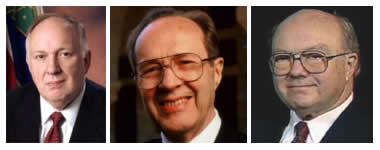
| Ambassador Brooks, Secretary Perry and Ambassador Matlock join FAS in call for continuing nuclear transparency under New START treaty |
.By Hans M. Kristensen,
Three former U.S. officials have joined FAS in urging the United States and Russia to continue to declassify the same degree of information about their strategic nuclear forces under the New START treaty as they did during the now-expired START treaty.
The three former officials are: Linton Brooks, former chief U.S. START negotiator and administrator of the National Nuclear Security Administration, Jack Matlock, former U.S. ambassador to the Soviet Union and Special Assistant to President Ronald Reagan for national security affairs, and William Perry, former U.S. Secretary of Defense.
At issue is whether the United States and Russia will continue under the New START treaty to release to the public detailed lists – known as aggregate data – of their strategic nuclear forces with the same degree of transparency as they used to do under the now-expired START treaty. There has been concern that the two countries might reduce the information to only include numbers of delivery systems but withhold information about warhead numbers and locations.
In a joint letter, the three former officials joined FAS President Charles Ferguson and myself in urging the United States and Russia to “continue under the New START treaty the practice from the expired START treaty of releasing to the public aggregate numbers of delivery vehicles and warheads and locations.” This practice contributed greatly to international nuclear transparency, predictability, reassurance, and helped counter rumors and distrust, the letter concludes.
Both governments have stated their intention to seek to broaden the nuclear arms control process in the future to include other nuclear weapon states and the letter warns that achieving this will be a lot harder if the two largest nuclear weapon states were to decide to decrease transparency of their nuclear forces under New START.
“Any decrease in public release of information compared with START would be a step back.”
The letter was sent to Rose Gottemoeller, the U.S. Assistant Secretary of State for Arms Control, Verification and Compliance, and Sergey Kislyak, the Ambassador of the Russian Federation to the United States.
This publication was made possible by a grant from Carnegie Corporation of New York and Ploughshares Fund. The statements made and views expressed are solely the responsibility of the author.
It is difficult to assess from photos whether the Sentinel missile is longer or wider overall than the Minuteman, but the Sentinel clearly has a thicker second stage, which could potentially contribute to the missile’s extended range.
This is not the first time Google has agreed to censor imagery at the behest of governments, but be warned: obfuscation at this broad level poses a direct threat to the public’s ability to monitor and scrutinize government operations.
As humans expand our geographic reach, encroach on untouched natural territories, and interact more with animal populations, we will encounter novel zoonotic diseases that threaten the human body. The sooner we act to address these risks, the better.
“One thing became increasingly clear: AI doesn’t simply introduce a new category of risk. It changes the speed, scale, complexity, and interaction of risks that already exist.”