 |
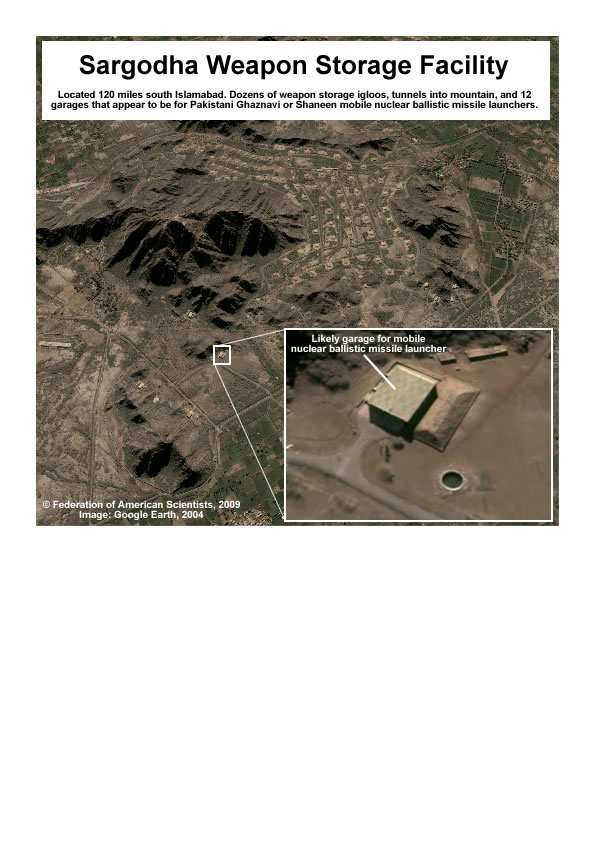
| Pakistan’s nuclear weapons are “widely dispersed” says Secretary of State Hillary Clinton. Does that include the large weapons storage complex at Sargodha? Click for image. |
.
By Hans M. Kristensen
Secretary of State Hillary Clinton has expressed concern over the safety of Pakistan’s nuclear weapons in the light of increasing violence in the country. The weapons “are widely dispersed in the country – they are not at a central location,” she said in what is perhaps the first U.S. public indication of its knowledge about how Pakistan stores its nuclear weapons.
We’re pleased that both Washington Times and the Carnegie Endowment use our estimates for how many nuclear weapons Pakistan and other countries have. For additional information about Pakistan’s nuclear forces, see:
* Preparation of Shaheen-2 ballistic missile launchers.
* Nuclear Notebook: Pakistan’s Nuclear Forces, 2007 (most recent update).
.
It is difficult to assess from photos whether the Sentinel missile is longer or wider overall than the Minuteman, but the Sentinel clearly has a thicker second stage, which could potentially contribute to the missile’s extended range.
This is not the first time Google has agreed to censor imagery at the behest of governments, but be warned: obfuscation at this broad level poses a direct threat to the public’s ability to monitor and scrutinize government operations.
As humans expand our geographic reach, encroach on untouched natural territories, and interact more with animal populations, we will encounter novel zoonotic diseases that threaten the human body. The sooner we act to address these risks, the better.
“One thing became increasingly clear: AI doesn’t simply introduce a new category of risk. It changes the speed, scale, complexity, and interaction of risks that already exist.”