North Korea’s Nuclear Test: Another Fizzle?
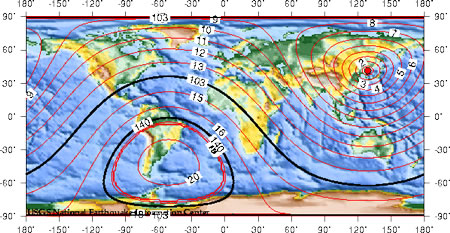 |
| The North Korean nuclear test on May 25, 2009, was “heard” loud and clear around the world despite its apparent limited size. Detection of small, clandestine nuclear tests seems to work. |
.
By Hans M. Kristensen
The Korean Central News Agency reportedly has announced that North Korea “successfully conducted one more underground nuclear test on May 25 as part of measures to bolster its nuclear deterrent for self-defense.” Several news media reported that the Russian Ministry of Defense estimating the test had a yield of approximately 10 to 20 kilotons.
Yet the preliminary seismic data published by the U.S. Geological Survey (USGS) shows that the test had a seismic magnitude of 4.7, only slightly more powerful than the 4.3 of the 2006 test.
Was it another fizzle? We’ll have to wait for more analysis of the seismic data, but so far the early news media reports about a “Hiroshima-size” nuclear explosion seem to be overblown.
Update: CTBTO’s initial findings.
.
As humans expand our geographic reach, encroach on untouched natural territories, and interact more with animal populations, we will encounter novel zoonotic diseases that threaten the human body. The sooner we act to address these risks, the better.
“One thing became increasingly clear: AI doesn’t simply introduce a new category of risk. It changes the speed, scale, complexity, and interaction of risks that already exist.”
In the current environment of declining trust and magnifying strategic competition, banning debris-creating tests is a concrete step towards stability that favors interests of all states seeking to conduct space activities.
Google’s motto famously used to be “don’t be evil.” However, its latest feature has just made being evil a whole lot easier.