Report: What NATO Countries Think About Tactical Nukes
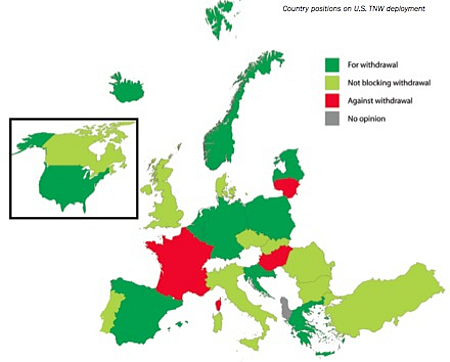 |
| Most NATO countries support withdrawal of U.S. nuclear weapons from Europe, only three oppose, according to interviews with NATO officials. |
.
By Hans M. Kristensen
Two researchers from the Dutch peace group IKV Pax Christi have published a unique study that for the first time provides the public with an overview of what individual NATO governments think about non-strategic nuclear weapons and the U.S. deployment of nuclear bombs in Europe.
Their findings are as surprising as they are new: 14, or half of all NATO member states, actively support the end of the deployment in Europe; 10 more say they will not block a consensus decision to that end; and only three members say they oppose ending the deployment.
Anyone familiar with the debate will know that while there are many claims about what NATO governments think about the need for U.S. weapons in Europe, the documentation has been scarce – to say the least. Warnings against changing status quo are frequent and just yesterday a senior NATO official told me that, “no one in NATO supports withdrawal.”
The report, in contrast, finds – based on “interviews with every national delegation to NATO as well as NATO Headquarters Staff” – that there is overwhelming support in NATO for withdrawal.
The most surprising finding is probably that most of the Baltic States support withdrawal, only Lithuania does not.
Even Turkey, a country often said to be insisting on continued deployment, says it would not oppose a withdrawal.
The only real issue seems to be how a withdrawal would take place. The three opposing countries – one of which is France – block a potential consensus decision, a condition for 10 countries to support withdrawal.
The Obama administration needs to take a much more proactive role in leading NATO toward a decision to end the U.S. deployment in Europe. This can be done without ending extended deterrence and without weakening the U.S. commitment to NATO’s defense.
Background: IKV Pax Christi study | Nuclear Notebook: U.S. Nuclear Weapons In Europe, 2011
This publication was made possible by a grant from Carnegie Corporation of New York and Ploughshares Fund. The statements made and views expressed are solely the responsibility of the author.
It is difficult to assess from photos whether the Sentinel missile is longer or wider overall than the Minuteman, but the Sentinel clearly has a thicker second stage, which could potentially contribute to the missile’s extended range.
This is not the first time Google has agreed to censor imagery at the behest of governments, but be warned: obfuscation at this broad level poses a direct threat to the public’s ability to monitor and scrutinize government operations.
As humans expand our geographic reach, encroach on untouched natural territories, and interact more with animal populations, we will encounter novel zoonotic diseases that threaten the human body. The sooner we act to address these risks, the better.
“One thing became increasingly clear: AI doesn’t simply introduce a new category of risk. It changes the speed, scale, complexity, and interaction of risks that already exist.”