Publication: US Nuclear Weapons in Europe
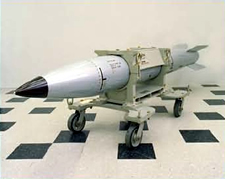
The US Air Force deploys 150-200 B61 nuclear bombs in Europe.
Following NATO’s strategic concept and expectations that the next round of US-Russian nuclear arms control negotiations will deal with tactical nuclear weapons in some shape or form, Stan Norris and I have published our latest estimate on U.S. nuclear weapons in Europe in the Bulletin of the Atomic Scientists.
Although the strategic concept states that “any” further reductions “must take into account the disparity with the greater Russian stockpiles of short-range nuclear weapons,” NATO has in fact been willing to make significant unilateral reductions in this decade regardless of disparity. Likewise, the United States has scrapped most of its tactical nuclear weapons because they are no longer important. It is important that the disparity argument does not become an excuse to prevent further reductions.
Our estimate of Russian tactical nuclear weapons is here with more details here.
Later this spring we will publish a more comprehensive report on U.S. and Russian tactical nuclear weapons.
This publication was made possible by a grant from Carnegie Corporation of New York and Ploughshares Fund. The statements made and views expressed are solely the responsibility of the author.
It is difficult to assess from photos whether the Sentinel missile is longer or wider overall than the Minuteman, but the Sentinel clearly has a thicker second stage, which could potentially contribute to the missile’s extended range.
This is not the first time Google has agreed to censor imagery at the behest of governments, but be warned: obfuscation at this broad level poses a direct threat to the public’s ability to monitor and scrutinize government operations.
As humans expand our geographic reach, encroach on untouched natural territories, and interact more with animal populations, we will encounter novel zoonotic diseases that threaten the human body. The sooner we act to address these risks, the better.
“One thing became increasingly clear: AI doesn’t simply introduce a new category of risk. It changes the speed, scale, complexity, and interaction of risks that already exist.”