On February 4, President Biden issued a memorandum to agency heads on “advancing the human rights of lesbian, gay, bisexual, transgender, queer, and intersex persons around the world.”
He directed that “it shall be the policy of the United States to pursue an end to violence and discrimination on the basis of sexual orientation, gender identity or expression, or sex characteristics.”
Somewhat surprisingly, the memorandum was designated National Security Memorandum/NSM-4 and was published as such in the Federal Register on February 26.
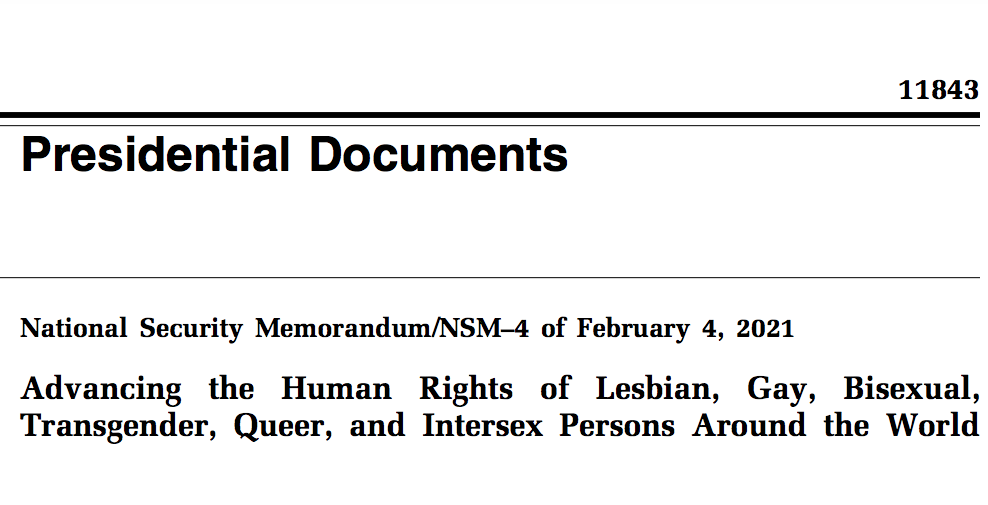
This was unexpected since the NSM designation was not included in the original White House release on February 4, and the memorandum itself does not make any explicit reference to national security. The Biden memo builds on a 2011 Obama Memorandum which also did not invoke national security.
In effect, the defense of LGBTQI+ rights has now been elevated by the Biden Administration to a national security policy of the United States.
* * *
A January 21 White House policy on International COVID-19 Response was originally issued as National Security Directive 1.
But perhaps because the “National Security Directive” designation was previously claimed by the first Bush Administration, Biden’s NSD-1 was renamed and reissued as National Security Memorandum 1.
An unnumbered National Security Memorandum dated February 4 on Revitalizing the National Security Workforce is apparently NSM-3.
It is difficult to assess from photos whether the Sentinel missile is longer or wider overall than the Minuteman, but the Sentinel clearly has a thicker second stage, which could potentially contribute to the missile’s extended range.
By mandating data centers that are clean, flexible, efficient, and beneficial, Colorado can bring opportunities to communities and enhance its overall infrastructure.
FAS is eager to see implementation of metascience to measure what works, promote novel and effective research programs such as the work of the NSF X-Labs program, and create policy that enables the AI-enabled scientific enterprise to reach its full potential, safely.
We won’t solve the cost-of-living crisis without improving the capacity of state public utility commissions to protect customers, find and implement new solutions to meet rising demand, and realign broken utility incentives.