Coloradans Should Require Data Center Measurements They Can Trust
A lack of monitoring, reporting, and transparency of data centers’ impacts have led to a near-complete loss in public support and trust in the development of data centers in Colorado and across the U.S.
And no wonder: Data centers require irrevocable amounts of electricity and water, can increase air and noise pollution, and become permanent heat islands for surrounding communities.
In this memo we recommend steps Colorado should take now to build an essential foundation for responsible data center development. We believe most Coloradans want data center development to be stewards of natural resources and deliver public benefits. To this end, we recommend the reporting of electricity usage and water usage, as well as fenceline monitoring of air quality and temperature. We also advocate for an independent investigation into infrasound noise pollution for data centers near residences and schools. To start, we must improve our fundamental understanding of data centers’ impacts on Colorado communities so that we can enable more evidence-informed decisionmaking for policymakers, utility companies, and people living near existing or proposed data centers. This is an important time for action.
Challenge and Opportunity
Recent advancements in artificial intelligence (AI) have catalyzed the fastest and broadest U.S. infrastructure buildout since World War II. AI advancement is only accelerating, with companies expected to invest up to $7 trillion by 2030 in the development of data centers, the physical infrastructure of AI. As of June 2026, Colorado has 68 operating data centers, with an additional 17 proposed or under development. Table 1 below shows the eight largest proposed, under construction, and operating data centers in the state.
Data centers vary in size, with AI advancement requiring large hyperscale data centers, which consume 100 megawatts (MW) or more. For reference, 100 MW could power over 105,000 Colorado households. Colorado currently has no operational hyperscale data centers, but there are five proposed or under construction. These five hyperscale data centers could consume approximately as much electricity as 84% of all households in Colorado and as much water as all households in Fort Collins and Grand Junction combined, as shown in Table 1.
This growth is outpacing the state’s ability to assess and manage the environmental and health impacts that data centers could have on local Colorado communities, raising concerns among local residents as development expands. Evidence suggests that data centers have the following environmental impacts.
Yet, there is a lack of transparency and public input on data center development and the potential impacts to diminishing water resources, aging electricity infrastructure, and surrounding communities. This has resulted in broad public opposition. Recent polling shows that 7 in 10 Americans oppose data center construction, with opposition spanning across political parties. In Colorado, 9 in 10 residents support commonsense rules to protect ratepayers, communities, and natural resources from unrestricted data center growth. A poll in Larimer County found that 94% of respondents opposed construction of new data centers. Despite strong public support for data center legislation, both Colorado bills on data centers failed in the previous legislative session: SB26-102 proposed investigating the technical and economic feasibility of large data centers and requiring use of renewable energy, and HB26-1030 proposed tax exemptions to data center development that fulfill specific requirements. One explanation for why these bills failed is because of a lack of understanding on environmental and community impacts of data centers. As a result, local opposition across the U.S. has blocked or delayed at least $64 billion worth of data center projects, including projects in the nearby states of Arizona and Texas. In response, governors in Texas and New York have signed executive orders halting data center development throughout their states to audit data centers’ impacts on electricity and water infrastructure, rate payers, and local communities. In Colorado, half of the 12 most populated counties have imposed moratoriums on data center development (Denver, Jefferson, Larimer, Weld, Boulder, Broomfield), impacting the largest proposed data center in the state and two other proposed data centers (see Map 1 for more information on local data center policies in Colorado). These moratoriums reflect an urgency and need to address gaps in our understanding of data centers’ impacts which have eroded public trust and stymied legislation on future data center development.
To rebuild public trust, promote public health, and improve data center development outcomes for the state’s economy, there needs to be more transparency with the public through clear, accessible data on data centers. Bills and legislation in other states (e.g., Nebraska LB1111, New York Senate Bill S9144A, Florida House Bill 1007, Oklahoma SB1488, Vermont S.205, Wisconsin LRB-6377/LRB-6391 as described in Appendix 1) offer models for Colorado. These examples highlight the need to monitor, report, and investigate key environmental and public health factors: electricity usage, electricity generation, water usage, fenceline temperature, air pollution, and noise pollution. This memo focuses in particular on data centers that consume an average of 10 MW or more to avoid undue burden on smaller enterprise data centers which are not used for AI purposes. This threshold is consistent with those used by the city of Broomfield and the state of South Dakota. The Colorado Department of Public Health & Environment (CDPHE) is well-positioned to facilitate these efforts given their existing work and expertise in industrial and environmental monitoring, reporting, and investigations. Ultimately, this solution can support Colorado in meeting the growing demand for data infrastructure, while still promoting responsible land stewardship and public health.
Plan of Action
Recommendation 1. Existing and new data centers must regularly report electricity usage, electricity generation, and water usage.
To inform government agencies, utilities, and the public, we recommend having all operating, under construction, planned, and future data center sites consuming 10 MW or more to report: (1) monthly electricity usage (average and peak), (2) amount of on-site electricity generation and from what sources, and (3) the amount of water used and discharged. Such reporting requirements are included in Nebraska LB1010, which was unanimously passed in the legislature and signed into law in April 2026. This usage data should be reported to the Colorado Department of Public Health and the Environment (CDPHE). The CDPHE should share relevant information with the Public Utilities Commission (PUC), Xcel Energy, Blackhills Energy, and investor-owned utilities, as well as the Colorado Energy Office (CEO) which develops programs and promotes energy policies to address climate change. The CDPHE should also conduct annual evaluations of reported metrics and revise their reporting requirements as needed to improve their assessment of data centers’ environmental impacts.
Penalties for non-compliance should be a fine of up to $10,000 per violation (consistent with Illinois SB2181), with collected fees going towards CDPHE activities to monitor and investigate data centers. Failure to report across three consecutive months, or four or more months a year, will lead to a notification from CDPHE and the PUC, and developers who fail to respond to these inquiries within 90 days are ineligible for future connection requests from the electric grid as determined by the CDPHE and PUC. This penalty is intended to deter data center operators from choosing not to disclose data during demanding seasons or weather events (e.g. during the summer, drought, or wildfires) when this information is most important. Funding for this monitoring and reporting should come from a fee associated with proposals for future data center development. For example, Nebraska LB1010 has a study fee of $50,000 or $1,000 per megawatt, whichever amount is greater, for data center developers.
Monitoring and reporting of electricity use, water use, and on-site electricity generation will enable PUC and utilities to understand demands on infrastructure and better prepare for future improvements and environmental risks, such as drought preparations. Furthermore, local and state governments can use these data to understand potential community health impacts and inform proposed development of future data centers.
Recommendation 2. Existing and new data centers within three miles of residential, educational, or agricultural areas must have continuous monitoring of air quality and temperature.
Data centers are often placed near residential areas, resulting in potential harm to nearby residents. For example, the under construction CoreSite DE3 Data Center is in the disproportionately impacted community of Elyria-Swansea and across the street from an elder care facility, affordable housing complex, park, and community health center. The CDPHE should conduct additional fenceline monitoring of any existing and future data center sites that meet two criteria: (1) provide a capacity of 10+ MW and (2) are located within three miles of residential, educational, or agricultural areas, which is the regulatory boundary set by Oklahoma SB1488.
Data centers’ operations, specifically the regular testing and/or usage of their on-site generators produce exhaust emissions, which will worsen nearby air quality. The CDPHE is required to conduct fenceline monitoring to control airborne emissions from oil and gas operations. Given this, the CDPHE should establish at least one reference or near-reference air quality monitor and maintain this fenceline monitoring consistent with existing CDPHE regulations and policies on fenceline monitoring (e.g. Regulation 7).
Data centers also generate exhaust heat, becoming a permanent heat island that heats up the surrounding area day and night. The CDPHE should monitor temperature with at least two reference or near-reference thermometers recording fenceline temperature upwind and downwind of the data center site and/or between the site and any concentration of people.
To fund fenceline monitoring, the CDPHE should establish a schedule of fees payable by the owners or operators of data centers (as consistent with Virginia SB 1448). This fee should scale according to the size of the data center sites (as measured by MW).
Recommendation 3. Investigate the impacts of data centers’ noise on people and agriculture.
Existing Colorado laws do not effectively regulate data center noise because of their low frequencies. Colorado’s maximum permissible noise levels (§ 25-12-103) are measured according to db(A). This measure biases towards audible, higher frequencies, as shown by the curved red line in the figure below. This method of measurement under-reports lower frequency noises associated with data centers by over 10 db. Therefore, existing laws do not effectively regulate low hums which come from data centers. In response to this, Weld County added a db(C) noise limit of 65 dB(C) at the property line, although it is unclear if this threshold is appropriate.
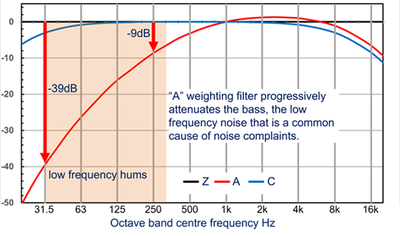
When compared to db(Z) and db(C) weightings, db(A) underreports low frequency hums which data centers emit (INVC)
To better understand how data center noise may impact local residences, schools, and livestock, the CDPHE should conduct an investigation of select data centers of varying sizes which are within three miles of any residential, school, or agricultural zones. This investigation may include use of infrasound microphones which meet industry standards (e.g. IEC) and include narrow band frequency analysis and target area analysis, as well as surveys and interviews with local residents and domain experts.
We expect this study to require one full time employee across two years. In the first year, this can be funded through a new one-time fee for all data centers owners and operators of a site of at least 10 MW of capacity. In the second year, this can be funded through fees associated with permits for generators, which CDPHE already requires, and for fines from non-compliance from data centers and industrial sites (as consistent with New York A09086). This application of fines is similar to Colorado’s Impact Cash Fund (§ 25-7-129). Future funding can also come from CDPHE annual emission fees.
Recommendation 4. Disclose data reporting and monitoring findings publicly
Rebuilding public trust requires transparent and independent disclosure. Therefore, we recommend the CDPHE collaborate with the Colorado Energy Office (CEO) to disseminate energy and water reports (Recommendation 1) and the CDPHE integrate fenceline monitoring data into existing platforms (Recommendation 2).
For monthly reporting of data centers’ energy generation, energy usage, and water usage, the CDPHE and CEO should conduct anonymization or aggregation (e.g. by county) required to protect industry secrets and make this data publicly available within 60 days through Colorado’s existing Open Data Portal. This data should be in a format which supports searching, filtering, data analysis, and downloading (e.g. a spreadsheet). Data should be publicly available for at least 10 years from reporting.
Fenceline air quality and temperature data should be made publicly available in approximately real-time through websites such as Colorado’s EnviroScreen and Love My Air. Historical data of at least 36 months should be available for download through public request to the CDPHE.
Regarding the noise pollution investigation (Recommendation 3), the CDPHE should produce publicly available updates every 4-6 months, and a final report within 24 months of receiving funding. This report can inform future standards for data center development and monitoring to mitigate negative impacts of noise pollution on residents, schools, wildlife and livestock. Specifically, local and municipal planning and zoning departments should use this data to inform decisions on data center sites (e.g. minimum distance from communities, farms, open spaces), resource allocation (e.g., grid power allocation, water allocation), and environmental impact mitigation requirements for new data center development.
Recommendation 5. Share data for Economic Development, Planning, and Research
The CDPHE should transmit this reporting and monitoring data to the Colorado Office of Economic Development & International Trade (OEDIT). Doing so will inform state research and development priorities for reducing the environmental impacts of data center operations while advancing economic opportunities. This data should be transmitted at regular intervals, jointly determined by CDPHE and OEDIT.
Conclusion
Data centers are crucial to advance AI innovation in the United States and an incredible opportunity for Colorado. Colorado could see an estimated $144 million in tax revenue and 28,000+ construction jobs and hundreds of permanent jobs across the next decade from 17 currently proposed data center projects.
However, these projects could also exhaust our water resources, compromise aging electricity infrastructure, increase utility rates, harm communities, wildlife and livestock, and violate the will of Coloradans. Monitoring and reporting managed by the CDPHE will ensure more transparency and build public trust, as opposed to asking data centers to voluntarily report or self-regulate. Through independent monitoring, reporting, and investigation on data centers’ environmental impacts, we can promote public trust, inform the allocation of natural resources, and enable responsible governance on future data center development.
Appendix 1. Relevant Legislation, Bills, and Memos on Monitoring and Reporting for Data Centers from other states
New York Senate Bill S9144A: Requires environmental impact reports for new data centers. This includes reporting current and maximum GW capacities and how energy is generated; total and daily water usage and how much water is lost; impact on farmland and prime farming soil; estimates on greenhouse gas and general air pollution emission, water and thermal pollution; noise pollution at half mile intervals from the property line; and health and general impacts on data centers.
Florida House Bill 1007: Any proposed large-scale data center within a 5 mile radius of a residential property or school would need to submit an independent study to ensure state and local law compliance, which may also include “low-frequency noise attenuation measures.” Any data center with an average daily usage of 100,000 gallons or more must report anticipated sources, amounts, and losses of water and a plan that incorporates water recycling.
Wisconsin LRB-6377/LRB-6391: Co-sponsorship memorandum calling for mandatory public reporting of electrical and water use, ensuring data centers do not invest in fossil fuels.
Vermont S0205: Requires the public utilities commission to investigate impacts of data center construction and operation on the state and report to legislative committees. Environmental impacts include “water quality and availability, air quality, local ecosystems, noise emissions, and the availability of surrounding land for other purposes, including farming, conservation, recreation, and housing.” Electrical reporting includes increases to electrical load, ways to strengthen grid reliability and security, ways to promote sustainable and efficient energy usage, and ways to reduce increased electrical costs on other customers. Water reporting include consumption of the cooling of computing equipment used.
Oklahoma SB 1488: Requires regulatory agency to investigate the impacts of data centers on the state’s water supply, utility rates, property rates within a 3 mile radius, and anything else determined necessary by the commission.
Nebraska LB1111: Requires annual reports on data center power usage for data centers using 20+ MW.
Appendix 2. Methodological notes
We assumed the stated energy capacity of data centers were their total facility capacity, not just IT capacity (known as critical megawatts, CMW). If the capacity reported was CMW, you have to multiply by the power usage effectiveness (PUE) ratio to calculate total facility capacity. PUE ≥ 1.0, where 1.0 is ideal and means 100% of power is used for IT. We also assumed facilities operate at their maximum capacity at all times, which AI data centers claim to but may not be true in common scenarios, such as when data centers’ IT usage is below capacity and/or when less cooling capacity is required. Water consumption was estimated based on energy consumption assuming a Water Use Efficiency (WUE) of 1.8L / kWh, a stated average for data centers, and that a data center is running at its stated maximum capacity at all hours. This equates to an annual water consumption of up to 4,165,857 gallons of water per MW (1 MW x 1,000 kW / 1MW x 1.8 L /kW x 1 gallon / 3.78541 L x 24 hrs/day x 365 days/yr). The minimum WUE is 0 (no water usage) which two data centers in Colorado Springs are working towards (Project Taurus and NOVVA). For reference, a three building data center totaling 60MW (CoreSite DE3) has a reported maximum water usage of 805,000 gallons a day. This translates to a WUE of 2.12 L / kWh.

We used 2020-24 census data to assume 2.42 people per CO household and 73 gallons of water used per resident daily (based on data from 15 CO cities in 2022). Therefore, an average CO household uses 64,481 gallons per year. To calculate the equivalent energy usage for Colorado households, we used a 2023 estimate of 8,302 kWh for an average household annually.
We used census estimates for 2025 to estimate the population. The population estimate for 1 July 2025 is 6,012,561, or 2,484,529 households assuming 2.42 people per household.
Data centers provide the most economic benefit during the construction phase. The 17 proposed data centers in Colorado could generate $144 million in tax revenue over 10 years and create 28,696 construction jobs, providing a boon to union labor and local economies. However, completed data centers have mixed permanent employment impacts. A hyperscale data center of 100 MW is estimated to result in 43 permanent jobs, with the number of jobs increasing at an unknown rate with the data center size. Most permanent jobs are typically low-wage, term-limited, non-technical positions (e.g. security, janitorial).
While tax breaks to incentivize data center development are becoming popular, they do not necessarily translate to significant permanent job creation. For example, a $77 million tax break in New Jersey resulted in one permanent high wage job. CO HB26-1030, a bill which lost in the 2026 legislative session, only required 10 permanent jobs for a $250 million minimum investment in data center development. Data centers are among the least labor-intensive structures in the economy, with typically no potential for further creation of permanent, high paying jobs without additional expansion.
Colorado’s climate goals include 80% of electricity coming from renewable sources by 2030. The three largest sources of renewable energy in Colorado are wind, solar, and hydroelectric. However, the federal government has cut more than $600 million in clean-energy funding, and droughts have hindered hydroelectric generation capacity in waterways such as the Gunnison River. As renewable energy generation faces challenges, data centers risk further impeding state climate goals. The five proposed hyperscale data centers which total 1,977 MW of capacity alone (see Table 1) could consume about 1/3 of all renewable energy estimated to be generated by 2030. This consumption does not consider the 68 existing data centers or other proposed data centers. It is therefore unlikely that Colorado can meet state climate goals with unregulated data center development.
To meet greater electricity demand, utility companies must add or upgrade transmission and generation infrastructure. This cost can be passed down to the consumer, resulting in increased utility rates. In Colorado, the Public Utilities Commission (PUC) must approve all rate changes. Alternatively, data center developers can pay for infrastructure upgrades. CO HB26-1030, a bill which lost in the 2026 session, proposed having data center developers invest in utility modernization in order to be eligible for tax incentives.
The goal: help communities approach data center development with stronger negotiating tools and a clearer understanding of what’s possible.
By mandating data centers that are clean, flexible, efficient, and beneficial, Colorado can bring opportunities to communities and enhance its overall infrastructure.
This report serves as a landscape assessment and toolbox from which local governments can negotiate an informed position when it comes to the levers available to them and includes a first-of-its kind analysis of eight executed community benefits agreements.
Colorado faces a projected shortage of more than 2,400 physicians by 2030, alongside the growing shortage nationwide, particularly in rural and certain underserved urban communities.