We Want Better Data Center Deals. We Need Your Help.
Join the FAS National Task Force to Establish a Model Community Benefits Agreement for Data Centers – Sign Ups by October 30
Our work starts with listening to state and local governments, understanding their challenges, and connecting research to practical solutions.
When we began researching data center Community Benefits Agreements (CBAs), we heard a consistent need: local governments wanted insight into how peer communities were approaching negotiations with data center developers. Which elements were most important to address in an agreement? Which CBAs were protecting communities the most? Which were yielding the most durable benefits to residents? But many agreements are negotiated confidentially, making them difficult to access and compare. That means too many communities are lacking a clear picture of emerging practices and their options at the negotiating table.
Today we are announcing the next step into this work – developing a model CBA template. But we need help from the people who are facing these new challenges first hand.
That’s why FAS is launching a national task force to bring together state and local government officials, subject-matter experts, and community practitioners.
How to Get Involved: Sign up by Friday, October 30, 2026
Become a Task Force Member
We’re looking for state and local government leaders who can bring firsthand experience, policy expertise, and practical perspectives to the template’s development.
Time Commitment: Two meetings per month through April 2027 – one full-group meeting and one committee meeting focused on a specific topic, plus written feedback on draft templates.
Sign up for the FAS Template CBA Task Force
FAS will not publicly identify participating individuals or organizations without their permission.
Join the On-Call Expert Panel
We’re also seeking academic, non-profit, and other subject matter experts to help address knowledge gaps and contribute relevant research, legal expertise, and historical context as the template develops.
Participate in Public Comment
FAS expects to release a draft for public comment in March 2027. Residents and other interested stakeholders, including people living near data centers or in communities negotiating with developers, will have an opportunity to share feedback.
How the Task Force Will Work
FAS has developed an initial draft CBA template based on our research. Task force participants will help refine it, identify knowledge gaps, and develop recommendations that reflect the realities of local policymaking.
The process will include three ways to participate:
- Task Force Members: State and local government leaders and staff who will help shape the template through meetings and written feedback.
- On-call Subject Matter Experts: Academic, nonprofit, and other experts who can contribute specialized knowledge, legal expertise, historical context, and emerging research.
- Public commenters: All interested stakeholders are invited to review and comment on a refined draft.
Drawing on the collaborative In the Lab model, FAS will prioritize evidence-based recommendations, transparency, an efficient timeline, and a community of practice among governments navigating data center development.
What Will the Task Force Cover?
Committee discussions will explore key provisions of a model CBA, including:
- Definitions
- Community engagement + advisory board
- Betterment Fund
- Construction requirements
- Air quality and heat mitigation
- Utility costs and energy requirements
- Water supply and reporting
- Residential setbacks, lighting, and noise
- Decommissioning and e-waste
- Enforcement, transparency, and reporting requirements
- Economic incentives and local hiring requirements
What Success Looks Like
By combining research with the experience of local leaders and subject matter experts, FAS aims to give communities practical tools for more informed negotiations.
The resulting template will help local governments evaluate proposals, identify potential community benefits, set clearer expectations, and strengthen accountability.
The goal: help communities approach data center development with stronger negotiating tools and a clearer understanding of what’s possible.
Our In the Lab initiative demonstrates the value of this collaborative approach. Our Model Data Governance Policy and Practice Guide for Cities and Counties remains the most robust publicly available guide even years later. Our Gen-AI initiative was one of the first task forces created by a national organization that brought together more than 45 unique local governments, 30 universities, four federal agencies, and philanthropic organizations to develop resources on AI community engagement, AI cybersecurity risks, and AI research priorities.
The CBA task force applies this same approach to a growing local policy challenge: bring the right people together, connect research with practical experience, and create the tools government can use.
Why a Model CBA?
To date, many negotiation efforts between local governments and data centers have been held confidentially. This makes it difficult for communities to see what others have secured or proactively identify emerging best practices. Without access to comparable agreements, local governments lack a clear baseline for negotiations. A model CBA can help communities:
- Negotiate from a stronger position with a clearer understanding of potential provisions and community benefits.
- Set expectations for developers around resource use, local hiring, and environmental protections.
- Strengthening transparency and accountability through clearer reporting and enforcement provisions.
- Adapt best practices locally rather than starting from scratch.
The goal isn’t a one-size-fits-all agreement. It’s a flexible starting point grounded in research and shaped by experience.
Why work with us?
The shared experience and perspective will shape a practical, adaptable template that communities can tailor to their own laws, needs, and policy goals. This is yet another form of FAS’s model of policy entrepreneurship: the practice of taking good policy ideas and turning them into actionable policy using science and evidence, and an understanding of how governments actually work. We know there are local residents and leaders already practicing policy entrepreneurship on this issue, and we want to collaborate.
If you have any questions about joining the FAS Template CBA Task Force, please contact metrolab@fas.org.
Before Breaking Ground: A Local Government Guide to Better Data Center Policy and Community Benefits
Data center development has outpaced most local governments’ capacity to respond to it, as evidenced by the increasing amount of moratoria legislation to give time for policy development and conversations with communities.1 As data center applications ramp, so have requests for policy guidance by local governments. Broadly, we are starting to see nascent best practices, understanding more clearly the knowledge gaps and research needs, and building a community of practice across industries. This report provides new information for local government policy makers, including property value impacts and a robust collection and analysis of community benefit agreements.
Over the course of 2026, the Federation of American Scientists (FAS) has conducted primary research, including interviews in the field, issued public records requests for difficult-to-find agreements, and created a series of trackers on new ordinances, state legislation, and moratoriums. This report serves as a landscape assessment and toolbox from which local governments can negotiate an informed position when it comes to the levers available to them and includes a first-of-its kind analysis of ten executed agreements between local governments and data center developers.
This report includes three sections:
Ordinances Analysis: provides a brief overview of what local governments are already doing through a landscape scan of 42 local ordinances and 12 state actions.
Data Center Property Values: provides a sampling of data for taxable value over time across six jurisdictions.
Community Benefits Agreements (CBA) – Review and Comparison: provides a comparative review of ten CBAs, identifying common requirements, what is offered as a benefit to the local government and to the developer, and what policy considerations are included within the agreement.
What We Heard: Perspectives From the Field
Alongside the desk research in this report, FAS conducted interviews with elected officials, economic development leaders, water utility staff, community advocates, and other stakeholders across multiple states currently experiencing rapid data center growth. Interviews were conducted under the Chatham House Rule. Insights below include recurring themes across these interviews rather than specific details regarding any one person, jurisdiction, or organization.
Public sentiment has recently changed
Several individuals described a shift in public sentiment over the past six to twelve months. Prior to this, complaints had been specific, including noise, proximity of data centers to homes, and air pollution concerns. More recently, sentiment has broadened into blanket opposition unrelated to any specific project. One local government interviewee noted, “Interest [in data centers] has increased and there is an entire population that hates it.” This interviewee said that they are spending most of their time “trying to establish a common understanding of facts” and that “the general national movement is largely misinformed or uninformed.”
CBAs should supplement ordinances
Even local government practitioners with years of data center development experience noted that their understanding of CBAs as a tool was knowledge they had acquired only within the past six months. In locations where CBAs had been adopted, interviewees noted that a CBA supplements an ordinance but does not replace it. They also noted that the two need to be written to reinforce each other because a CBA cannot fix a zoning gap and a zoning ordinance cannot capture specific project commitments like a CBA can.
Enforcement around decommissioning is largely untested
Multiple interviewees stated they were not aware of a single case where a data center had ceased operations or been formally decommissioned. This indicates the enforcement provisions in most agreements and ordinances are theoretical to date, and one local government interviewee recommended other jurisdictions “approve a decommissioning plan when you approve a data center.”
Transparency is a recurring complaint
The most consistent frustration from both water utilities and environmental advocates was the absence of standardized, facility-level reporting that would let a utility or community actually verify usage against what was promised at permitting. One noted, “Water demands of today are a function of air conditioning [in our climate]. Cooling methodologies of data centers becomes a topic: there are strategies to reduce this but until we have a more common framework and lexicon, we don’t have a single clearinghouse to share this information and better understand it.”
Structural channels for local governments to learn from each other are lacking
Nearly every local government practitioner interviewed said they have wondered who else has dealt with this, and wanted to understand what others have learned in the process. Additionally, these same practitioners described primarily relying on informal calls with counterparts in other jurisdictions because no structured learning pathway or resource exists.
Spend the time during a moratorium to address concerns
With the recent wave of moratoria, we asked interviewees how they would recommend others use this time. One interviewee recommended that other jurisdictions: “[Look] at the energy infrastructure because that touches everything else. It touches the air quality impact on the back-up systems. Same with the water supply concerns as well. Ensure that the industry is actually paying.”
Determine whether, where, and under what conditions before you need to
Local government interviewees’ advice included to decide whether, where, and under what conditions your jurisdiction wants data centers before you are at the negotiating table with a developer. One noted, “Determine up front if you want them, where you want them, and under what conditions you will take them. Understand your taxing structure up front. If you give away the store, then you’re taking away the main reason you would want to get them. Incentives are necessary for data centers.”
Ordinance Analysis
As state and local governments turn to legislative actions to regulate data centers, FAS examined and tracked 42 local ordinance measures. These 42 ordinances were collected during our research process as a starting place to analyze trends and compare themes. Our analysis looks at these ordinances to highlight what key areas of policy they cover (noise, environment, etc), and beginning trends. It is not an exhaustive list.2
Local and state governments have increasingly been racing to regulate data center development: of 42 local ordinances and ballot measures reviewed, 33 of them were passed in 2026 alone, compared with two in 2024 and six in 2025. Only one action in the dataset predates the current wave (Chandler, Arizona in 2022). The local actions span 24 states and follow varying approaches. For instance, a jurisdiction receives an unexpected large-scale data center proposal. The zoning code may or may not classify data centers as a distinct use. Next, the council might enact an emergency moratorium to buy time. Alternatively, a permanent zoning ordinance may be enacted from the outset or after a temporary moratorium, which reclassifies data centers as an industrial use requiring special permits, subject to setbacks of varying degrees, noise limits, and water use/cooling restrictions.
Two major developments in the current dataset mark a genuine escalation beyond earlier trends. First, Monterey Park, California’s Measure NDC3 passed on June 2, 2026 with 86% of the vote, making it the first voter-enacted ban on data center construction in the country on a local level. Second, New York Governor Kathy Hochul’s Executive Order 62 (July 14, 2026) created the first statewide data center permitting moratorium in the country, a new category of wide-reaching executive action on this front.
Of the 42 local ordinances FAS tracked, the following timeline highlights how quickly local action on data centers has escalated since 2022:
- 2022. 1 action. Chandler, AZ: one of the earlier data center zoning ordinances in the country.
- 2024. 2 actions. Atlanta, GA; Fairfax County, VA.
- 2025. 6 actions. Loudon County, VA Phase 1; Atlanta’s second ordinance 25-O-1063; Clayton County, GA; Loudon County, VA Phase 2; Springfield Township, MI; Chandler, AZ’s permit denial.
- 2026. 33 actions. 28 with a fully specified 2026 date, plus 5 more designating a scheduled month in 2026 (Saline, MI in January; Frederick County, MD in January; Mason, MI in February; Port Washington, WI in April; and Boulder City, NV scheduled for November)
Local actions span 24 states. Georgia leads with 7 local actions (Atlanta with two separate ordinances, Clayton County, DeKalb County, Athens-Clarke County, Camden County, and Statesboro), reflecting Atlanta’s status as one of the fastest-growing data center markets in the country. Michigan follows with 4 (Springfield Township, Saline, Mason, Ypsilanti). Virginia (3) rounds out the top jurisdictions, unsurprising given Virginia’s “Data Center Alley” concentration in Loudoun and Fairfax counties.
Two Core Regulatory Approaches
Moratoria (14 of 42 actions)
Moratoria sometimes are the first tool jurisdictions tend to reach for, varying in length from a few months to over a year, in some cases. The stated rationale is almost identical across every entry: the zoning code does not yet define or address data centers as a specific land use, so the jurisdiction needs time to study impacts (water, noise, energy, property values) and draft permanent standards before more projects arrive. Examples include Denver (effective May 21, 2026 by unanimous vote), Minneapolis (six-month pause with a downtown carve-out), Seattle (finalized as Ordinance 127447, effective through June 2027), New Orleans (interim zoning district effectively banning data centers citywide for at least a year), and Wright County (emergency moratorium across all 18 townships).
Zoning ordinances (23 of 42 actions)
Zoning ordinances tend to follow an expired moratorium or are enacted directly, and contain many similarities:
- Formally define “data center” in the municipal code for the first time (9 ordinances do this explicitly, including Atlanta, Chandler, Linn County, and Seattle). Note: the ways in which data centers are defined (and their scale/size) vary widely. For example, some define them by square footage, some define data centers by a threshold of water or electricity usage. There is no uniform definition.
- Reclassify data centers as an industrial use rather than commercial, often limiting them to specific industrial zoning districts (Kansas City, Lawton)
- Require a special use permit, special exception, or conditional use approval rather than “by right” development (Fairfax County, Loudoun County, Fayetteville, Franklin Park, Atlanta’s 25-O-1063), meaning applications now require public hearings before a planning commission or council rather than administrative approval alone
Common Themes
Three community concerns are consistent: 1) noise; 2) water consumption (especially in drought-prone regions); and 3) increasing residential utility rates.4
Ballot Measures
Direct voter action has now produced a concrete result rather than only proposals. Again highlighting that Monterey Park, California voters approved Measure NDC on June 2, 2026 by 86%, permanently prohibiting data center development within city limits. It is the first U.S. city to lock in such a ban by ballot rather than council vote. Boulder City, Nevada has a similar prohibition measure scheduled for the November 2026 ballot. Port Washington, Wisconsin voters already approved, with a 66% vote, a measure requiring voter approval before any tax incentive can be offered to a data center developer. Frederick County, Maryland residents were looking to vote in a November 2026 referendum that would have invalidated a 2,614 acre overlay zone the county council had already approved for data center development. However, the Maryland Supreme Court blocked the referendum citing that zoning ordinances are not subject to referendums and even if so, the referendum question was unclear. Since that time, Frederick County has executed an agreement benefit with the developer that is available for public comment. The recent “Development Rights and Responsibilities Agreement” – is included in the analysis below.
State and Executive Action
The 12 state-level bills and executive orders reviewed take a broader range of approaches than local ordinances. Most of the state legislative bills focus on who pays for the power, water, and grid infrastructure data centers require, rather than restricting where they can be built, which is a more localized issue. New York’s Executive Order 62, however, takes a more assertive approach: the first statewide permitting moratorium enacted by executive action rather than legislation.
Only South Carolina’s bill and New York’s executive order propose or impose an outright statewide moratorium; the remaining ten state bills aim to keep data centers financially self-contained through separate utility rate classes, mandatory water/energy reporting, environmental review requirements, and (in Pennsylvania’s case) a voluntary model ordinance municipalities can adopt. Note, Governor Shapiro did recently announce an Executive Order that requires data centers to provide information on energy affordability, transparency and community engagement, workforce, and environmental protections in order to be eligible for certain state tax incentives.5
Ordinance Analysis Conclusion
The data support a clear and intensifying narrative that data center regulation in the U.S. increased drastically in terms of moratoriums and permanent zoning overhauls in 2026, driven by community concern over noise, water, and energy costs. Local governments are largely using the same approach: pause first, then reclassify as industrial, require special-use review, and impose setback/noise/water conditions. Two recent developments suggest this wave is still escalating rather than levelling off: Monterey Park’s voter-enacted permanent ban shows communities are willing to go beyond temporary pauses when council action feels insufficient, and New York’s statewide executive-order moratorium shows state governments are now willing to intervene directly rather than leaving the issue to municipalities or the legislature alone.
Property Values Over Time
FAS examined empirical data to capture changes in property value over time for data centers. Why this matters: if local governments are going to abate a property in exchange for creating a betterment fund, it is essential to perform a cost benefit analysis to the greatest extent possible.
What is a tax abatement?
A tax abatement works differently in each jurisdiction, but generally, it means freezing a property value over a long period of time for the purpose of attracting business or development. For example, the Texas Comptroller6 defines it as “a local agreement between a taxpayer and a local taxing unit that exempts all or part of the increase in the value of property from taxation for a period not to exceed 10 years.”
Increasingly, local governments are offering abatements or tax rebates in exchange for the creation of a “betterment fund.” For example, a developer can own abated property for ten years, in exchange for the obligation to contribute $20M to a betterment fund. An alternative is to offer no abatement, receive no money in support of a betterment fund, and to collect the standard rate of property taxes on a data center parcel. This tradeoff can be illustrated by the following:
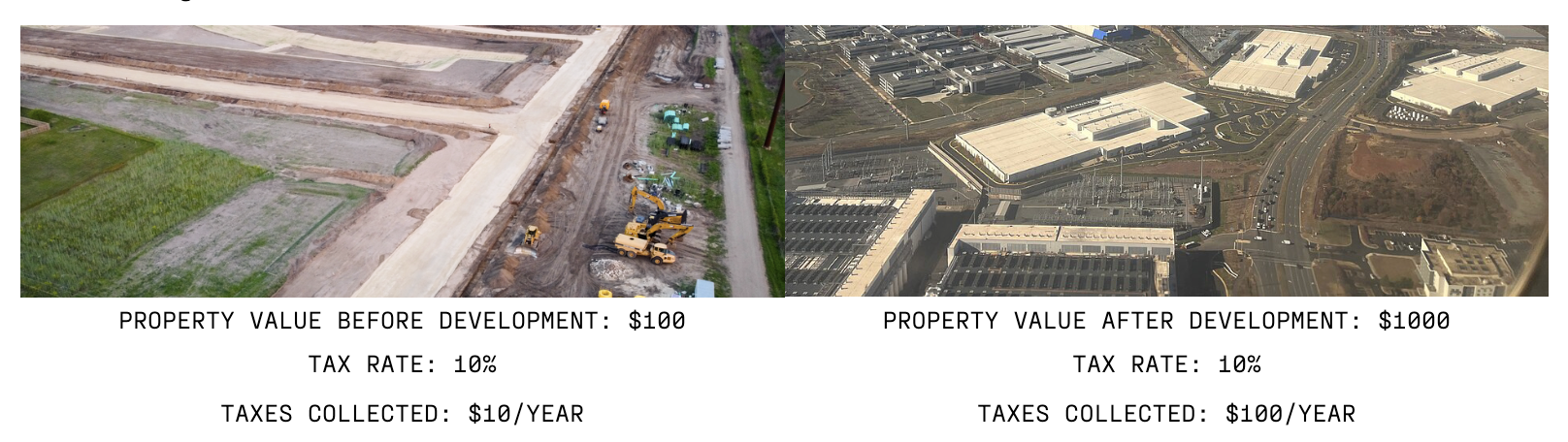
The abatement offers the developer a savings of $90 per year. Therefore if the local government offers a 10 year tax abatement, a community betterment fund should receive at least $900 for the local government to be made whole. By understanding property values over time, we can start to see what kind of deals developers are actually receiving.
Historically, local governments have had challenges in understanding or assessing asset value over time. For example, the City of Chicago sold its parking to a private vendor for 75 years, and the private vendor recouped the costs and made a profit in under 10 years,7 illustrating the difficulty any level of government may have in assessing the property value of a parcel more than five years into the future.
As evidenced by the CBAs FAS has collected, as well as some recent legislation, the deals being made for data centers have long runways. In 2025, the state of Kansas passed SB 98, the Data Center Sales Tax Exemption, establishing a 20-year state and local tax exemption for data centers with over $250M in capital costs. And many of the CBAs hold a term of 10-20 years.
This report examines several properties to identify early trends in property values, a key component of the economic development equation. The report does not analyze neighboring property values, which may somewhat have an impact on the overall property tax collections for a jurisdiction, as well as on neighboring residential property values. This reduction in property value for nearby residential properties, or even entire neighborhoods, should be taken into consideration when contemplating a betterment fund.
This report includes the following six U.S. jurisdictions with either existing and/or growing data center presence:
- Loudoun County, Virginia;
- King County, Washington;
- Cook County, Illinois;
- Montgomery County, Ohio;
- Maricopa County, Arizona; and,
- Fulton County, Georgia
Loudoun County, Virginia
Located in Northern Virginia, Loudoun County is home to “Data Center Alley”. This unique location attracts data centers due to the immense amount of fiber and connectivity. Beginning in 1997 with the arrival of AOL, Loudoun County is now home to more than 25 million square feet of data centers that are currently in operation, with 4 million square feet in construction.8
It should be noted that Northern Virginia has unique assets, including an extensive fiber buildout thanks to AOL’s origin in 1997. To compare to other properties, below is data that pertains to Maricopa County, Arizona and Fulton County, Georgia.
Maricopa County, Arizona
Fulton County, Georgia
Key Considerations and Takeaways:
- Understanding property value over time is the most important component to the equation of any property tax deal. There are other factors to consider when calculating the entire financial impact of a data center that include personal property tax or use tax. Those are not considered in the above tables.
- The variables with respect to property values of industrial or office buildings differ greatly, but especially with data centers. These numbers are early indicators of property values and should be regularly followed.
- Data availability varied by jurisdiction, meaning not all jurisdictions have a complete data series from 2021-2026.
Community Benefits Agreements – Review and Comparison
Community Benefits Agreements (CBAs) have been used in numerous contexts to ensure that cities, counties, or local community groups obtain the benefit of the bargain when negotiating with a developer for large infrastructure projects. They ensure that developers of such projects act in the interest of the community that they are located in, such as building or upgrading infrastructure, hiring locally, and abiding by sustainable practices, for example. The proliferation of data centers across the United States in recent years provides a golden opportunity to employ CBAs as a method to level the playing field for communities that might otherwise receive little to no benefits from the presence of these data centers.
As the country sees an exponential increase in data center applications, local governments have been considering CBAs. However, due to reasons such as confidentiality agreements, it has been difficult to find examples of executed agreements. Indeed, much analysis points to only one well known one, hailing from Lancaster, Pennsylvania. In late 2025, the City of Lancaster entered into a CBA with the developers of two AI data center campus hubs.
The following review of Lancaster’s CBA and an additional nine agreements, obtained by FAS through public records requests as allowed via state “sunshine laws” or other similar open-records statutes, is a first-of-its-kind comparative analysis of executed agreements in terms of scope and data access given CBAs are rarely published.
FAS pursued these records for the purpose of:
- Identifying the spectrum of options local governments are considering to include,
- Collecting best practices, and
- Making more public these important agreements as policy makers across the country contemplate what a suggested approach should look like.
This report compares ten community benefit agreements, covering the terms and conditions present in each, analyzing which are present, and which are not.
A note on scope and terminology: some municipalities like El Paso, Texas split terms and conditions up across multiple separate agreements, all of which taken in the aggregate constitute a binding contract among the parties. The majority of the agreements found are known by other names, often phrased as “Development Agreement” or “Memorandum of Agreement,” for example. Despite the disparate naming, their purpose matches that of a CBA: to serve as a legally binding document between a community and developers of large infrastructure projects ensuring certain terms are abided by for the community’s benefit over time. For the purpose of this report, we will refer to all of the referenced agreements below as a CBA.
Through extensive research, this analysis examines CBAs from the following jurisdictions:
- Cedar Rapids, Iowa – Amended and Restated Development Agreement
- Pima County, Arizona – Memorandum of Agreement
- Marysville, Ohio – Community Reinvestment Area Agreement
- DeKalb, Illinois – Annexation and Development Agreement
- St. Louis, Missouri9
- Festus, Missouri – Infrastructure Development and Funding Agreement
- El Paso, Texas – Economic Development Program Agreement
- Lancaster, Pennsylvania – Community Benefits Agreement
- Warrenton, Missouri – Cost Benefit Analysis of the Community Benefits Agreement11
- Frederick County, Maryland – Development Rights and Responsibilities Agreement
Given that Lancaster is the only explicitly named CBA, it will serve as the baseline to compare and contrast the other data center agreements in the subsections to follow. While the other agreements have community benefits provisions found throughout, it is not the overall theme of the contract, whereas Lancaster’s is specifically written around community benefits, and thus tends to be more in-depth regarding certain focus areas. Thus, some excerpts for Lancaster’s CBA will contain recommendations for future CBAs, based on what terms the agreement already contains, as well as where there may be room for growth.
Overall, the CBAs pertaining to data centers analyzed in this report consider the following policy areas and sub-areas:10
Duty for Public Improvements
Mentioned in 8 of the 10 jurisdictions
- Lancaster, Pennsylvania: Terms focus on allocating $20 million to a foundation and a clean energy fund ($10 million each), which will then disburse the money according to where they see fit, along with $250,000 for planning purposes. Article 4 of the document requires certain improvements to the land that was disturbed by the data center construction, but this is not mentioned in detail across the rest of the CBA.
- Cedar Rapids, Iowa: Obligates the municipality to undertake the designs of the public improvements, their cost of construction, and the construction of the infrastructure itself. The only readily apparent area in which the developer takes on an obligation for the public improvements is in covering the costs for easements and other rights-of-way.
- Marysville, Ohio: The agreement states that the developer and municipality will cooperate on any road and traffic issues in a commercially reasonable manner. This leaves room for interpretation and is not binding on the developer to take action.
- DeKalb, Illinois: There is language in the agreement that discusses water, sewer, and roadway improvements, but it provides for a right, not an obligation to build anything beyond the borders of the project site. The developers design the improvements, but after construction (if completed) the cost falls on the municipality to maintain them. In the event of construction, the municipality benefits from a security deposit from the developer prior to performance.
- Festus, Missouri: Developers are responsible for designing, constructing, and/or funding on-site and off-site infrastructure, roadways, utility extensions, and repaving. All water/sewer improvements must be made at the developer’s sole cost. Assigns all construction and traffic control costs to the developer. Easements and rights-of-way must be sought using commercially reasonable efforts at developer’s expense.
- St. Louis, Missouri: Requires the construction of sidewalks and pathways for pedestrian connectivity as a CBA term, but the stipulation that the developer must bear the full financial cost of impacts on public water and electrical infrastructure is listed as a conditional use provision.11 Despite the latter not being in the CBA itself, it still is a binding term that the data center developer must abide by.
- El Paso, Texas: The main public improvements included are the improvements of Stan Roberts, Sr. Avenue, where the developer pays to a point, with the municipality reimbursing some of the cost up to a cap of $7.5 million. In addition to the terms laid out in the economic development agreement, the terms of the road improvements are included in a separate development agreement solely for the purpose of road improvements. Water and wastewater infrastructure provisions are located in a separate agreement with the city’s Water Utilities Public Service Board.
- Frederick County, Maryland: The agreement ties public improvements to an existing Adequate Public Facilities Ordinance (APFO) framework rather than negotiating them from scratch. Road improvements required of the developer as set out in the approved APFO Letter of Understanding (LOU) include constructing or funding the construction of certain road improvements or contributing to an escrow fund for road improvements. Public sewer and water will be extended to the site and the developer must pay tap (capacity) fees in accordance with the current fee schedule in effect. With regards to right-of-way acquisition, the developer’s good faith acquisition costs are capped at $2 million and the agreement creates a procedure for county assistance in the case of an impasse where private landowners are unwilling to sell. Notably, the developer and county will cooperate to design and construct a public wastewater effluent supply system for use as cooling water. The county is obligated to design and construct this new reclaimed water system as a developer-funded capital improvement project with the developer paying on a cost-reimbursement basis.
Financial Contributions
Mentioned in 8 of the 10 jurisdictions
- Lancaster, Pennsylvania: Most of the terms and conditions surrounding financing relate to contributions to a community foundation as well as a clean energy fund. They specifically detail how much money is to be allocated over time: $20 million to a foundation and a clean energy fund ($10 million each), along with $250,000 for planning purposes. There is also a provision on allocating money for planning and strategic purposes. Additionally, the funding is secured by a Letter of Credit, ensuring that the money is guaranteed to the beneficiaries.
- Cedar Rapids, Iowa: Payment into a community betterment fund will total $18 million over the life of the project. The company will be provided the opportunity to provide input to the City regarding use of the fund.
- Pima County, Arizona: Explicit figures in a variety of sectors are included, but they are framed as projections and to be disbursed at the developer’s sole discretion.
- Marysville, Ohio: Estimates capital investments in the context of developing the project to be around $1 billion. The agreement also contains language describing a Payment in Lieu of Taxes (PILOT) agreement, from which an estimated $1.2 million base rate plus adjustments will be paid to the municipality annually, disbursed according to a separate Donation Agreement.
- Festus, Missouri: Provides $40 million in Community Development Payments ($3 million/yr for Years 1–5, $5 million/yr for Years 6–10). Also provides for a $5 million payment to the municipality for construction of a new fire station. These are all subject to the developers’ receipt of a personal property tax abatement.
- St. Louis, Missouri: Explicitly states the developer will pay $30 per square foot of data center development, amounting to almost $16 million to the community, to be disbursed for environmental justice, infrastructure, and inclusion projects.
- Warrenton, Missouri: Contains a schedule of payments layered on top of the PILOT structure including $4 million to the city split across two milestones, $30 million to the Warren County Emergency Services Board paid in installments tied to state Data Center Sales Tax Exemption approval and stretched over 15 years, $45 million to the Warren County Sheriff’s Department spread over 15 years, $250,000 to the fire district, and $100,000 to the school district.
- Frederick County, Maryland: In exchange for the county freezing zoning laws for the time of construction, the developer will contribute more than $110 million, earmarked for specific projects including elementary school renovations, park improvements, youth recreation facility construction, community solar project funding, workforce development training center construction, fire engine funding, agricultural preservation funding, trail construction, and nature preserve land contributions. The county will have unilateral discretion to reallocate funds among these project line items without the developer’s consent or an amendment to the agreement.
Taxes
Mentioned in 9 of the 10 jurisdictions
NOTE: Terms and conditions surrounding tax exemptions or abatements are fully absent from the Lancaster CBA, unlike the other agreements discussed in this Report. Moving forward, future CBAs should consider emulating this, as many jurisdictions lose the opportunity for significant amounts of tax revenue due to abatements or exemptions that are enacted as part of the deal between the data center developers and the jurisdictions that will host them.13 For further information on this, please refer to the Tax Analysis Section of this Report.
- Cedar Rapids, Iowa: The City will provide a tax rebate of 70% over 20 years. Expected property taxes will generate up to $1 billion, and the rebate (including other limitations and formulas cited) will be an estimated $529M. The City will also provide a 75% rebate of the Data Center Franchise Fee, received from the electrical provider for each Data Center. The data center site is eligible for one property tax exclusion, but is otherwise expected to pay all other property taxes it is required to. Additionally, in the event of assignment of the property to a third party, there is a term specifically prohibiting the use of the property as a tax-exempt property by the third party, preserving some tax revenue from the project.
- Pima County, Arizona: See “Financial Contributions” above. The tax revenue figures are shown as projections to Pima County and the state of Arizona. However, there are no mentions of tax abatements or exemptions, but that could be the subject of future deliberation as this is a Memorandum of Agreement (MOA). PILOT agreements are also not mentioned in the Pima County MOA.
- Marysville, Ohio: Contains a provision for 15 year 100% real property tax exemption for each new building constructed on the project site, with no new exemptions granted after tax year 2045. Also requires that developers will pay all non-exempt taxes as required by law.
- DeKalb, Illinois: Gives the developers the ability, within the constraints of the law, to protest any and all taxes. Additionally, it provides for a 50% tax exemption from the municipality’s electricity tax for 20 years after the commencement date, which begins two years after the project is energized.
- Festus, Missouri: Contains a schedule for the abatement of personal property taxes and PILOT payments to the community (100% abatement for years 1–5, 95% abatement for years 6–15 with a 5% PILOT, 75% abatement for years 16–25 with a 25% PILOT). Also includes a clause saying that developers will not seek abatement of real property taxes, only personal property, with additional exemptions for sales-and-use taxes.
- St. Louis, Missouri: No abatements or subsidies of any kind will be sought, ensuring that the tax revenue is maximized over the lifetime of the project. While not outlined in the CBA terms, there is a projected revenue for the municipality of $432 million over ten years, broken down by tax type and recipient of the funds, located in the details sheet for the data center project.
- El Paso, Texas: (confirmed by the City’s data center website) The tax abatement agreement provides 80% city property tax rebate. For Phase 1 the duration is 15 years for a total of 35 years for all phases. The estimated value of this incentive (City and County combined) for Phase 1 is around $110M and up to $550M over all phases. These incentives are conditioned on maintaining $800M investment and 50 jobs. Tax abatements, per phase, are statutorily limited to 10 years within the 15 years phase period.
- Warrenton, Missouri: Under Missouri’s Chapter 100 mechanism, the city takes title to the personal property (equipment) and leases it back to the developer, making it exempt from ad valorem personal property tax while any bonds are outstanding. In total, the City will issue $85 billion in bonds. In place of that tax, the developer will pay PILOTs equal to 25% of what would otherwise be owed to most taxing jurisdictions, but 100% to the ambulance district and fire district which may elect full reimbursement under state law. The abatement period runs 15 years and is extendable to 20. Real property taxes are not abated and the document projects those revenues to show they remain unaffected.
- Frederick County, Maryland: There are no specific tax-related provisions related to this project, but the agreement does require that the developer agree to publicly support future state legislation creating a business personal property tax on Critical Digital Infrastructure (CDI) uses.
Energy Usage/Clean Energy
Mentioned in 6 of the 10 jurisdictions
- Lancaster, Pennsylvania: States that energy will be “entirely derived” from clean energy sources, but an exact figure for how much energy in megawatts (MW) or gigawatts (GW) the data center will use as part of its operations is not included.
- Pima County, Arizona: Mentions a separate Energy Supply Agreement (ESA) with the local utility, meaning power will be drawn from the grid. No other explicit terms are provided, as they will likely be found in the ESA. Contains a severability clause for the renewable energy commitment, in case a court finds it unlawful or jeopardizes approval of the ESA. The renewable energy commitment is presented in terms of “matching” the data center’s energy consumption by purchasing renewable energy credits. There is no mention of renewable energy generation onsite.
- DeKalb, Illinois: There are no explicit caps on energy consumption, but there is language around using generators to power the site until interconnection to the grid has been achieved. Clean energy usage is optional, with no stated repercussions for refusal nor standards for efficiency.
- Festus, Missouri: The developers are solely responsible for all energy usage and for the cost of any expanded energy infrastructure via a binding agreement with the local utility. The agreement does not contain consumption caps or efficiency standards. Environmental Protection Agency (EPA) standards for Tier IV generators with natural gas or low-sulfur diesel are required to be adhered to if generators are used, but no other renewability standards appear to be listed except for a statement requiring compliance with all local, state, and federal environmental standards applicable to the project, without listing specifics.
- St. Louis, Missouri: Specifies that the data center is to have 50% of its energy generation be renewable within five years of operations starting. There is no commitment to 100% clean energy, but the conditional uses contain language that additional targets can be set in the forthcoming final CBA. The conditional uses mandate LEED certification, a power usage effectiveness (PUE) of 1.25, Tier IV backup generators, and battery storage to minimize the need for generators during a power outage.
- El Paso, Texas: The language is almost identical to the energy language contained in the DeKalb, IL agreement above. The agreement does not contain explicitly stated energy consumption caps, efficiency standards, provisions related to grid power or on-site generation, or timely reporting requirements.
Water Usage
Mentioned in 6 of the 10 jurisdictions
- Lancaster, Pennsylvania: An exact daily limitation in gallons is included: 20,000 per day. The agreement also requires a closed-loop cooling system, which recycles cooling water constantly until it needs to be discharged due to impurities accumulating over time. The CBA does not explicitly state the sources of where the water will be extracted from, whether the data center will use reclaimed water, how much water will likely be captured from rainfall, and what the specific procedures regarding wastewater would be.
- Pima County, Arizona: Requires an air-cooled system as opposed to a water-cooled system, reducing water usage significantly compared to other data centers. The MOA includes language that water usage will be for domestic purposes only, using about as much water as non-data center commercial facilities of a similar size.
- Festus, Missouri: Much of the language on water pertains to future agreements (like a “Water Infrastructure Plan”) that defer specific terms and actions to a later date. The agreement also includes language on “advanced cooling technologies,” but does not specify whether that entails a closed-loop water-cooled system or an air-cooled system.
- St. Louis, Missouri: The conditional use provisions require the use of a closed-loop system, along with air-cooled chillers to minimize water use. There are no other specific limitations on how many gallons of water the data center will use over a period of time, nor anything indicating where the water will be taken from.
- El Paso, Texas: Water use is not detailed in the economic development agreement itself, but refers to a separate water and wastewater agreement with the municipality’s water utility.
- Frederick, Maryland: The agreement includes extensively negotiated water provisions reflecting the scale of the project’s cooling demand, including the funding of the aforementioned reclaimed water system. The developer also agrees to reduce the maximum allocation of potable water to the property from 1.5 million gallons/day to .3 million gallons/day upon completion of the new reclaimed water system capable of providing service of up to 5.3 million gallons per day for cooling use. The agreement also addresses Potomac River low flow augmentation requirements under Maryland regulation, obligating the county to help secure low flow storage and notify the developer of any state-imposed water use restrictions while disclaiming any guarantee of uninterrupted water supply during a low flow period.
Noise
Mentioned in 5 of the 10 jurisdictions
- Lancaster, Pennsylvania: The noise section is detailed, but does not contain a specific numerical figure in decibels (dB) of ambient noise as measured from the nearest residential property line. While the CBA also mentions noise testing, it only does so in the context of the municipality making a complaint and limits noise complaints to once every two years.
- DeKalb, Illinois: Statements related to potentially acoustical functions of screening walls and fencing are located in a separate “Development Standards” document. Beyond this language, no explicit decibel limit or provisions for noise testing are included. A provision for a 100-foot residential setback from the data center is found in the agreement itself, but without any reference to noise attached to it.
- Festus, Missouri: Noise standards are the same as those prescribed in the Festus City Code (60 dB at residential property line).
- St. Louis, Missouri: While there is no decibel threshold listed in the CBA provisions or the conditional uses, noise-emitting structures must be fully enclosed by acoustically treated barriers and verified by an annual third-party noise emissions report to the municipality. Diesel generator testing is also restricted to limited weekday hours.
- Frederick County, Maryland: The agreement states that the maximum noise emitted at any boundary line of the property shall not exceed 55dBa. The agreement notes that this is a voluntary concession since the underlying industrial zoning would otherwise permit noise levels up to 70 dBa. Monitoring is governed by a separate county ordinance.
Lighting
Mentioned in 3 of the 10 jurisdictions
- Lancaster, Pennsylvania: The provisions on lighting are based on the standards of the International Dark Sky Association, which is a verified credential indicating a strong commitment to reducing light pollution.
- DeKalb, Illinois: The separate Development Standards document requires that lighting must comply with the DeKalb’s Unified Development Ordinance.
- Festus, Missouri: Lighting standards are the same as those prescribed in the Festus City Code (0.5 footcandles15 at the property line).
E-Waste
Mentioned in 2 of the 10 jurisdictions
- Lancaster, Pennsylvania: The CBA contains provisions on E-Waste, but leaves much of the negotiation surrounding its disposal to the future, requiring a plan to be formulated that both the developers and the municipality agree on.
- St. Louis, Missouri: Conditional uses require that E-Waste disposal utilize an R2-certified (Responsible Recycling) contractor throughout the facility’s lifespan. The CBA itself requires a decommissioning plan if the data center site is vacant for over one year.
Compliance with Law
Mentioned in 10 of the 10 jurisdictions
- Lancaster, Pennsylvania: Contains a clause stating that the Agreement is enforceable only to the extent that it complies with federal, state, and local laws, but does not include a mechanism to determine such compliance. For instance, it does not include a community-based oversight body that ensures compliance with law and the terms of the CBA itself.
- Cedar Rapids, Iowa: Contains standard provisions that developers will comply with federal, state, and local laws, ordinances, rules, regulations, and permitting requirements.
- Pima County, Arizona: The laws of the state of Arizona govern, and the developer’s commitments do not arise from any local ordinances or regulations.
- Marysville, Ohio: Includes covenants against false statements and delinquent obligations, certification against delinquent taxes, revocation of tax exemptions for statutory violations, an anti-corruption clause, non-discriminatory hiring, and states that Ohio is the applicable governing law.
- DeKalb, Illinois: Contains standard clauses about complying with state and federal laws. Ordinances and codes enacted subsequent to the effective date of the project approval ordinances are not applicable to the developers, unless they explicitly elect for them to apply to the project moving forward.
- Festus, Missouri: Contains standard clauses about complying with state and federal laws, and explicitly emphasizes compliance with ordinances. The agreement does not contain any standards beyond those already legislatively prescribed.
- St. Louis, Missouri: Does not mention state and federal compliance, but requires compliance with non-discriminatory standards and ensuring that employees are paid a “prevailing wage.”
- El Paso, Texas: Contains standard clauses about complying with federal, state, and local laws, rules, ordinances, and regulations. Also contains statements that the developer will use “legitimate and ethical business practices” pursuant to city rules and laws, and anti-corruption legislation.
- Warrenton, Missouri: Compliance language is limited to the statutory mechanics of the Chapter 100 financing itself.
- Frederick County, Maryland: Contains standard compliance language requiring the developer to obtain all applicable county, state, and federal permits and approvals.
Employment
Mentioned in 7 of the 10 jurisdictions
- Lancaster, Pennsylvania: The Lancaster CBA states that a hiring plan will be drafted to include percentage of local workforce, hiring policies, living wage guarantees, and representation commitments. The number of expected employees (150) is listed at the beginning in the background section.
- Cedar Rapids, Iowa: Lists the minimum number of employees per phase of the project (15) and states that only workers with unemployment and workers’ compensation insurance provided by their contracting/subcontracting company will be hired by the developers. The agreement does not include local hiring goals or target wage rates.
- Pima County, Arizona: The MOA lists job projections and average wage. A letter from the developer to the county administrator mentions “prioritizing local union and trade labor,” but does not include binding local-hire requirements, wage floors, or hiring commitments.
- Marysville, Ohio: Estimates approximately 50 permanent full-time jobs and $4 million total payroll by December 2036 (roughly $80,000 salary per worker on average), but expressly states these are good-faith estimates. Includes a clause on non-discriminatory hiring.
- St. Louis, Missouri: Lays out the projected job figures as 1,050 construction jobs, with around 200 permanent jobs once the data center has begun operations. An additional 176 jobs are expected to be created within the local community as a result of the development. Also mentions a separate Project Labor Agreement with the American Federation of Labor and Congress of Industrial Organizations (AFL-CIO), indicating a commitment to union jobs.
- El Paso, Texas: States a goal of 50 full-time employees throughout the entirety of the data center development. Failure to achieve this is enforced through reductions in the tax abatement grants that the municipality is paying to the developer.
- Warrenton, Missouri: The developer must create and maintain at least 35 new jobs for each of two project phases, totalling 70 jobs within five years of each phase’s certificate of occupancy, with an average annual wage of at least $100,000. Failure to meet these requirements will trigger additional PILOTs.
Transparency
Mentioned in 9 of the 10 jurisdictions
- Lancaster, Pennsylvania: The terms and conditions require the creation and maintenance of a community website where residents can lodge questions or concerns, and be answered in a “timely” manner, as well as be informed of where and when public meetings surrounding the data center are held. Further, there is a section mandating annual reporting of the data center site’s energy usage and where the energy is obtained from.
- Cedar Rapids, Iowa: There is a yearly commitment to certify to the municipality the number of employees as well as their wage rate. Additionally, meetings between the municipality and developers are required. The agreement does not include a website for public use or notification of public meetings surrounding the data center.
- Pima County, Arizona: An annual certification regarding renewable energy commitment is required. The agreement does not include other provisions about transparency including public use, public meetings, or energy use and sourcing.
- Marysville, Ohio: The agreement does not include mention of community websites or forums within which people can be informed. Regarding financial transparency, the agreement requires keeping financial records for seven years, as well as keeping the tax incentive review council apprised of developments to ensure that compliance with the agreement’s terms is met, even though there is no explicit requirement for how often this needs to be done.
- DeKalb, Illinois: Building plans are considered confidential material. Further, in the event of a public records request received by the municipality, the agreement states that the municipality must give time to the data center company/developers to look over the request, make redactions, or decide to deny divulging certain information. The municipality will also be defended and/or compensated in the event of any lawsuit surrounding the release of materials by the data center parties themselves.
- Festus, Missouri: The agreement is required to be recorded publicly within 90 days of execution. However, there are no ongoing reporting, audit, or disclosure duties on the developer in terms of water usage or energy, for instance. There are also no provisions about maintaining a community website tailored around the data center and its operations.
- St. Louis, Missouri: The conditional use provisions include an annual third-party noise report, and the CBA terms encompass annual electricity, waste heat, and water reporting to the municipality. Neither the conditional use provisions nor the CBA provisions include requirements for a community website or regular community meetings or hearings in either writing.
- El Paso, Texas: Includes an Initial Completion Report, Employment Report, and optional Subsequent Investment Reports if applicable. The municipality is allowed limited inspection rights once per year, escorted by developer personnel. Developers are permitted to designate certain material as “confidential,” if asked to provide documents as part of a public records request.
- Frederick County, Maryland: Any future amendment or county-initiated termination/suspension of the agreement requires a public hearing, and the agreement itself becomes a public record upon recordation. Further transparent reporting requirements are limited to the reclaimed water system specifically; the county must provide the developer with quarterly cost invoices and progress updates and must make its books and records available for audit upon request.
Remedies
Mentioned in 9 of the 10 jurisdictions
- Lancaster, Pennsylvania: Contains clear terms for timelines, grace periods to cure breaches or default, requirements for notice, as well as describing when certain situations demand the interference of a court.
- Cedar Rapids, Iowa: Explicitly details which events are “Events of Default,” distinguishing which events trigger the remedies within and which ones do not. The agreement also outlines when a party can seek certain remedies, such as suspension of performance, termination of the agreement, or taking legal, equitable, or administrative action. There is a provision for attorney’s fees for the municipality to be paid should the developers default on an obligation. The agreement does not include specific terms around alternative dispute resolution or what the proper venue for litigation would be. There is a 60 day cure period.
- Pima County, Arizona: Consequential, punitive, incidental, or special damages cannot be sought, neither can specific performance. All other disputes, except those around renewable energy commitments, can be brought in court subject to the limitations stated prior. With regard to disputes arising from the renewable energy commitment terms, the parties are directed to meet and confer to try to resolve the issue, and if that does not work, to refer the matter to non-binding mediation.
- Marysville, Ohio: Requires rescission of the agreement for unpaid non-exempt taxes, material-failure termination with 90-day cure, recovery of up to 100% of taxes for the cessation year plus two prior years secured by a mortgage-style lien in the event of cessation of data center operations for over one year, and revocation of tax exemptions. The agreement does not include specific terms for litigation, alternative dispute resolution, or special or liquidated damages owed. Financial penalties appear to be revocation of tax exemptions and the cessation clawback.
- DeKalb, Illinois: Provides notice-and-cure (15 days, extendable), termination, damages, and specific performance, as well as an attorney’s fees provision. The agreement calls for waiver of consequential damages (except gross negligence/bad faith/willful misconduct), and of jury trial.
- Festus, Missouri: Provides a 30-day default curing framework, an explicit tiered dispute process (notice → meeting → non-binding mediation → litigation), and governs termination and refunds. Remedies are limited due to waiver of punitive, special, incidental, and consequential damages, waiver of jury trials, non-binding mediation, and the indemnity provisions are particular on requiring compensation.
- St. Louis, Missouri: The remedies provisions describe liquidated damages payments in the event of hiring fewer individuals than initially agreed upon, and for deficits in tax revenue if not up to the projected annual level. Litigation, alternative dispute resolution, termination or suspension of the agreement, and other similar provisions are not included, as they are possibly still under negotiation.
- El Paso, Texas: The municipality’s main remedy is to terminate the agreement with the developer, with certain exceptions in some circumstances, where the remedy is instead to reduce the tax abatement grant awarded to the developer. In the event of unpaid city taxes, El Paso may use all remedies available under law and equity.
- Frederick County, Maryland: Breach by either party triggers a 60-day cure period after which the non-breaching party may seek damages. The agreement describes specific “Impairing Actions” as any county zoning, regulatory or legislative action that reduces density, restricts use, or otherwise undermines the developers availability to build, and notes these actions automatically constitute a breach and tolls all of the developer’s deadline for as long as impairment continues. The agreement also requires mandatory non-binding arbitration as a condition precedent to litigation.
Corporate Restructuring
Mentioned in 9 of the 10 jurisdictions
- Lancaster, Pennsylvania: The CBA addresses obligations flowing from original parties to third-party assignees, providing that obligations must be assigned first prior to conveyance of the property to the third party.
- Cedar Rapids, Iowa: Stipulates that no transfer or assignment of interests would occur unless the municipality provided written consent and the transferee/assignee assumed all of developer’s obligations in writing. However, an exception to the municipality consent provision would occur if part of the project were leased to third parties, all or part of the developer’s assets were assigned, or all project portions were assigned to an affiliate.
- Pima County, Arizona: The developer may create other single purpose entities under the main company, and convey title to them. The agreement does not include mention of permission from the county, nor any mention of assigning or transferring interests to other third parties.
- Marysville, Ohio: Mentions free assignment to affiliates, merger/consolidation successors, asset purchasers, reorganizations, and financing entities without municipality approval, release from liability on notice, and cooperation with the municipality to amend the agreement in the event that it is warranted.
- DeKalb, Illinois: The agreement allows free assignment to affiliates or successors of the rights and obligations of the agreement. Liability does not extend on a personal level to officers or other representatives of the company.
- Festus, Missouri: Mentions “Permitted Transfers” that do not require the municipality’s consent to carry out. All other transfers must be undertaken with the municipality’s consent. Leasing and subleasing is allowed so long as the original data center parties do not renege on their obligations under the agreement.
- El Paso, Texas: To affiliates and future owners or lessees, the developer may transfer their rights or obligations without the municipality’s permission, but rather just on notice, for which a timeline is not defined. The same criteria apply to assignments for mortgage collateral purposes. Other assignments or transfers must be done with the municipality’s permission.
- Warrenton, Missouri: The developer is expected to either assign the lease agreement to the end user of the project site or sublease the project equipment to that end user, and the general Chapter 100 lease framework notes that the benefited company may assign its interests under the lease agreement or sublease the project.
- Frederick County, Maryland: The developer may transfer or assign its rights and obligations only with the county’s written approval, which may not be unreasonably withheld. Any transfer must be documented in a recorded written instrument assumed by the transferee. All obligations under the agreement are stated to run with the land and bind successor owners
Foreclosure/Mortgages/Encumbrances
Mentioned in 6 of the 10 jurisdictions
- Cedar Rapids, Iowa: Treats a lender’s foreclosure resulting in transfer to a third party that does not become party to the agreement as an event of default, but with a carve-out that foreclosure on one project phase is not a default as to the other project phases.
- Marysville, Ohio: Only mentioned in the context of the cessation clawback provision, in that the money will be secured via a lien, much like a mortgage lien would (see “Remedies” above). There is no further mention of a mortgage structure in the agreement, nor does foreclosure apply.
- DeKalb, Illinois: All mortgage terms are clearly laid out in a separate article within the agreement. Includes unlimited right to mortgage, mortgagee notice-and-cure (120 days), and a good-faith obligation on the municipality to negotiate a new agreement with a senior mortgagee after default/bankruptcy.
- Festus, Missouri: Mentions the right to encumber the property in general, but has no explicit mention of a mortgage framework in the agreement.
- El Paso, Texas: Contains an entire section on mortgages, stating that the developer can encumber the property freely with mortgages, and that mortgagees (lenders) have no obligations under the economic development agreement. Should the agreement be partially terminated, the municipality will negotiate a new agreement in good faith with a mortgagee upon request.
- Frederick County, Maryland: Only addressed through a consent and subordination mechanism which requires all persons with a lien interest in the property consent to the agreement, and lienholders with power of sale must subordinate their liens to the county’s position.
Eminent Domain
Mentioned in 3 of the 10 jurisdictions
- Festus, Missouri: There is a section labeled “Voluntary Residential Buyout Program,” which pertains to certain homes within 1000 feet of the project site. Those living within 1000 feet of the data center site may choose to sell their homes within the time period between the issuance of the first project permit and three years after the issuance of an occupancy permit.
- El Paso, Texas: Mentioned in the context of the municipality using its eminent domain power if needed to facilitate the construction or use of the Stan Roberts, Sr. Avenue improvements.
- Frederick County, Maryland: The agreement invokes the county’s eminent domain authority in the context of right-of-way acquisition, saying that if the developer reaches an impasse trying to acquire necessary easements from third party landowners, the county may step in and use its eminent domain authority to complete the acquisition, funded by the developer.
CBAs Summary and Recommendations
1. Tax and Financing
The overwhelming majority of agreements focus on money in a broad sense, whether addressing tax requirements or providing funding for infrastructure development or philanthropic causes. Funding requirements appear in the terms and conditions the most often, as most of the agreements are structured around a transactional relationship where monetary “benefits” are conferred in exchange for data center development. Communities should be mindful of the possibility that data center property values may increase to the point where such benefits are less than the government funding gained through property taxes. Thus, while some communities may receive some benefits, the benefits are less than what they could have been had there been no exemptions or abatements.
Additionally, to say the size of these agreements is substantial for the size of the jurisdiction its being made in is an understatement. For example, the City of Warrenton, MO will issue $85 billion in bonds per the agreement. The 2020 census marks a population of 8,429 residents. Thus, Warrenton will issue bonds at a rate of approximately $10 million per resident.
2. Environmental Protections
Specific terms related to water, energy usage, noise, or any other concern about the data center on the surrounding lived environment are less frequent, presenting an opportunity for meaningful change. Whenever they are present, they are either broad, or in some cases are completely optional or otherwise have little to no enforcement mechanisms.
Considerations for Future Agreements:
- Energy: Future agreements should outline what the procedures would be during a sudden surge in demand, and whether the data center would generate its own energy or be connected to the grid. Mandating a sustainable development credential like Leadership in Energy and Environmental Design (LEED) would also go a long way in ensuring measurable efficiency standards. Requirements for clean energy generation should also be considered.
- Water: Any municipality drafting a data center-related CBA could consider including reporting requirements by the gallons of water used for community transparency. Procedures when additional water beyond an average day’s demand would be necessary should also be outlined, similar to the above section on Energy Usage. Closed-loop systems should be prioritized, which tend to be far more efficient than open cooling systems, where water simply passes through and is discharged.16 For desert or other water-scarce environments, air-cooled systems, which use little to no water, are recommended.
- Noise: Municipalities drafting a CBA should consider adding a specific numerical figure that is measurable, and therefore enforceable. We also recommend that municipalities consider mandating yearly testing at property lines regardless of whether complaints are received or not to ensure the dB level is being complied with when drafting CBAs.
- Lighting: Consider emulating the language from the International Dark Sky Association17 to articulate clear terms and conditions on lighting and reduce light pollution from data centers as much as possible.
- E-waste: Consider requiring an inventory of site components, lifetime of facility, and a timeline of the decommissioning process.
3. Accountability
Agreements varied widely in their coverage of accountability provisions, with some expressing more detail than others in areas that necessarily need precision, such as transparency to the community and remedies for default. On the employment front, none of the agreements contained binding requirements; just projections, if at all.
Considerations for Future Agreements:
- Employment: Municipalities negotiating CBA terms could consider detailing the number of expected employees, percentage of local workforce, hiring policies, living wage guarantees, and representation commitments in the contract itself.
- Transparency: CBA drafters could consider integrating these terms into the agreement in order to ensure the community is well aware of the impact and status of the data center project at all times: concrete deadlines for updating the public, as well as explicitly listing the categories to be reported on, such as water and energy usage, employment statistics, noise level testing, details on where the money benefiting the community is going, and more as needed.
- Remedies: Municipalities drafting CBAs could consider including language allowing special or consequential damages, and also containing a clause on alternative dispute resolution, like mediation, instead of relying on traditional litigation for issue resolution. This would allow multiple alternative solutions should any problems arise.
4. Deal Structure
Many agreements touched on what the protocols are for assigning interests to third parties. A common theme was that these assignments can largely take place without the consent of the host municipality. Over half mentioned mortgages and the rights and obligations that take place under those arrangements, including what happens during foreclosure. Three agreements mentioned eminent domain in some fashion, one of which was in the context of buying out residential properties for the data center development.
Overall Recommendation and Outstanding Questions
Data centers touch on a wide range of policy areas. As the FAS team collected materials and information for this endeavor, we maintained a list of priority, time-sensitive knowledge gaps that, if research were conducted or translated to fill, would further support policy making as communities grapple with these decisions.
We present these gaps below as research questions, a format FAS uses across its Civic Research Agenda work which identifies specific research needs from local governments to the university, national lab, and federal science communities best positioned to answer it. A research question in this sense is a concrete gap that a researcher could take on as a discrete study. Once answered, these findings must be adapted into plain-language guidance that local policymakers can act on directly.
- What share of jobs associated with a completed data center project are construction, permanent operational, and indirect/supplier jobs?
- What reporting requirements and frequency would allow local governments to track construction, permanent, and indirect jobs separately over a project’s lifecycle going forward?
- Among jurisdictions that have hosted data center development, is there a documented case where the agreement produced a structural shift in the local economy (e.g., a new industry cluster or workforce pipeline) rather than simply adding to existing budget capacity?
- At what level of government (utility, state, or federal) has facility-level resource-use disclosure been successfully required for other large industrial users, and what precedent does that offer for data centers?
- What operational or classification criteria would allow utilities and water authorities to consistently distinguish data center water/energy use from other large industrial users (e.g., semiconductor fabs, research computing) in their billing and forecasting systems?
- What are the air quality conditions of nearby neighborhoods? How does the size and direction of a data center’s downwind thermal plume vary with atmospheric stability, wind speed, and cooling system design?
- What air quality and energy implications exist from backup diesel generators?
- Which specific design interventions (buffer distance from residential land, fan/exhaust configuration, adjacent green space) measurably reduce a data center’s downwind heat impact, based on field observation or validated modeling?
- Is there a measurable relationship between the density of data center development in a region and changes in local precipitation patterns or microclimate, and what modeling approach could isolate that effect from other confounding variables (e.g., general urban heat island growth)?
- What data would a regional cumulative-impact review need to incorporate (grid capacity, ratepayer cost allocation, air quality, state clean-energy-policy consistency) to evaluate a proposed data center project beyond what a single local jurisdiction currently assesses?
Collectively, FAS recommends that state and local governments not allow for tax exemptions or provide economic incentives without the opportunity to open up negotiations beyond five years. The value of these properties may increase substantially. The number of employees required to maintain these facilities could decrease because of better technology. We simply do not have enough information to understand the true economics of these deals.
FAS’ State and Local Innovation team intends to work with local government and university partners to continue this research on best practices, as well as considering template language for ordinances and community benefit agreements.
How We Found Eight Data Center Community Benefit Agreements and Why It Matters
These days, data centers are the hot-button topic in policy circles everywhere. Between the explosion of AI and the sheer scale of some of these facilities, it seems like people cannot go a single day without hearing them come up in some capacity.
Communities weighing a data center project are considering real opportunities: construction jobs, new tax revenue, and the promise of economic development that comes with a major capital investment landing in town. But they are also considering real costs. Data centers bring elevated noise, especially for homes sitting close to a facility; they also can consume significant amounts of water and energy, affecting rates and the energy grid. And the tax breaks that some of the data centers receive could outweigh any financial benefits the community gets in return.
Local governments face a surmounting number of questions, with best practices not readily available. The policy decisions we make today will affect much of the work that comes tomorrow and the decades after that. Beginning in early 2026, FAS began interviewing experts in the field, as well as searching for executed agreements on data center developments that were difficult to find. This included tracking local government ordinances as well as finding Community Benefit Agreements (CBAs).
Many times, the negotiations between data center developers and officials from the municipality or county are conducted behind closed doors, protected by non-disclosure agreements (NDAs). As a result, community members have significantly fewer opportunities to influence the terms by which the data center should abide by as a fixture in the community.
In the spirit of increased transparency, FAS wants to share our experience of “flipping over rocks” and discovering the hard-to-find contract. This is how we discovered eight community benefit agreements and why it matters.
Local Policy Levers: The Ordinance and The Contract
Generally, local governments have two enforceable levers to create policies around data centers. First, an ordinance considers issues such as zoning, land use requirements, and other permitting features – ultimately providing a pathway to allowable activities (and specific limitations). The ordinance process includes a public comment period, and it applies to all projects that qualify under the definition of a “data center.”
A CBA involves the power of contract law, crafting and entering into binding bilateral (or sometimes multilateral) agreements that dictate the expectations of each party. CBAs are helpful in cases where existing zoning and permitting do not specifically identify “data centers” as a specific type of property to regulate (this is most frequent as the proliferation of data centers is so new). However, CBAs can be negotiated with fewer public comment opportunities, and they are required on a case-by-case basis.
CBAs are not a new legal concept, and they have been used for large scale projects before on major development projects, like airports or energy generation infrastructure. They very recently started to be used in the context of data centers, after the explosion in usage of AI. Thus, FAS went searching for every agreement that fit the CBA model.
As of the time of this writing, only one fully executed and publicly posted CBA exists that pertains to data centers: The Lancaster AI Hub agreement entered into by the City of Lancaster, Pennsylvania and the developers of two large data center campuses in the city. Lancaster’s CBA contains many terms and conditions that are beneficial to a data center agreement with the host community. It covers community transparency, water use, energy, noise restrictions, funding for public works, decommissioning, and many more. However, this agreement appears to leave much of the substance to be decided later on. Oftentimes, it requires the parties to submit separate plans to the city which detail the specifics of how the developers will conduct themselves.
Finding Agreements: Discovering CBAs
Finding executed CBAs took expertise, a concentrated effort, and follow-up. To expand beyond the Lancaster CBA, FAS first turned to blog posts that mentioned CBAs from sources like the Brookings Institution and Columbia University to see if there were any stories about localities that are negotiating terms with data center developers, or that have already done so. Initially, that is how FAS found Cedar Rapids, IA, St. Louis, MO, and El Paso, TX. Then, we looked for news articles referencing data center construction in these cities to see if they mentioned anything about an agreement between the city and the developers. If the terms of the agreement, or even discussion about its existence, were covered in these articles, that was where we knew we had to dig deeper.
While the majority of agreements found were publicly available, the only way to obtain some of them was through a public records request. Thankfully, most states did not have such broad prohibitions on what can be public record, allowing FAS to uncover more contracts to serve as references.
Over the summer of 2026, seven other agreements were uncovered besides the one in Lancaster between cities, counties, and data center developers that mention community benefits:
During the search for more agreements, FAS was making note of the trends in each one, and comparing trends among the different agreements. Many of these agreements contain a heavy focus on money and taxes. Tax abatements, exemptions, and Payment in Lieu of Taxes (PILOT) schemes served as incentives for the data centers to be built in various communities. In total, we found the following policy areas considered across multiple CBAs:
FAS’ Forthcoming Analysis + Next Steps
By putting a light on the language of multiple CBAs, we can start to understand what is commonplace, what sections need to be tailored to local needs, and where there is a need to consider more comprehensive policy requirements (e-waste, for example). In late Summer 2026, FAS will publish a report analyzing and comparing the various sections of each CBA. The report will also include a template CBA for the taking, and a summary of recent trends in local ordinances.
In the meantime, we hope that others will continue to look for these agreements, and apply pressure to private partners in providing them. How can we have an informed debate, when we don’t know what’s on the table?
If your community or local government has an executed CBA, please send it to metrolab@fas.org.
This will enable us to build best practices and inform communities nationwide on how local governments are crafting policies. Every community is different, and will therefore have different needs, underscoring the necessity for thoughtful decision making, not hasty and impulsive actions. It is also imperative to learn from these early agreements. Comparing them against each other allows us to understand early norms, “extreme” ranges, and expected outcomes from various projects. And by having these baseline terms, governments can enter into agreements with data centers with a clearer sense of what can be negotiated on a local level, what is reasonable to require, which policy areas need strengthening, and how to enforce these agreements over time.
From Lab to Life: Research Questions for the Taking
For the last 4+ years, I’ve sat at the intersection of local governments and universities. That time has been used to be a convener, a communicator, and importantly, a student. These two types of institutions are critical to our communities. How do they work together? How can they support each other? How can we think differently about their relationship to one another – moving beyond big employers and land users to thinking about the fruits and labors of what the research community can do for local policy making.
From my personal experience and that of my time at MetroLab, one thing was clear: we need to focus on the demand and supply for research to the local government community. While well intended, much of the research community assumes what local governments need. How can we break these assumptions and understand what the true research needs are for cities and counties across the country?
Inspired by the annual Administration Research and Development Budget Priorities issued by the White House Office of Science and Technology Policy, MetroLab envisioned an opportunity for a priority research needs document that is informed by, and in the service of, local governments.
This effort came with ambitious goals. First, it needed to represent local governments across the country. To do this, we knew we had to have a breadth of scale; we needed to talk to folks inside local governments that “live in the weeds.” We knew that it was important to get the perspective of local governments across all geographies with varying priority concerns and varying levels of resources. In-person workshops were a must to meet the community where they are.
Next, it needed to make sense to the research community. Each in-person workshop was hosted on a university campus. Every single research question that resulted from the workshops or the surveys has been reviewed to be presented in a way that can easily shape a research project or program.
We set out to work, hosting workshops and surveys. At our in-person workshops across the country we had a total of 42 universities represented, 12 local governments (with 85 unique departments represented in total). We recovered hundreds of Post-it notes and created a master database of over one thousand research questions or points of feedback.
With gratitude and enthusiasm, we are publishing the results. In total, FAS is publishing nineteen reports, including the overarching findings – The Civic Research Agenda.
Importantly, we learned more than just research questions. We studied how these institutions work together, what are friction points, and how transformative partnerships thrive between the research and local policy making communities.
For example, we asked folks for both institutions, what myth do you want to bust? And this is what we found:
Myths local governments would like to “bust” – in other words, statements they believe university communities believe but are untrue –include the following:
- [21%] that local governments have a lot of money available, are themselves adequately resourced, and have ample time to read large amounts of research
- [20%] that local government staff are uninformed, not smart, or not resourceful
- [16%] that local government staff lack motivation, are lazy or don’t care, and want to preserve bureaucracy
- [13%] that local governments cannot innovate and adapt
- [13%] that local governments are hard to work with, and in particular, they resist academic insight
- [6% ] that local governments are not data-driven
Generally, local governments aimed to position themselves as capable partners, and to correct structural misconceptions.
Myths universities would like to “bust” – in other words, statements they believe local government communities believe but are untrue include the following:.
- [25%] that universities are elite; faculty live in an ivory tower
- [19%] that universities produce research that is impractical, only theoretical, or not client-driven
- [15%] that universities only care about publishability, and faculty/staff do not care about their community
- [11%] that universities are slow, research takes a long time, and they can’t work quickly
- [11%] that universities have a lot of money and funding is not constrained
- [11%] that research only takes into account quantitative data
Almost half of all responses indicate that faculty and staff at a university feel they are perceived as detached, selfish, or difficult partners. University participants wanted to convey to the audience that research is indeed useful, applied work matters, and that research is impact-oriented.
Why does this matter? It’s a foundation on which to build. Bringing two institutions together should include the following considerations: how do you know who to talk to, what are the levels of trust to work together, and how do you consider potential road blocks from the start.
Recommendations
First, the primary goal of this report is to provide to the research community these questions that are in demand by local governments. But that is just the start. They must then get answered, and they have to be produced in a way that optimizes the “supply” of research – will research publications be applied.
Some top findings on how local governments want to ingest research:
One hundred percent of respondents cited that a concise summary of results that is easy to understand is very important or important. No more than one page and no technical jargon.
One hundred percent of respondents also cited that research needs to be as specific to their community as possible.
Local governments almost always want to see a comparison to their peer cities/counties.
As appropriate, research that goes beyond observation and makes recommendations is highly actionable.
I’m going to say this again. ONE PAGE. Executive summary no more than one page. I know. Not the easiest.
What’s Next
I hope these research questions get answered. Imagine the world of what’s possible if these questions are addressed. If these knowledge gaps close. We could have increased housing supply, understand the impacts of our policy interventions, and can do more with less.
The Civic Research Agenda considers civic research as infrastructure. Treating the pipeline as civic infrastructure means making collaboration predictable and durable. It could include elements such as:
- Standardized data systems and clear data sharing agreements
- Dedicated research partnership or translation staff
- Clear public entry points for engagement
- Shared templates for scoping, executive briefs, and implementation planning
- Recurring joint priority-setting aligned with city strategic plans
These are solvable problems. If local governments and universities can commit to creating and maintaining the coordination and collaboration required, we can unlock policy innovation for communities across the country, starting at the state and local levels.
This report is a roadmap that will move further the theory of change that our research ecosystem has a bounty of insights and policy interventions, and when done in partnership with local innovators, catalytic impact is in our grasp.
FAS looks forward to continuing this work, and hopefully, bringing research problem statements and answers to communities across the country.
Feedback from Community Leaders
“As Kansas City’s top research university, the relationship between UMKC and the City of Kansas City is vital,” said UMKC Chancellor Mauli Agrawal. “When we closely collaborate with the community, we’re able to align UMKC’s advanced innovation capabilities with the city’s needs, ensuring that the solutions we generate have a direct, positive impact on the quality of lives of our residents. It’s important to note that our university’s community partnerships are not just about advancing academic inquiry — they are about building a stronger, more resilient Kansas City.”
“If we want to make positive, lasting progress on the most pressing challenges facing our cities—from gun violence and homelessness to transportation and traffic safety—we must be able to access and understand cutting-edge research and innovation,” said Kansas City Mayor Quinton Lucas. “MetroLab is working to make it possible for policymakers across the nation to influence the creation and pioneer the implementation of evidence-based solutions and research to help us build more equitable and thriving communities.”
“The City of Lincoln welcomed the opportunity this convening presented to catalyze our research partnership with the University of Nebraska-Lincoln. Following the workshop, we have continued to collaborate with UNL to develop the City’s Research Agenda.” – Mayor Leirion Gaylor Baird, Lincoln, NE
“Research is essential to us. We hosted six university institutions at our workshop and are keen on continuing these conversations. We want to have the data to provide tailored solutions to each of our individual neighborhoods, we want to know what programs get the best outcomes, and we hope to partner with our universities to better our evaluation capabilities so that we know what’s working and what needs to be improved.” – Mayor Matt Tuerk, City of Allentown, PA
“The event was a huge success, not only because it was well-attended and well-run, but because the participants responded with action.” – Dr. Ruth N. López Turley, Director, Kinder Institute for Urban Research
Local Government Research Needs Revealed in The Civic Research Agenda, a New Report Published by the Federation of American Scientists
Report provides research questions and calls to action that bring science closer to local communities
Washington, D.C. – April 7, 2026 – Today the Federation of American Scientists (FAS), a non-partisan, nonprofit science policy organization dedicated to developing evidence-based policies to address national challenges, released a long-anticipated report, The Civic Research Agenda: A national study of local government research needs and roadmap for university collaboration.
“Local governments are a juggernaut of policy delivery. The Civic Research Agenda underscores that giving cities and counties more ways to access the best and most relevant research produced by technical experts is crucial to driving that progress. Deeper connections between universities and local governments can unlock innovations from the mundane to the monumental,” says Dr. Jedidah Isler, Chief Science Officer at FAS. “Not only does this report include 432 research questions, it provides recommendations on how we can improve the actionability of research into communities.”
In addition to the Civic Research Agenda, this effort also produced seven (7) priority policy research agendas, one (1) Research-to-Impact Ecosystem report, and nine (9) city-specific science R&D reports.
“We know that science and research can bring catalytic impact to local policy making. Publishing an agenda to the university community breaks down the myths and assumptions of true knowledge gaps and research needs. Communities stand to benefit directly from the calls to action cited in this report.” says Kate Garman Burns, Director of State and Local Innovation at FAS.
Key Findings
The number one research need of cities and counties concerns housing.
The other priority areas of research needs include: community engagement, economic development, service delivery, climate and energy, transportation, and human services (education, public safety, and health).
Incorrect perceptions are stalling trust between these institutions. University faculty and staff fear being seen as too intellectual and disconnected. Local government staff fear being seen as not intellectual enough.
Beyond any specific policy domain, local governments expressed the desire for support from the research community in three overarching areas: 1) evaluation; how can the research community measure and provide evidence that a policy intervention has achieved desired (or negative) impacts; 2) efficiency; how can the research community help local governments do more with less; and 3) data generation; how can the research community create and provide access to useful data that do not currently exist.
“The City of Lincoln welcomed the opportunity this convening presented to catalyze our research partnership with the University of Nebraska-Lincoln. Following the workshop, we have continued to collaborate with UNL to develop the City’s Research Agenda.” – Mayor Leirion Gaylor Baird, Lincoln, NE
Tracking the Demand and Supply of Research
The Civic Research Agenda considers the demand and supply of research: what are the research needs of local governments, and how can research outputs improve to “supply” or provide answers to better serve that audience? FAS’s State and Local Innovation team hosted nine (9) in-person workshops in cities/counties across the country, and partnered with the National League of Cities and Porchlight Insights to produce two (2) national surveys.
“Research is essential to us. We hosted six university institutions at our workshop and are keen on continuing these conversations. We want to have the data to provide tailored solutions to each of our individual neighborhoods, we want to know what programs get the best outcomes, and we hope to partner with our universities to better our evaluation capabilities so that we know what’s working and what needs to be improved.” – Mayor Matt Tuerk, City of Allentown, PA
###
ABOUT FAS
The Federation of American Scientists (FAS) works to advance progress on a broad suite of contemporary issues where science, technology, and innovation policy can deliver transformative impact, and seeks to ensure that scientific and technical expertise have a seat at the policymaking table. Established in 1945 by scientists in response to the atomic bomb, FAS continues to bring scientific rigor and analysis to address national challenges. More information about FAS’s work at fas.org.
The State and Local Innovation (formerly, MetroLab) team within FAS aims to take good ideas from the lab to local governments through intentional, regular and impact-driven policy alignment. This mission is two-fold: to put science in cities and to understand, support, and enable transformative partnerships between cities and universities. More information about the State and Local Innovation team’s work at https://fas.org/issue/metrolab/.