New Climate Intervention Regulation in Alaska Takes Inspiration from Permitting That Already Works
On October 20, a borough just shy of 60,000 Alaskans did something that no government in the world has done: it passed a law requiring permits to conduct climate interventions and weather modification. Academic debates around intervention oversight have dragged on for decades. Alaska’s Kenai Peninsula Borough just went and did it. The new law is a sensible approach that ensures community buy-in and provides oversight to reduce risk without stymying critical research. And now it’s the leading global model for how to get basic transparency into a growing area of research.
If the good people of the greater Soldotna area can figure this out, so can Congress.
How did they do it? By responding to a surprising experiment with deliberate policy. This past summer, a cloud-seeding company, Rainmaker, conducted tests in Homer, the town at the end of the road in the Kenai Peninsula. This came as a surprise to local officials and residents, and people weren’t happy. Past interactions with frontier science in other towns have wound up with canceled experiments, as happened in 2024 in Alameda, California, on a project to cool marine areas with sea mist. Indeed, there’s been a growing, profoundly misguided, effort to ban frontier climate and weather science nationally with over 130 state bans proposed since 2023. We’ve been seeing jurisdictions shut down science wholesale rather than insisting on disclosure, despite evidence that Americans prefer atmospheric research under strict government oversight over a ban by 8 to 1.
But something different happened this time. Consistent with model permitting proposals out of Texas, the Borough Assembly instead decided transparency was the path forward. They wrote a new statute, which is just a few paragraphs long, that simply directs anyone who wishes to do any form of weather modification – from local cloud-seeding to globally relevant experiments – to file disclosures with the government on what they will be doing, and seek permission, or face a fine. It’s dead simple, it’s effective, and it responds sensibly to public concerns. Sure, the ordinance doubtless will see tweaks over the years and other jurisdictions may add more improvements. Perhaps we’ll see additional penalties for noncompliance, or clearer community participation requirements, or a more explicit standard for decisions on permits – but it’s the right start. It’s certainly way better than criminalizing or blocking science.
The Borough also passed a resolution urging the Alaska legislature to take action to address climate interventions in Alaska – and again, to explore doing so with strong regulations. The resolution, to be fair, is more split, reflecting the ongoing policy debate on these issues. It does suggest considering a nuanced ban, arguing the legislature should ban unauthorized climate interventions and weather modification, but it also presses for “permitting and regulatory requirements, including civil or criminal penalties for violations, to govern such activities” that could be used “in lieu of an outright ban.” It calls for federal lawmakers to review their authorities to improve oversight too. That makes sense; the current federal oversight structure, a weather modification reporting requirement, dates from the 1970s and doesn’t include permit denial authority. At every level, updates are needed. But the path forward now looks a bit clearer: Permit-and-disclose looks like the leading framework – but whether that approach will stay local or evolve towards updates to federal law is yet to be seen.
The new Kenai ordinance may be the first in the world to apply permit-and-disclose to climate interventions, but it’s not fancy. It’s just common sense. And this permit-and-disclose model is exactly what most western states already do for run-of-the-mill cloud seeding. It’s how Utah, for instance, has handled cloud seeding since 1973. Ditto Texas, since 1967. Alaskans are sensibly pulling back from the vogue for bans and returning to a western tradition that has worked for more than half a century – one that welcomes innovation but also oversees it closely.
There are many political and economic challenges ahead as global temperatures are set to cross 1.5°C above pre-industrial levels in the next few years. But some things don’t have to be hard. Getting sensible disclosure and oversight in force can be done in months – as Kenai just showed the world. Now, it’s up to more states and the federal government to learn from leaders in the north.
At Summer Camp We Stress Tested Policy Implementation So You Can Too
Even the best-designed policy rests on assumptions about who will staff it, how it will be funded, whether the responsible institutions have ever coordinated, and if the goals are achievable. Those assumptions usually go unchecked until a program is already struggling, stalled by capacity bottlenecks, overlapping authorities, and other predictable implementation problems.
To dig into these questions and start to better prepare the policy design field for delivery, the FAS Center for Regulatory Ingenuity launched State Capacity Summer Camp, a workshop series that tests our assumptions about how policy gets implemented, where it breaks down, and what it takes to get from bill signing to on-the-ground results. Through tabletop simulations and interactive discussions, participants work through the most common implementation failure points: unclear outcomes and accountability; thin institutional capacity; policy design risk; empty chairs in drafting, execution, and evaluation; fragile trust; complex hand-off points; and weak feedback loops. Participants build the habit of deeply integrating implementation considerations from a wide range of perspectives into policy design and leave with practical tools for tackling unforeseen capacity and coordination challenges. And of course, there’s ice cream.
We developed a toolkit for asking these questions about any policy before it launches: the Pre-Implementation Stress Test Checklist. And now, we’re sharing it with you – to test, to tailor, to play with, and to build habits that integrate delivery considerations as soon as you have a policy idea.
Who is this checklist for?
Anyone who’s written a policy, program, or regulation and can still change it before it launches — or is at an inflection point where the direction or details of implementation can be changed. This checklist is designed for any level of governance (city, state, or federal – certainly tailor it for your use) and any policy that assumes implementation actions will take place, particularly out of sight or control of the drafter.
What is this for?
To test the assumptions, transitions, and expectations most likely to impact or break policy delivery across seven categories, and to focus scarce time on what’s manageable:
- Outcomes and Accountability: Is there a specific, evidence-based outcome this policy is meant to achieve — not just a process to complete? Is there a named owner who faces real consequences if that outcome isn’t reached?
- Institutional Capacity Assumptions: Does this policy assume institutions have the capacity, coordination, and willingness to deliver it? Have those assumptions actually been tested — or are they just being taken on faith?
- Policy Design Risk: Does the policy’s text or policy relationships create risk, through ambiguity, specificity, red tape, or outside veto exposure?
- Empty Chairs: Is there a group affected by this policy who wasn’t consulted in its design — and who might know something the drafters don’t?
- Trust and Legitimacy: Do the people and institutions affected by this policy trust that it’s fair — both how it was designed and how it’s being carried out?
- Hand-off Points: Are there points where authority, information, or responsibility transfer between institutions? If so, is each one set up to work — clear ownership, functioning information flow, no legal barriers in the way?
- Feedback and Learning: Is there a mechanism that will show, within the first 60-90 days, whether this is on track? Is there someone who is empowered to act on what it shows?
How to use it?
The checklist helps you identify key stakeholders and institutions, work through a policy deep dive, and understand spheres of influence.
Explore the Pre-Implementation Stress Test Checklist here. And tell us what you think!
Interested in learning more about State Capacity Summer Camp? We’re gathering around the campfire again this fall to continue learning and sharing best practices. Email us!
Leveling the Analytical Playing Field for State Regulators
How a federal technical and talent hub could strengthen state energy affordability and deployment efforts
The Problem
State regulators are making increasingly complex, high-stakes decisions about the electricity system: The confluence of electricity demand from data centers, manufacturing, and electrification is driving utilities to propose major investments in infrastructure. Public Utility Commissions (PUCs) must evaluate these decisions while balancing state priorities and weighing reliability/affordability for ratepayers.
Public Utility Commission (PUC) analytical capacity has not kept pace: Many commissions have limited access to specialized expertise in modelling and forecasting analysis that allows them to make independent, informed decisions with public funds. The challenge is not simply the number of staff, but whether commissions have the expertise and tools to independently evaluate the sophisticated models and assumptions underlying utility proposals.
Utilities can have substantially greater analytical resources than the regulators overseeing them: Utilities and other stakeholders can invest heavily in proprietary consultants and models while PUCs may rely on utility-provided analysis or procure outside expertise on a case-by-case basis. Commission-retained consultants can provide valuable analysis but do not necessarily build durable institutional capacity.
The talent pipeline of people who are trained to work on public interest analysis—and want to—is limited: Even if all PUCs had the funding to support greater staff capacity, they would struggle to find experts to hire. There are too few people with the right expertise who are not already working for utilities or their consultants. Even when these experts are available, it can be difficult for individual commissions to compete with private sector employees on salary, work location, and benefits.
The Opportunity
Congress can build on existing DOE and national-laboratory technical assistance programs to create a pooled capacity hub for state regulators. The hub could provide (1) shared staff to rotate between commissions, (2) a prestigious brand and training program to attract new talent and build the pipeline, and (3) analytical firepower for PUCs to use for free. Existing programs, like the State Technical Assistance Program housed across four labs, demonstrate the value of connecting state regulators with national-laboratory expertise. A dedicated national resource could provide more sustained analytical support throughout major utility planning and regulatory cycles.
Policy Recommendation
Congress should establish a Modeling, Analysis, and Technical Talent for Energy Regulation Hub (MATTER Hub) within the Department of Energy (DOE). Administered by one or more national laboratories, the program would:
- Build a dedicated multidisciplinary surge team with expertise in ratemaking, resource planning, modeling, load forecasting, and the latest innovations in grid technologies and strategies (e.g., virtual power plants, alternative transmission technologies, surplus interconnection, etc.). Make the team available to detail to PUCs who need additional capacity to complement full-time PUC staff. Make compensation competitive with utility positions and utility consultants to attract strong talent.
- Develop and maintain shared analytical tools that commissions can use (either directly or with the help of the detailed surge members or national lab staff) to evaluate utility proposals, model alternatives, test assumptions, and conduct proactive work. Rather than requiring every commission to build its own modeling infrastructure, the federal resource could provide a shared analytical foundation.
- Build a talent pipeline by training new experts in utility oversight and ratemaking, providing a landing place for recent graduates to find a job in public interest utility regulation, and partnering with universities to increase awareness and interest.
- Strengthen state capacity over time by training PUC staff and facilitating peer learning among commissions.
The program would complement—not replace—permanent PUC staff and existing state and federal technical assistance programs, with DOE coordinating with NARUC and other groups to leverage existing capabilities and avoid duplication.
What Congress Should Do
Some good ideas for supporting PUC capacity are already swirling, including the newly introduced State Energy Oversight Act from Representative Tonko that would provide formula grants to state PUCs to expand commission capabilities and establish a DOE technical assistance program for PUCs.
In addition to formula funds and technical assistance, Congress should authorize and appropriate dedicated funding for DOE to establish a hub for shared resources and staff that PUCs can draw upon directly, including modeling capabilities and experts in key topic areas that can be seconded to PUCs for surge capacity. The hub could live at one or multiple national labs, perhaps Lawrence Berkeley National Laboratory, the National Lab of the Rockies, and the Pacific Northwest National Laboratory. Congress should provide approximately $30 million annually for five years to cover staff, tool development, and training. The program should include safeguards to ensure that assistance is provided at the direction of state commissions and remains independent of utilities and other parties.
A Vision for Western Solidarity in the Mid-Transition, Beyond the Resource Curse
The energy transition happens in real places with real people, and different regions face different obstacles in moving through the “messy middle” of the energy transition toward a more fully decarbonized economy. So while clean generation and capacity are growing fast across the country, continued progress depends on supporting that growth from the ground up.
Mid-transition challenges are particularly salient in Alaska and other Western states. Along with Appalachia, the American West has long been at the core of the fossil economy. Now, at a time of federal retreat with respect to clean energy, the American West can play an outsized role in driving a new kind of energy story.
The American West has a proud history: of policy leadership, environmental stewardship, and entrepreneurialism. However, the region is also largely dependent on resource extraction and fossil fuel production, industries that are deeply woven into its social, political, and economic fabric. This resource curse has concentrated economic and political power in the hands of a few companies at the expense of residents and communities. As new pressures like climate overshoot and geopolitical turmoil have arisen, the resource curse has complicated Western states’ ability to chart a more resilient future.
Complicated, but not compromised. The flip side of the resource curse is that Western states – as the bedrock of U.S. energy production – have a unique opportunity to reinvent not only their relationship to energy, but that of our entire country. Too often, the national conversation on climate and energy centers on the Eastern states that are geographically proximate to our nation’s capital. To the extent that policymakers look west, they often focus myopically on California. This essay broadens the aperture, exploring how the principles of regulatory ingenuity can position Western states beyond California to lead on mid-transition challenges and help a region transform itself in ways that can also create new possibilities for the country as a whole, starting now.
Escaping the Resource Curse
Escaping the resource curse means envisioning a future that does not simply replace oil with other extractive industries, but instead drives shared prosperity.
As home to significant domestic oil and gas production, Western states face complex pathways to decarbonization. In states like Alaska, Texas, Arizona, and Wyoming, natural resource extraction is inseparable from economic and government structures (e.g., sovereign wealth funds that underpin public services or gas industries as majority local employers), and that relationship directly impacts how these states go about the transition. For example, Alaska’s Renewable Energy Fund, which supports more reliable and cleaner energy sources for remote and Indigenous communities, is funded by state revenue and has historically benefited from windfalls resulting from global oil shocks. Boosts (or drops) in state funding are often driven by the volatility of resource markets, and the inconsistency of that revenue makes it difficult to sustain energy transition funds like Alaska’s.
Similarly, Wyoming’s mineral resources provide at least a third of the state’s annual public revenue (not counting earnings from its sovereign wealth fund). Though mineral extraction supports the development of clean energy technology, it has its own environmental impacts. In New Mexico, a recent oil boom has helped supercharge critical services, like universal childcare and public schools, but has also made it harder for the state to provide those services long-term without the help of fossil fuel revenue.
The legal frameworks of oil-producing states often favor investment in and subsidization of fossil fuels, including through tax incentives and below-market rate land leases. That limits market development for clean tech and renewables, and makes it harder to implement conventional policy tools that drive the transition in other states, like renewables mandates and supply-side incentives. Even where Western states are moving to accelerate renewables, existing regulation can favor incumbent fossil fuels over emerging clean sources because of the deep ties between resource revenue and public services and the higher bar to entry for clean sources versus subsidized energy sources. New Mexico has made significant progress on clean generation, but its budget still relies heavily on resource wealth.
In addition, the actual time, expertise, and resources necessary to reform an entire statutory and regulatory structure can be well beyond the capacity of any legislative body, even one with the best intentions. Many Western states have legislatures that operate on a biennial cycle of short and long legislative sessions; others have very short sessions every year (California is unique, with a year-round legislature). These structures can limit legislatures’ ability to dig deeply into existing legal frameworks and start untangling these dependent policies. Hyperpolarization nationally and electoral whiplash don’t help – state officials aren’t incentivized to try new things when there might be political consequences.
Alaska’s recent political wrangling to facilitate the construction of a new natural gas pipeline from the North Slope to Southcentral Alaska is an unfortunate example of how those pressures hinder progress. State elected leaders sparred in three special legislative sessions in 2026 over creating a more favorable tax structure for the pipeline developer, while also trying to safeguard the fiscal interests of the cities through which the pipeline would pass. Legislators otherwise largely ignored renewable energy policy, beyond one-time budget allocations. Given the revenue a gas pipeline represents for Alaskans and their public services, elected officials are incentivized to spend time figuring out how to create a friendlier environment for those developers, instead of for clean energy that doesn’t represent as much direct wealth for the state.
Turning the freighter of these policy frameworks risks very real impacts on communities. In Alaska, the singular dependence on oil and gas as the state’s economic driver for nearly 50 years has made it a classic resource colony, while exposing it to untenable long-term fiscal risk as the world energy system evolves away from fossil fuels. Early resource wealth helped build civic institutions that provide basic services to communities, like education, childcare, and safety. As those resource markets become more unstable, state and local institutions have contracted – the city of Juneau is facing a $10–12 million budget gap and Alaska’s projected deficit is $1.8 billion next year. The state is already prioritizing Permanent Fund dividends over things like childcare workers and increased Medicaid payments. Communities need reliable services, and dependence on fossil fuels or resource extraction won’t provide that stability long-term. But diversifying too quickly or haphazardly could upend the current system and leave Westerners unable to access basic needs, further damaging public trust in institutions, and hobbling the state’s ability to make it through the mid-transition.
Opportunity for Transformation
How, then, do Western states break their resource curse? The ideas below are a starting point for Western states looking to diversify – and thereby strengthen – their economies while simultaneously leading on environmental stewardship and an equitable, politically attractive energy transition.
The West has long echoed with calls for a more independent and self-reliant future, but often these visions, including the Sagebrush Rebellion of the 1970s and 80s, ended instead in frustration and constraints on the very government creativity needed to reshape economies – leading to neither local control nor shared prosperity. This is a chance for a more constructive path, aimed this time at creating fiscal room for democratic creativity.
Governance/Finance
Many Western states have unique economic instruments in their policy toolboxes. Sovereign wealth funds, for instance, are inherently tied to resource extraction but can also provide the capital needed to finance economic diversification and decarbonization. Resource wealth can be invested to derisk renewables markets, build more resilient infrastructure, and catalyze innovation – the building blocks of a modern, climate-smart economy. Resource wealth can also be invested in the enablers of that economy: e.g., better public engagement strategies that increase trust in government while producing better policy, new legal regimes that decouple state budgets from resource revenues, and accountability structures for reigning industries that force them to pay their fair share and keep benefits local. Initial approaches could include:
Collaborative finance. States can pool capital from green banks and infrastructure banks across the West into shared investments, or at least align on a shared strategy to reach the scale needed to shift markets while keeping capital in the region. Mutual lending and intra-West investing could shore up regional relationships and allow states to focus on what helps them grow instead of exporting resource wealth outside of the state. The West already has much of the capital it needs for economic growth, and being more strategic about scaling within the region would support independence and diversification.
Long-term revenue sustainability, including through resource stewardship. By diversifying their funding sources and investment strategies, Western states can secure truly permanent funds. Alaska’s Permanent Fund helps stabilize its budget, but is not large enough to sustainably support public services and relies on diminishing resources, while federal safety net cuts and natural risks like wildfires and floods increasingly burden public budgets. But Alaska – like many Western states – can provide valuable services to the country that extend well beyond raw resource production. Their land bases and locations position them to reduce global risks – and secure revenue for doing so. As an example, the Tongass Rainforest is a globally important carbon storehouse whose services warrant federal investment – not just in science but in enhancing its capacity on the ground by supporting continued stewardship in the state budget. Likewise, Alaska, alone among the states, can take meaningful action to lessen methane releases from permafrost that threaten trillions in global investments, or explore new climate interventions that may be able to protect globally important sea ice and the reflectivity of the Arctic. Other Western states have aligned opportunities in their land bases, from carbon capture to forestry stewardship to novel research and experimentation with public oversight. Monetization solutions are complex, nuanced, and need development – and can receive that attention through Western collaboration. The West can be a place that reduces national and global risk, reaps federal research dollars in exchange, and potentially secures longer-term financial support to maintain critical solutions.
These new strategies can also open up more opportunities for interdependence between Western states and the federal government, through federal capital transfers (when possible) supporting the West’s role in the national transition, as well as local governments, with increased funding shoring up responsive capacity at the city level. These could include new payments to manage public health and climate risks (e.g., forest management or underwriting community resilience investments like workforce development).
Western interdependence and solidarity. Creating a system where Western resources help build shared benefits within the West – not outside of it. Western state governors have already begun to weave together Western power grids, and they should look to other shared infrastructure and economic development projects, like new transmission lines connecting regional grids to the East and Canada. States can secure the benefits of these lines within the region by activating major new opportunities to build and sell clean energy projects (while capturing those benefits in enhanced state revenue) or new regional clean industrial zones to support advanced manufacturing.
Proactive transfer of governance to Tribes. Tribal governments play a unique role in Western governance and resource management. Transferring that role through compacts and co-management of federal lands, creative financing partnerships, shared workforce development, and increased Tribal authority and decision-making power can strengthen Western and Tribal independence from extractive industries and resilience to climate risks. Tribal leaders still face similar economic pressures, but have their own sets of policymaking tools – providing Tribal governments more policymaking agency could spur more innovation and allow for more supportive regional partnerships.
Energy
As pressures for energy generation and production mount, fossil fuels will continue to play a role in the West. But states also have unique opportunities to diversify their supply of affordable, reliable, and clean power and catalyze new Western economic engines. Geothermal energy and hydropower are uniquely abundant in the West, and vast amounts of federal land, if managed appropriately and sustainably, can unlock new development opportunities that don’t rely on extraction. State regulatory structures currently tilt the scales toward fossil fuels, so while states start the process of reforming those structures, governments will need to get creative in the short term to make sure renewables have a fair shot at staying competitive. Regardless of source, states will also need to invest in grid stabilization and modernization as prices and demand increase.
Some are leading already. The New Mexico Comprehensive Energy Transition Strategy is building out an integrated roadmap to support the state on its transition toward clean energy and net-zero commitments. Both Wyoming and Utah have made significant investments in renewables markets despite their reliance on fossil fuels. Utah’s DOE-sponsored and state-supported FORGE laboratory focuses on enhanced geothermal research, and groundbreaking geothermal developments across the state have helped kickstart the industry. Wyoming hosts major wind and solar projects alongside its coal production, and the state provides matching funds for innovative energy projects to attract outside developers. These states are not unique in the West in terms of political makeup, resource wealth, and generally limited government capacity, making them useful examples of how others can adapt to a new energy reality.
Resilience
The West’s tens of millions of acres of wilderness are a crown jewel of the continent and another unique opportunity for the region. Its intact natural systems are important not just as a focus of conservation or nature-based solutions, but also as a key component of economic development, built environment, and resilience. Joint strategies to build out learning and capacity for how to leverage that nature – for example, through public–private partnerships – could aid Western states in strengthening resilience to climate shocks. Turning nature into part of states’ economic engines (while stewarding the land responsibly) is a way to further aid the transition – and is something only Western states can do.
But the increasing risks of climate overshoot also complicate those efforts. Wildfires, floods, droughts, and changing landscapes result in massive cost increases and community disruptions. Current costs associated with climate-driven wildfire risks alone are in the hundreds of billions per year, to say nothing of the health costs of wildfires that are still difficult to quantify. There is tremendous need for wildfire prevention across Western landscapes, whether on federal, state, or private lands.
Broadly, more research is needed on both climate risk and stabilization approaches, especially, as noted above, because Western states functionally manage trillions in global climate risk (permafrost, forest carbon, etc.) and can do so in ways that drive state economic development. There are enormous opportunities to put public universities and science agencies in the lead on this front, securing federal appropriations to further support this work, and linking together collaboratives across the landscape. Imagine a cross-Arctic collaborative from Alaska on emergent ideas such as protecting volatile permafrost or restoring sea ice, along with paths to develop economies around these ideas, or a Pacific Northwest academic/government/industry collaborative to move the needle on forest and ocean carbon storage. With increased global attention on ecological systems interventions, Western states can be proactive leaders in research and governance on this front. Success in any of these efforts could reduce billions, or even trillions, of dollars’ worth of risk to the country and the world – making it vital to invest and creating a path for returns not just in knowledge but in careers for young people moving through public university systems.
Capacity and Expertise
To make this regulatory and economic transformation successful, the West will need smart and capable people to carry it out. In states where the dominant industries are fossil fuels, the workforce tends to be fossil fuel-oriented as well, but deep understanding of energy systems and skills with specific infrastructure or operations can be useful foundations for other industries (like geothermal). Professional expertise, mentoring and development, and training pipelines are all critical to workforce transition and economic diversification, including educational and vocational resources, workforce development programs, and good opportunities across the public and private sectors.
States can design both push and pull strategies for workforce development. Reinvesting resource wealth into clean job opportunities in technology, manufacturing, infrastructure, and energy; creating public sector openings for key expertise in permitting and utility regulation; and redesigning educational curricula to diversify pathways for students should all be part of the playbook. Interdependence among states can help expand pipelines for resource sharing, regional collaboration, and shared learning. Western state university systems – which are already linked through the Western Undergraduate Exchange (WUE) – can work together to create professional on-ramps for the next generation of energy leaders and workers.
Why now?
With many of them facing resource curses, increased natural disasters, and uphill political battles, Western states cannot afford to wait around for new policy tools. They have the know-how and the history to be able to lead in this moment – to reimagine economic and governance structures, to work regionally toward safer and healthier communities, and to build out cleaner and more reliable energy systems. This is a critical moment. Next month, nine Western states, including Alaska, will hold gubernatorial elections at a time when constituents are hungry for new ideas that actually deliver on government promises. Policymakers who can reimagine the existing paradigm will be the ones who usher in this new era of Western leadership.
Virginia Has an Energy Plan. Now It Needs the Tools to Deliver It.
Virginia has become ground zero for one of the country’s biggest energy questions: how do we keep the lights on as electricity demand surges, without sending costs soaring or locking in the energy system of the past?
Recently, Governor Spanberger’s administration offered its answer with the release of Virginia’s 2026 State Energy Plan.
The plan recognizes that Virginia needs to meet rapidly growing electricity demand while keeping energy affordable and reliable. It calls for deploying more of the lowest-cost, fastest-to-build resources available today—distributed, small resources and large batteries and solar farms—while preparing for longer-term clean firm resources. And it recognizes that Virginia can’t simply build its way out of growing demand: the commonwealth also needs to get more out of the grid it already has.
There’s a lot to like here. But a plan is a roadmap, not the road.
Now comes the harder part: implementation. Turning the plan’s ideas into lower bills, new clean energy projects, and a more flexible grid will depend on whether Virginia’s institutions—especially the State Corporation Commission (SCC) and Virginia Energy—have the tools and capacity to make it happen.
The plan gets the moment right
Virginia is at the frontlines of the impacts of demand growth on electricity bills, and Gov. Spanberger’s plan takes the right approach: pulling on the levers within state jurisdiction that can help deploy new low-cost electricity supply the fastest.
Demand from data centers was trivial a decade ago and now makes up nearly a third of Virginia’s energy use. The commonwealth’s peak electricity demand is expected to grow by 5 percent per year and total energy use by 7 percent per year. Because of the regional grid operator PJM’s inability to integrate new supply fast, rising demand has driven up bills in the region, including in Virginia.
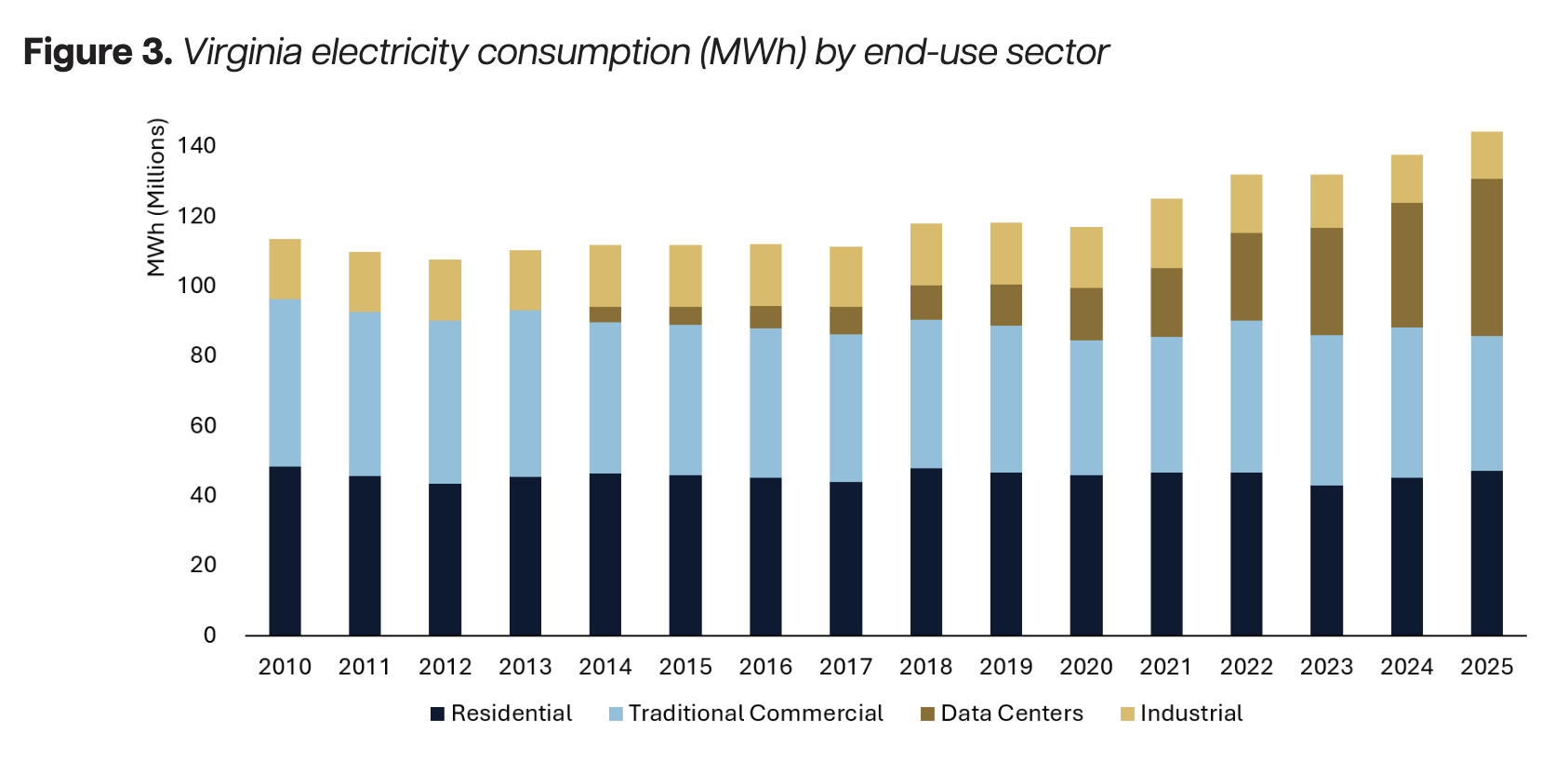
The most encouraging part of Virginia’s energy plan is that it identifies the cheapest new supply that can come online fast and lays out the levers within state control to unlock this power. And excitingly, the report is rooted in the idea that the government needs more tools—and the ability to wield those tools more effectively—to pull those levers.
The plan leans heavily on adding distributed energy resources (DERs), which can add significant new power in a matter of months and whose deployment is fully in the state’s control without waiting for PJM. The plan’s modeling shows that greater deployment of these resources, often sited at homes and businesses, could reduce total system costs by 10 percent. That would require up to 12 GW of these resources online by 2050, a big task! The plan lays out good first steps to get there, including speeding up processes to permit these projects and connect them to the grid and developing state programs to properly compensate these resources for their benefits to the grid.
For bulk power, the plan includes creative approaches to get big batteries and solar projects online faster. That includes a clever state-led procurement mechanism and efforts to help site projects at locations with surplus interconnection capacity where projects could be built faster.
The plan also looks beyond building more infrastructure to using the existing grid more effectively, including through advanced transmission (ATTs) and grid-enhancing technologies (GETs).
Beyond getting new power on the system fast, the plan lays out creative approaches to other drivers of rising bills. Take utility financing. The plan calls for pursuing debt-to-equity reforms that could reduce costs for customers while keeping utilities financially capable of making the investments Virginia needs. It also calls for examining broader reforms to utility returns and cost allocation, shifting the focus from how much utilities build toward whether they are delivering reliability and other outcomes cost-effectively.
All told, this is an impressive document with many smart and implementable ideas, grounded in modeling that shows the commonwealth’s energy needs.
Not just power capacity, Virginia needs state capacity to deliver
Gov. Spanberger’s plan rightly identifies many areas where the state government plays an essential role in building new power and reducing bills. For the plan to be successful, state institutions will need the right capacity—people, tools, and processes—to deliver.
Implementation will not be easy. Several of the plan’s critical strategies challenge established utility business models. Greater grid utilization, for example, can reduce the need for some traditional capital investments. Expanded DERs and plug-in solar can change how customers produce and consume electricity and could avoid some utility spending that shareholders like. And utilities may see a state-led marketplace or procurement process as competing with their existing procurement function.
Many of the plan’s most promising ideas will by default flow through the SCC. The new ideas in the plan come on top of a big existing workload for the SCC, including implementation of new legislation and reviewing the pending acquisition of Dominion by NextEra. And as we and others have written before, regulators and public interest intervenors are already underwater compared to utility companies, who have immense regulatory capacity.
Today’s implementation model—running these new requirements through the SCC, with utilities filing proposals and the SCC reacting and approving—is not sufficient to get the best outcomes for Virginians.
That is precisely why it’s so important to embed implementation considerations upfront when designing policies and in parallel take steps to bolster state capacity for execution. The state must have a stronger role in implementation to find the path forward that best benefits Virginians.
So what can Virginia’s leaders do to ensure strong implementation?
Embed implementation in policy design
When designing the new legislation envisioned in the plan, Virginia leaders should keep implementation front of mind. A few specific examples:
Clear Proactive Roles and Responsibilities. For new state responsibilities, like the proposed state-led market mechanism to procure new bulk power resources, legislation should clearly delineate roles and responsibilities. For major new programs, policy should lean heavily on state agencies like Virginia Energy to conduct proactive planning and procurement work, as the SCC is not equipped for that kind of function.
Explicit, Specific Requirements for Data Sharing. For proposals that hinge on utility data, such as efforts to use surplus interconnection capacity or increase transparency of the capacity of the distribution grid to host DERs, new policy should include specific, explicit requirements for data granularity, frequency of update, and transparency. Without strong, specific statutory requirements, it is often difficult to make utility data sharing useful for planning and project development purposes.
Expand state capacity for execution
Virginia leaders should include state capacity solutions—funding, staffing, authorities, and process changes—as a core part of the strategy. Here are some examples of capacity solutions Virginia could adopt:
Increasing Coordination Between the SCC and State Agencies. PUCs in other states benefit from the data, analytical, and technical capacity at state agencies. For example, Kentucky’s energy office reviews utility-submitted IRPs and helps the PUC formulate data requests, easing capacity burdens at the PUC, and Minnesota’s Division of Energy resources within the Department of Commerce provides technical assistance and analysis to the PUC to inform its work in planning and policy implementation.
Virginia Energy has capacity that is going underutilized in utility regulation—the agency conducted in-house energy-system modeling to evaluate different pathways for meeting demand. The agency is now one of the few state energy offices in the country with that modeling capability. With policies to support more coordination, the SCC could leverage Virginia Energy’s analytical capacity to support more proactive planning and more informed oversight of utility modeling.
Direction to the SCC on a More Proactive Approach. The SCC traditionally operates reactively, evaluating utility filings and weighing them against evidence submitted by other intervenors. While this should remain the core function of the SCC, relying solely on utility-led proceedings limits the creativity and effectiveness of implementation.
Opening proactive investigations into under-explored topics (e.g., grid-enhancing technologies, surplus interconnection, distributed energy resource aggregation) can yield cost-saving solutions. The legislature could direct the SCC to open investigations into particular topics and solicit proposals from a wide range of stakeholders, not just utilities.
Dedicated Funding and Hiring Direction. This year’s budget provided additional funding for the SCC’s Department of Public Utility Regulation (about $400k per year for three new positions), but that is insufficient to handle the additional complex responsibilities that the SCC is shouldering. The legislature could support implementation by providing additional funding, with direction to hire staff focused on surplus interconnection, grid utilization, data center tariffs, and distributed energy resources.
The roadmap is only the beginning
Virginia has laid out a useful vision for navigating an unusually consequential moment for its energy system. The choices Virginia makes now will shape not just how it meets today’s electricity demand, but what its energy system—and its economy—looks like for decades to come. The plan sets the direction, but now Virginia has to build the capacity to get there.
California’s SB 1213 is an example of regulatory ingenuity in action
California just took an important step toward making electric trucks more affordable and easier for businesses to buy.
On September 20, Governor Gavin Newsom signed SB 1213, a new law that will require more transparency around the prices of electric trucks that receive state incentives. Sounds trivial, but is actually a remarkable example of regulatory ingenuity in action.
More than 70% of freight by weight in the United States is transported via aging diesel fleets: a reality that’s bad for our health, bad for our climate, and – with wars in Ukraine and Iran pushing diesel prices through the roof – increasingly bad for our wallets. Yet even though drivers who’ve tried them often prefer electric trucks to diesel, the high upfront costs of electric trucks makes it nearly impossible to break the diesel habit. The median cost of a battery-electric Class 8 tractor in the United States is $411,200 – 2.4x times the cost of a comparable diesel tractor.
The thing is that these high truck prices are artificially high. An independent ICCT analysis found that as battery-pack costs fell from 2020 to 2025, prices of electric Class 8 tractors in the European Union fell by 32%… while prices for comparable big rigs in the United States rose by 27% (about $87,000).
Another investigation found that legacy manufacturers are pricing electric trucks well above what’s justified based on underlying production costs. They’re able to do this because the U.S. market for heavy-duty trucks is hyperconcentrated, allowing oligopolistic behavior that inflates electric truck prices and slow-walks the transition away from diesel.
SB 1213 breaks the stranglehold by forcing manufacturers to provide better information about what electric trucks actually cost to produce. Price transparency ensures that fleet operators and individual drivers can depend on lower, more predictable prices, and helps public incentives for zero-emission technology go further.
This type of market-shaping strategy is a valuable complement to supply-side regulations (e.g., emissions limits or electrification targets). It’s also remarkably popular – SB 1213 passed the California state legislature unanimously, and was endorsed by environmental, business, and economic groups alike.
At FAS, our Center for Regulatory Ingenuity is pushing forward creative solutions like SB 1213. Our research on how states can use economic and financial tools to de-risk the clean energy transition helped inspire this legislation, and we’re working with multiple other states across the nation on how they might adapt and adopt California’s approach.
As we’ve written, much must happen to alleviate the economic and health costs of freight for Americans, including cutting pollution exposure in overburdened communities and ensuring a just transition for workers caught between the fossil and electric eras. But market fixes are genuinely necessary. Without them, it will be very hard to restart progress on truck modernization and electrification, much less to push for even greater ambition. By rooting clean-truck policy in affordability and competitiveness, these fixes also align policy with politics; by addressing factors that inflate truck prices and stifle innovation, they can win truckers, fleets, new companies, and consumers – a coalition that, added to the existing environmental movement, can win.
Solving the Housing Shortage is a Force Multiplier
Read the full report here
In the United States, we have an unprecedented opportunity to reimagine where and how we build housing. Our country faces a severe housing shortage: We need to build at least 14 million homes to meet demand over the next decade. This shortage drives up housing costs, prevents people from living near good jobs and schools, and makes it all but impossible for many would-be buyers to break into the housing market.
Fortunately, policymakers are taking notice. Between July 2024 and July 2025, state and local governments passed 124 housing bills across 33 states aimed at increasing housing production. At the federal level, the recently enacted 21st Century ROAD to Housing Act similarly intends to boost supply. And this is only the beginning — throughout the country, bipartisan momentum continues to build.
Recent bipartisan reforms share a throughline: they remove the restrictions and barriers that create artificial housing scarcity. Once these strangleholds loosen, opportunities for ingenuity abound. But it’s not a given that the policies that governments enact will be the best policies for getting homes built at the scale, speed, and prices we need. And depending on how we proceed, we may also leave major benefits on the table.
The best housing policies make it easier to build homes. They also do something critical: they recognize how housing connects to other domains. America’s affordability problem, for instance, is bigger than home prices and rents. Household spending on energy and transportation is heavily shaped by where homes are located and how they are built. At the same time, increasingly frequent and intense disasters and extreme weather both impose direct costs and contribute to escalating insurance prices that squeeze family finances and limit housing. Each year, disasters destroy the equivalent to one month’s worth of the nation’s new home construction. And a constrained electric grid and rising utility costs add to the pressure.
Our research shows that when done right, new homes are a force multiplier: they lower housing, transportation, and energy costs; strengthen resilience and insurance markets; improve state and local fiscal health; protect open and working lands; increase grid reliability; and reduce emissions.
Using evidence to find the best housing policies
This white paper puts forth the most impactful housing policies that states and localities can implement to stimulate housing production at the scale and speed we need. Given today’s fiscal constraints, we focus on state and local policies that require limited public dollars, which then prime the pump for market forces, private capital, and targeted public investment to get housing built. Based on an extensive research review, analysis of case studies from across the United States formal interviews, and less formal conversations with hundreds of subject matter experts, we surface evidence-based policies to:
- Solve the U.S. housing shortage faster and more cost effectively, and
- Make housing a force multiplier for progress.
Achieving these goals means rejecting the myth that we must choose between building more housing and pursuing other societal objectives. Instead, we must recognize how housing intersects with these issues and adopt policies that align them.
In short, we must build for benefits.
While the systems are complex, the agenda is simple: We need more of the right homes in the right locations, at the lowest costs. The evidence overwhelmingly shows that the following principles should guide where, what, and how we build:
- Where: homes in connected, lower-hazard established neighborhoods with access to jobs and services.
- What: home types that more people can afford, including accessory dwelling units (ADUs), townhomes, duplexes, fourplexes, sixplexes, apartments, single-family starter homes, and manufactured homes.
- How: homes that are better able to withstand disaster, have lower utility costs, reduce pollution, and strengthen the grid rather than strain it.
In some cases, this may mean new construction. In other instances, it may mean repurposing non-residential buildings for housing, or adding units to existing housing.
Moreover, what constitutes an established neighborhood differs by geography. In urban areas, the best opportunities may center on more housing near transit and robust public infrastructure. In rural areas without transit or existing infrastructure, the best opportunities may center on proximity to jobs, schools, and the other routine needs of daily living.
From evidence to action: six state and local tactics
To turn these principles into results, we’ve identified six tactics that localities and states can adopt with limited public dollars to solve the housing shortage faster, more cost-effectively, and with greater benefits to households and communities. They create the conditions for private and public capital to flow faster and more efficiently into homebuilding. When implemented as a package, these tactics can increase housing production quickly, affordably, and at the scale our current shortage demands. The research draws on what’s already working across the country, and focuses on aligning targeted deregulation with thoughtful building standards and strategic land, transportation, and utility policies.
These tactics are:
- Cut red tape specifically to allow homes of all shapes and sizes in connected, lower-hazard established neighborhoods.
- Put public land in lower-hazard established neighborhoods to work.
- Simplify public financing so dollars for income-restricted housing and starter homes go further.
- Make disaster-prepared construction the norm.
- Build lower utility costs into new homes from the start and make homes critical energy infrastructure.
- Align utility reforms with housing affordability and grid reliability.
These tactics mix two approaches. Some make it easier to build by eliminating regulations that slow construction. Others position state and local governments in a proactive role: such as putting municipal, and state-owned land to work; offering pre-approved plans, training, and financing that speed approvals and expand the pool of small developers and builders; or recruiting modular builders to establish local factories.
Scaling housing reforms that work
These reforms need to be dramatically scaled across the United States. And they can be. Colorado, for example, is beginning to adopt the integrated approach this paper recommends. Since 2022, the state has legalized more housing of all shapes and sizes and at all budgets in established neighborhoods; strengthened wildfire standards; reformed insurance standards; incentivized efficient, electric construction; developed a new low energy and carbon code, and enabled virtual power plants and fairer electric rates. Many other localities and states across the U.S. have also made notable progress.
In the following report, we lay out the state and local government actions that can, collectively, turn America’s housing shortage into an engine of prosperity rather than a brake. The task is to scale reforms that make resilient, efficient housing faster and more cost effective to build. The goal is not to sacrifice speed; it is to remove real cost barriers to dramatically increase production and deliver homes that people need and that are affordable for the long term.
Read the full report here
Unlocking Housing Supply is Only the First Step. The Real Opportunity Lies in What, Where, and How We Build.
Housing in America is expensive, and there isn’t enough of it in the places people want to live. The resulting competition among renters and buyers drives up home prices and rents, widening the gap between what people earn and what it costs to keep a roof overhead. Today, roughly 750,000 people are homeless. Teachers, healthcare providers, first responders, and other critical workers are increasingly priced out of the communities they serve, while homeownership — long a primary pathway to building wealth — drifts further out of reach.
Decades of underproduction have led to today’s housing shortage and high home prices and rents. The housing shortage is currently estimated at about 4 million homes; we’ll need to build at least 14 million over the next decade to close this gap and meet additional demand. In our Civic Research Agenda published earlier this year, we at the Federation of American Scientists (FAS) found that tackling the structural, market, and policy factors that most strongly drive housing affordability and shape economic mobility for individuals and families is a top priority for cities and counties across the country.
Fortunately, policymakers are taking notice. Between July 2024 and July 2025, state and local governments passed 124 housing bills across 33 states aimed at increasing housing production – at improving legacy approaches to land use, slow approvals, outdated regulations, and other systemic barriers that have constrained housing for too long. At the federal level, the recently enacted 21st Century ROAD to Housing Act similarly intends to boost supply.
Once these strangleholds loosen, opportunities for ingenuity in housing abound. But it’s not a guarantee that the housing policies that governments enact will be the best policies for getting homes built at the scale, speed, and prices we need. And depending on how we proceed, we may also leave major benefits on the table.
Housing as a force multiplier
A new report from the Housing Multiplier Project and the FAS Center for Regulatory Ingenuity lays out the most impactful policies to stimulate housing production and how these policies can make housing a force multiplier for progress. Recent bipartisan housing reforms share a throughline: They remove the restrictions and barriers that create artificial housing scarcity. Yet as the report points out, unlocking housing supply is only the first step. The best policies recognize how housing connects to other domains.
America’s affordability problem, for instance, is bigger than home prices and rents. How we build affects household costs like insurance and utilities. In Alabama, fortified roofs and stronger building codes are helping bolster the insurance market for new and existing homes alike, while making homes far safer. In Vermont – a state where manufactured homes typically burn expensive fuel oil or propane for heating, new superefficient manufactured homes can cut annual energy bills by about $2,700 per year compared to existing stock. Across the country, building more efficiently can provide relief for the 80 million people struggling to pay their energy bills, while protecting people from the escalating threat of extreme heat.
Where we build influences affordability as well. Pew finds that homes built in established neighborhoods rather than on greenfields save taxpayers an average of $21,000 per home in roads, water, sewer, and utility infrastructure and up to 50% in ongoing maintenance. More new homes near jobs and services also save an average of $700 per person per year in fuel and vehicle costs through shorter commutes and fewer miles driven.
Much undeveloped land is also in areas, such as floodplains or the wildland-urban interface, that are becoming increasingly risky. Disasters – hurricanes, floods, fires – destroy the equivalent of one month’s worth of new home construction in the United States every year. What’s the point of building new homes if those homes are just going to get flattened? Even homes left standing are facing rising insurance costs that simply don’t pencil for most people.
It’s not enough to just build. We must build for benefits. While the systems are complex, the agenda is simple: We need more of the right homes in the right locations, at the lowest costs. The evidence overwhelmingly shows that the following principles should guide where, what, and how we build:
- Where: homes in connected, lower-hazard established neighborhoods with access to jobs and services.
- What: home types that more people can afford, including accessory dwelling units (ADUs), townhomes, duplexes, fourplexes, sixplexes, apartments, single-family starter homes, and manufactured homes.
- How: homes that are better able to withstand disaster, have lower utility costs, reduce pollution, and strengthen the grid rather than strain it.
In some cases, this means new construction; in others, it means repurposing non-residential buildings or adding more units within existing housing. In urban areas, the best opportunities for housing may be near transit and robust public infrastructure; In rural areas, direct proximity to jobs, schools, and other routine needs of daily living may be bigger priorities.
Regardless of geography, the underlying principles remain the same. Ingenuity in housing policy can expand supply and lower costs across the board while simultaneously strengthening resilience and insurance markets; improving state and local fiscal health; protecting open and working lands; lowering energy costs; increasing grid reliability; and reducing emissions by at least 70 million tons per year – equivalent to half the country buying electric vehicles by 2035.
But the full emissions and economic opportunity is even larger. Strategic housing reforms position homes as critical energy infrastructure – they put in motion a built environment that strengthens the grid, optimizes clean energy, and serves as the backbone of the energy transition. Every new home that is built to be grid-interactive, efficient, and with low embodied carbon materials compounds emissions savings, while lowering household utility bills, easing strain on a congested grid, reducing the need for new fossil fuel peaker plants, and maximizing the use of clean energy on the grid. Paired with utility reforms like heat-pump-friendly rates and virtual power plant infrastructure, this can cut utility costs and emissions dramatically by reshaping how tens of millions of new and existing homes are heated and cooled, while easing peak loads on the grid. More homes also feed a positive feedback loop that cuts transportation costs and emissions: more people justify better transit, sidewalks, and bike infrastructure, which further reduces hours spent in the car.
Putting the principles to work
The report focuses on six tactics that localities and states can adopt with limited public dollars to solve the housing shortage faster, more cost-effectively, and with greater benefits to households and communities. They create the conditions for private and public capital to flow faster and more efficiently into homebuilding. These tactics are:
- Cut red tape specifically to allow homes of all shapes and sizes in connected, lower-hazard established neighborhoods.
- Put public land in lower-hazard established neighborhoods to work.
- Simplify public financing so dollars for income-restricted housing and starter homes go further.
- Make disaster-prepared construction the norm.
- Build lower utility costs into new homes from the start and make homes critical energy infrastructure.
- Align utility reforms with housing affordability and grid reliability.
When implemented as a package, these tactics can increase housing production quickly, affordably, and at the scale our current shortage demands. In Colorado, integrated housing reforms aligned with these tactics have legalized more housing of all shapes and sizes and at all budgets in established neighborhoods; strengthened wildfire standards; reformed insurance standards; incentivized efficient, electric construction; developed a new low energy and carbon code; and enabled virtual power plants and fairer electric rates.
In Montana, conservatives who saw overregulation and progressives who saw an affordability emergency converged on the same solution: legalize more homes. The reform package they designed and adopted dismantled regulatory barriers across the board: rewriting local planning procedures; allowing duplex, triplex, and fourplex housing and ADUs as-of-right in single-family zones; legalizing larger apartment buildings in commercial zones and buildings up to six stories; enacting single-stair reforms; capping parking mandates; and making it easier to build manufactured housing.
The window for this work is open now. The pro-homes movement has momentum across regions and parties. The task ahead is to convert that momentum into law and executive actions, improving both housing policy design and implementation in ways that deliver tangible, immediate benefits for Americans (e.g., more affordable and desirable homes) while also making progress on higher-order societal goals (e.g., stabilizing insurance markets and driving down emissions). If we get this right, we won’t just solve a housing shortage. We’ll strengthen the fabric of our nation.
FAS Center for Regulatory Ingenuity and ICLEI USA Launch Local Advisory Council to Build More Connected National Climate Policy
Washington, D.C. – September 2, 2026 From cheaper housing to more reliable energy, people across the nation are clamoring for solutions that make their lives better. The FAS Center for Regulatory Ingenuity (CRI) is building a new, transpartisan vision of government that works – that achieves ambitious goals while adeptly responding to people’s basic, everyday needs.
To further that mission, FAS has partnered with ICLEI USA – the nation’s first and largest local government network dedicated to helping communities achieve their climate and sustainability goals – to launch the CRI Local Advisory Council.
The CRI Local Advisory Council brings together a diverse cohort of leaders with working knowledge and practical experience in energy, housing, and transportation policy or implementation across local governments. Council members will help CRI strengthen connectivity between the federal and local levels by providing expert thought leadership and policy guidance, engaging in cross-sector convenings, and working together with federal counterparts to build creative, ambitious, and functional climate policy at all levels of government. Members will serve one-year terms.
The inaugural Council members are:
- Pam Adams, Regional Planning Director, Centre Region Council of Governments, PA
- Ryan Freed, Climate Action Officer, City of Alexandria, VA
- Amanda Graor, Chief Innovation Officer and Director of Data and Digital Services, Mid-America Regional Council, KS & MO
- Charlotte Lin, Sustainability Manager, Avon, CO
- Kacey Lizon, Deputy Executive Director of Programs, Sacramento Area Council of Governments, CA
- Wilfred Mbah, Councilmember, City of Somerville, MA
- Patrick McGuire, Director of Civic Innovation, City of South Bend, IN
- Emmett Pepper, Councilmember, City of Charleston, WV
- Ryan Schuchard, Councilmember, City of Boulder, CO
- Micki Varney, Councilmember, City of Salem, OR
“Strong climate policy depends on strong connections between the people shaping policy and the communities putting it into practice. By bringing local leaders into the conversation, we can build interconnected solutions that reflect the realities and needs of communities across the country,” says Saharnaz Mirzazad, CEO of ICLEI USA.
FAS CRI leads Hannah Safford and Loren Schulman agree.
“Policymakers and advocates in Washington, D.C. tend to spend too much time talking to each other, rather than people across the country who are on the front lines of climate impacts and climate solutions,” says Dr. Hannah Safford, FAS Associate Director of Climate and Environment. “To write the next chapter of climate policy, federally oriented folks will have to turn their perspectives outwards – and be willing to hand the pen to local partners.”
“Good government isn’t just about drafting the right policy, but also about building the muscle to actually deliver. The local leaders who show up every day to decide where to build new energy projects or keep communities cool during a heat wave are vital resources for designing solutions that meet people’s needs,” says Loren Schulman, FAS Director of Government Capacity.
Earlier this year, FAS CRI published a series of whitepapers, focused on core principles of the next era of federal policy implementation and design. This Council leverages local expertise to complement and strengthen the principles outlined in those whitepapers, continuing to build cross-government coalitions in support of more durable and democratic climate solutions nationwide.
To learn more about CRI, click here or contact Zoë Brouns (zbrouns@fas.org).
To learn more about ICLEI USA, click here or contact Alyssa Wilbur (alyssa.wilbur@iclei.org).
Federation of American Scientists (FAS)
The Federation of American Scientists (FAS) works to advance progress on a broad suite of contemporary issues where science, technology, and innovation policy can deliver transformative impact, and seeks to ensure that scientific and technical expertise have a seat at the policymaking table. Established in 1945, FAS continues to bring scientific rigor and analysis to address national challenges. More information about FAS’s work at fas.org.
ICLEI USA
Since 1991, ICLEI – Local Governments for Sustainability USA (ICLEI USA) has led the nation’s largest network of local governments committed to sustainability and climate action. We are an independent 501(c)(3) nonprofit, founded in Massachusetts and headquartered in Denver, with staff working in communities across the country. As an affiliate office of the global ICLEI network, we connect to more than 2,500 local and regional governments in 125+ countries.
Led by and for local governments, we meet communities where they are and provide the tools, expertise, and peer connections they need to advance their climate and sustainability work forward.
Meet the FAS CRI + ICLEI USA Local Advisory Council
 | Pam Adams, Regional Planning Director, Centre Region Council of Governments, State College, PA Pam Adams has 18 years of experience in local government, specializing in regional planning, climate action, and collaborative implementation. She has led community-wide climate planning, regional energy initiatives, and the integration of land use, transportation, housing, and sustainability through the Centre Region Comprehensive Plan. She holds a B.S. in Industrial Engineering from Penn State University. |
 | Ryan Freed, Climate Action Officer, City of Alexandria, VA Ryan Freed serves as the Climate Action Officer for the City of Alexandria, Virginia, leading municipal efforts to advance sustainability, reduce emissions, and implement local environmental policies. Prior to joining the city, he served as the Senior Director for Policy and Programs at the Institute for Market Transformation (IMT), where he focused on building decarbonization and energy efficiency solutions. In his role with Alexandria’s Office of Climate Action, Freed oversees the implementation of the city’s Environmental Action Plan and Energy & Climate Change Action Plan while advocating for residents in regional utility rate interventions and sustainability initiatives. |
 | Amanda Graor, Chief Innovation Officer and Director of Data and Digital Services, Mid-America Regional Council (MARC), KS & MO Amanda Graor has been with MARC for over 18 years with work areas over time including air quality, workforce transportation, energy policy and climate strategy. Amanda also spent time as an Economic Mobility Policy Fellow with the Center for Applied Public Research at Johns Hopkins University and is an advisor to the Evidence for Policy fellows through Stanford Impact Labs. She holds a bachelor’s degree in Earth System Science and Engineering from the University of Michigan, a master’s degree in Public Administration from the University of Kansas and a certificate in infographics and data visualization from Parsons School of Design. |
 | Charlotte Lin, Sustainability Manager, Avon, CO A former Arctic climate ecologist with international experiences in communications and behavioral science, Charlotte Lin is currently overseeing the implementation of Eagle County’s Climate Action Plan in Avon, Colorado. She’s also completing a Doctorate of Business Administration at the University of Michigan, Flint, on regulatory policies and infrastructure investment in the electricity sector. |
 | Kacey Lizon, Deputy Executive Director of Programs, Sacramento Area Council of Governments (SACOG), CA In her role with the Sacramento Area Council of Governments, which serves the 22 cities and six counties of the Sacramento region, Kacey Lizon oversees integration of SACOG’s planning, funding, and technical assistance programs. During her 20+ year tenure at SACOG, Kacey has played an instrumental role in innovations in bottom-up regional planning, which has taken her deep into topics of land use, housing, transportation, transit-oriented development, public engagement, environmental and rural planning. |
 | Wilfred Mbah, Councilmember, City of Somerville, MA Wilfred N. Mbah is an environmental advocate, public servant, and progressive leader based in Massachusetts. Originally from Cameroon, he earned a master’s degree in Sweden before immigrating to the U.S., where he serves as a City Councilor At-Large and Vice President of the Somerville City Council. Focusing his work on affordable housing, climate action, and social equity, Mbah has also served as a Democratic candidate for State Representative in the 34th Middlesex District and works as a Non-Resident Tutor in Humanities and Social Studies at Harvard University’s Quincy House. |
 | Patrick McGuire, Director of Civic Innovation, City of South Bend, IN Patrick McGuire serves as the Director of Civic Innovation for the City of South Bend, Indiana, leading citywide initiatives to integrate technology, data, and research into municipal operations. Drawing on his experience as an enFocus Fellow advancing local digital equity, Patrick now oversees smart city developments, including AI-assisted 311 services and private LTE networks for local schools, while partnering with academic institutions and community leaders to drive equitable civic engagement. |
 | Emmett Pepper, Councilmember, City of Charleston, WV Emmett Pepper serves as an at-large member of the Charleston City Council in West Virginia, a position he has held since his appointment in November 2021. Raised in Charleston, Pepper graduated from George Washington High School before earning a Bachelor’s degree in Political Science from Virginia Tech in 2000 and a Juris Doctor from American University Washington College of Law in 2012. Outside of his public service, he is a practicing attorney specializing in consumer law and bankruptcy at the law firm Pepper & Nason. He also works extensively with Energy Efficient West Virginia, helping promote policy solutions for affordable utility rates and local sustainability. |
 | Ryan Schuchard, Councilmember, City of Boulder, CO Ryan Schuchard serves as a member of the Boulder City Council, having been elected to office to champion climate action, sustainable transportation, and affordable housing. Drawing on over two decades of professional experience in climate strategy, supply chain sustainability, and clean mobility, Schuchard leads initiatives designed to accelerate local environmental solutions and build resilient community infrastructure. Prior to joining the council, he worked extensively with sustainability-focused organizations and corporate advisories, specializing in decarbonization strategies, zero-emission transportation programs, and local policy frameworks aimed at reducing emissions and improving quality of life across Boulder. |
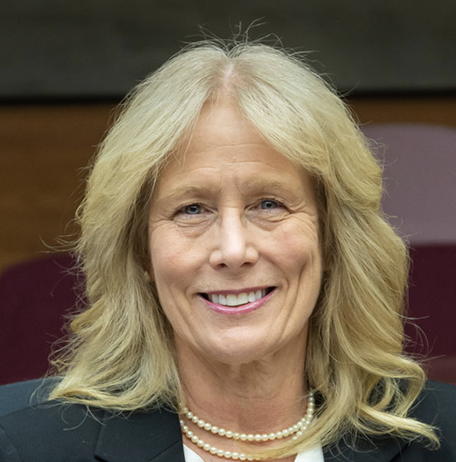 | Micki Varney, Councilmember, City of Salem, OR Councilmember Micki Varney is a 33-year salmon research biologist who built a reputation for solving hard problems by devising new tools and methods to collect and analyze data to increase Pacific Salmon survival and recruitment into fisheries. She served as Oregon’s representative on a standing committee of the US/Canada Pacific Salmon Commission, and her commitment to environmental stewardship dates back to the first Earth Day in 1970, when, at the age of 10, she organized a group of classmates to go pick up litter along the road each week. She chairs Salem’s Climate Action Plan Committee and serves on the League of Oregon Cities’ Energy & Environment Policy Committee, bringing a scientist’s insistence on data and independent verification to municipal climate, housing, and transportation policy. |
The Affordability and Climate Agendas Run Through State Regulators. It’s Time to Rethink Their Roles.
Skyrocketing utility bills and rapid growth in electricity demand from data centers are sparking a wave of new affordability policies and commitments from state and federal leaders. Successful implementation of many of these policies will hinge on a state institution that rarely makes it into the public eye: the Public Utility Commission, or PUC.
PUCs are the primary government entity responsible for setting rates for electricity and heating fuel. Together, U.S. PUCs oversee $200 billion a year in utility spending and determine what technologies and strategies utilities should pursue, what expenses are justified and should be passed onto customers, and how much profit utilities should make.
And their role is expanding. PUCs were originally designed to lead ratemaking proceedings and keep utilities in check. Now they are being asked to do so much more—expand customer-owned resources and aggregate them to benefit the grid, integrate new technologies, engage customers in new ways, manage massive impacts of data centers and other large loads, accelerate electrification and manage the transition away from gas, handle major mergers, and more. When state legislatures enact new policies—like those intended to protect households from data center impacts or unlock more customer-owned resources—PUCs are responsible for implementation.
Despite their importance, most PUCs are understaffed and ill-equipped to handle their new and expanded responsibilities. Like many aspects of government, we are asking old institutions to solve modern problems without changing the tools at their disposal.
To build an affordable, modern grid powered by clean energy, we need more than the right policies; we must also upgrade—and, in some cases, redesign—PUCs to regulate in the public interest and effectively implement new policies.
This blog post lays out a vision for modernizing PUCs and enhancing their capacity. FAS is developing additional resources to help states implement this vision. If you want to get involved, reach out to Arjun Krishnaswami, akrishnaswami@fas.org.
What exactly is going wrong?
Several features of PUC design are limiting states’ efforts to rein in utility bills and making it harder to implement new policies.
Often the NPC, Rarely the Main Character
PUCs are reactive by design. Utilities drive planning and ratemaking processes—from submitting proposals to kick off proceedings to dictating timelines by choosing when to file rate increases. PUCs then evaluate those proposals, weighing them against evidence submitted by other intervenors, such as consumer advocacy groups or nonprofits. This reactive posture – to use video game lingo here, being the non-player character (NPC) – sets PUCs up for failure when it comes to finding opportunities for savings, such as through increased scrutiny on utility-proposed grid spending, consideration of alternatives, and more integrated planning across different parts of the energy system.
Our failure to build a more proactive muscle at PUCs also makes them less prepared for the expanded responsibilities associated with modern energy policy. The new wave of affordability policies—including novel sophisticated requirements on data centers, standards to improve grid utilization, smart operation of customer-owned resources like rooftop solar and batteries, improved grid flexibility, realigning utility incentives, and more—require PUCs to step in more forcefully and proactively on key grid planning decisions.
PUCs can be more proactive by scrutinizing utility spending proposals, pushing for consideration of alternatives, and launching and driving new initiatives on specific topics rather than waiting for utility action. For example, in 2019 the Connecticut PUC (Public Utilities Regulatory Authority) launched the Equitable Modern Grid Initiative to investigate solutions in 11 topic areas, including affordability, interconnection, distributed energy resources, and more. Most PUCs are not currently equipped to effectively manage these new responsibilities.
Bringing a Knife to a Gun Fight
Electricity regulation is a battle between the utility’s interests to maximize shareholder profit and the PUC’s responsibility to protect customers and ensure a reliable grid, and PUCs are consistently outgunned. Utilities have the advantage on every front: they have teams of technical, legal and engineering staff to engage with proceedings and the money to attract top talent; they can hire consultants specialized in ratemaking and planning to provide bespoke analysis and legal support; and they have more data on their system than PUC staff or other intervenors. In contrast, PUCs have limited staff working across many proceedings and a constrained budget to conduct bespoke independent analysis to challenge utility proposals and present alternatives. The Commissioners themselves have even fewer resources and staff to evaluate proposals and make decisions. And public interest intervenors, such as state consumer advocates or independent organizations advocating on behalf of customers, also have fewer resources and less information than utilities.
Insufficient PUC resourcing is already a barrier to regulators effectively fulfilling their baseline responsibilities to interrogate utility proposals and protect customers. But this problem will only get worse as we add more to their plate.
As one example, a legislative commission in Texas found that the PUC needed more staff and resources to be able to independently analyze utility sector data. Additionally, the Texas PUC had its mandate expanded to include regulating telecommunications on top of the wastewater and electric utilities they already regulate—without hiring additional staff. The Wisconsin PUC also recently got approval for 23 new staff to keep up with increased workload to evaluate new generation and transmission projects.
Old Procedures for New Problems
The statutes governing utility regulation are old. They were enacted long before customers could help power the grid through rooftop solar, batteries, and smart appliances; before the electric and gas industries started to fiercely compete with each other to heat homes and power factories; and before utilities became the biggest political spenders in state politics. Relying on these statutes and the resulting regulatory frameworks we have been using for the past century is making it harder for states to solve modern problems and make peoples’ lives better.
How to Upgrade PUCs for Today’s Problems
To address these issues with PUC design and support strong policy implementation, policymakers must explore answers to a new set of questions, including:
- What is the PUC’s mandate? How proactive or reactive can a PUC be in addressing affordability or clean energy deployment?
- What decision-making processes and procedural rules are still serving us, and which can we throw away or rewrite?
- What capabilities, such as independent analysis, public engagement, data collection, and more, are missing?
- How can new funding models help fill resource gaps?
- What tools do PUCs need to attract and retain talent?
- How can we prevent political capture and political influence from impeding PUCs role to represent the public?
These questions don’t have ready-made, robust answers, as we haven’t redesigned most of these century-old institutions since they were founded. The time is ripe for energy professionals and government capacity experts to work together to develop a new playbook for ingenious PUC design.
In the meantime, state and federal leaders can take steps now to start improving PUC capacity and testing potential solutions to these problems. Below are four no-regrets near-term steps policymakers should take.
Main Character Energy: Provide New Direction to PUCs
PUCs need the authority, direction, and top cover to open proactive proceedings, fill in gaps in existing processes and re-think approaches to electrification, grid flexibility, and interconnection. Governors and legislators can direct PUCs to open proactive investigations and processes to develop new solutions outside of traditional processes. For example, New Jersey Governor Sherill directed the state’s Board of Public Utilities to proactively review utility business models and evaluate their alignment with affordability.
Use Federal Resources to Support State PUCs
When it comes to PUC capacity concerns, the federal government has been MIA. While the Inflation Reduction Act and the Bipartisan Infrastructure Law sent hundreds of billions of dollars to state agencies (including State Energy Offices, transportation departments, and air agencies), they provided zero dollars for state PUCs, which were tasked with overseeing and approving all the grid upgrades and new clean energy projects that resulted from these new laws.
The federal government could inject new energy into PUCs immediately through:
- Formula grants for PUCs, potentially split out by purpose (PUC staff, Commissioner staff, certain types of analysis, etc.);
- Fellowship programs to build a talent pipeline for PUCs in particular emerging areas, such as virtual power plants, distributed energy resource interconnection, grid flexibility, and performance-based regulation; and
- Shared resource hubs that PUCs can draw upon for little to no cost (e.g., a modeling hub at a National Lab that PUCs can tap into for independent modeling of utility proposals in a rate case).
Bolster the PUC’s Affordability Arsenal
States must expand funding for PUCs to hire additional staff, bring in new types of capacity, and modernize PUC analytical capabilities. Currently, PUCs are funded through customer bills, state budgets, or a combination of the two. States can consider raising additional funding through state appropriations or charging fees on some large customers (like data centers) to account for additional PUC capacity needs as a result of these customers. In addition to increasing the budget, states can help equip PUCs with their own analytical tools by leveraging state agency resources and expertise. States can also upgrade PUC hiring authority to make key roles more competitive and improve talent retention, including through competitive salaries, remote work, and empowering staff to get things done.
Upgrade Public Engagement and Participation
Intervening in a PUC proceeding is expensive and time consuming, making it difficult for many organizations to engage, let alone individuals. Some states have attempted to address these barriers through intervenor compensation funds that reimburse intervenors for their involvement in regulatory proceedings. However, only 16 states have authorized interventor compensation programs, and of those 16 states, a measly eight have active programs that the public can utilize.
Beyond improving intervention, PUCs can expand their engagement with the broader public. PUC efforts directly impact peoples’ lives through energy bills for families and businesses and the ability for customers to access cost-saving resources like rooftop solar, distributed storage, and energy efficiency. PUCs can do a better job telling the story of their work and soliciting broader public input on priorities.
Fixing a Broken Market: A Plan for Cheaper Freight, Cleaner Air, and American Truck Leadership
Americans are paying too much for almost everything, and a major driver is the cost of moving freight by truck. While other countries modernize their freight systems, more than 70% of freight by weight in the United States is transported via aging diesel fleets: an expensive habit that’s hitting Americans hard. A first set of costs comes at pumps and registers. Diesel’s a notoriously volatile commodity, and when prices spike – as they did after Russia invaded Ukraine and as they’re doing again right now – freight carriers pass the increases through, hitting Americans hardest on essential goods like food, beverages, and building materials. A second comes at homes and hospitals. Diesel dependence directly drives higher rates of childhood asthma, heart disease, and respiratory illness in those living near warehouses, highways, and ports, as well as the extreme weather that’s becoming unnervingly common in communities nationwide. Using EPA data, the Clean Air Task Force estimates that diesel pollution causes roughly 8,800 premature deaths, 3,700 heart attacks, and $100 billion in monetized health damages each year in the United States.
The key to breaking the freight sector’s diesel dependence lies in innovative economic policy. Electric trucks are a direct hedge against diesel price volatility, produce zero air and climate pollution, and can perform as well or better than diesel trucks even in difficult real-world conditions. Yet progress towards a modern electric trucking system has been substantially derailed by the high upfront costs of electric trucks in the United States. Let’s dwell on that emphasis, because electric truck pricing is really an us (with a capital “U.S.”) problem.
The Broken Truck Market
The United States has long treated its trucking industry as an artifact to be preserved rather than as an opportunity for innovation. The government’s support for, and deference to, legacy manufacturers on policy and program design has made it difficult for trucking startups to gain a toehold in the domestic market. Agencies and advocates focused on the benefits of electrification as a pollution-control strategy while underweighting the arguments for electrification as a geopolitically strategic imperative. We’ve leaned in on rebate programs for individual electric trucks, not comprehensive, sector-wide initiatives needed for long-term transformation.
That’s not to say we haven’t taken any steps in the right direction. Under the Biden administration, federal government and states tried to weave together regulations and initial incentive programs with an eye towards supporting deployment of electric trucks. But those efforts are now stalled out, and even while active were geared towards commercialization rather than comprehensively fixing the truck market – they still treated electric trucks as delicate new tech rather than something capable of being the standard on the road. The absence of that market focus meant that even otherwise ambitious regulatory strategies ran hard into an incumbent oligopoly.
The U.S. Class 8 market (the market for the big rigs that do most on-road long-haul freight transport) is hyper-concentrated. Four manufacturer groups — Daimler, Paccar, Volvo, and Traton — control roughly 99.9% of sales across seven brands, with the Freightliner brand alone accounting for more than a third of domestic market sales. These companies are deeply invested in diesel; having built an oligopoly on legacy technology, they’re understandably loath to relinquish it. As such, we’ve seen the “Big 4” lobby heavily against pollution rules that would drive electrification and slow-walk development of their own electric models.
We’ve also seen them inflate and obscure electric-truck prices. An independent ICCT analysis found that as battery-pack costs fell from 2020 to 2025, prices of electric Class 8 tractors in the European Union fell by 32%… while prices for comparable big rigs in the United States rose by 27% (about $87,000). Another investigation found that legacy manufacturers are pricing electric trucks well above what’s justified based on underlying production costs.
Indeed, the vast majority of new trucks in the United States don’t even have posted public prices. In a concentrated market, price obscurity reduces competitive pressure to lower prices.
The resale (“residual”) value of used electric trucks is also unknown. Lenders, unable to value the collateral, have sometimes set it at zero, making affordable commercial loans nearly impossible even for fleet owners eager to electrify. Against this backdrop, it’s little wonder that even ambitious states like Oregon have delayed electric-truck rules, citing market dysfunction.
Restoring Order: Market Innovation as Durable Truck Policy
Policy caused today’s truck market issues; policy can also fix it. Governments are fundamentally market-shapers. When they get economic policy right (e.g., by funding innovation, supporting competition, and checking incumbent power), it paves the way for new ideas and technologies to beneficially spread as the economy evolves.
Yet there’s no comprehensive national plan to modernize freight in force, courtesy major rollbacks of Biden-era policies. On the contrary, the Trump administration and this Congress have made legally questionable moves to eliminate federal greenhouse-gas standards for trucks, delay remaining pollution rules to 2029, and revoke the waiver for California, and the states that follow it, to set their own truck rules: exactly what you might go for if you wanted to chill investment in next-gen technology and keep U.S. trucking stuck in the past.
Under prevailing policy, the United States will be badly adrift by 2029. Rebuilding old regulatory frameworks would take years – years that our climate and health can’t afford, and years in which American consumers, workers, and communities continue to shoulder the costs of a creaky and dirty freight system. Even if time was less of an issue, there are opportunities to improve decades-old environmental laws to drive a rapid, equitable, and durable transition to modern clean technologies.
These laws, in conjunction with rebates and other direct incentives, have helped commercialize electric vehicle technology. But getting to a new regulatory (ideally statutory) framework that builds on and extends those policies is going to require a broader political base of support than we had when the last rules were repealed, as well as repairs to the broken market that let electric truck prices spike while legacy companies delayed progress.
It’s time for the United States to lean in on economic and industrial policy as powerful levers for modernizing the truck market and paving the way for heavy-duty electrification at scale. Electric trucks now make economic sense. Over their lifetime they can save fleets tens of thousands of dollars in fuel and maintenance, and independent modeling finds battery-electric heavy trucks reaching total-cost-of-ownership parity with diesel around 2030 in most states – sooner where electricity is cheap, like in Texas. But that value only materializes if our markets and financing systems unlock it fairly and competitively. As we’ve seen above, today’s don’t.
To be clear, we continue to need strong emission standards, but we recognize that a heavy-duty vehicle strategy predicated on waiting for a new administration to reinstate old standards without fixing underlying market issues could slow progress. A much better approach is to expand the toolbox, focusing on domestic innovation in truck technology today in order to build momentum for smart, effective federal regulation when there’s next political opportunity.
A Six-Point Plan
Fortunately, there’s much that states and their partners can do today to help. Tesla’s low-priced Semi (about $250,000 for the standard model and $290,000 for the 500-mile version, roughly $100,000 below comparable legacy electric trucks) shows that another way is possible. In California, stacked state incentives can already cover up to 90% of an electric truck’s pre-tax cost. But one competitor and one state’s subsidies aren’t enough.
Put the following six fixes in place, and the national American electric-truck market begins to hum on private capital. This in turn makes it possible for states (and down the road, federal government) to (i) lock in durable pollution and performance standards, and (ii) target limited public dollars such that benefits of electrification are equitably distributed and that American companies are at the global frontier of vehicle innovation, rather than relying on taxpayers to subsidize an entire non-competitive market. Here’s what’s needed:
- Transparent pricing. This is Econ 101. The industry is used to selling its vehicles through highly complex, dealer-mediated service contracts, without public prices. It doesn’t have to be this way. Truck companies could just tell people what their trucks cost. In fact, states could make them do so. California’s SB 1213, which cleared the California Senate committee with no opposition, would do exactly that: require manufacturers to disclose MSRP quarterly for any zero-emission model seeking state incentives (beginning 2027) and let vouchers cover up to 90% of cost. Other states are also making efforts to enhance pricing disclosure.
- Easy, affordable electric truck loans. Good electric-truck loans are hard to write at scale because used value is uncertain; risk-averse banks sometimes default that value, unrealistically, to zero. To solve this problem, states and leading financial institutions could provide residual value guarantees that set a floor on electric-truck resale prices. Such guarantees cost far less than subsidizing the full purchase of an electric truck, so public dollars stretch further while fleets turn profits.
- Affordability-based financing. Once prices are visible and used trucks are financeable, states can focus on driving prices down. Typical purchase incentives or rebates provide a fixed dollar amount or percentage of an electric truck’s cost, which in turn create perverse motivation for manufacturers to artificially inflate electric truck prices. The better approach is to focus on maximizing the number of electric trucks deployed per public dollars spent – which opens a wide range of tools that can include “total-cost-of-ownership (TCO)”-based incentives, wherein states cover only legitimate, documented technical cost gaps between electric and diesel trucks, along with bulk procurement supports, and other financial approaches that focus in on driving down costs and driving up volumes.
- Support for competitors, including re-shored ones. A competitive, innovative market delivers lower cost and higher performing goods and services that benefit everyone. In the absence of federal leadership and given today’s heavily concentrated truck manufacturing market, states must lead with an economic innovation and affordability agenda. States can accelerate competition by supporting trucking startups with state green-bank loans (modeled on the federal Loan Programs Office), while using their convening power to bring new capital and projects to the table. States can also push to reshore manufacturing and supply chains, including by bringing in foreign investment through joint ventures with high-road job standards and community benefits built in. States can even take equity stakes in companies they support, capturing upside for the public.
- Firm up demand. States can support rapid scale by demanding zero-emission freight services in their own service contracts, require publicly owned fleets to transition to zero-emission solutions, and help arrange financing for major procurements by large private shippers and carriers. States can lower sales taxes, registration and licensing fees so these are at least equal to if not lower than diesel. And they can set rules like a Clean Miles Standard that ensure demand for zero-emission freight does not backslide.
- Help with charging. States can make it easier for private firms to build charging networks, provide public money for key facilities, and coordinate charging around shared hubs and corridors. States can also offer purpose-built electricity tariffs to enable cost-effective charging, rewarding fleets that use their trucks as batteries to balance an increasingly renewable grid. And states can provide revenue guarantees based on installed charging capacity, expand customer access to flexible service connections, designate ‘no-regrets’ zones to accelerate permitting approvals where existing grid capacity and charging demand potential align.
These fixes don’t get us all the way there. Much else must happen to alleviate the economic and health costs of freight for Americans, including cutting pollution exposure in overburdened communities and ensuring a just transition for workers caught between the fossil and electric eras. Environmental justice groups, labor unions, and local governments have done much on these fronts in the past and will continue to play an important role moving forward.
But market fixes are genuinely necessary. Without them, it will be very hard to restart progress on truck modernization and electrification, much less to push for even greater ambition. By rooting clean-truck policy in affordability and competitiveness, these fixes also align policy with politics; by addressing factors that inflate truck prices and stifle innovation, they can win truckers, fleets, new companies, and consumers – a coalition that, added to the existing environmental movement, can win.
These fixes are also an invitation. Legacy companies have undermined progress on electrification in order to defend their diesel businesses. But they are also in real trouble as electric competition, increasingly from low-cost Chinese rivals, begins to destroy their market share. Their success in derailing clean truck rules has, ironically, left them without a supportive policy framework for changing course. The market fixes outlined above, which also address the demand side of the equation, will give incumbents a pathway for moving electric trucks from a boutique side offering to a profitable core product. Legacy manufacturers will have to compete, but they can still come out ahead. The best outcome for all Americans is a competitive market, in which transformed incumbents and new entrants alike race in the best tradition of American capitalism to build affordable, quality electric trucks, cleaning the air as they do.
States Are Plugging into Experimental Electricity Policy to Find Cost-Saving Success
The energy affordability crisis is hitting American communities hard, and nowhere is the pressure more acute than at the state and local level. Leaders are responding to the needs of their constituents while navigating a tangle of barriers—ranging from project development hurdles to political and social constraints. Tackling these challenges requires a holistic approach, as addressing one barrier—whether it’s clean energy permitting, financing, or supply chains—without the others won’t work.
To tune into the action on the ground, FAS convened practitioners, state and local officials, advocates, and policy experts to discuss what it will actually take to deploy clean energy faster, modernize electricity systems, and lower costs for households.
We heard about lots of efforts underway in city halls and state capitals across the country, many of which are aligned with our recently released Clean Energy for Local and State Governments (CELS) playbook and other recent recommendations for capacity support and innovation at the state and local level. One message came through clearly: while barriers are real, so are the opportunities. Across the conversation, participants identified practical, high-impact levers that states and cities can use right now.
The ideas were so good we wanted to share them far and wide—read below for more.
Building capacity for ambition by maximizing what we already have
States and cities have good ideas—and motivation—to bring down electricity prices. But the reality is more complicated. Institutional and political constraints strongly shape the pace and scope of their desired reforms. State and local governments face legal and administrative limitations, including state-level restrictions related to financing, building codes, and utility authority. Many cities (and states!) operate with limited staff and budgetary resources. Lack of capacity makes it difficult to implement ambitious energy policies – even when there’s political will.
Expanding this capacity is a path to better government and lower prices—and the first step towards rebuilding trust in government as a vehicle to do big things. Resources are a not-insignificant part of being able to do those big things, but of course, it’s not always possible to hire whole new teams of staff or stand up new programs. It’s also not always necessary!
We heard from state and local leaders across the county about how they’re getting creative with existing resources to carry out their promises to constituents. Permitting processes, for example, are an oft-cited barrier to increasing energy supply and driving down electricity prices. With little meaningful change at the federal level, states are looking for ways to improve their own permitting pipelines.
Pennsylvania has led on this front by clarifying and centralizing permitting authority across agencies, establishing clear timelines and accountability for permit reviews, and digitalizing processes to cut down on administrative burden. Making progress didn’t require building whole new teams or throwing out environmental protections—instead, Pennsylvania made the permitting process clearer, more consistent, and more predictable to increase certainty for solar developers without increasing impact.
Identifying capacity investments with a high return like these are useful—not just for improving delivery, but getting near-term wins that governments can point to to build trust with constituents and provide proof of concept. The think tank and advocacy community can help by identifying creative solutions to increase government capacity at low cost and better leverage existing capacity.
PUCs, PUCs, PUCs!
We heard a lot of anecdotes about increased attention on Public Utility Commissions (PUCs) given how hard utility bills are hitting constituents.
Most critical decisions affecting utility bills occur in regulatory proceedings—rate cases and planning dockets in front of PUCs. However, these processes are often technically complex and dominated by utilities, which typically have significantly more resources and information than governments or community members. States and local governments identified help engaging with PUCs—through more capacity and increased data tranparency—as a key opportunity to reduce energy costs and make other clean energy and affordability programs work.
Capacity at PUCs themselves also came up as a major barrier and opportunity. States can appropriate additional funds to PUCs to help them access adequate staff and technical expertise, or can establish intervenor compensation funds to help level the playing field in rate cases. Ann Arbor, Michigan reported saving ratepayers over $1 billion through interventions in electric and gas cases, in part by investing in legal and technical support for intervenors. Municipalities in Wisconsin, organized under the Wisconsin Local Government Climate Coalition, also banded together to intervene before the Public Service Commission and advocate collectively.
The advocacy community can help as well. By training intervenors, pressuring utilities to increase transparency or provide additional, and supporting local and state governments’ ability to intervene in rate cases, they can help provide key perspectives and evidence to inform PUC decisionmaking.
Mind the (financing) gap
Unsurprisingly, state leaders identified the cliff in federal financial support for projects as a reason it is harder to implement state and local clean energy programs.
Getting creative with financing can help state governments stretch existing funds or partner with peers or community organizations. States can use tools like revolving loan funds to support pre-development and construction financing, pooled lending authorities, or loan guarantees to reduce interest rates. Mechanisms that merge public and private financing capacities or improve transparency and certainty around project development can help public dollars go further.
States and local governments are hungry for help using creative financing mechanisms. For example, how can municipalities play in using public debt to finance projects and reduce costs? This is a major place where the advocacy community can help.
Don’t be afraid to experiment!
Policymakers were excited about experimenting with new policies that emphasize affordability, resilience, and economic benefits and in turn broaden political support for clean energy initiatives. One example discussed was the Utah Community Clean Energy Program, a first-of-its-kind opt-out clean energy procurement model created through collaboration between 19 Utah communities and Rocky Mountain Power. Approved by the Utah Public Service Commission in March 2026, the program allows participating customers to support new utility-scale clean energy resources through a modest monthly charge, with income-qualified households eligible to participate for free and all customers able to opt out at any time.
This work is already happening and not just in the areas highlighted here. Creating structures for policymakers to share successes and creative ideas can help multiply wins across the country. Collaboration can also support officials working in politically or institutionally constrained environments, where proof of concept and policy examples can help build momentum. The Metropolitan Washington Council of Governments offers one example of how regional institutions can pool resources to accelerate local action. Through its regional environment fund, the COG supports the design and coordination of climate initiatives that signal aggregate demand across members, like fleet electrification or emissions reductions. It then follows up with implementation guides, technical assistance, and best practices that local governments can adapt.
There is a lot of momentum in utility operation and regulation to reexamine the way we’ve always done things. Political will from state or local leadership can help question old ideas and advance new ideas to benefit the public. Combined with successful implementation experiments above, further experimentation and research can drive progress and support for state-level climate leadership.