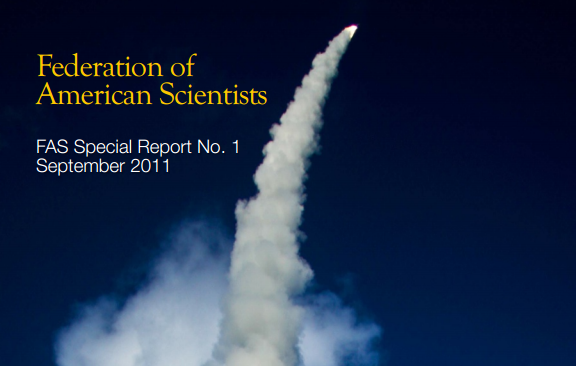
Upsetting the Reset – The Technical Basis of Russian Concern Over NATO Missile Defense
The Obama administration is working with NATO to develop a missile defense shield to protect U.S. and European interests from ballistic missile attacks by Iran. Russian President Dmitry Medvedev has expressed strong concerns over this shield and has warned of a return to Cold War tensions, as well as possible withdrawal from international disarmament agreements like the New Strategic Arms Reduction Treaty (START).
On June 9, the NATO-Russia Council plans to meet with defense ministers to establish cooperation guidelines for the new European antiballistic missile system. The Federation of American Scientists (FAS) is releasing a new report that addresses concerns made by officials of the Russia Federation and provides recommendations for moving forward with a missile defense system..
Dr. Yousaf Butt, Scientific Consultant to FAS, and Dr. Theodore Postol, Professor of Science, Technology and National Security Policy in the Program in Science, Technology, and Society at the Massachusetts Institute of Technology, have published a technical assessment (PDF) of the Phased Adaptive Approach (PAA) missile defense system proposed by NATO and the United States and analyzed whether the Russian Federation has a legitimate concern over the proposed NATO-U.S. missile defense shield.
In practice the PAA will provide little, if any, protection leaving nuclear deterrence fundamentally intact. While the PAA would not significantly affect deterrence, it may be seen by cautious Russian planners to impose some attrition on Russian warheads. While midcourse missile defense would not alter the fundamental deterrence equation with respect to Iran or Russia, it may, in the Russian view, constitute an infringement upon the parity set down in New START.
It is difficult to assess from photos whether the Sentinel missile is longer or wider overall than the Minuteman, but the Sentinel clearly has a thicker second stage, which could potentially contribute to the missile’s extended range.
This is not the first time Google has agreed to censor imagery at the behest of governments, but be warned: obfuscation at this broad level poses a direct threat to the public’s ability to monitor and scrutinize government operations.
As humans expand our geographic reach, encroach on untouched natural territories, and interact more with animal populations, we will encounter novel zoonotic diseases that threaten the human body. The sooner we act to address these risks, the better.
“One thing became increasingly clear: AI doesn’t simply introduce a new category of risk. It changes the speed, scale, complexity, and interaction of risks that already exist.”