Israel’s Official Map Replaces Military Bases with Fake Farms and Deserts
Somewhat unexpectedly, a blog post that I wrote last week caught fire internationally. On Monday, I reported that Yandex Maps—Russia’s equivalent to Google Maps—had inadvertently revealed over 300 military and political facilities in Turkey and Israel by attempting to blur them out.
In a strange turn of events, the fallout from that story has actually produced a whole new one.
After the story blew up, Yandex pointed out that its efforts to obscure these sites are consistent with its requirement to comply with local regulations. Yandex’s statement also notes that “our mapping product in Israel conforms to the national public map published by the government of Israel as it pertains to the blurring of military assets and locations.”
The “national public map” to which Yandex refers is the official online map of Israel which is maintained by the Israeli Mapping Centre (מרכז למיפוי ישראל) within the Israeli government. Since Yandex claims to take its cue from this map, I wondered whether that meant that the Israeli government was also selectively obscuring sites on its national map.
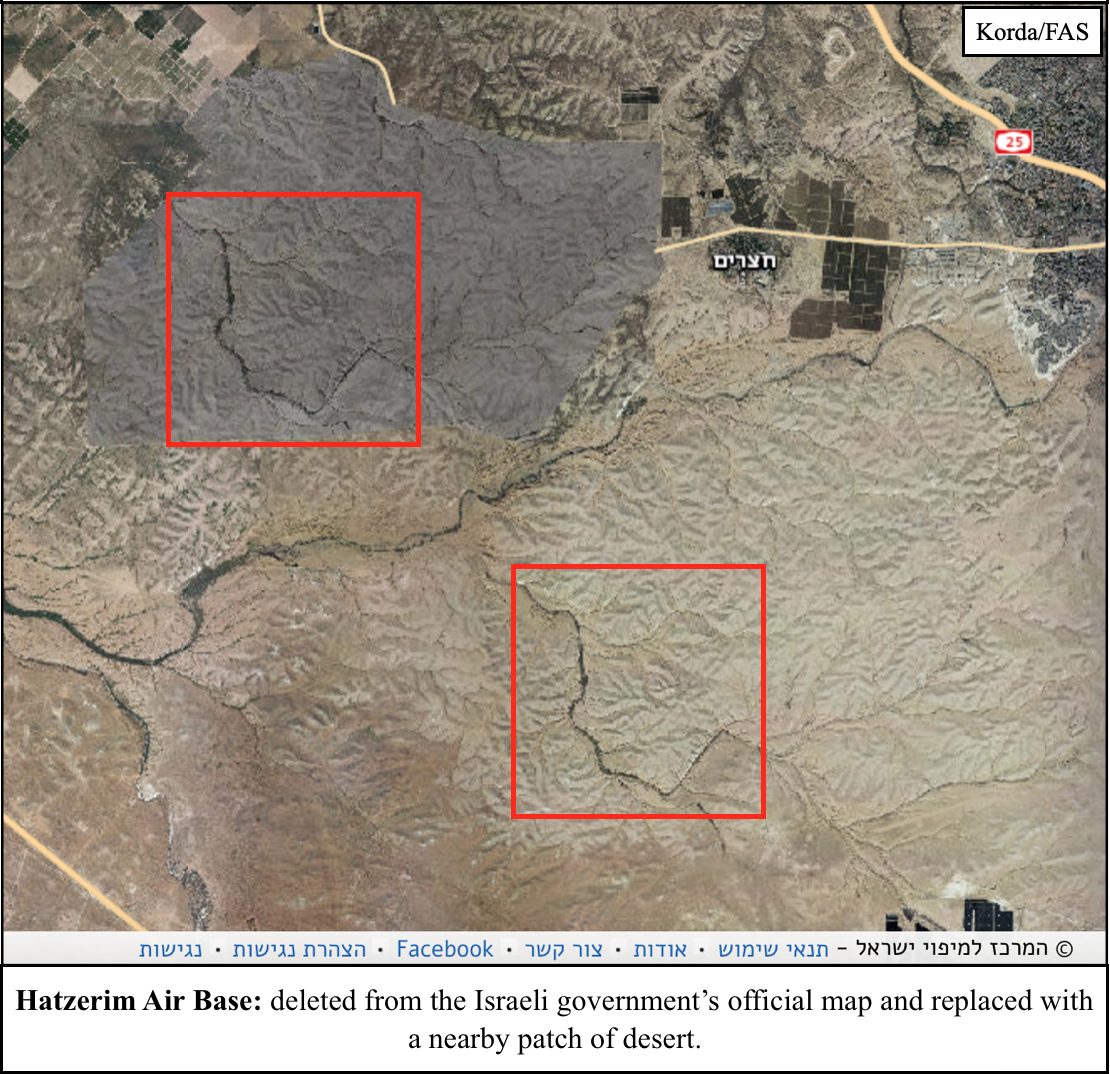
I wasn’t wrong. In fact, the Israeli government goes well beyond just blurring things out. They’re actually deleting entire facilities from the map—and quite messily, at that. Usually, these sites are replaced with patches of fake farmland or desert, but sometimes they’re simply painted over with white or black splotches.
Some of the more obvious examples of Israeli censorship include nuclear facilities:
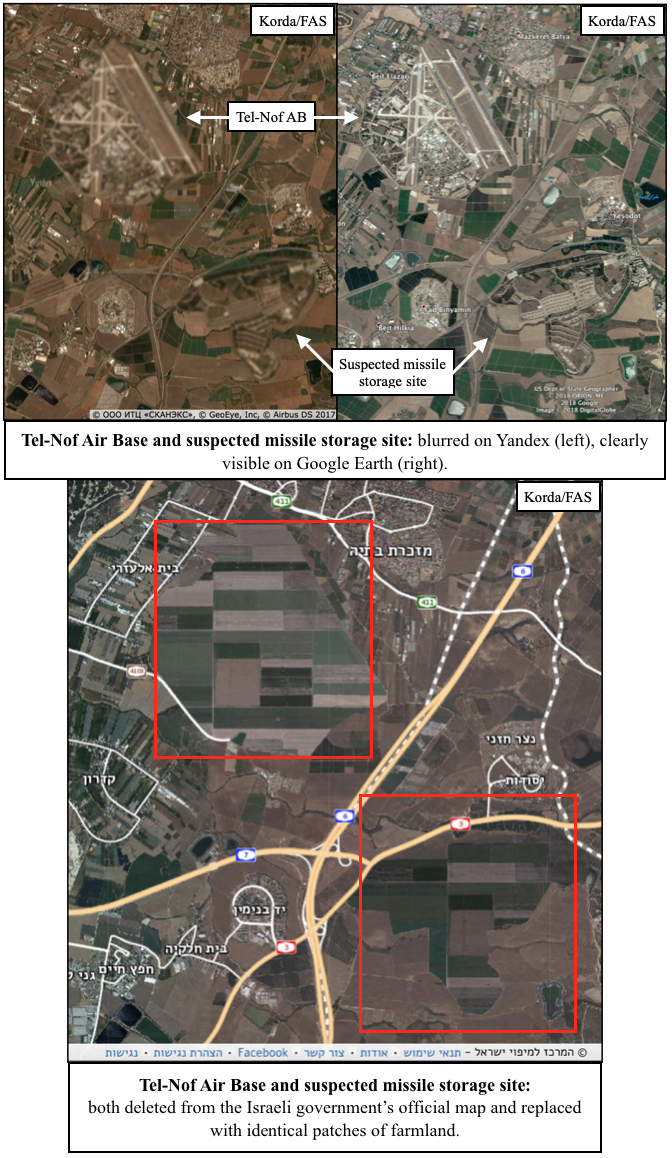
- Tel-Nof Air Base is just down the road from a suspected missile storage site, both of which have been painted over with identical patches of farmland.
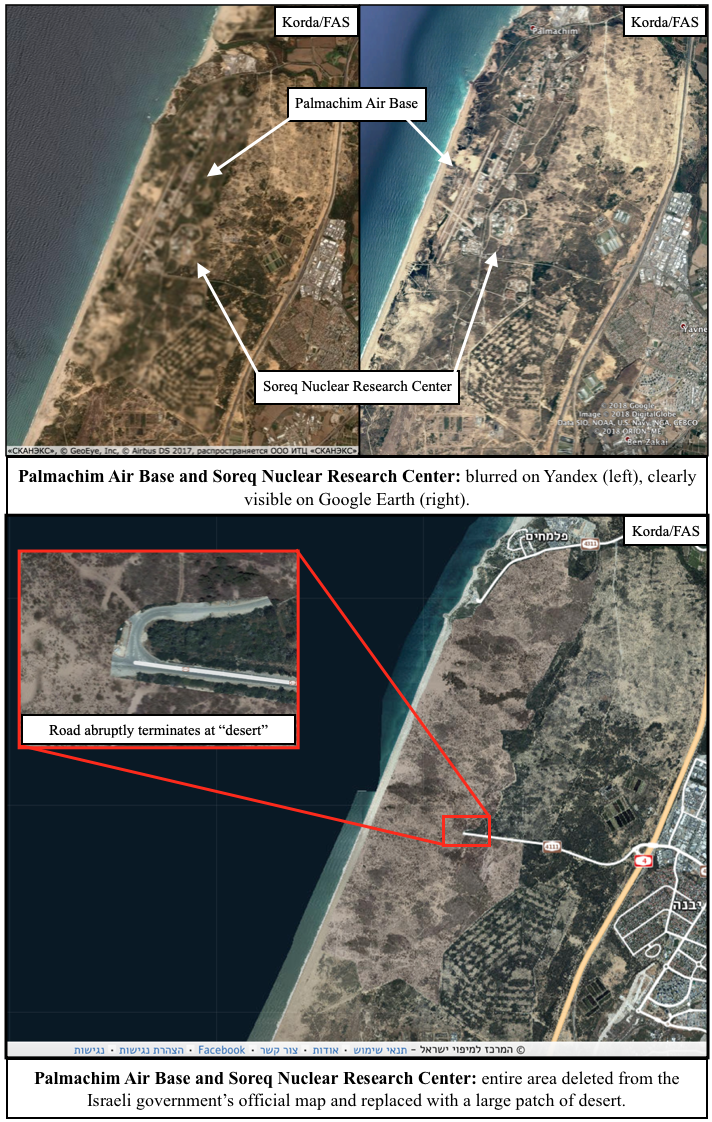
- Palmachim Air Base doubles as a test launch site for Jericho missiles and is collocated with the Soreq Nuclear Research Center, which is rumoured to be responsible for nuclear weapons research and design. The entire area has been replaced with a fake desert.
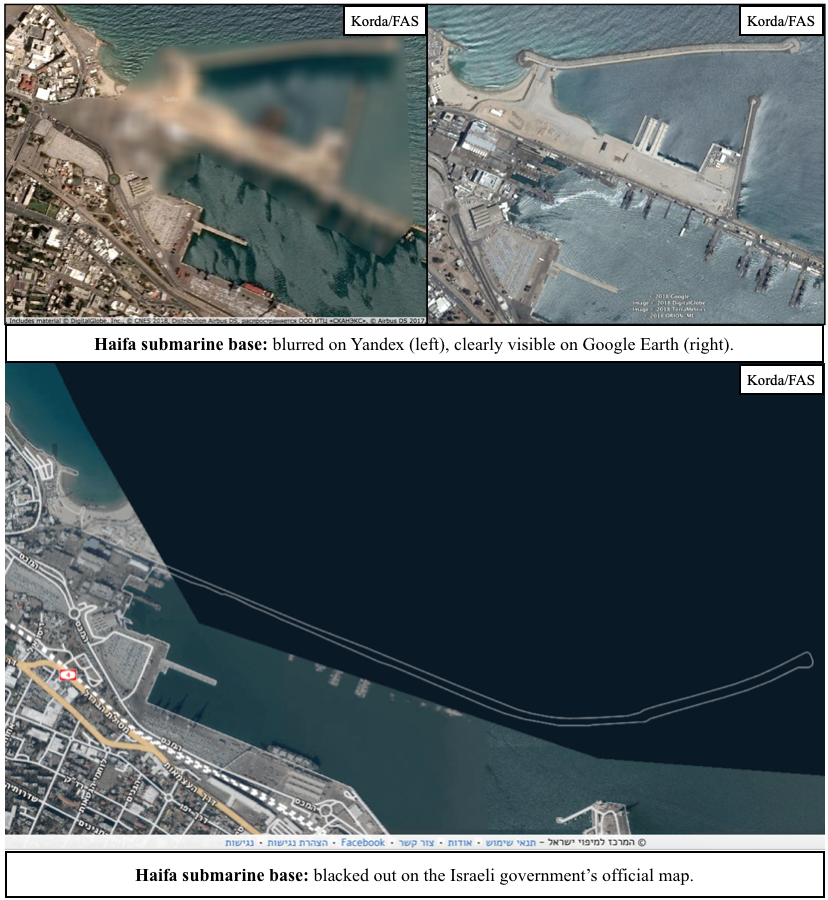
- The Haifa Naval Base includes pens for submarines that are rumoured to be nuclear-capable, and is entirely blacked out on the official map.
- The Negev Nuclear Research Center at Dimona is responsible for plutonium and tritium production for Israel’s nuclear weapons program, and has been entirely whited out on the official map.
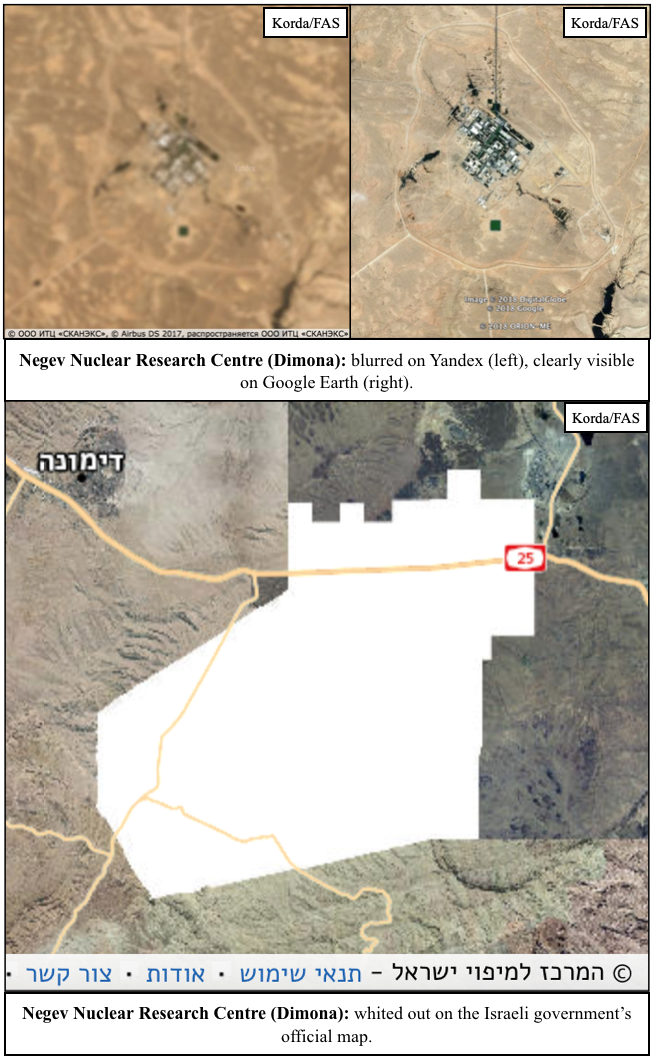
- Hatzerim Air Base has no known connection to Israel’s nuclear weapons program; however, the sloppy method that was used to mask its existence (by basically just copy-pasting a highly-distinctive and differently-coloured patch of desert to an area only five kilometres away) was too good to leave out.
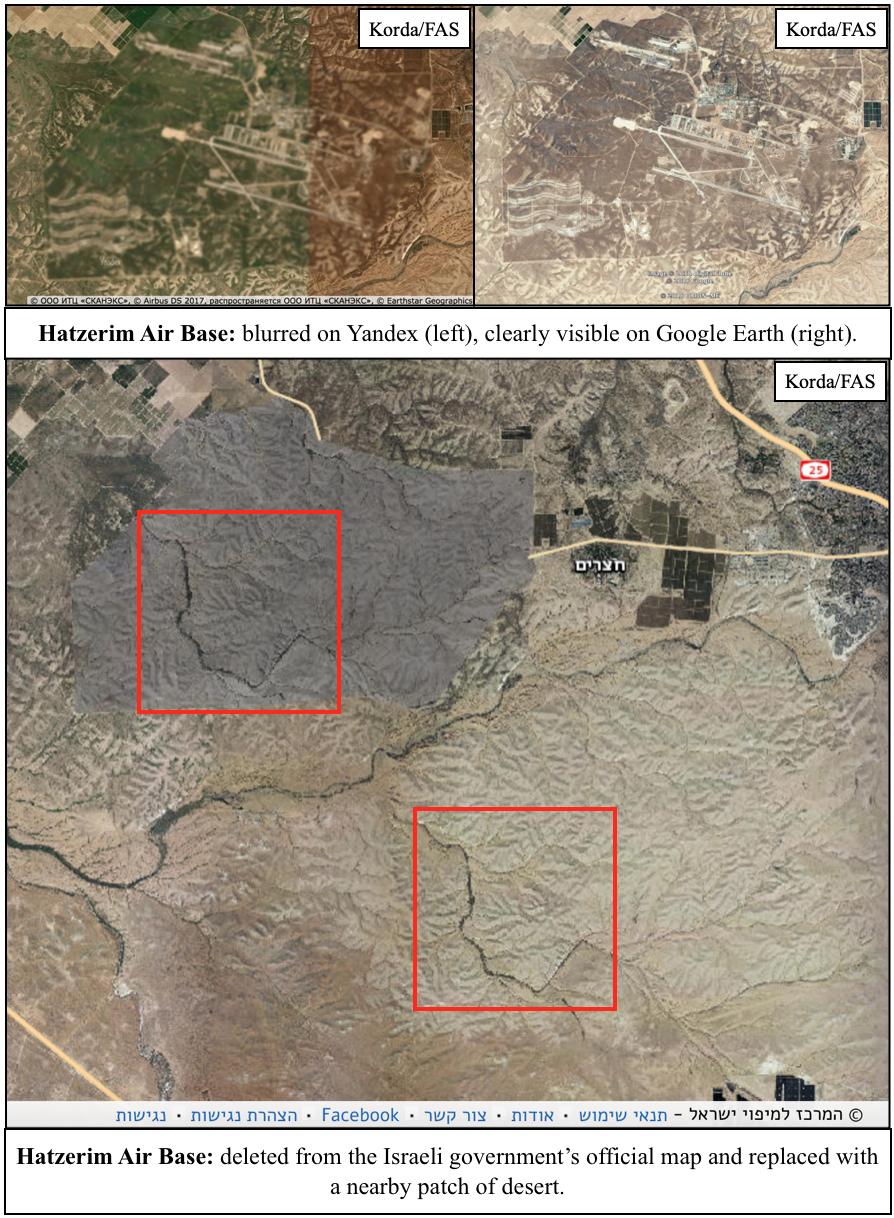
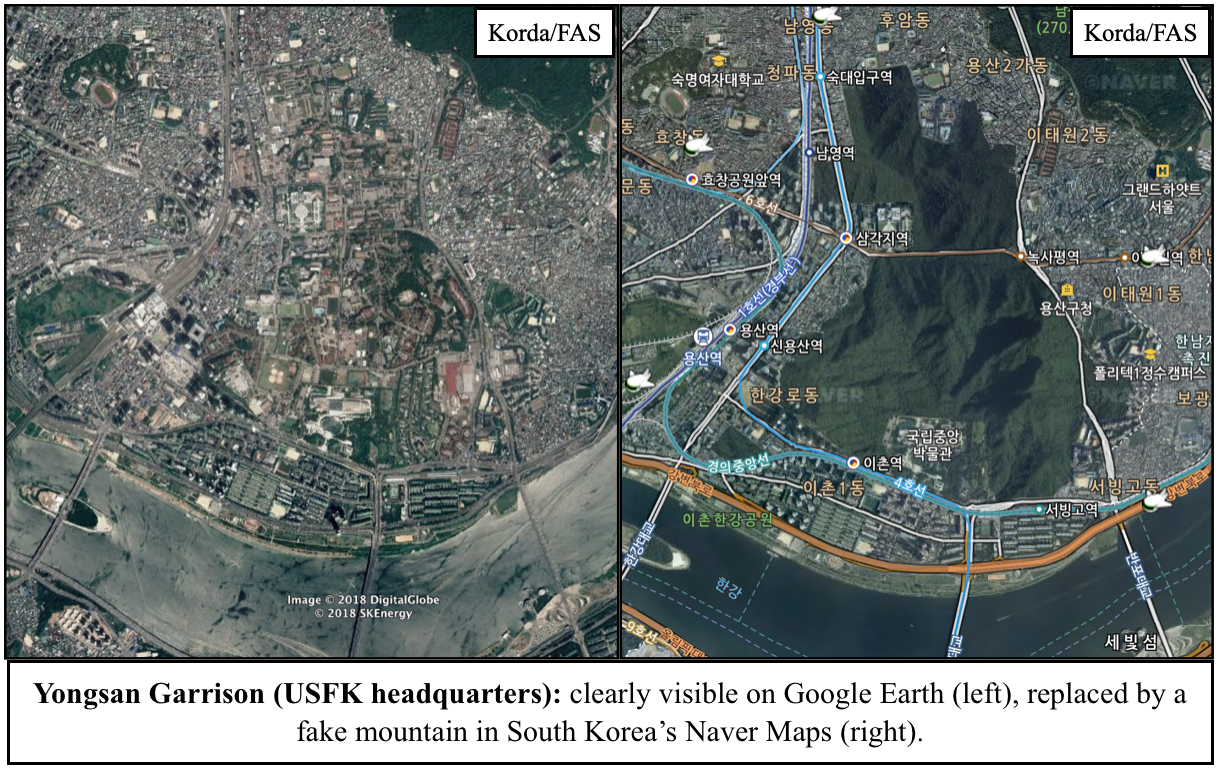
Given that all of these locations are easily visible through Google Earth and other mapping platforms, Israel’s official map is a prime example of needless censorship. But Israel isn’t the only one guilty of silly secrecy: South Korea’s Naver Maps regularly paints over sensitive sites with fake mountains or digital trees, and in a particularly egregious case, the Belgian Ministry of Defense is actually suing Google for not complying with its requests to blur out its military facilities.
Before the proliferation of high-resolution satellite imagery, obscuring aerial photos of military facilities was certainly an effective method for states to safeguard their sensitive data. However, now that anyone with an internet connection can freely access these images, it simply makes no sense to persist with these unnecessary censorship practices–especially since these methods can often backfire and draw attention to the exact sites that they’re supposed to be hiding.
Case studies like Yandex and Strava—in which the locations of secret military facilities were revealed through the publication of fitness heat-maps—should prompt governments to recognize that their data is becoming increasingly accessible through open-source methods. Correspondingly, they should take the relevant steps to secure information that is absolutely critical to national security, and be much more publicly transparent with information that is not—hopefully doing away with needless censorship in the process.
It is difficult to assess from photos whether the Sentinel missile is longer or wider overall than the Minuteman, but the Sentinel clearly has a thicker second stage, which could potentially contribute to the missile’s extended range.
This is not the first time Google has agreed to censor imagery at the behest of governments, but be warned: obfuscation at this broad level poses a direct threat to the public’s ability to monitor and scrutinize government operations.
As humans expand our geographic reach, encroach on untouched natural territories, and interact more with animal populations, we will encounter novel zoonotic diseases that threaten the human body. The sooner we act to address these risks, the better.
“One thing became increasingly clear: AI doesn’t simply introduce a new category of risk. It changes the speed, scale, complexity, and interaction of risks that already exist.”