 |
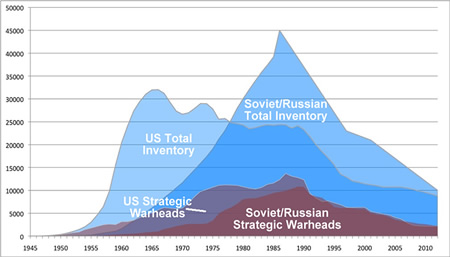
| Vast inventories of nuclear weapons remain after the Cold War arms race ended. |
.
By Hans M. Kristensen
Russia’s nuclear forces are expected to drop well below 500 offensive strategic delivery vehicles within the next five years, less than one-third of what’s permitted by the 1991 START treaty. Unless the next U.S. Nuclear Posture Review significantly reduces the number of land-based intercontinental ballistic missiles, that single leg of the U.S. Triad of nuclear forces alone could soon include more delivery vehicles than the entire Russian strategic arsenal of land- and sea-based ballistic missiles and long-range bombers. With this in mind, Russia is MIRVing its ballistic missile to keep some level of parity with the United States.
This and more from a briefing I gave this morning at the Arms Control Association meeting Next Steps in U.S.-Russian Nuclear Arms Reductions. I was in good company with Ambassador Linton Brooks, the former U.S. chief negotiator on the START treaty, who spoke about the key issues and challenges the START follow-on negotiators will face, and Greg Thielmann, formerly senior professional staffer of the Senate Select Committee on Intelligence, who discussed how the a new agreement might be verified through START-style verification tools.
Download: Briefing on US-Russian Nuclear Forces
.
As humans expand our geographic reach, encroach on untouched natural territories, and interact more with animal populations, we will encounter novel zoonotic diseases that threaten the human body. The sooner we act to address these risks, the better.
“One thing became increasingly clear: AI doesn’t simply introduce a new category of risk. It changes the speed, scale, complexity, and interaction of risks that already exist.”
In the current environment of declining trust and magnifying strategic competition, banning debris-creating tests is a concrete step towards stability that favors interests of all states seeking to conduct space activities.
Google’s motto famously used to be “don’t be evil.” However, its latest feature has just made being evil a whole lot easier.