Iran Owned Part of Eurodif – Document Posted
By Ivanka Barzashka
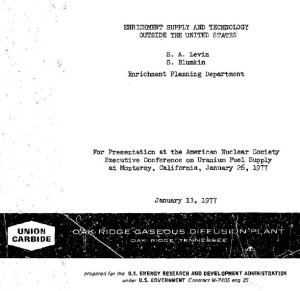
FAS has posted a report on “Enrichment Supply and Technology Outside the United States” by S. A. Levin and S. Blumkin from the Enrichment Department of the Oak Ridge Gaseous Diffusion Plant, operated at the time by Union Carbide. The document, prepared for the U.S. Energy Research and Development Administration, reviews international uranium enrichment capacity and isotope separation technology as of 1977.
Apart from being of historical interest, the report explicitly states that Eurodif, a French-organized multinational enrichment consortium, was in part owned by Iran.
“The membership and apportionment of shares in Eurodif has been changeable. Presently, it is constituted by Belgium and Spain 11% each. Italy 25%, France 28% and Sofidif 25%, which is 40% owned by Iran and 60% by France.”
“In 1975, another consortium called Coredif with the same multinational membership as Eurodif but a different distribution of shares (Eurodif 51%, France 29% and Iran 20%) was organized to assess future nuclear demand and build a second Eurodif-type plant if the study results justified it.”
This is consistent with Iran’s claims that it owned shares of the enrichment company prior to the Islamic Revolution in 1979. This claim has been confirmed by the French government, but Iran has never received enriched uranium from the company.
The document has a disclaimer that “[i]t should not be presumed that the inclusion in this presentation of any reported information necessarily attests to its validity.”
The United States’ biosecurity governance system is structurally incapable of detecting and responding to certain classes of threats. U.S. biosecurity tools have not kept pace with technological advancements or a changing threat landscape.
FAS and FLI partnered to build a series of convenings and reports across the intersections of artificial intelligence (AI) with biosecurity, cybersecurity, nuclear command and control, military integration, and frontier AI governance. This project brought together leaders across these areas and created a space that was rigorous, transpartisan, and solutions-oriented to approach how we should think about how AI is rapidly changing global risks.
AI is already consequential, but its future trajectory remains contested. Policymakers should make their assumptions explicit, focus on what can be shaped rather than what can be perfectly predicted, and build institutions that can learn and respond as evidence changes.
From grassroots community impacts to global geopolitical dynamics, understanding developing data center capacities is emerging as a critical analytical challenge.