 |
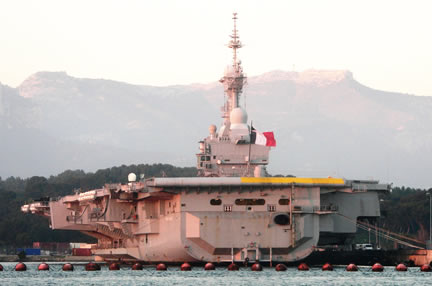
| Sarkozy says he wants to be more open about France’s nuclear arsenal “than anyone ever has been” about theirs. OK, does the aircraft carrier Charles de Gaulle still carry nuclear weapons in peacetime? |
.
By Hans M. Kristensen
The French nuclear weapons arsenal currently includes approximately 300 warheads, according to our latest estimate published in the Bulletin of the Atomic Scientists. Roughly 80 percent of the warheads are for delivery by three ballistic missiles submarines. The remaining warheads are on cruise missiles for delivery by land- and sea-based strike aircraft. The total arsenal is expected to decrease further to some 290 warheads in the next few years.
Although President Nicolas Sarkozy declared in March 2008 that he had “decided that France could and should be more transparent with respect to its nuclear arsenal than anyone ever has been,” France remains the only European nuclear weapons state that has not yet declared whether its aircraft carrier still carries nuclear weapons under normal circumstances.
Background: French Nuclear Forces 2008
As humans expand our geographic reach, encroach on untouched natural territories, and interact more with animal populations, we will encounter novel zoonotic diseases that threaten the human body. The sooner we act to address these risks, the better.
“One thing became increasingly clear: AI doesn’t simply introduce a new category of risk. It changes the speed, scale, complexity, and interaction of risks that already exist.”
In the current environment of declining trust and magnifying strategic competition, banning debris-creating tests is a concrete step towards stability that favors interests of all states seeking to conduct space activities.
Google’s motto famously used to be “don’t be evil.” However, its latest feature has just made being evil a whole lot easier.