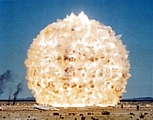
 The Defense Threat Reduction Agency announced today that it has canceled the controversial Divine Strake experiment.
A 700 tons chemical explosion at the Nevada Test Site was intended to provide data for calibration of nuclear and conventional weapons against underground targets. Local fear that the explosion would kick up and disperse radioactive material from the ground – as well concern about Divine Strake’s role in calibrating the use of low-yield nuclear weapons against underground targets – prompted members of Congress to raise questions about Divine Strake.
The Federation of American Scientists was the first to obtain and publish confirmation from DTRA that Divine Strake was the same experiment described in the FY2006 and FY2007 DTRA budget requests as intended to “improve the warfighter’s confidence in selecting the smallest proper nuclear yield necessary to destroy underground facilities while minimizing collateral damage.” DTRA public affairs officials subsequently denied Divine Strake had any connection to nuclear missions, but were later contradicted by senior DTRA officials saying that it was nuclear related.
Background: Divine Strake
As humans expand our geographic reach, encroach on untouched natural territories, and interact more with animal populations, we will encounter novel zoonotic diseases that threaten the human body. The sooner we act to address these risks, the better.
“One thing became increasingly clear: AI doesn’t simply introduce a new category of risk. It changes the speed, scale, complexity, and interaction of risks that already exist.”
In the current environment of declining trust and magnifying strategic competition, banning debris-creating tests is a concrete step towards stability that favors interests of all states seeking to conduct space activities.
Google’s motto famously used to be “don’t be evil.” However, its latest feature has just made being evil a whole lot easier.