Modernizing Colorado’s Canals to Save Water Lost in Transit
About 86% of Colorado’s water is used for agriculture, but only about 30-60% of that water actually reaches crops. With historic drought, record-low snowpack, and the Colorado River nearing “system crash,” this proposal focuses on a critical and largely untapped source for Colorado’s water future: the water lost in transit. This may be Colorado’s most readily available tool for strengthening drought resilience and meeting Colorado River Compact obligations without further reducing agricultural production.
Many conservation programs try to reduce the amount of water used in agriculture by targeting consumptive use, i.e. the water actually consumed by crops, through changing irrigation practices, adjusting crop choices, or taking land out of production (“fallowing”). These efforts matter, but they place the burden of conservation squarely on farmers and face significant pushback.
This proposal shares that burden upstream. Conveyance systems consist of thousands of miles of century-old canals that transport water from rivers to farms. Irrigation districts and ditch companies (referred to as “districts” throughout this memo) typically manage these systems with operators driving around the clock to manually adjust wooden boards and heavy gates to control canal flow. These systems lose enormous volumes of water due to inefficiency, imprecise delivery, evaporation, and seepage during transit before water ever reaches a crop.
Infrastructure upgrades like automated gates, real-time measurement, lining, and piping can sharply cut conveyance losses, free water up for other uses, and substantially improve day-to-day district operations. Efficiency also makes water more reliable for farmers, especially in dry years. Most districts want to modernize, but face financial and legal barriers. The policy recommendations outlined in this memo address these challenges, simultaneously benefiting Colorado irrigation districts, farmers, and rivers by:
- Protecting water rights from legal challenges when diversions are reduced through efficiency improvements.
- Incentivizing districts to become more efficient by compensating water freed up through modernization.
- Enabling water savings to be flexibly used and reliably planned around to help meet Colorado’s water goals.
Challenge and Opportunity
Colorado is in the midst of a long-term water crisis. The Colorado Water Plan projects a shortage of 560,000 acre-feet (ac-ft) by 2050. The 2026 snowpack peaked at only 51% of average, and in June, Colorado entered a Statewide Drought Emergency. Summer runoff is forecasted at 21-37% of the median, and a Colorado River conference white paper warned of “system crash” as early as 2027.
This water crisis has drawn intense attention and effort, but agricultural water conservation has mostly focused on reducing consumptive use through measures like fallowing fields. While this is effective in reducing total water demand, these measures risk accelerating Colorado’s already-leading rate of farmland loss, put disproportionate responsibility on farmers, and impose real economic and cultural costs.
Less attention has gone to the significant portion of water lost in transit before reaching a field. Given that agriculture uses over 86% of Colorado’s water (Figure 1), and only 30-60% actually reaches crops, this means roughly a quarter to half of all water diverted statewide is lost in conveyance to evaporation, seepage, or unmanaged return flow. While some of this water is reused and returns to the river, much of it is tied up in inefficient canal systems and unavailable for other beneficial use or planning. Harnessing a fraction of these losses in the Colorado River basin would contribute significantly to the 200,000 ac-ft voluntary conservation goal for the Upper Basin detailed in the U.S. Bureau of Reclamation’s (USBR) Final Environmental Impact Statement (EIS).
Conveyance efficiency is also a powerful drought resilience strategy. For example, a canal system operating at 60% efficiency would require 167,000 ac-ft of river water to deliver 100,000 ac-ft of consumptive use to farms. At 80% efficiency, that system could meet the same demand with just 125,000 ac-ft, and withstand a 25% dry-year cut with no reduction in water deliveries. In a wet year, that extra 42,000 ac-ft could be left instream for rivers and habitats, banked in storage, or exchanged under the new Colorado River conservation framework.
The technical feasibility of conveyance efficiency gains has long been proven. For instance, in response to the Millennium Drought, Australia’s Murrumbidgee Irrigation Area completely modernized and was able to cut water losses by two-thirds. In Colorado’s Grand Valley, automated check structures on the Government Highline Canal reduced the minimum flow needed to operate by more than 60%. Combined with other modernization upgrades, these improvements have kept an additional 40,000+ acre-feet per year in the Colorado River. That’s roughly 13 billion gallons, or nearly 20% of Denver’s annual water use.
Is This Really Saving Water?
This is a common objection to efficiency-based conservation, and it’s worth addressing head-on. Reducing conveyance inefficiencies doesn’t necessarily shrink total water consumption the way fallowing does, since most of what’s “lost” isn’t permanently removed from the system, but eventually returns to rivers or aquifers as “return flows.” However, consumptive use isn’t the only thing that matters to water managers. Timing and location matter just as much as quantity. Water saved through efficiency can be metered and delivered to a specific reach or reservoir on a predictable schedule. Water that resurfaces later as diffuse, degraded return flow generally cannot. Tracking water through a modernized delivery system is also far easier than tracking it across thousands of miles of canals, farm runoffs, spills, and geologically complex aquifers. That distinction is critical for initiatives like the Colorado River Upper Basin’s voluntary conservation goal, which requires water to actually reach Lake Powell, not just exist somewhere in the system. Efficiency and modernization can deliver that kind of control and accountability, and they do so without asking farmers to reduce or change what they grow, unlike consumptive-use-focused programs.
Current Barriers to Efficiency
Several barriers discourage efficiency improvements even when the operational case is clear. The primary argument is that conveyance losses are harmless, or even necessary, since return flows are assumed to stay in the basin, and downstream users and habitats often depend on them. However, it’s an inefficient way to manage water. It’s comparable to leaving the tap running while you brush your teeth because the water comes back to the system through the drain. In reality, a portion of return flows is lost to disconnected groundwater systems or evaporation before returning to the river, and what does return is often mistimed or degraded. This status quo results in river depletions and salinity damages estimated at $332 million annually for the Colorado River alone. The fix is not to keep canals inefficient or to eliminate all return flows, but rather to distinguish critical return flows from nonbeneficial losses through the same no-injury review used in existing state programs like water leasing. Modern measurement and control can then precisely deliver critical return flows where and when they’re needed, while the extra water can stay in the river.
A second barrier is that “use it or lose it” legal fears persist among districts. While formal abandonment is rare, the more realistic concern is “diminishment”: a permanent reduction of a portion of a water right. A lower diversion pattern due to efficiency gains may be read as evidence that the right’s true extent is smaller than decreed. Even though these doctrines are meant to reduce waste, not discourage efficiency, districts are reluctant to show they can do more with less for fear of inviting a future challenge to their right. Districts need a statutory guarantee that investing in efficiency won’t threaten their water rights.
Third, modernization is expensive, and districts often lack the funds to pursue it. Upfront capital is hard to recover because districts have no way to monetize the water they save. As it stands, districts have no legal claim to water conserved through efficiency gains; if they don’t divert it, it simply flows to the next user in line. Despite water’s high value, districts receive no return on their investment. This is compounded by growing unpredictability in funding sources water projects have historically relied on, like federal grants and state severance taxes, and by farmers’ resistance to funding upgrades through higher water prices. Without a way to turn saved water into a new source of revenue, modernization will remain a pipe dream for most districts.
To address these barriers, Colorado already has a strong legal foundation. Existing state statutes protect historic consumptive use when diversions are reduced under approved conservation programs, and the Colorado Water Conservation Board’s (CWCB) Instream Flow (ISF) program provides a model for compensating saved water and streamlining no-injury review. Other prior appropriation states also offer precedent. In Idaho, Code § 42-223(9) protects the full extent of a water right for users who decrease diversions through efficiency gains, so long as the full beneficial use is maintained. In Oregon, the Allocation of Conserved Water Program has enabled districts to certify a legal claim on their efficiency savings since 1987, which they can then lease, sell, or in some cases, apply to new consumptive use.
Colorado came close to solving this problem before. In 2014, SB 14-023 passed both the Colorado House and Senate with broad bipartisan support. This bill would have allowed water users to receive compensation for efficiency savings transferred to the CWCB for instream flow protection. However, Governor Hickenlooper vetoed it at the last minute over water rights issues. This proposal takes the same core approach but resolves some of the earlier concerns by allowing flexible use of saved water rather than an instream-only design.
A Growing Sense of Urgency and Window to Act
The time to finally pass this legislation is now. Record drought, an historic state election cycle, and the expiration of the Colorado River operating guidelines have together created a sense of urgency that makes this common-sense, infrastructure-focused solution extremely timely and critical. Two recent announcements add concrete, immediate stakes. In mid-July 2026, CWCB announced a new state-run contribution program to save 100,000 ac-ft across the Upper Basin by 2028. Two weeks later, USBR’s Final EIS for Post-2026 Colorado River operations was released, setting a target of 200,000 ac-ft per year of voluntary Upper Basin conservation.
Both goals depend on the state’s ability to generate real, verifiable savings, which starts with modernization, control, and measurement. We can’t save what we can’t measure. State Engineer Jason Ullmann has called accurate measurement critical to protecting Colorado’s entitlement under the Colorado River Compact, and the Colorado Department of Water Resources (DWR) is already rolling out new basin-by-basin measurement rules. Colorado is on the right track, but gauges alone will not save water. This proposal builds directly on that foundation by treating measurement not as an endpoint, but as an essential step towards modernization and efficiency savings that support Colorado’s conservation goals.
The conditions for this proposal to succeed are as favorable as they have been in years. Heading into the 2026 elections, water security is a front-of-mind, bipartisan issue. Republicans emphasize water rights as property rights, while Democrats champion full funding of the Colorado Water Plan and an end to “buy-and-drys.” Conveyance modernization advances both agendas simultaneously. It expands water security without asking farmers to bear the cost of conservation, while also providing the legal and technical foundation to support the conservation, storage, and exchange objectives set out in the new Colorado River operating framework.
Plan of Action
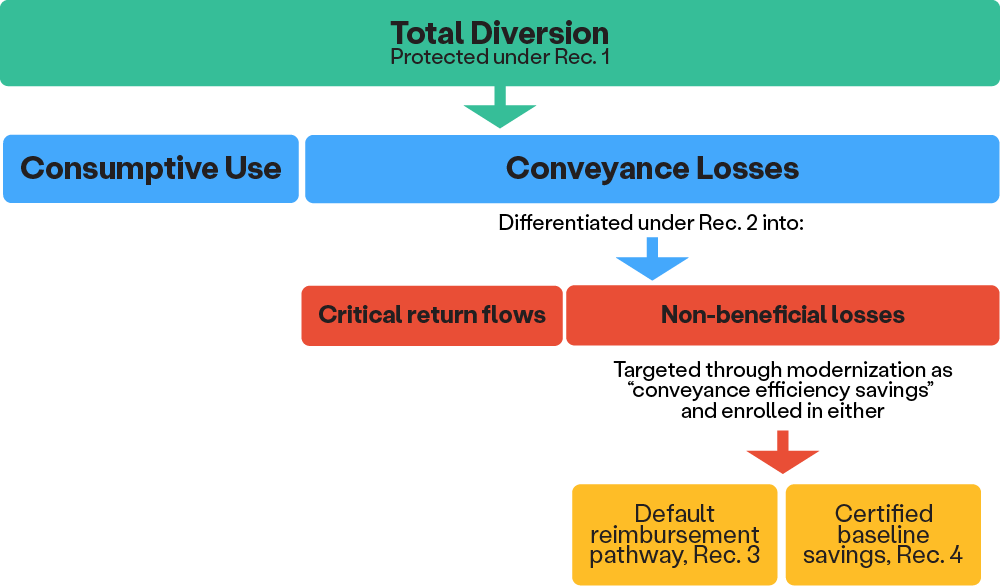
Figure 3. Recommendations 1-4 mapped onto a breakdown of a district’s total diversion.
Recommendation 1. Protect water users from legal challenges when diversion reductions result from conveyance efficiency savings.
The Colorado General Assembly should amend C.R.S. 37-92-103(2)(b) to suspend abandonment and diminishment when diversion reductions are the result of conveyance efficiency savings. Conveyance efficiency savings are the amount of water by which conveyance loss is reduced as a result of infrastructure and operational improvements. This definition excludes any reductions attributable to changes in consumptive use, cropping patterns, or weather. In other words, a district that can divert less water because it invested in efficiency should not risk losing the full extent of its water right. Districts must retain the ability to divert their full entitlement when needed, regardless of how much they previously diverted, since needs vary from year to year and efficiency measures may fail. This would extend the same tolling protection SB13-019 and HB17-1233 already provide for historic consumptive use under approved conservation programs, applying protection to the entitlement itself.
Recommendation 2. Create a no-injury administrative process to separate conveyance losses into two categories: 1) critical return flows that should be preserved, and 2) nonbeneficial losses that can be targeted and reduced through efficiency improvements.
The DWR (Office of the State Engineer) should develop an administrative no-injury review process that sets a ceiling on how much a district can reduce its conveyance losses without harming other water rights, ecosystems, or Colorado’s compact obligations. This process would identify where, when, and to what extent critical return flows must be preserved. This mirrors how DWR already handles no-injury review for other specific, temporary changes of a water right, such as Substitute Water Supply Plans, where a full water court proceeding is not required since no water right will be permanently transferred. The process would include public notice, comment periods involving basin roundtables, and technical determinations by Division Engineers.
Recommendation 3. Create a default reimbursement pathway for conveyance efficiency savings registration and compensation.
CWCB and DWR should create a program allowing districts to register conveyance efficiency savings for reimbursement. Districts would be compensated for voluntary reductions in diversions attributable to efficiency improvements, conditioned on all payments being reinvested in continued efficiency improvements. Under the reimbursement pathway, districts would be compensated post-season, based on metered savings against a verified pre-modernization baseline, with no pre-season savings commitments and no penalty for falling short of prior years. This structure reflects the reality that modernization unfolds over many years, and savings will vary while upgrades are underway. As a result, these savings volumes cannot yet be predicted ahead of time or relied upon by other water users for planning purposes, but still merit compensation. The saved water would simply not be diverted and remain in the priority system, like any unclaimed water today, and how savings were treated under the Upper Colorado River Commission’s System Conservation Pilot Program (SCPP).
Recommendation 4. Develop a certification pathway to give conveyance efficiency savings a defined legal status and enable flexible use.
The default reimbursement pathway under Recommendation 3 would not be the only option. Similar to Oregon’s certificate model, once a district has registered savings for several consecutive seasons, DWR would issue conservative baseline savings certificates that give districts a choice on how the water is to be used. Once certified, a district may opt to lease the savings to CWCB’s ISF program for instream protection, lease to other users at negotiated rates, simply leave them in the reimbursement pathway, or shepherd them downstream once the legal authority exists. No portion of the certified volume could be used to expand historic consumptive use. Leasing is an equal, fully voluntary option once savings are predictable enough to support it. Of a district’s total year-to-year savings, these certified baseline savings would be the only portion eligible for leasing to other users, and the priority date of the underlying right would be untouched. Everything saved beyond the certified amount would remain in the flexible, default reimbursement pathway described in Recommendation 3. As with the reimbursement pathway, all resulting revenue must be reinvested in continued efficiency improvements. Baseline savings certificates can be reevaluated and increased as districts continue to become more efficient.
Conclusion
Colorado’s water future is at a crossroads, and the window to act is now. The drought is real, and the political moment is rare. This proposal doesn’t require fallowed fields or further depleted rivers. It targets something simpler and largely overlooked: the water we’re already diverting but not putting to use, lost in transit through century-old infrastructure before it ever reaches a field. By addressing the legal risks and financial barriers that have kept irrigation districts and ditch companies from modernizing, this proposal transforms conserved water from a perceived loss into a tangible asset.
For districts, this means legal certainty and new revenue to modernize infrastructure that was overdue for investment a generation ago. For farmers, it means a more reliable water supply, even during drought years, without having to change their practices or dry-up their fields. For rivers, it means more water staying instream for ecosystems, recreation, and interstate compacts. For other water users like municipalities, it means increased water availability and security. For Colorado, it means a replicable and sustainable model of water stewardship for other states to follow.
Conveyance modernization won’t solve the water crisis alone. However, it is one of the clearest, most actionable steps available right now that protects agriculture, strengthens water rights, and puts more water back in the river.
This is an important concern, especially in Colorado, and this proposal takes it seriously. Not all conveyance losses are equal, and some return flows are genuinely critical to downstream ecosystems, junior water users, or compact obligations. No-injury technical review by Division Engineers must identify and protect critical return flows before any reductions in diversions or conveyance efficiency savings are approved or compensated. However, this proposal argues we shouldn’t keep systems inefficient for the sake of return flows. Instead, we should modernize them, measure what’s actually critical, and deliver it precisely where and when it’s needed. Many return flows are mistimed, degraded, or permanently lost, contributing to depletions along long reaches of Colorado’s rivers and salinity loading that affects water quality across state lines. If that water stayed in the river or in storage, rather than taking a long round-trip through a district, water quality would improve, and Colorado would gain a real ability to plan around that water.
By default, a district’s savings would remain in the river at the point of diversion, just like any unclaimed water today. The Upper Colorado River Commission’s System Conservation Pilot Program operated the same way, leaving voluntarily saved water to reenter the priority system. While this approach is most straightforward in early years when savings volumes are unpredictable, after several consecutive seasons of registered data, conserved volumes would become reliable enough to certify and plan around. At that point, districts could choose to keep the savings in the default reimbursement pathway, formally enroll them in a CWCB ISF lease, lease to a municipality, or share with junior users. These certified volumes are also strong candidates for shepherding once state legislation enables it. Efficiency savings cannot, however, be used to increase historic consumptive use within a district. How efficiency savings are treated in this proposal is one of the biggest departures from the vetoed SB 14-023, which designated savings for protected, instream use only.
Only the proposed default pathway, essentially unclaimed water, falls entirely outside expansion-of-use. Once a district certifies savings to lease to other users, that may be an expansion of use, but a narrowly bounded one. In fact, it’s narrower than Oregon’s program, which permits conserved water to be used toward new consumptive use on farms of participating districts. No recommendation here increases historic consumptive use of farms in Colorado. What does expand is who benefits from water that’s currently tied up in inefficient canals. The Colorado Water Plan projects a 560,000 ac-ft supply gap by 2050, and new supply is unlikely to come and help close it. Making better use of the water already diverted is one of the few options left that doesn’t entail drying up farms. Oregon’s own prior appropriation system has been successfully carving out exceptions to expansion-of-use limits to incentivize efficiency for nearly 40 years. Given that, this proposal is best understood not as a departure from prior appropriation’s principles, but as a practical, limited step toward making them work under conditions the system wasn’t originally designed for. This proposal offers a genuine win-win where farmers can continue farming, while cities, rivers, and other water users gain resilience that doesn’t currently exist under the status quo.
Conveyance losses are already a recognized part of districts’ total entitlement, and they can continue diverting that full amount (if available) until the moment they no longer need it. In other words, if they stay inefficient, they’re entitled to that water. If they become more efficient, they’re not. That’s the crux of the “use-it-or-lose-it” disincentive. Under current law, a district that voluntarily diverts less than its entitlement thanks to efficiency has no claim to the saved water. In this proposal, districts would not divert more water than they were historically entitled to; they’d take less and be paid for the difference. Compensating it isn’t a windfall; it’s recognition of the value the district created through their investment in modernization. Payments must also be reinvested in continued efficiency improvements, so the incentive compounds instead of stopping at one upgrade.
It is fundamentally different in that it does not ask farmers to change their operations or fallow their land. Demand management and fallowing reduce consumptive use by requiring farmers to grow less, change what they grow, or stop farming. This carries real economic and cultural costs and has contributed to Colorado losing more farmland than any other state from 2017 to 2022. (AgDaily, January 2026). Conveyance efficiency, on the other hand, reduces the total amount of water diverted by districts while enabling the same consumptive use and farming operations, even in drier years. There’s a strong perception in Colorado that reducing consumptive use is the only way to generate “real” water savings, but that view rests primarily on assumptions rather than concrete data. Efficiency generates real savings too, not just by cutting evaporative loss, but by capturing water currently assumed to return to the river or aquifer. In reality, no one has precise measurements on where, when, if, or how much return flow actually makes it back. Efficiency offers a path to help meet Colorado’s conservation goals while actually strengthening agriculture rather than scaling it back.
Just as sports fanatics had plenty to celebrate this year, so does the heat policy team at FAS. In response to recent heat events, leaders across the country have taken steps to build heat resilience.
Western states functionally manage trillions in global climate risk (permafrost, forest carbon, etc.) and can do so in ways that drive state economic development.
Implementation will not be easy. Several of the plan’s critical strategies challenge established utility business models.
We won’t solve the cost-of-living crisis without improving the capacity of state public utility commissions to protect customers, find and implement new solutions to meet rising demand, and realign broken utility incentives.