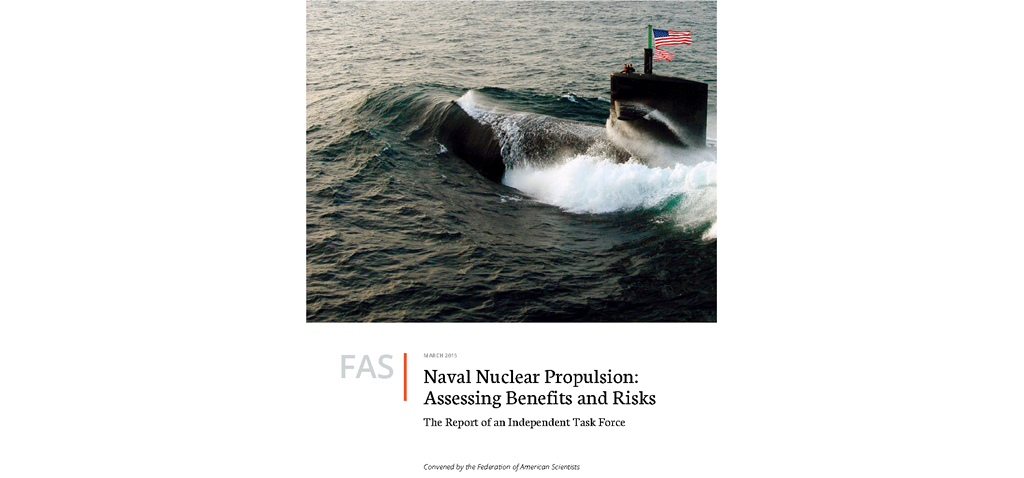
Naval Nuclear Propulsion: Assessing Benefits and Risks
The United States and other countries with nuclear navies have benefited from having nuclear-powered warships. But do the continued benefits depend on indefinite use of highly enriched uranium (HEU)—which can be made into nuclear weapons—as naval nuclear fuel? With budgetary constraints bearing down on the U.S. Department of Defense, the Naval Nuclear Propulsion Program is finding it difficult to address many competing needs including upgrading aging training facilities, handling spent nuclear fuel, and designing the next generation submarines to replace the Virginia-class attack submarines.
FAS convened an independent, nonpartisan task force of experts from the national security, nuclear engineering, nonproliferation and nuclear security fields to examine effective ways to monitor and safeguard HEU and LEU in the naval sector, and consider alternatives to HEU for naval propulsion so as to improve nuclear security and nonproliferation.
The results of the year-long task force study are compiled in the report, Naval Nuclear Propulsion: Assessing Benefits and Risks. The task force concluded that the U.S. Navy has strong incentives to maintain the continuing use of highly enriched uranium and would be reluctant, or even opposed, to shift to use of low enriched uranium unless the naval nuclear enterprise is fully funded and the Naval Nuclear Propulsion Program has adequate financial resources to try to develop a life-of-ship reactor fueled with LEU that would meet the Navy’s performance requirements. The task force endorses having the Obama administration and Congress allocate adequate funding for R&D on advanced LEU fuels no later than 2017 in time for development of the next generation nuclear attack submarine. “The United States should demonstrate leadership in working urgently to reduce the use in naval fuels of highly enriched uranium–that can power nuclear weapons–while addressing the national security needs of the nuclear navy to ensure that the navy can meet its performance requirements with lifetime reactors fueled with low enriched uranium,” said Dr. Charles D. Ferguson, Chair of the Independent Task Force and President of FAS.
Four companion papers written by task force members are also available:
- Investigation into the Unintended Consequences of Converting the U.S. Nuclear Naval Fleet from Highly Enriched Uranium (HEU) to Low Enriched Uranium (LEU) by Dr. Alireza Haghighat, Professor, Virginia Tech Transport Theory Group (VT3G), Nuclear Science and Engineering Laboratory (NSEL) Nuclear Engineering Program, Jack Bell, Graduate Research Assistant and Nathan Roskoff, Graduate Research Assistant.
- Phasing Out Highly Enriched Uranium Fuel in Naval Propulsion: Why It’s Necessary, and How to Achieve It by Dr. Alan J. Kuperman, Coordinator, Nuclear Proliferation Prevention Project and Associate Professor , LBJ School of Public Affairs, University of Texas at Austin.
- The UK Naval Nuclear Propulsion Programme and Highly Enriched Uranium by Dr. Nick Ritchie, University of York, UK.
- A Novel Framework for Safeguarding Naval Nuclear Material by Naomi Egel, Dr. Bethany L. Goldblum, & Erika Suzuki, University of California, Berkeley.
Naval Nuclear Propulsion: Assessing Benefits and Risks can be read and downloaded here (PDF).
The task force members thank the John D. and Catherine T. MacArthur Foundation for its generous support of this project.
It is difficult to assess from photos whether the Sentinel missile is longer or wider overall than the Minuteman, but the Sentinel clearly has a thicker second stage, which could potentially contribute to the missile’s extended range.
This is not the first time Google has agreed to censor imagery at the behest of governments, but be warned: obfuscation at this broad level poses a direct threat to the public’s ability to monitor and scrutinize government operations.
As humans expand our geographic reach, encroach on untouched natural territories, and interact more with animal populations, we will encounter novel zoonotic diseases that threaten the human body. The sooner we act to address these risks, the better.
“One thing became increasingly clear: AI doesn’t simply introduce a new category of risk. It changes the speed, scale, complexity, and interaction of risks that already exist.”