Federation of American Scientists Announces Arrival of our Inaugural Cohort of Senior Fellows to Advance Audacious Policy that Benefits Society
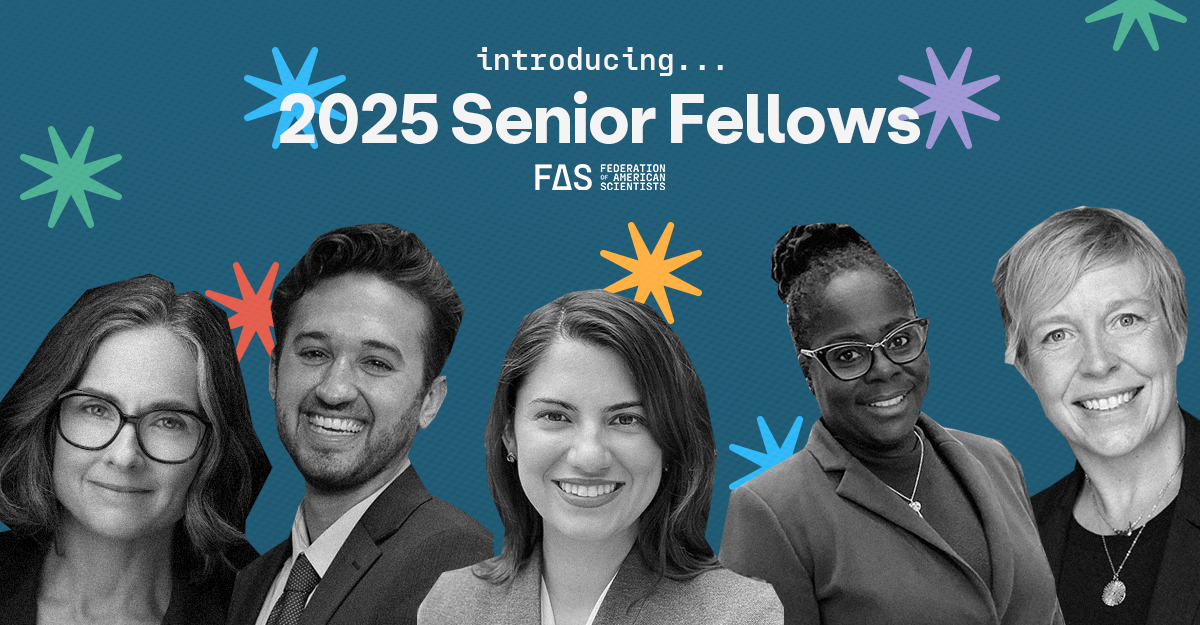
Fellows Brown, Janani-Flores, Krishnaswami, Ross and Vinton will work on projects spanning government modernization, clean energy, workforce development, and economic resiliency
Washington, D.C. – March 17, 2025 – Today our first cohort of Senior Fellows join the Federation of American Scientists (FAS), a non-partisan, nonprofit science think tank dedicated to developing evidence-based policies to address national challenges. These senior-level scientists and technologists represent a diverse group of thinkers and doers with deep experience across multiple fields who have committed to developing policy solutions to specific problems. The fellows were selected through a competitive process of project proposals, and will work in their area of expertise independently and collaboratively with FAS staff for six months.
“We are leaning into the reality of the present moment and bringing exceptional talent to join forces with our staff and the wider science and policy community to develop new policy ideas that solve specific and difficult societal challenges,” says Daniel Correa, CEO of the Federation of American Scientists.
Senior Fellows – 2025 Cohort
The inaugural cohort of senior fellows and their primary areas of focus are:
Quincy K. Brown served as Director of Space STEM and Workforce Policy on the National Space Council in the White House Office of the Vice President. She will design a participatory, strategic foresight process to identify solutions to the most pressing challenges we face in the evolving science and technology ecosystem. She will leverage data-driven insights, strategic partnerships, and evidence-based research to shape national policy, scale innovative initiatives, and cultivate cross-sector collaborations.
Maryam Janani-Flores served as the Chief of Staff of the U.S. Economic Development Administration at the Department of Commerce, where she oversaw policy, strategy, and operations for a $5 billion grant portfolio. She will focus on broad-based participation in innovation ecosystems by placing recently departed federal scientists, engineers, and technologists in innovation hubs nationwide to build inclusive, durable innovation ecosystems.
Arjun Krishnaswami served in the Biden-Harris Administration as the Senior Policy Advisor for Clean Energy Infrastructure in the White House. He will take lessons learned at the federal level to elicit adoption of clean technology at the state level, modernizing our nation’s energy grid so that communities across the country can benefit from the greater resiliency, lower costs, and cleaner air that follow from clean energy upgrades.
Denice Ross, former U.S. Chief Data Scientist and Deputy U.S. CTO, will prototype a Federal Data Use Case Repository for documenting and sharing how people across the nation use priority federal datasets from many agencies. Her project is a front-line effort to protect the continued flow of federal data.
Merici Vinton served as a Senior Advisor to IRS Commissioner Danny Werfel and prior to that was an original architect of the Direct File service. She will focus on technology innovation to deliver public services in a post “digital services” era, making institutions more relevant and responsive.
“This is a time where we need solutions, and these senior fellows bring with them the expertise, motivation and a vision for how to use policy as a tool to affect meaningful, positive change,” says Dr. Jedidah Isler, Chief Science Officer at FAS.
She continues: “These senior fellows have years of hands-on experience to draw upon to imagine, plan, and develop ambitious science and technology policy. We look forward to a bidirectional flow of expertise between senior fellows and our staff to deliver actionable policy ideas that will serve the public using the technical tools of today and emerging technology of tomorrow. They give me hope that we can co-create a future that provides safety, access and prosperity for all.”
Role of Senior Fellows at FAS
Senior fellows will work independently to develop and refine their policy plans over the next six months. All of the proposals are ambitious; to reach their desired outcomes, fellows will collaborate with a wide range of stakeholders in the science and policy communities, seeking to understand and implement feedback from evidence-based datasets, specialized experts, people with lived experience, and ultimately, from the people whom their policy could impact.
During the course of this policy development senior fellows will have access to FAS resources and full-time staff to ensure these ideas can be realized.
Senior fellows will be an extension of the wide range of scientific and technical expertise housed within FAS – ranging from nuclear weapons to climate science to emerging technologies – one of the country’s oldest science policy think tanks.
###
About FAS
The Federation of American Scientists (FAS) works to advance progress on a broad suite of contemporary issues where science, technology, and innovation policy can deliver transformative impact, and seeks to ensure that scientific and technical expertise have a seat at the policymaking table. Established in 1945 by scientists in response to the atomic bomb, FAS continues to bring scientific rigor and analysis to address national challenges. More information about FAS work at fas.org.
It is in the interests of the United States to appropriately protect information that needs to be protected while maintaining our participation in new discoveries to maintain our competitive advantage.
The question is not whether the capital exists (it does!), nor whether energy solutions are available (they are!), but whether we can align energy finance quickly enough to channel the right types of capital where and when it’s needed most.
Our analysis of federal AI governance across administrations shows that divergent compliance procedures and uneven institutional capacity challenge the government’s ability to deploy AI in ways that uphold public trust.
From California to New Jersey, wildfires are taking a toll—costing the United States up to $424 billion annually and displacing tens of thousands of people. Congress needs solutions.