Experimenting with Science and Structure in Government
This piece is the first of a series of conversations hosted by FAS CEO Daniel Correa aimed at highlighting issues ripe for deeper discussion, and bringing together thinkers with valuable perspectives on how to drive positive change in public policy. The following transcript has been lightly edited for concision and clarity.
Daniel Correa, FAS CEO: Thank you both so much for joining me for this conversation. Seemay, I’m going to start with you. So you’ve practiced science. You’ve taught and now you are running several organizations that have as their mission a desire to encourage more experimentation, and to provide more funding and support for ambitious, scientific and useful breakthroughs. At the same time, you’ve done a decent amount of writing about how research institutions that perform and support science need to be more experimental.
So I would actually just like to start there. Why is the point about experimental, at the institutional level, so important?
Seemay Chou, co-founder of Arcadia Science and Astera Institute: For a really long time in the U.S., we’ve had just one main type of [research] institution. It’s very monolithic. And I think experimentation is important for a couple of reasons. One is that we don’t actually know: what are the right solutions? And the opposite of what people do is not necessarily correct. Also, I would argue that there’s not one solution. We need to learn a lot more about the heterogeneity of solutions that could exist that are fit for purpose. It’s very difficult to even explore that space, without just trying things. And what does it mean to do an experiment?
Is there some level of uncertainty where it could fail? Number one, that framing allows you to try many more things that in each case don’t have to hedge as much. Because if you do a bunch of things that hedge, you actually don’t shoot yourself into any new space to actually test some new hypothesis.
There’s so much we don’t know still, because of how few things we’ve tried.
You have to go far out enough [from institutions] where people actually behave differently, and do something differently, and that creates a level of risk for everybody involved. And then you have to find the kinds of funding sources where they’re okay if it doesn’t go well.
So when are the moments in history where [experimentation] might be the most important? I would argue right now. This is the most important time to do it because the technological and sociological contexts in which we established these institutions has completely blown up.
Correa: This very much resonates with me. I would love an example of what it looks like to do meaningful experimentation within scientific institutions.
Chou: Why don’t I just draw from my own example? But I’ll caveat it by saying the reason I will draw from my own examples is because I know the most about them. It is not because I think that they’ve fully succeeded, because I think that we’ve gone through a bunch of iterations where most of the experiments that got initiated in the last decade, we don’t actually have enough information to know if they’re full success.
Correa: Caveat accepted.
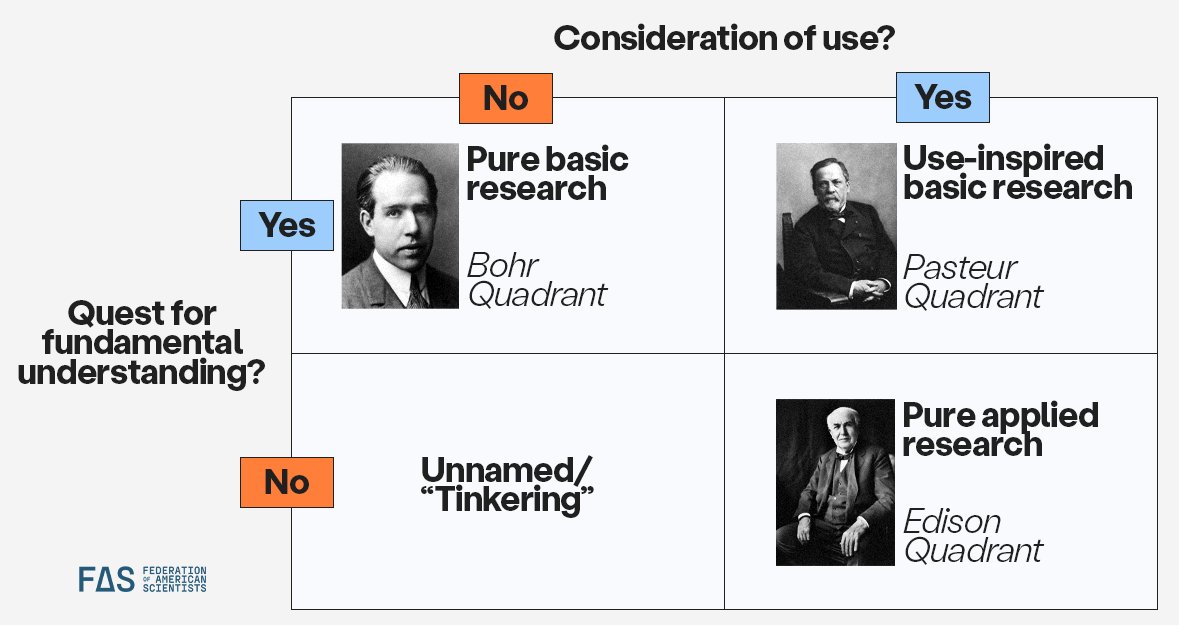
Chou: At Arcadia, one hypothesis we’re trying to test is that we think that there’s a whole lot of basic science that could be happening in the upper right hand quadrant of Pasteur’s quadrant, which is like a combination between basic and applied.
That is actually why we have set Arcadia up as a for-profit. If we have enough capital and different investment metrics, it’s basically self-funded to want to see a return on investment way later – like we can give it at least a decade. That’s very different from how capital usually flows today in the for-profit sphere.
Then the question is, can we see a win-win here that’s actually both good for science? Because you see more money coming in from the for-profit space, you see better connection with for-profit outcomes, like product outcomes that have true utility in the world.
It’s very different from what you see in current institutions. It’s not quite “company” and not quite “academia”. There’s no “Oh, let’s start out as a nonprofit and then if it goes well, we’ll become a for profit,” right?
We have to go for it. This is the thesis. We’re going to have to make sure we find the right capital that’s aligned for it, and then we can really try it. And the jury’s still out on whether we’re going to succeed. But what I can tell you is that, I think we would have behaved very differently if we hadn’t done it exactly in this way. We would have recruited a very different set of people, the outcomes would have been different in terms of the activities that we’re doing and the behaviors we’re seeing.
If you talk to actual academic scientists, their ultimate deliverable right now is a journal article. That deliverable drives a whole lot of behaviors and activities that happen, because that is the incentive. Besides money, there’s journal articles and prestige.
And so that was a test at Arcadia: no more journal articles. It’s not even an option. How would that fundamentally shake up how people are approaching their science? Incentives alone may not change people – but the most important thing this did was filter for the right people who are willing to approach things differently.
If you look at my track record, I’m not like an open science warrior. Before this, I was definitely publishing in journals. I knew from my own experience and the scientists around me that this was extremely influential to how we did things, sometimes subconsciously.
So [at Arcadia] we took that off the table, and actually it was remarkable. It was surprising to me the degree to which it changed the game. Even more so than funding – this was number one.
For one, the thing that was the simplest to remove was the ranked authorship hierarchy that creates an incredibly zero-sum prestige game that really changes the way you think about your cost-benefit analysis of where you’re going to put your time. You want to make sure you own things, you want to make sure you only work on things where you have the potential to be a higher up author.
There’s no ranked order; it is just listed, alphabetically. Overnight, every single scientist at Arcadia told me that was the biggest game changer for them, because then when they thought about working together as a team – it was truly as a team.
And I’ve seen this over and over even with other things we funded outside of Arcadia. When I take [journal publishing] off the table, people then actually have to go back to the drawing board and think, ‘All right, like, what should we do then?’ Because if that’s not part of the calculus, they literally come back and propose something entirely different. That’s maybe the strongest piece of evidence I have.
And I do want to clarify: I don’t think these are the types of experiments government should take the first step on because government has a huge responsibility to think about lasting infrastructure. This is where I feel like philanthropy or private public partnerships are really helpful to be like, ‘What are the things that we need to try out for the first time?’
There’s a bunch of de-risking that should happen to develop conviction and tactical strategies and infrastructure and all that before you ask the entire ecosystem to do it.
Correa: You put a lot on the table. So let me just synthesize a little bit. So, institutional innovations and institutional experimentation – that is actually downstream of a broader exercise that you described, which is finding intervention points in the entire ecosystem of what it would take to change the system. I think it’s relevant to how federal agencies should think about their missions and their work.
Because the condition you put on publication in journals is born out of an experiment you wanted to run on an insight about what was wrong with the system broadly. Then you also built an institution that was itself designed to be experimental as an intervention. And these things go together, but they come from a common systems level, thinking about what’s needed to drive change.
Chou: Yes, that’s absolutely right. What is worth building incentives around? You really need to identify those ‘first principles’. And then the closer you can stick to those ‘first principles, the better off you’ll be.
Correa: Loren, I want you to react. Are our federal institutions capable of this type of experimentation?
Loren DeJonge Schulman, FAS Director of Government Capacity: I think the answer is: maybe.
The simplest question is, ‘What do you want federal institutions to be there for?’ They could do this, but is that actually the role that we want them to play?
And that’s very related to something that I often think as people are talking about federal innovation or reform, no matter what it is: ‘Who is your customer? What are you actually trying to do? And who are you trying to do it for?’
Because odds are, as you’re thinking about incentives and trying to manage them, you’re not actually thinking about who else is going to come in and mess with the dynamics in your ecosystem no matter what kind of incentives you try to build.
For federal science institutions, you’ve got a lot of customers, and it’s often hard to consider what those incentives are to serve each. It’s something where we need to make more active choices and fewer tacit choices. You’ve got Congress, you’ve got the scientific community, you’ve got the public – hopefully, the public matters! And then you have industry that you’re trying to actually keep alive, and you have universities.
But we are not usually explicit about the master that we’re trying to serve most; or we try to serve them all, and serve all of them badly. And as a consequence, you end up designing incentives around things that are either more convenient or match the master of the time.
The other challenge I see in federal institutions is so often we turn to: “We’ll bring in a new leader that will make everything better.” Which is not a wrong choice short term, but all the experimentation that you are trying to drive with that new leadership change will probably end when they leave, unless you’ve actually rearchitected the incentives and the understanding of what you’re trying to innovate around – change management.
I think that your point on budget is an interesting one, because most of the people outside of the federal space tend to think of there being a lot more funding in the federal government to invest in things than there actually is. Or, if they’re right about the amount, they’re wrong about the flexibility.
So much of [federal funding] is already sort of pre-baked. So the amount of resources and flexibility you have to do new tiny things goes into a smaller and smaller and smaller box. And with that comes all of the administrative burden requirements that we lump on top, and in government that’s often, “Well, since you’re wanting to innovate in this particular way, can you also do it also in this region of the country, with these particular innovators in mind ,and with also these sorts of outcomes?”
[Public servants] tend to get to the end of that process and feel like, “I’m not really innovating, I’m just sitting here treading water in place,” even if it’s all very, extremely well-intentioned.

That’s where I think talent ends up being like the final constraint on innovation. The ways that we bring people in and out of the federal space, and particularly in the science space, is all very well-intentioned in terms of particular rotator programs, and particular civil service programs. But none of which allows you to accumulate the kind of knowledge you need in order to drive change consistently and sustainably, and also makes it so these people are incentivized to do the least innovative thing possible.
All that said I believe the federal government can also be a really good vehicle for carving a space that no one else could before – and so I’ll guess I put it back to you two, should I be thinking about this in a drastically different way – that federal government should be carving a space no one else can or that the federal government should be the slightly conservative infrastructure behind the scenes?
Correa: I have thoughts on this, but I’d love to hear from [Seemay Chou].
Chou: The thing you said about talent really resonates with me.
But the thing I have found most useful in, like, any of my interactions with government so far with our experiments is thinking of the government in one way as my customer. So I’m thinking, “What do I need to test to de-risk this [institutional experiment]?”
In some cases, the government has, actually, enormous power to sort of anoint something as potentially acceptable. Like preprints is a good example of that, right? Like when the government started basically paying attention and changing certain language and policy to basically say, ‘we accept this,’ that can move the Overton window. That is actually really helpful.
Your comment about talent is very related to that. What I have found in every arena that I’ve worked in is that there is no training people how to be risk-tolerant.
If you want to do the crazy experiments, you need to find crazy people, because otherwise it’s going to continue coming towards the middle. And the people who are least crazy are the ladder climbers and so institutionalist. So now, when I hire for stuff like this, the more radical of a thing that we’re trying, the more I push on this with people – I’m trying to get a sense of them innately.
Do they have a stomach for this? Because otherwise, they’re not the right person to lead this. And this is part of the reason why we have such a sharp line on the open science stuff about being outside journals. It’s a sharp line that only a maniac would cross, and that’s the right kind of maniac for me.
Correa: I’m imagining three categories of experimentation for government and for research institutions. I think one is where we started, which is government itself is not actually doing anything experimental at all. Things are being de-risked elsewhere. So I think a good example of this is the way in which the philanthropic community directs new funding models or new vectors of research.
Focused research organizations (FROs) are a good example – de-risked by philanthropic dollars, as a model for team-based time-bound science that now government is adding to its portfolio, at least at a modest size. An earlier example of that was, the work that HHMI (Howard Hughes Medical Institute) did to fund people, not projects, [to the point] where we now see NIH adding it to the portfolio.
We can quibble about whether those are the right level of adoption amid the portfolio in the government. But you can see that this move where someone else experiments, gets some success, and government can go take it and say, ‘Hey, this thing benefits from scale that only government can deliver.’ That is a move.
Category two is explicit experimental function. So we’re talking now about things like a metascience unit at the National Science Foundation. There are antecedents to this in government through the Evidence Act, that gave agencies a mandate to ask questions and to evaluate whether the answers and have them inform the way that they work, and other movements before that.
There’s a piece of that that’s deeply relevant to the state of the field. And what we understand about how to fund breakthrough science and how to organize it and what works. We actually don’t know enough.
And then the third piece is where you want to empower talented people to be the living embodiment of a vibrant, experimental approach to shaping a field. Our institutions on the research side are not organized this way.
It’s a very different structure, talent model, and level of empowerment that would get us to that. You don’t even need to call it experimentation. It just looks like empowering field leaders and tackling bottlenecks as a substantial part of what government research does.
DeJonge Schulman: The thing that struck me most immediately as you were talking is the explicit experimental functions that government can create space for: the metascience unit, the Evidence Act, the ARPAs, and things like that. Government needs to get better at being able to provide the behind the scenes infrastructure for that kind of work, and to acknowledge that sometimes it’s going to start a new team, a new organization, a new ARPA, whatever it is, and that’s going to last for like three years.
Not necessarily because it was a bad idea, but because momentum will fade – the right leader is not there. You may have the right moment in time for a thing, and it doesn’t need to be forever. But what you need to get good at is starting it, and making sure that whatever incentive you’re trying, you’re getting that perfect, whether that be the get-the-money-out-the-door function, which is hard in government, or the hiring function that gets you the right kind of people in quickly.
If I said, “I’m going to go start a totally new experimental research institution in government,” people might say, “Okay, cool. That’s going to be like ten years from now,” because it just takes forever to do.
Let’s get better at doing the shorter-term stuff with the acknowledgment that it may be shorter term.
Chou: There has to be an on and off rate. Otherwise there’s not really innovation. I have often found that the startup space does way better than the nonprofit space: if you talk to founders, they’re not that nervous if their first company fails, because that just happens.
Then they found a new company or find a new job. There’s more of a market around that. So none of it’s that scary. The metascience stuff would benefit from that, and it makes sense why the government would benefit from it too.
Things fail and things also expire as the world changes.
Correa: It’s not like this is a novel thing that only science is grappling with. We sit here and talk about Vannevar Bush – that was 75 years ago, but think about how long the Department of Interior has been around. Everyone’s grappling with aging institutions and mechanisms and trying to fit them to a changing mission.
Loren, are there any examples outside of our research institutions that we should be grabbing on to, for how our federal reasons from some situations can do this better?
DeJonge Schulman: Some of the newer institutions that have kicked off in government have done reasonably well: U.S. Digital Service, Consumer Financial Protection Bureau and a few others. They have tried to find the systems and authorities that made the most sense for them to operate, as opposed to just accepting whatever authority was handed over to them.
So whether that be around the amount that you could pay people, how quickly you can hire them, the way you do procurement, your enforcement power – one key thing is being able to mine the authorities that are available to you. You hire a bunch of genius lawyers who are ‘yes’ people, ‘yes-and’ people, to find what is available for you to actually go out and do. You either build those into the system that you’re trying to create, or be as flexible as you can in order to adopt them in some way.
Something else these sorts of organizations have done really well is be really purposeful about learning and adapting. In the federal space, that’s a really nice-to-have phrase. But what I mean by that is that there’s a cyclical moment in those organizations where they’re saying, “Hey, we set up this process that really sucked for everybody. Let’s redo it, not just on an every-year basis, but iterate every couple of weeks, every week or so.” Check on things that you have power over in those moments, as opposed to putting them off.
You can’t just rely on your superstar celebrity leader being the person who takes you over the innovation curve. You’ve probably got to have something like them at a key stage, but you also have to build up the cadre of, like, the most boring administrative functions you can think of who make their vision happen. They’ve got to be your champions, too.
When Seemay was talking about, ‘you need the crazy people,’ – I think you also need the crazy people who are building the safe space for that crazy person. I don’t mean ‘safe space’ like I’m going to limit you, but let me give you the infrastructure around you to make sure you succeed. So that they are always there to kind of have an internal absorption rate of the crazy [innovators] that come in, and so that they are not maybe safe, but like they are not likely to totally go off the rails.
The ‘point five’ to that last point is having really, really, really strong recruitment pipelines. Federal government doesn’t invest in that. They just wait for people to apply. Having and investing in people whose job it is to recruit and find the weirdest and most amazing possible talent for you is something that would get us so much gain in the federal space.
Correa: And so you could imagine something coming into focus that is a more experimental, agile form of federal research institution. Can you all help me understand what the core components of an agenda like that might be in your mind? Where do we start?
Chou: There are existing examples to draw on outside of government. I think a lot about pharma because I’m in biotech. There’s a whole bunch of innovation labs within companies like Johnson and Johnson, and Pfizer. They hire the right people, with guardrails.

But they’re really trying to figure out how to increase the surface area and touch points between them and the startup ecosystem. It can be anything from them going out and literally funding startups, to just advising them.
[Eli] Lilly is doing this with the new Lilly Tunelab. They provide basically the [AI-driven drug development] models and the data, or they provide the models and the infrastructure. And then outside folks come in from all over, whether it’s startups, academia, and sometimes they can have access to the models, but they at least introduce data. It’s a win-win. It’s also a great way to ‘date’ and see who’s out there, doing what.
Is there something like that that the government can help with, through data infrastructure or something like that, that actually creates like an awesome scaffold to have people trying lots of different things that [government] may not even need to directly fund, but that draws people in that are innovating in different arenas and for different problems to kind of learn from that?
DeJonge Schulman: To build on that, something that we talked a lot about in the tech talent space is that for a while – actually probably still – government would hire incredible technology talent into the federal government, and they would be brought in and it would take three months to get them an actual working computer, or the printer would never work.
Then it took ten minutes to load up the software in the morning to get them to log in. And the analogy we use for that was, ‘you’re bringing in World Cup players and asking them to play on a concrete field at an elementary school.’ Don’t even think the mission is going to be possible until you’re willing to invest in whatever that playing field is.
I think some of the other obvious [elements for success]: independence of some kind, whatever that means when you’re operating in a political context because it’s always going to be political in some way. And figuring out ways to have failure tolerance, and being really clear upfront all the time in every possible conversation about what that means, not only with Congress and the appropriators, but also with leaders, and the people that are doing your hiring for you.
We talked about talent, we’ve talked about hiring authority a whole lot. But we should also be really clear on not just the kinds of folks you want to bring in and how long you want to have them there, and how you want to grow them – but what a healthy organization looks like to you. How do you want people to feel at the end of the day? Do they have what they need to succeed? We’re not thinking about that a lot in the federal space. It’s just more, ‘Here’s your cube. Show up.’
We would have a far more productive, and often experimental, federal government if we were more focused on the health of the organization – not just how a few people feel about it, but how you know you’re actually doing the right work and are actually building that environment around it.
Correa: Going back to where we started the conversation, there’s a north star for what the National Science Foundation should be doing, and what its role in the research system is or can be. And this is like the bleeding edge of pushing the frontier, and there are a vast number of ways to effectuate that, but there are some common sense things that can get us closer to what it might look like to do that really well.
A couple of examples that I can think of are: in the global development context, for a long time, there’s there’s a nonprofit organization called UnlockAid. Back in the days of USAID, this nonprofit was both a source of programmatic ideas and accountability for actual evidence and ROI of what USAID was doing.
There’s no ‘Unlock NSF’, for example, where it is like a friendly partner on the outside that has capacity and expertise in how to think about how to make what you’re doing even better, given that some of those functions are hard to endure in government.
That strikes me as a little bit similar to the models that Seemay was just describing. By the same token, an aligned, philanthropic foundation like what DOE (Department of Energy) has and a bunch of other research institutions have. NSF doesn’t have one where you can imagine resources being deployed in a really aligned way.
In addition to some of the core attributes that we would want to include, just to continue to pull this thread for the National Science Foundation: it is up for a reauthorization just next year. So there’s an actual opportunity to kind of interrogate the DNA of the institution at a moment.
As Seemay pointed out, we are in one of these founding moments for federal institutions, by choice or not, where you can actually pull a number of different levers that could shape how an organization like that functions [and make sure that it’s] rooted in a more experimental approach.
Chou: One thing that really strikes me is just how difficult it is to move that process in conversation, because it’s getting really conflated with political polarization in this moment. The way I think about an institution like NSF, I actually feel like the shift in the technological landscape is actually bigger, even though the political landscape is louder.
If we can try and move past some of the political polarization to actually talk about what needs to happen, because there needs to be a lot of change, actually. And it’s kind of a once in a lifetime opportunity for that.
Correa: I think that’s why ‘experimental’ is the right Northstar. It’s not in the political sense. But like in reality, as a metric, an agile, self-learning institution is one that is equal to the challenge that our science endeavors present.
What excites me is that it’s very tempting to be very discouraged, and say, ‘Oh, we’ve got these archaic institutions that are calcified and you could never change them.’ But I think we’re in the middle of a technological revolution that will upend lots of things, and does provide a window.
But we have to be really intentional about building that experimental capability into the institutions, and it gives me hope.
DeJonge Schulman: I think this NSF moment is both good unto itself, but also it’s a good moment for us to think about how to do this on any number of levels with federal institutions. One of the things that is true of every federal institution is there’s just a ton of mythology built up around it, some of it kind of close to true, and some of it maybe not as much true.
There’s probably a lot of mythology at NSF around what is the right kind of instrument mix. What is it that we actually know about? What works in terms of funding mechanics and getting money out of the door, not just at NSF, but in the overall R&D enterprise. We know a little bit about that, and we have a lot of biases about it.
But that’s an example of something where we really need to interrogate our mythology around NSF, and around similar institutions before we go in and say, here’s where this has to be. Something that often happens when Congress gets a chance to relook at something – their instinct is, ‘What do I want to protect and keep, and constrain and keep in a box?’
We need to do as much as possible to get [Congress] to think about what they’re trying to empower and incentivize overall. That’s a much better platform to start from. But it’s harder. It requires looking at questions like: ‘What slowed us down before that we had wanted to do? What is it that we always want to be true about this institution? What is it we would want a chance to be able to revisit on a regular basis as the science changes?’
Because reauthorizations may end up taking forever because of how Congress works. They just delay things and kick it down the road. It’s something where there’s a lot of trust and mistrust that is resident in this space right now.
Rethinking how public accountability, public feedback, public participation in science and design work. It doesn’t have to be a radical rethinking, but at least opening the door to that is really important, as is thinking about what the public wants to know about boundaries within R&D. As we look at artificial intelligence, like in health care, or look at quantum, or biosecurity, any number of issues where there’s a lot of fear in this space and there doesn’t necessarily have to be. There is an opportunity to have a dialogue, and we miss those chances when we don’t take this moment to say, ‘How might this work better?
Correa: I think it’s a great place to leave it. Thank you both.
What Does it Take to Deliver a New Golden Age?
The vision outlined in Science: A New Golden Age is a serious reimagining of the structure of the scientific enterprise and its relationship to society. Michael Kratsios, Director of the Office of Science and Technology Policy (OSTP), ambitiously frames the report as an update to Vannevar Bush’s pivotal Science: The Endless Frontier, which set the general tone of federal R&D post-war. The structures and institutions formed under Bush’s vision helped position the United States as a global science and technology superpower, but prior success should not prevent an honest reflection on our ability to meet today’s needs and to regain the public’s trust. Kratsios’s report is a timely, constructive contribution to the ongoing debates on the direction of scientific inquiry, the technical merits of AI in research, and the role of metascience (the application of scientific methods to science itself). While refreshing to see these ideas in a policy document of this level, lessons from the last decade of federal science policy show that the next era ultimately hinges on what federal agencies can actually accomplish.
Bold visions have high implementation costs—agencies need to translate vision into organizational structure, funding models, and hiring practices. For example, FAS and the report both champion using metascience methods to evaluate scientific performance to inform better program design and funding decisions. Embedding metascience units within agencies gained traction through inclusion in NSF’s FY2027 budget request, but structural issues around authority, funding, and professionalization could threaten this promising idea. FAS’s recommendations to Director Kratsios on accelerating science are rich with examples on how to build that durable capacity, such as an interagency subcommittee that reviews and approves agency metascience pilots; a federal fellowship that embeds term-limited experts inside agencies; and a designated testbed agency where new grantmaking approaches can be tried without threatening a core mission. Vision becomes practical through the details of a well-designed metascience learning loop.
The same pattern holds for another major focus of the report, AI for science as embodied in the Genesis Mission. The promise of AI depends on the data, infrastructure, and integration into specific aspects of research processes. The flagship success story, AlphaFold, relied on training data curated and built over decades. Since many scientific fields have no equivalent, FAS’s recommendations to Director Kratsios include funding the creation of AI-ready datasets, establishing benchmarks and evaluation standards, and building the interdisciplinary workforce required for integration. Forging ahead without this infrastructure, or without testing the benefits of integration, risks failing to deliver on the vision.
These examples demonstrate the scale of implementation challenges which are largely ahead of us. While the report calls for a lighter, faster, and more capable research enterprise, the Office of Management and Budget’s (OMB) proposed revisions to the Uniform Guidance that governs how federal grant funding is administered, runs counter to that goal. As one example, it would make publication costs unallowable unless preapproved by Congress or the agency through yet-to-be-determined processes, even as the Gold Standard Science directive calls for transparency that open publication models enable. In both FAS’s public comment to OMB on the rule and our recommendations to Director Kratsios, we argue that major reform attempts should be supported by regulatory impact analysis to evaluate costs against stated benefits, and that reforms must be sequenced so that agencies and institutions can adapt with durability.
The public will judge the next era of American science by the innovation that touches their lives through the new cures, products, and opportunities created within their communities. FAS will keep pressure-testing good ideas, naming the costs honestly, and translating visions into programs and plans that agencies can adopt. If you have a tangible idea on strengthening the scientific enterprise, consider sharing it with us through our Day One Project Open Call. We would love to partner on shaping what comes next.
Allies or Adversaries? Science Diplomacy’s Calibration in the President’s Budget Request
The White House released its Fiscal Year 2027 budget request last week, with sweeping implications for science, technology, and innovation policy. Nestled in the cuts and investments of interest to the S&T community is a more complex story of how the administration is approaching the practice of science diplomacy–leveraging science as a bridge between countries in order to build trust, open dialogue, advance shared interests, and participate in discoveries that benefit the American people.
Headlining the budget request are deep reductions in funding for programs and initiatives traditionally responsible for providing science diplomacy capacity. While those programs languish, and the administration is requesting investments in new and existing initiatives, a coherent reoriented strategy emerges: one that shifts away from traditional, cooperation-based, institution-building models of science and technology engagement and instead embraces a more transactional posture that prioritizes U.S. strategic competition and national security.
The Cuts
First, the administration has requested significant program cuts and eliminations across agencies, with implications for science diplomacy capacity and priorities.
Department of Commerce
NOAA operations, research, and grants are cut by $1.6 billion, affecting international research partnerships such as Argo, which powers global weather forecasting through a global network of thousands of profiling floats; the Global Ocean Monitoring and Observing Program (GOMO), which provides one million ocean observations per day to “understand our changing ocean and its impact on the environment”; and the Partnership for Sustainably Managed Fisheries, which supports efforts to prevent illegal, unreported, and unregulated (IUU) fishing. In addition, National Institute of Standards and Technology (NIST) funding is cut by $993 million, with implications for the ability of NIST to credibly function as a world-class international standards organization. Finally, there is a $150 million reduction for the International Trade Administration (ITA), reducing America’s scientific and trade presence in what the administration has characterized as “low-value markets,” and potentially leaving a vacuum for a U.S. adversary to fill instead.
Department of Energy
Cuts to the Office of Science by $1.1 billion, affecting research programs that have historically anchored international scientific collaboration, such as the international fusion flagship the International Thermonuclear Experimental Reactor (ITER). Cuts to ITER imperil the domestic fusion research enterprise, as ITER is currently the only long-pulse fusion experiment with U.S. investment where some of the most difficult basic research challenges will also take place. In addition, the administration also calls for a prohibition on the use of federal funds for subscriptions to academic journals and for publishing costs, which can mean that federal researchers lose access to international journal databases, federal researchers may be less able to publish in high-visibility international venues, and foreign researchers will see fewer U.S. voices in shared academic spaces.
Department of Health and Human Services
The budget request proposes a $5 billion reduction in funding to the National Institutes of Health (NIH), and specifically, the elimination of the Fogarty International Center, which advances NIH’s mission by “supporting and facilitating global health research conducted by U.S. and international investigators, building partnerships between health research institutions in the U.S. and abroad, and training the next generation of scientists to address global health needs.” Fogarty has a history of training biomedical researchers around the globe to defend against emergent health threats, including Dr. Sikhulile Moyo, who sequenced and identified the first major vaccine-resistant strain of COVID-19 in Botswana; and Dr. Christian Happi, who led efforts diagnosing and confirming Ebola in Nigeria which ended up saving millions of lives.
Department of State and International Programs
The President’s request calls for a reduction of $4.3 billion for global health programs, with a restructuring of the President’s Emergency Plan for AIDS Relief (PEPFAR) towards more bilateral health assistance under the America First Global Health Strategy (AFGHS). In addition, it calls for a $2.7 billion reduction in funding for international organizations like the United Nations. President Trump has not shied away from critique of the UN in the past, remarking that “not only is the UN not solving the problems it should, too often, it is actually creating new problems for us to solve.” Instead, the administration proposes supporting peacekeeping missions through more flexible funding in the America First Opportunity Fund (referenced later in this analysis under investments). The budget request also calls for a reduction of $642.4 million for Treasury’s international programs, with total cuts to multilateral financial institutions such as the African Development Bank and Global Environment Facility.
National Aeronautics and Space Administration
The administration proposes $3.4 billion in cuts to NASA’s science program, with implications for the SERVIR program, a joint venture with USAID which “provides satellite-based Earth observation data and science applications to help developing nations in Central America, East Africa, and the Himalayas improve their environmental decision making.” In addition, it calls for $1.1 billion in cuts to the International Space Station (ISS), considered a premier example of international science diplomacy and collaboration. The Administration has also canceled U.S. involvement in NASA flagship programs, like the Lunar Gateway, which are only possible through cooperation with dozens of countries. When the United States unilaterally withdraws from projects without consulting our partners, it can damage the reputation of the United States due to the hundreds of millions of dollars in unrecoverable effort spent by those countries. This undermines the credibility and reliability of the United States, making similar undertakings dramatically more difficult in the future.
National Science Foundation
The National Science Foundation (NSF) is requesting a dramatic cut to funding for its Office of International Science and Engineering (OISE), requesting just $2.74 million, down from $48 million in FY25. While NSF characterizes its overall budget request, down significantly from previous years, as a reflection of a “strategic alignment of resources in a constrained fiscal environment,” OISE programs like Accelnet and MultiPlex provide funding for U.S. institutions to participate in international networks, giving American researchers access to specialty knowledge, platforms, and talent that is necessary to advance American discovery and innovation. This includes funding to ensure American leadership in international organizations like the International Science Council and ensuring access to extreme laser platforms currently only located in Hungary, Czechia, and Romania. At the requested level, OISE would be unable to support grant programs and maintain minimal staff.
The New Investments
At the same time, the budget also proposes significant new investments, whose shape is equally telling to the administration’s approach to science diplomacy.
Department of Commerce
The administration touts an unprecedented $215 million budget increase request for the Bureau of Industry and Security to protect American innovation and national security from the threat of “malign actors.” The DNI’s Foreign Malign Influence Center defines malign influence agents as potentially being “foreign government officials, intelligence services, cyber actors, criminal groups, state-run media organizations, social media actors, and businesses with close ties to government officials.” Despite targeting malign actors in theory, in practice, this orientation has historically also implicated legitimate scientific exchange. While export controls may limit foreign competitiveness in the short term, once foreign governments adapt, they can also undermine the competitiveness of American companies.
Department of Energy
A $394 million investment to drive American dominance in critical minerals production, and the insulation of critical mineral production and processing supply chains from potential threats posed by adversaries. Notably, critical minerals are essential inputs for clean energy technologies, such as electric vehicles and battery storage, that the budget simultaneously eliminates funding for, even as it expands support for coal and fossil fuel production.
Department of State and other international programs
$5 billion in funding for the America First Opportunity Fund, which would replace several accounts–including Development Assistance (DA), Democracy Fund (DF), Economic Support Fund (ESF), and Assistance for Europe, Eurasia, and Central Asia (AEECA)–with a more flexible pool of money oriented towards bilateral partnerships and initiatives that, according to Secretary of State Marco Rubio, will advance “US diplomatic, security, and economic goals.” In addition, the budget requests $13 billion in funding for critical mineral supply chains, complementing similar investments at the Department of Energy.
This is not simply a story of cuts; rather, it is a story of whole-of-government reorientation towards science diplomacy that has consequences not just for American innovation and competitiveness, but critical interests that we share on a global scale. How Congress responds to the President’s budget request with its own appropriations legislation, and how the broader S&T community engages with that process, will determine whether this shift represents a temporary recalibration or a more durable transformation of how the United States shows up as a partner on the world stage, and, equally important, how it is seen by its allies and adversaries.
Working with academics: A primer for U.S. government agencies
Collaboration between federal agencies and academic researchers is an important tool for public policy. By facilitating the exchange of knowledge, ideas, and talent, these partnerships can help address pressing societal challenges. But because it is rarely in either party’s job description to conduct outreach and build relationships with the other, many important dynamics are often hidden from view. This primer provides an initial set of questions and topics for agencies to consider when exploring academic partnership.
Why should agencies consider working with academics?
- Accessing the frontier of knowledge: Academics are at the forefront of their fields, and their insights can provide fresh perspectives on agency work.
- Leveraging innovative methods: From data collection to analysis, academics may have access to the new technologies and approaches that can enhance governmental efforts.
- Enhancing credibility: By incorporating research and external expertise, policy decisions gain legitimacy and trust, and align with evidence-based policy guidelines.
- Generating new insights: Collaboration between agencies and outside researchers can lead to discoveries that advance both knowledge and practice..
- Developing human capital: Collaboration can enhance the skills of both public servants and academics, creating a more robust workforce and potentially leading to longer-term talent exchange.
What considerations may arise when working with academics?
- Designing collaborative relationships that are targeted to the incentives of both the agency and the academic partners;
- Navigating different rules and regulations that may impact academic-government collaboration, e.g. rules on external advisory groups, university guidelines, and data/information confidentiality;
- Understanding the different structures and mechanisms that enable academic-government collaboration, such as sabbaticals, fellowships, consultancies, grants, or contracts;
- Identifying and approaching the right academics for different projects and needs.
Academic faculty progress through different stages of professorship — typically assistant, associate, and full — that affect their research and teaching expectations and opportunities. Assistant professors are tenure-track faculty who need to secure funding, publish papers, and meet the standards for tenure. Associate professors have job security and academic freedom, but also more mentoring and leadership responsibilities; associate professors are typically tenured, though this is not always the case. Full professors are senior faculty who have a high reputation and recognition in their field, but also more demands for service and supervision. The nature of agency-academic collaboration may depend on the seniority of the academic. For example, junior faculty may be more available to work with agencies, but primarily in contexts that will lead to traditional academic outputs; while senior faculty may be more selective, but their academic freedom will allow for less formal and more impact-oriented work.
Soft money positions are those that depend largely or entirely on external funding sources, typically research grants, to support the salary and expenses of the faculty. Hard money positions are those that are supported by the academic institution’s central funds, typically tied to more explicit (and more expansive) expectations for teaching and service than soft-money positions. Faculty in soft money positions may face more pressure to secure funding for research, while faculty in hard money positions may have more autonomy in their research agenda but more competing academic activities. Federal agencies should be aware of the funding situation of the academic faculty they collaborate with, as it may affect their incentives and expectations for agency engagement.
A sabbatical is a period of leave from regular academic duties, usually for one or two semesters, that allows faculty to pursue an intensive and unstructured scope of work — this can include research in their own field or others, as well as external engagements or tours of service with non-academic institutions . Faculty accrue sabbatical credits based on their length and type of service at the university, and may apply for a sabbatical once they have enough credits. The amount of salary received during a sabbatical depends on the number of credits and the duration of the leave. Federal agencies may benefit from collaborating with academic faculty who are on sabbatical, as they may have more time and interest to devote to impact-focused work.
Consulting limits & outside activity limits are policies that regulate the amount of time that academic faculty can spend on professional activities outside their university employment. These policies are intended to prevent conflicts of commitment or interest that may interfere with the faculty’s primary obligations to the university, such as teaching, research, and service, and the specific limits vary by university. Federal agencies may need to consider these limits when engaging academic faculty in ongoing or high-commitment collaborations.
Some academic faculty are paid on a 9-month basis, meaning that they receive their annual salary over nine months and have the option to supplement their income with external funding or other activities during the summer months. Other faculty are paid on a 12-month basis, meaning that they receive their annual salary over twelve months and have less flexibility to pursue outside opportunities. Federal agencies may need to consider the salary structure of the academic faculty they work with, as it may affect their availability to engage on projects and the optimal timing with which they can do so.
Informal advising
Advisory relationships consist of an academic providing occasional or periodic guidance to a federal agency on a specific topic or issue, without being formally contracted or compensated. This type of collaboration can be useful for agencies that need access to cutting-edge expertise or perspectives, but do not have a formal deliverable in mind.
Academic considerations
- Career stage: Informal advising can be done by faculty at any level of seniority, as long as they have relevant knowledge and experience. However, junior faculty may be more cautious about engaging in informal advising, as it may not count towards their tenure or promotion criteria. Senior faculty, who have established expertise and secured tenure, may be more willing to engage in impact-focused advisory relationships.
- Incentives: Advisory relationships can offer some benefits for faculty regardless of career stage, such as expanding their network, increasing their visibility, and influencing policy or practice. Informal advising can also stimulate new research questions, and create opportunities for future access to data or resources. Some agencies may also acknowledge the contributions of academic advisors in their reports or publications, which may enhance researchers’ academic reputation.
- Conflicts of interest: Informal advising may pose potential conflicts of interest or commitment for faculty, especially if they have other sources of funding or collaboration related to the same topic or issue. Faculty may need to consult with their department chair or dean before engaging in formal conversations, and should also avoid any activities that may compromise their objectivity, integrity, or judgment in conducting or reporting their university research.
- Timing: Faculty on 9-month salaries might be more willing/able to engage during summer months, when they have minimal teaching requirements and are focused on research and impact outputs.
Regulatory & structural considerations
- Contracting: An advisory relationship may not require a formal agreement or contract between the agency and the academic. For some topics or agencies, however, it may require a non-disclosure agreement or consulting agreement if the agency wants to ensure the exclusivity or confidentiality of the conversation.
- Advisory committee rules: Depending on the scope and scale of the academic engagement, agencies should be sure to abide by Federal Advisory Committee Act regulations. With informal one-on-one conversations that are focused on education and knowledge exchange, this is unlikely to be an issue.
- University approval: An NDA or consulting agreement may require approval from the university’s office of sponsored programs or office of technology transfer before engaging in informal advising. These offices may review and approve the agreement between the agency and the academic institution, ensuring compliance with university policies and regulations.
- Compensation: Informal advising typically does not involve compensation for the academic, but it may involve reimbursement for travel or other expenses related to the advisory role. This work is unlikely to count towards the consulting limit for faculty, but it may count towards the outside professional activity limit, depending on the nature and frequency of the advising.
Federal agencies and academic institutions are subject to various laws and regulations that affect their research collaboration, and the ownership and use of the research outputs. Key legislation includes the Federal Advisory Committee Act (FACA), which governs advisory committees and ensures transparency and accountability; the Federal Acquisition Regulation (FAR), which controls the acquisition of supplies and services with appropriated funds; and the Federal Grant and Cooperative Agreement Act (FGCAA), which provides criteria for distinguishing between grants, cooperative agreements, and contracts. Agencies should ensure that collaborations are structured in accordance with these and other laws.
Federal agencies may use various contracting mechanisms to engage researchers from non-federal entities in collaborative roles. These mechanisms include the IPA Mobility Program, which allows the temporary assignment of personnel between federal and non-federal organizations; the Experts & Consultants authority, which allows the appointment of qualified experts and consultants to positions that require only intermittent and/or temporary employment; and Cooperative Research and Development Agreements (CRADAs), which allow agencies to enter into collaborative agreements with non-federal partners to conduct research and development projects of mutual interest.
Offices of Sponsored Programs are units within universities that provide administrative support and oversight for externally funded research projects. OSPs are responsible for reviewing and approving proposals, negotiating and accepting awards, ensuring compliance with sponsor and university policies and regulations, and managing post-award activities such as reporting, invoicing, and auditing. Federal agencies typically interact with OSPs as the authorized representative of the university in matters related to sponsored research.
When engaging with academics, federal agencies may use NDAs to safeguard sensitive information. Agencies each have their own rules and procedures for using and enforcing NDAs involving their grantees and contractors. These rules and procedures vary, but generally require researchers to sign an NDA outlining rights and obligations relating to classified information, data, and research findings shared during collaborations.
Study groups
A study group is a type of collaboration where an academic participates in a group of experts convened by a federal agency to conduct analysis or education on a specific topic or issue. The study group may produce a report or hold meetings to present their findings to the agency or other stakeholders. This type of collaboration can be useful for agencies that need to gather evidence or insights from multiple sources and disciplines with expertise relevant to their work.
Academic considerations
- Career stage: Faculty at any level of seniority can participate in a study group, but junior faculty may be more selective about joining, as they have limited time and resources to devote to activities that may not count towards their tenure or promotion criteria. Senior faculty may be more willing to join a study group, as they have more established expertise and reputation, and may seek to have more impact on policy or practice.
- Soft vs. hard money: Faculty in soft money positions, where their salary and research expenses depend largely on external funding sources, may be more interested in joining a study group if it provides funding or other resources that support their research. Faculty in hard money positions, where their salary and research expenses are supported by institutional funds, may be less motivated by funding, but more by the recognition and impact that comes from participating.
- Incentives: Study groups can offer some benefits for faculty, such as expanding their network, increasing their visibility, and influencing policy or practice. Study groups can also stimulate new research ideas or questions for faculty, and create opportunities for future access to data or resources. Some study groups may also result in publication of output or other forms of recognition (e.g., speaking engagements) that may enhance the academic reputation of the faculty.
- Conflicts of interest: Study groups may pose potential conflicts of interest or commitment for academics, especially if they have other sources of funding related to the same topic. Faculty may also be cautious about entering into more formal agreements if it may impact their ability to apply for & receive federal research funding in the future. Agencies should be aware of any such impacts of academic participation, and faculty should be encouraged to consult with their department chair or dean before joining a study group.
Regulatory & structural considerations
- Contracting and compensation: The optimal contracting mechanism for a study group will depend on the agency, the topic, and the planned output of the group. Some possible contracting mechanisms are extramural grants, service contracts, cooperative agreements, or memoranda of understanding. The mechanism will determine the amount and type of compensation that participants (or the organizing body) receive, and could include salary support, travel reimbursement, honoraria, or overhead costs.
- Advisory committee rules: When setting up study groups, agencies should work carefully to ensure that the structure abides by Federal Advisory Committee Act regulations. To ensure that study groups are distinct from Advisory Committees , these groups should be limited in size, and should be tasked with providing knowledge, research, and education — rather than specific programmatic guidance — to agency partners.
- University approval: Depending on the contracting mechanism and the compensation involved, academic participants may need to obtain approval from their university’s office of sponsored programs or office of technology transfer before joining a study group. These offices may review the terms and conditions of the agreement between the agency and the academic institution, such as the scope of work, the budget, and the reporting requirements.
Case study
In 2022, the National Science Foundation (NSF) awarded the National Bureau of Economic Research (NBER) a grant to create the EAGER: Place-Based Innovation Policy Study Group. This group, led by two economists with expertise in entrepreneurship, innovation, and regional development — Jorge Guzman from Columbia University and Scott Stern from MIT — aimed to provide “timely insight for the NSF Regional Innovation Engines program.” During Fall 2022, the group met regularly with NSF staff to i) provide an assessment of the “state of knowledge” of place-based innovation ecosystems, ii) identify the insights of this research to inform NSF staff on design of their policies, and iii) surface potential means by which to measure and evaluate place-based innovation ecosystems on a rigorous and ongoing basis. Several of the academic leads then completed a paper synthesizing the opportunities and design considerations of the regional innovation engine model, based on the collaborative exploration and insights developed throughout the year. In this case, the study group was structured as a grant, with funding provided to the organizing institution (NBER) for personnel and convening costs. Yet other approaches are possible; for example, NSF recently launched a broader study group with the Institute for Progress, which is structured as a no-cost Other Transaction Authority contract.
Collaborative research
Active collaboration covers scenarios in which an academic engages in joint research with a federal agency, either as a co-investigator, a subrecipient, a contractor, or a consultant. This type of collaboration can be useful for agencies that need to leverage the expertise, facilities, data, or networks of academics to conduct research that advances their mission, goals, or priorities.
Academic considerations
- Career stage: Collaborative research is likely to be attractive to junior faculty, who are seeking opportunities to access data that might not be otherwise available, and to foster new relationships with partners. This is particularly true if there is a commitment that findings or evaluations will be publishable, and if the collaboration does not interfere with teaching and service obligations. Collaborative projects are also likely to be of interest to senior faculty — if work aligns with their established research agenda — and publication of findings may be (slightly) less of a requirement.
- Soft vs. hard money: Researchers on hard money contracts, where their salary and research expenses are supported by institutional funds, may be more motivated by the opportunity to use and publish internal data from the agency. Researchers on soft money contracts, where their salary and research expenses depend largely on external funding sources, may be more motivated by the availability of grants and financial support from the agency.
- Timing: Depending on the scope of the collaboration, and the availability of funding for the researcher, efforts could be targeted for academics’ summer months or their sabbaticals. Alternatively, collaborative research could be integrated into the regular academic year, as part of the researcher’s ongoing research activities.
- Incentives: As mentioned above, collaborative research can offer some benefits for faculty, such as access to data and information, publication opportunities, funding sources, and partnership networks. Collaborative research can also provide faculty with more direct and immediate impact on policy or practice, as well as recognition from the agency and stakeholders (and, perhaps to a lesser extent, the academic community).
Regulatory & structural considerations
- Contracting: The contracting requirements for collaborative research will vary greatly depending on the structure and scope of the collaboration, the partnering agency, and the use of internal government data or resources. Readers are encouraged to explore agency-specific guidance when considering the ideal mechanism for a given project. Some possible contracting mechanisms are extramural grants, service contracts, or cooperative research and development agreements. Each mechanism has different terms and conditions regarding the scope of work, the budget, the intellectual property rights, the reporting requirements, and the oversight responsibilities.
- Regulatory compliance: Collaborative research involving both governmental and non-governmental partners will require compliance with various laws, regulations, and authorities. These include but are not limited to:
- Federal Acquisition Regulation (FAR), which establishes the policies and procedures for acquiring supplies and services with appropriated funds;
- Federal Grant and Cooperative Agreement Act (FGCAA), which provides criteria for determining whether to use a grant or a cooperative agreement to provide assistance to non-federal entities;
- Other Transaction Authority (OTA), a contracting mechanism that provides (most) agencies with the ability to enter into flexible research & development agreements that are not subject to the regulations on standard contracts, grants, or cooperative agreements
- OMB’s Uniform Guidance, which set forth the administrative requirements, cost principles, and audit requirements for federal awards
- Bayh-Dole Act, which allows academic institutions to retain title to inventions made with federal funding, subject to certain conditions and obligations.
- Collaborative research may also require compliance with ethical standards and guidelines for human subjects research, such as the Belmont Report and the Common Rule.
Case studies
External collaboration between academic researchers and government agencies has repeatedly proven fruitful for both parties. For example, in May 2020, the Rhode Island Department of Health partnered with researchers at Brown University’s Policy Lab to conduct a randomized controlled trial evaluating the effectiveness of different letter designs in encouraging COVID-19 testing. This study identified design principles that improved uptake of testing by 25–60% without increasing cost, and led to follow-on collaborations between the institutions. The North Carolina Office of Strategic Partnerships provides a prime example of how government agencies can take steps to facilitate these collaborations. The office recently launched the North Carolina Project Portal, which serves as a platform for the agency to share their research needs, and for external partners — including academics — to express interest in collaborating. Researchers are encouraged to contact the relevant project leads, who then assess interested parties on their expertise and capacity, extend an offer for a formal research partnership, and initiate the project.
Short-term placements
Short-term placements allow for an academic researcher to work at a federal agency for a limited period of time (typically one year or less), either as a fellow, a scholar, a detailee, or a special government employee. This type of collaboration can be useful for agencies that need to fill temporary gaps in expertise, capacity, or leadership, or to foster cross-sector exchange and learning.
Academic considerations
- Career stage: Short-term placements may be more appealing to senior faculty, who have more established and impact-focused research agendas, and who may seek to influence policy or practice at the highest levels. Junior faculty may be less interested in placements, particularly if they are still progressing towards tenure — unless the position offers opportunities for publication, funding, or recognition that are relevant to their tenure or promotion criteria.
- Soft vs. hard money: Faculty in soft money positions may face more challenges in arranging short-term placement if they have ongoing grants or labs to maintain; but placements where external resources are available (e.g., established fellowships), could be an attractive option when ongoing commitments are manageable. The impact of hard money will depend largely on the type of placement and the expectations for whether institutional support or external resources will cover a faculty member’s time away from the university.
- Timing: Sabbaticals are an ideal time for short-term placements, as they allow faculty to pursue intensive research or external engagement, without interfering with their regular academic duties. However, convincing faculty to use their sabbaticals for short-term placement may require a longer discovery and recruitment period, as well as a strong value proposition that highlights the benefits and incentives of the collaboration. Because most faculty are subject to the academic calendar, June and January tend to be ideal start dates for this type of engagement.
- Incentives: Short-term placements can offer benefits for academics, such as having an impact on policy or practice, gaining access to new data or research areas, and building relationships with agency officials and other stakeholders. However, short-term placements can also involve some costs and/or risks for participating faculty, including logistical complications, relocation, confidentiality constraints, and publication restrictions.
Regulatory & structural considerations
- Contracting: Short-term placements require a formal agreement or contract between the agency and the academic. There are several contracting & hiring mechanisms that can facilitate short-term placement, such as the Intergovernmental Personnel Act (IPA) Mobility Program, the Experts & Consultants authority, Schedule A(r), or the Special Government Employee (SGE) designation. Each mechanism has different eligibility criteria, terms and conditions, and administrative processes. Alternatively, many fellowship programs already exist within agencies or through outside organizations, which can streamline the process and handle logistics on behalf of both the academic institution and the agency.
- Compensation: The payment of salary support, travel, overhead, etc. will depend on the contracting mechanism and the agreement between the agency and the academic institution. Costs are generally covered by the organization that is expected to benefit most from the placement, which is often the agency itself; though some authorities for facilitating cross-sector exchange (e.g., the IPA program and Experts and Consultants authority) allow research institutions to cost-share or cover the expense of an expert’s compensation when appropriate. External fellowship programs also occasionally provide external resources to cover costs.
- Role and expectations: Placements, more so than more informal collaborations, require clear communication and understanding of the role and expectations. The academic should also be prepared to adapt to the agency’s norms and processes, which will differ from those in academia, and to perform work that may not reflect their typical contribution. The academic should also be aware of their rights and obligations as a federal employee or contractor.
- Confidentiality: Placements may involve access to confidential or sensitive information from the agency, such as classified data or personal information. Academics will likely be required to sign a non-disclosure agreement (NDA) that defines the scope and terms of confidentiality, and will often be subject to security clearance or background check procedures before entering their role.
Case studies
Various programs exist throughout government to facilitate short-term rotations of outside experts into federal agencies and offices. One of the most well-known examples is the American Association for the Advancement of Science (AAAS) Science & Technology Policy Fellowship (STPF) program, which places scientists and engineers from various disciplines and career stages in federal agencies for one year to apply their scientific knowledge and skills to inform policy making and implementation. The Schedule A(r) hiring authority tends to be well-suited for these kinds of fellowships; it is used, for example, by the Bureau of Economic Analysis to bring on early career fellows through the American Economic Association’s Summer Economics Fellows Program. In some circumstances, outside experts are brought into government “on loan” from their home institution to do a tour of service in a federal office or agency; in these cases, the IPA program can be a useful mechanism. IPAs are used by the National Science Foundation (NSF) in its Rotator Program, which brings outside scientists into the agency to serve as temporary Program Directors and bring cutting-edge knowledge to the agency’s grantmaking and priority-setting. IPA is also used for more ad-hoc talent needs; for example, the Office of Evaluation Sciences (OES) at GSA often uses it to bring in fellows and academic affiliates.
Long-term rotations
Long-term rotations allow an academic to work at a federal agency for an extended period of time (more than one year), either as a fellow, a scholar, a detailee, or a special government employee. This type of collaboration can be useful for agencies that need to recruit and retain expertise, capacity, or leadership in areas that are critical to their mission, goals, or priorities.
Academic considerations
- Career stage: Long-term rotations may be more feasible for senior faculty, who have more experience in their discipline and are likely to have more flexibility and support from their institutions to take a leave of absence. Junior faculty may face more barriers and risks in pursuing long-term rotations, such as losing momentum in their research productivity, missing opportunities for tenure or promotion, or losing connection with their academic peers and mentors.
- Soft vs. hard money: Faculty in soft money positions may have more ability to seek longer-term rotations, as the provision of external support is more in line with their institutions’ expectations. Faculty in hard money positions may face difficulties seeking long-term rotations, as institutional provision of resources comes with expectations for teaching and service that administrations may be wary of pausing for extended periods of time.
- Timing: Long-term rotations require careful planning and coordination with the academic institution and the federal agency, as it may involve significant changes in the academic’s schedule, workload, and responsibilities. These rotations may be easier to arrange during sabbaticals or other periods of leave from the academic institution, but will often still require approval from the institution’s administration. Because most faculty are subject to the academic calendar, June and January tend to be ideal start dates for sabbatical or secondment engagements.
- Incentives: Long-term rotations offer an opportunity for faculty to gain valuable experience and insight into the impact frontier — both in terms of policy and practice — of their field or discipline. These experiences can yield new skills or competencies that enhance their academic performance or career advancement, can help academics build strong relationships and networks with agency officials and other stakeholders, and can provide a lasting impact on public good. However, long-term roles involve challenges for faculty, such as adjusting to a different organizational structure, balancing expectations from both the agency and the academy, and transitioning back into academic work and productivity following the rotation.
Regulatory & structural considerations
- Regulatory and structural considerations — including contracting, compensation, and expectations — are similar to those of short-term placements, and tend to involve the same mechanisms and processes.
- The desired length of a long-term rotation will affect how agencies select and apply the appropriate mechanism. For example, IPA assignments are initially made for up to two years, and can then be extended for another two years when relevant — yielding a maximum continuous term length of four years.
- Longer time frames typically require additional structural considerations. Specifically, extensions of mechanisms like the IPA may be required, or more formal governmental employment may be prioritized at the outset. Given that these types of placements are often bespoke, these considerations should be explored in depth for the agency’s specific needs and regulatory context.
Case study
One example of a long-term rotation that draws experts from academia into federal agency work is the Advanced Research Projects Agency (ARPA) Program Manager (PM) role. ARPA PMs — across DARPA, IARPA, ARPA-E, and now ARPA-H — are responsible for leading high-risk, high-reward research programs, and have considerable autonomy and authority in defining their research vision, selecting research performers, managing their research budget, and overseeing their research outcomes. PMs are typically recruited from academia, industry, or government for a term of three to five years, and are expected to return to their academic institutions or pursue other career opportunities after their term at the agency. PMs coming from academia or nonprofit organizations are often brought on through the IPA mobility program, and some entities also have unique term-limited, hiring authorities for this purpose. PMs can also be hired as full government employees; this mechanism is primarily used for candidates coming from the private sector.