Federation of American Scientists, Collaborators Debut ‘Future Systems’ Policy Proposals to Build Upon Colorado’s Success
Coloradans deliver new policy ideas to strengthen the workforce, leverage the economic benefits of emerging technology, and increase land, climate and energy resilience
Washington, D.C. – August 31, 2026 – With the shape of federal policymaking uncertain, and as midterm elections fast approach, states have a golden opportunity to experiment with policy and provide testing grounds for worthy policy ideas. To meet this unique moment, the Federation of American Scientists teamed up with the Association of Science and Technology Centers (ASTC) and the Institute for Science & Policy (ISP) at the Denver Museum of Nature & Science to surface policy ideas for the Colorado Future Systems Policy Sprint.
“With so much disruption and partisan gridlock at the federal level, states must step up to meet the challenges that concern the public with innovative policy solutions. As laboratories of democracy, states like Colorado can stress-test evidence-based policy solutions to address an aging labor market, climate change, and shifting energy demands – challenges so many other states face as well,” says Dr. Jedidah Isler, FAS Chief Science Officer. “Whoever wins Colorado’s gubernatorial election should be equipped to provide for their public, and the proposals that emerged from the Colorado Future Systems Policy Sprint are a great place to start.”
From dozens of applications, FAS, ASTC, and ISP chose the nine most-promising for an intensive policy sprint, where contributors honed their ideas into action-ready policy memos, equipped with step-by-step instructions for implementation. The memos span issues central to Colorado’s future: water scarcity, electric grid vulnerabilities, workforce development, energy capacity, wildfire resilience, and more. All memos are bespoke to Colorado’s policy-creation process, and are written by Coloradans.
The Colorado Future Systems Policy Sprint is FAS’s first state-level policy sprint. Policy sprints are key incubators for “policy entrepreneurship,” FAS’s method for equipping individuals with strong ideas with the technical assistance to develop policy.
“The strongest policy proposals are built with the people who live with the challenges those policies aim to solve,” said Christofer Nelson, President and CEO of ASTC. “ASTC connects science and technology with the public, and by bringing that to FAS’s rigor in policy entrepreneurship and ISP’s deep Colorado relationships and policy experience, we helped shape proposals informed by stakeholders from communities they’re meant to serve.”
“Good decisions start with good processes,” says Kristan Uhlenbrock, Executive Director of the Institute for Science & Policy at the Denver Museum of Nature & Science. “What made this sprint valuable was not only the ideas that surfaced but how they were produced: with evidence, community engagement, and a non-partisan approach. These are ideas from Colorado leaders and based on the realities communities are living in across the state.”
###
ABOUT
Federation of American Scientists (FAS)
The Federation of American Scientists (FAS) works to advance progress on a broad suite of contemporary issues where science, technology, and innovation policy can deliver transformative impact, and seeks to ensure that scientific and technical expertise have a seat at the policymaking table. Established in 1945, FAS continues to bring scientific rigor and analysis to address national challenges. More information about FAS’s work at fas.org.
Institute for Science & Policy (ISP)
Established in 2018, the Institute for Science & Policy at the Denver Museum of Nature & Science elevates evidence-informed and data-driving thinking on societally relevant issues. The Institute is non-partisan and designed to work across divides to help solve our most complex statewide, national, and global challenges such as climate change, energy, public health, technology, and more. The Institute’s overall objective is for science to become a second-nature consideration in public discourse and policymaking by providing resources and tools to facilitate productive conversations. Learn more at institute.dmns.org.
Association of Science and Technology Centers (ASTC)
Founded in 1973, the Association of Science and Technology Centers (ASTC) is a network of more than 600 science and technology centers and museums, and allied organizations, engaging nearly 110 million people annually across North America and in more than 35 countries. With its members and partners, ASTC works towards a vision of increased understanding of and engagement with science and technology among all people to enhance lives and livelihoods, strengthen communities, and sustain the planet. Explore more about ASTC at astc.org.
San Luis Valley Model for Agricultural Water, Energy, and Workforce Resilience
In the San Luis Valley, agriculture remains a foundational employer and economic engine, yet producers face increasing water constraints, rising energy costs, and aging irrigation systems. Qualified modernization projects stall for lack of affordable financing and skilled local labor. Closing that gap does not require a new state grant program or a broad new appropriation, because Colorado already has the building blocks in place: San Luis Valley Rural Electric Cooperative, Tri-State, and the Collective Clean Energy Fund (formerly the Colorado Clean Energy Fund) launched the Electrify and Save On-Bill Repayment Program in 2024, and rebates already cover eligible measures. What is missing is state recognition, credit support, and trained local capacity to move qualified projects forward at scale. The Colorado State Legislature should advance enabling legislation for a focused three-year San Luis Valley pilot that builds on existing on-bill repayment and rebates with three additions: a state-qualified credit support program, a workforce pathway through Adams State University, and a regional performance dashboard. Done well, the pilot would help producers lower energy use, cut operating costs, and manage water better, while giving other rural agricultural regions a model they can adapt.
Challenge and Opportunity
The San Luis Valley illustrates a broader challenge confronting rural agricultural regions across Colorado: the systems that produce crops, move water, deliver electricity, and train the workforce needed to maintain those systems are tightly linked, but policy responses are often fragmented.
This is not a new problem. Producers have long managed groundwater limits, high pumping demands, and large capital costs, but the urgency has grown as drought conditions, aquifer decline, equipment age, and farm operating margins have converged. Producers need irrigation reliability, efficient pumping systems, affordable capital, and a local workforce capable of installing and maintaining modern equipment at the same time. Cooperatives and local utilities need stable load, cost recovery, and healthier distribution systems. The state needs to sustain rural economies, protect Interstate Compact compliance, support water management goals, and ensure that rural communities outside the urban Front Range can participate in modernization efforts rather than fall behind them.
The Colorado Department of Agriculture emphasizes that the state is facing a significantly dry year in 2026, with the Governor activating Phase 2 of the Drought Response Plan in March 2026. The Upper Rio Grande is expected to see poor spring runoff (roughly 25% of average) alongside declining aquifers, adding continued stress on producers who already operate under strict groundwater management requirements.
At the same time, San Luis Valley agriculture remains too important to ignore. Colorado’s potato economy is heavily concentrated in the Valley, and regional economic analysis has shown that agribusiness is a major share of local employment. The scale of irrigation infrastructure is substantial: the Valley operates up to 3,000 center pivots and more than 14,000 wells, and replacing or reconstructing a single center pivot can be costly. In 2019, estimates found that building a well-irrigated, single center pivot could cost approximately $170,000. Even incremental modernization represents a major capital demand for individual producers. The workforce challenge is just as central as the financing challenge. Even when a project is technically sound and financially attractive, it can stall if the Valley lacks enough trained engineers who understand irrigation systems, pumps, controls, motors, rural electric infrastructure, and local water conditions. If producers cannot access both affordable modernization pathways and the local talent needed to deliver them, the likely results are a continued squeeze on farm margins, reduced competitiveness, delayed capital upgrades, and added pressure on the local electric system and workforce base.
Colorado Leadership Opportunities
This challenge also creates a concrete opportunity for state leadership. Colorado does not need to build a policy response from scratch or commit to a large new spending program. The Electrify and Save On-Bill Repayment Program and existing rebates already provide a practical deployment platform for rural consumers and small businesses, with repayment tied to the utility bill rather than conventional credit underwriting. The remaining barrier is that some qualified agricultural projects still need additional credit support, implementation capacity, or capital flexibility to pencil out.
A targeted state-qualified credit support program would strengthen the existing system by backing the financing gap that remains above on-bill repayment. It would also enable qualified projects to secure additional capital at lower rates without replacing local program delivery. The more flexible financing options available will increase accessibility and help reduce barriers and motivate improvements.
Meanwhile, the Adams State University and Colorado State University mechanical engineering partnership has now produced its first graduating class in Alamosa, proving that the Valley can grow technical talent locally rather than relying entirely on outside labor. The workforce component is not secondary; it is what makes the financing strategy deployable. Together, these developments create the foundation for a place-based initiative that links financing support, local technical talent, deployment, and measurement in one coordinated effort.
If Colorado acts now, it can accelerate qualified irrigation and farm energy projects that are already close to viable but remain constrained by financing gaps and limited implementation capacity. Benefits include lower energy use, lower water waste, stronger farm balance sheets, more resilient rural electric infrastructure, and a stronger local workforce trained to install, maintain, and improve these systems. The state would also gain a replicable framework for other agricultural basins by demonstrating how limited public credit support and existing programs can unlock more private and cooperative financing. If Colorado does not act, many producers will continue to navigate a fragmented capital stack in which even well-designed projects stall despite existing rebates and on-bill repayment options. That delay raises the odds of slower adoption, missed savings, and weaker long-term outcomes for both communities and the state.
Plan of Action
Here are the recommendations to construct a pilot program that will help producers lower energy use, reduce operating costs, and support better water management.
Recommendation 1. Create a state-qualified credit support program for agricultural water and energy projects.
The Colorado State Legislature should direct the Colorado Energy Office, in partnership with the Colorado Clean Energy Fund and participating utilities, to establish a state-qualified credit support program for irrigation and farm energy projects in the San Luis Valley. This should be structured as an enabling credit support tool, not as a request for a new state grant program for individual projects. The state should reinforce the existing Electrify and Save On-Bill Repayment Program and available rebates by backing the financing gap that remains above on-bill repayment, so eligible projects can secure additional capital at lower rates to proceed. Eligible measures could include irrigation pump upgrades, variable frequency drives, control systems, motor replacements, and related efficiency investments. The purpose is to expand financing options for producers whose projects are operationally sound and policy-aligned but still need added assurance or structured capital support.
The Colorado Energy Office should serve as the lead state coordinating entity, with the Colorado Clean Energy Fund administering or supporting financing mechanics in partnership with San Luis Valley Rural Electric Cooperative, Tri-State Generation and Transmission Association, and other participating distribution cooperatives. Participating utilities would identify eligible customers, support on-bill repayment coordination, and help verify utility-related project performance. The Colorado Department of Agriculture and Colorado Water Conservation Board should advise on project qualification criteria so the program aligns with agricultural resilience, groundwater management, and state water goals. Local water entities, irrigation districts, and producer organizations should provide field-level input on whether proposed measures are practical under Valley conditions.
Because this request centers on agricultural water resilience, rural energy financing, and state credit support, it would likely be best supported through the Colorado General Assembly’s Agriculture, Water and Natural Resources committees. The Energy and Environment and Appropriations committees could coordinate as needed. Framing the request as an agricultural water and energy resilience pilot gives it the strongest policy fit while recognizing that the financing structure and any reserve funding would also require energy and fiscal review.
The state could operationalize the program through a reserve, guarantee structure, or other credit support mechanism that is only available for projects meeting defined technical and repayment standards. Because credit support leverages private and cooperative capital rather than spending it, the program can be seeded with $25 million from the state’s Unclaimed Property Trust Fund rather than a new general-fund appropriation, with each dollar of reserve backing several dollars of producer and cooperative financing. The Colorado Unclaimed Property Trust Fund holds abandoned or forgotten property in trust until rightful owners make valid claims, and its funds do not revert to the state general fund at the end of the fiscal year. Because this proposal would use the fund as a credit support reserve rather than as direct grants, it fits the fund’s structure by preserving principal, supporting claims obligations, and recycling public backing to leverage private, cooperative, and producer investment.
To keep the program practical, participating entities should use simple application standards, approved equipment lists, and contractor or vendor pathways that reduce transaction costs for producers. The state should require annual reporting on supported project counts, financing leverage, repayment performance, estimated energy savings, and water-related operational benefits.
Recommendation 2. Build a workforce pathway focused on agricultural energy and water systems.
Colorado should make workforce development a core feature of this policy by supporting Adams State University as the regional training hub for agricultural energy and water systems. Rather than creating an entirely new degree from scratch, the state can build on the existing mechanical engineering and water program partnerships in Alamosa. The university should add coursework, internships, and applied projects focused on water resource, irrigation systems, pumps, controls, motors, rural electrification, and farm equipment optimization. Students who complete the pathway should receive an Adams State University Agricultural Water and Energy Engineering Certification that demonstrates applied engineering competency in agricultural energy and water systems. This approach would help retain local students, support employers in the Valley, and reduce the need to import specialized labor for every installation or retrofit. It also ensures that financing support leads to completed projects, not just approved applications. Because this pathway builds on an existing program rather than a new one, the most direct way for Colorado to support it is to prioritize existing state higher-education funding toward the Adams State University certification program, consistent with this proposal’s broader approach of using existing resources rather than new appropriations.
Adams State University should serve as the regional training hub, in coordination with support from the Colorado Commission on Higher Education and the Colorado Office of Economic Development and International Trade. Local cooperatives, irrigation districts, contractors, equipment vendors, and regional employers should help define applied skills; host paid internships, provide capstone project opportunities, and connect students with real infrastructure needs. The goal is to create a local pipeline of certified engineers who understand Valley conditions and can help farmers adopt modern irrigation and energy technologies more affordably.
Recommendation 3. Launch a regional performance dashboard to measure outcomes and support replication.
The Colorado Energy Office should lead the regional performance dashboard and publish annual pilot updates. The dashboard would feature project and program data transmitted by participating utilities, the Colorado Clean Energy Fund, Adams State University, Colorado State University, contractors, and state agency partners. The dashboard should track projects completed, estimated energy savings, water-related operational improvements, repayment performance, financing leverage, workforce participation, internships, capstone projects, and local economic impacts where feasible. This does not need to be a burdensome reporting regime. The purpose is to give policymakers and implementing partners an evidence base that shows how well the model works, how well the local workforce pipeline is growing, and which elements should be expanded to other rural communities. California offers a useful precedent: the California State Treasurer’s Office publishes periodic public reports on its credit enhancement financing programs, covering participation, capital leveraged, and portfolio performance in a format Colorado could adapt for the Valley pilot.
The pilot should run for three years, followed by a formal evaluation report prepared by the Colorado Energy Office in consultation with the Colorado Department of Agriculture, the Colorado Water Conservation Board, participating utilities, financing partners, and higher-education partners. That report should assess project performance, repayment results, producer participation, workforce outcomes, administrative burden, and regional benefits. Ultimately, these reports would reveal whether Colorado should expand the model, maintain it as a targeted Valley program, modify it, or sunset it based on performance.
The three recommendations should be implemented as one coordinated pilot rather than as separate programs. The Colorado Energy Office should convene the implementing partners, set reporting expectations, and coordinate annual updates. Senator Cleave Simpson and other rural legislators could play a pivotal role by advancing enabling legislation, securing any needed budget direction, and convening cross-agency alignment. A three-year pilot timeline would allow Colorado to move quickly, learn from implementation, and determine whether a broader statewide model is warranted.
The foundation for this effort is already in place. The Valley has producers who understand the challenges of managing water and operating costs, water leaders focused on long-term sustainability, colleges and universities training future engineers, and energy and financing partners with programs that are already delivering results. Rural economic development organizations and other local stakeholders bring additional experience and support. Rather than creating a new system from scratch, this proposal builds on existing relationships, programs, and local expertise. That makes it a practical candidate for state support and positions the Valley to move quickly from policy to implementation.
Conclusion
Colorado should act now to create a state-qualified credit support program for San Luis Valley agricultural water and energy projects while making workforce development a central part of implementation.
This is not a request for a broad new state spending program. It is a practical pathway that uses existing programs, available rebates, targeted credit support, and regional higher-education capacity to help qualified projects move forward. Doing so would respond directly to drought pressure, rising operating costs, and the need to preserve the Valley’s agricultural base while modernizing critical infrastructure. If implemented well, the San Luis Valley can become a state-tested model for using limited public credit support and locally trained talent to unlock more rural investment, conserve resources, and build long-term community resilience.
Not in the form of a new general-fund grant program. The proposal does request a one-time $25 million credit support reserve drawn from the state’s Unclaimed Property Trust Fund rather than the general fund. Because that reserve backs financing rather than being spent as grants, it is recyclable and is designed to leverage several dollars of private, cooperative, and producer investment for each dollar committed. It does not replace existing financing tools. It asks the state to recognize qualified projects, provide enabling credit support where appropriate, coordinate existing programs, and help align workforce training with local implementation needs. The goal is to make current tools work better and attract more private, cooperative, and producer investment.
Some qualified projects still do not move forward even with on-bill repayment and rebates in place. A state-qualified credit support program would not replace the existing program. This proposal would support additional financing options for projects that meet technical and repayment standards but still need added credit support or capital flexibility to proceed. That approach helps Colorado get more value from systems and incentives that are already working.
Similar efforts can stall when programs are too complicated, when local contractors are not prepared to deliver projects, or when agencies work in silos. This proposal addresses those pitfalls by emphasizing simple rules, a defined pilot geography, local higher-education and workforce alignment, and clear annual reporting. A small but well-supported pilot is more likely to succeed than a statewide rollout that lacks implementation capacity.
Federal resources may still play an important role, but state action can move faster, be tailored to Colorado’s water and agricultural realities, and position the Valley to absorb future federal funds more effectively. Acting now allows Colorado to shape the model, generate evidence, and demonstrate bipartisan value through rural cost savings, resource efficiency, and workforce development.
Close Physician Gaps in Rural and Underserved Areas By Leveraging Global Talent Already in Colorado
Colorado faces a projected shortage of more than 2,400 physicians by 2030, alongside the growing shortage nationwide, particularly in rural and certain underserved urban communities. Meanwhile, as of 2017, there were an estimated 3,000 immigrants in Colorado with healthcare-related degrees in jobs that do not utilize their training, 2,000 of whom received their training outside the United States. Many immigrants, including physicians with extensive experience in their countries of origin, are unable to practice without policy changes and/or support in navigating licensing requirements. Colorado has already invested in solutions. HB22-1050, enacted in 2022, created two pathways for internationally trained physicians — a clinical readiness program (CRP) that prepares international medical graduates (IMGs) for U.S. residency and an expanded re-entry license for internationally trained physicians (ITPs) — individuals who have completed postgraduate training and hold a foreign medical license. The CRP has produced real results, including a 100% residency match rate, all in rural and underserved communities. But CRP grant funding is expiring, the re-entry pathway has not yet been utilized, and a critical third pathway — supervised provisional licensure — remains absent from Colorado statute despite having been enacted in 24 states and two territories.1 This memo calls on the incoming Governor to complete the architecture that HB22-1050 began and strengthen implementation of all three pathways through data assessment, interagency coordination, private funding, and outreach to ITPs and employers. Together, these actions can help close documented gaps in health services for communities with the greatest need. This is an opportunity for the Colorado government to deliver by maintaining rigorous physician standards while eliminating unnecessary barriers to practice.
Challenge and Opportunity
Colorado is entering a healthcare workforce crisis decades in the making, at a moment when the state’s capacity to respond through traditional pipelines is shrinking. Colorado faces an estimated shortfall of 2,400 physicians by 2030, consistent with national projections of a shortage of 86,000 physicians by 2036.2 The needs align with the state’s most vulnerable communities: rural counties, primary care, mental health, and obstetrics face the deepest gaps, with some eastern regions reporting ratios as high as 5,600 residents per primary care provider; and the vast majority of Colorado’s 64 counties contain at least one federally designated health professional shortage area. Colorado’s residency pipeline is insufficient to meet statewide needs.
Meanwhile, demand is accelerating, especially for older adults who require more care. For the first time, more Coloradans are over 60 than under 18, and by 2030, roughly 20 percent of the population will be 65 and over, with many living in the rural communities where physician access is most acute.
HB22-1050, enacted in 2022, established a framework for activating the state’s immigrant physician workforce by creating a program to help IMGs enter a U.S. residency and a pathway to gain licensure through a competency assessment. The bill envisioned that IMGs needing additional training and assistance, such as provided through a residency, could access the CRP program. Those that did not need additional training could access a streamlined path to full and unqualified licensure through the re-entry pathway. However, the bill did not provide a pathway for those who may benefit from additional supervision but who do not need a full residency. Since HB22-1050 became law, other states have enacted a provisional pathway for this purpose. This path does not lower standards — it creates a supervised, employment-linked route to demonstrate equivalency. It is the missing piece in Colorado’s framework to ensure pathways to licensure for all incoming international talent. It is also the piece with the most potential to scale, since it is employer-driven. (See Table 1.)
Navigation and Support — IMG Assistance Program. Threading across all three pathways listed above3 is the IMG Assistance Program, which connects individual IMGs to whichever pathway they are best positioned to enter through career coaching, credential evaluation, and USMLE preparation support. Without this connective tissue and support structure, even a broader set of pathways will be inaccessible to immigrants with underutilized healthcare credentials currently living in Colorado and even more in the region.
Research by More in Common found that healthcare workers are among the most broadly supported immigration categories among Americans across the political spectrum4. This proposal is a workforce competitiveness initiative: it addresses a documented shortage with a tested, supervised pathway. New policy that translates into lifesaving services for Colorado communities would be a clear win for the new governor.
Plan of Action
Recommendation 1. Commission an assessment of physician and policy gaps and crosswalk with information on international medical graduates in Colorado.
Colorado’s physician shortage data exists, but is incomplete for policymaking. Aggregate shortage statistics — doctor-to-patient ratios, HRSA Health Professional Shortage Area designations — tell us where gaps exist in general terms, but do not tell the incoming administration which specific locations and specialties face the most acute near-term hiring needs, or which segments of the IMG population in Colorado are closest to practice-readiness. Without this crosswalk, it is difficult to effectively target efforts to fill physician workforce gaps.
The incoming Governor should direct Colorado’s Department of Public Health & Environment (CDPHE) and Department of Labor & Employment (CDLE), in coordination with the Office of New Americans (ONA), the Colorado Rural Health Center, the Department of Health Care Policy and Financing (HCPF), and the Department of Regulatory Agencies (DORA) to publish a physician workforce gap assessment within 90 days. Building on existing data, the assessment should map shortage areas by county, specialty, and care setting; document unfilled physician positions by metrics such as time-to-fill and applicants-per-posting; and identify and prioritize rural and frontier counties with the most acute needs. Simultaneously, CDLE’s Global Talent Survey and other data sources should be used to produce an updated estimate of the IMG and ITP populations in Colorado, their degree of practice-readiness, and which licensing pathway — CRP, re-entry, or provisional — each segment is best positioned to enter.
The assessment should also analyze the ITP evaluation criteria for the provisional pathway, including by reviewing and building upon the existing evaluation criteria used in the re-entry pathway. Prior outreach generated interest in assisting Colorado to build out this specific pathway for ITPs (rather than having the same criteria used for evaluations of U.S.-trained doctors seeking re-entry), but the assessment plan should ground-truth the viability, costs, and potential scale.
This assessment will serve as the evidentiary backbone for the action plan and will allow the administration to set measurable targets and create a monitoring and evaluation framework: how many IMGs and ITPs to activate, in which specialties, and in which communities, over a defined timeline. The assessment should be conducted with input from health systems, rural hospital associations, the Colorado Medical Society, and others, and should be completed in time to inform the 2027 legislative session.
Recommendation 2. Build on HB22-1050 by amending Article 87 of the CO Revised Statutes to authorize the Colorado Medical Board to grant provisional licenses to qualified international medical graduates.
Colorado is one of fewer than half the states in the country that do not yet authorize a supervised provisional licensure pathway for ITPs. 24 states and two territories — including Arkansas, Illinois, Florida, Louisiana, Massachusetts, Washington, and Wisconsin — have enacted versions of this pathway, and the list is growing. Colorado’s current framework requires both IMGs and ITPs to either complete a U.S. residency program (highly competitive, with very few slots successfully allocated to them) or navigate the re-entry license, which has not yet been underutilized in part due to the high cost in time and dollars. The result is that many qualified physicians already living in Colorado cannot practice.5
The incoming Governor should work with legislative champions to amend HB22-1050 in the 2027 session to authorize the Colorado Medical Board to issue provisional licenses to qualified ITPs. To be eligible, an applicant would need to: hold a current or recently active foreign medical license in good standing; demonstrate substantially equivalent postgraduate training; hold ECFMG certification; have passed USMLE Steps 1 and 2; demonstrate English proficiency; and secure a full-time offer of employment from a sponsoring healthcare entity — including hospitals, Federally Qualified Health Centers (FQHCs), rural health clinics, or medical practices — that agrees to provide supervision and periodic competency evaluation. The provisional license would be valid for two to four years. Upon passing USMLE Step 3, receiving a positive evaluation from the supervising physician or medical director, and maintaining good standing, the license would convert to a full, unrestricted license.
A new provisional pathway would maintain current standards by ensuring strict eligibility criteria followed by an extended evaluation period — it creates supervised, assessment-based routes to demonstrate equivalency. The provisional license increases the pool of potential applicants because it allows physicians to earn income while practicing under supervision, while they work toward a full license. The bill should explicitly prioritize placement and retention in rural counties, primary care shortage areas, and/or facilities serving Medicaid populations, and also include guidance on supervision, employer eligibility, malpractice coverage, reporting, discipline, patient safety, and conversion to the full license. Placement in rural and underserved areas could be incentivized by prioritizing the assessment of provisional license applications for those with job offers in rural and underserved areas, among other measures.
Recommendation 3. Collaborate with healthcare employers, philanthropies, and impact investors to create revolving fund, loan, and scholarship programs that sustain alternative licensure pathways for physicians across all three pathways, with incentives for doctors to work in rural and underserved areas.
Given Colorado’s budget challenges and competing funding priorities, support for alternative pathways must be sustainable with philanthropic and private support, rather than relying on ongoing state appropriations. The CRP and IMG Assistance Program created by HB22-1050 were funded through state appropriations that are now expiring. Without a durable, privately capitalized financing mechanism, programs that have produced strong results will fail. The costs IMGs face on the path to licensure are substantial and prohibitive for many candidates: ECFMG certification, USMLE preparation and testing fees, credential evaluation, and living costs during non- or low-income training periods.
The Governor should direct a senior advisor (see Recommendation 5) to convene a working group in the first 90 days of the initiative, including health systems, rural hospitals, philanthropic funders, assessment providers, and impact investors, to design a revolving and loan fund structure. The blended-capital revolving fund — seeded with public and philanthropic dollars and replenished by loan repayments and employer contributions so it needs no recurring appropriations — should build on past lessons from successful models of State Revolving Funds and CDFIs, including the in-state precedent of the Denver Regional TOD Fund, and Minnesota’s grants for IMG residencies, which apply the concept directly to internationally trained physicians. The fund could include an allocation for grants and incentives for ITPs to serve in rural and underserved areas; where there are persistent physician gaps, incentives could also be offered to ITPs from other states who commit to working in an underserved area in Colorado for a specific term. The fund should draw on three primary sources of private and non-state capital.
Healthcare employer co-investment. Hospitals, health systems, rural health clinics, and FQHCs that hire ITPs through the provisional licensure pathway — and that currently spend significantly on temporary (locum tenens) coverage — are the natural anchor funders. The per-year cost of a locum tenens physician routinely exceeds $150,000; co-investment in the talent pipeline is substantially cheaper and produces a permanent hire rather than a temporary fill. Employers who place ITPs through the provisional licensure pathway should contribute a defined amount per placement back into the fund, creating a self-reinforcing cycle as the pipeline scales.
Philanthropic capital. Colorado philanthropies with missions aligned to health equity, workforce development, and immigrant integration are natural partners: the Colorado Health Foundation, the Denver Foundation, the Denver Health Foundation, the Rose Community Foundation, and national health funders such as the Milbank Memorial Fund and the Commonwealth Fund.
Impact investment and loan programs. Loan programs that allow individuals to finance their own path to licensure — with repayment structured around physician income once practicing — can support candidates who have the credential profile but lack upfront capital. Loan repayment and/or other financial incentives tied to rural or shortage-area service commitments can further align individual financial incentives with community needs.
A note on the Rural Health Transformation Program (RHTP). Colorado has secured up to $1 billion in federal RHTP funding over five years to strengthen health systems across the state’s 52 rural and frontier counties. While this initiative does not require RHTP funds, it can help Colorado meet the workforce goals RHTP is designed to achieve. The administration should engage the CO Department of Public Health and Environment to explore whether rural placement of ITPs can be recognized within Colorado’s RHTP implementation plan as a workforce strategy. This is not simply a funding ask: it is an opportunity to demonstrate to the Centers for Medicare and Medicaid Services that Colorado has an implementation-ready plan for activating the physician workforce in rural communities.
Recommendation 4. Launch employer outreach to build a pipeline of sponsoring institutions and connect IMGs and ITPs to available pathways.
A provisional licensure pathway is only as effective as the employer network ready to use it. The incoming administration should start building that network as soon as possible, so that willing sponsors are identified and the business case is established to support the bill and its implementation.
The Governor should direct a senior advisor (see Recommendation 5) to launch a targeted employer engagement campaign, working through the Colorado Hospital Association and the Colorado Rural Health Center as primary conveners. The campaign should identify health systems, rural hospitals, rural health clinics, and FQHCs willing to serve as sponsoring employers and make the business case directly; someone who becomes a permanent hire is substantially cheaper than a temporary physician and produces durable workforce gains. The shortage assessment commissioned under Recommendation 1 should drive targeting, concentrating outreach in the specialties and geographies where employer gaps are most acute.
In parallel, Colorado’s Office of New Americans, in partnership with stakeholders, should reach IMGs and ITPs through trusted community channels — immigrant-serving organizations, refugee resettlement networks, and professional associations — to map the eligible population and connect candidates to whichever pathway they are best positioned to enter.6 A single state-maintained landing page consolidating all pathway options, eligibility criteria, and contact points should be established to simplify navigation for both applicants and employers. Progress should be reported annually on the number of employer sponsors identified, individuals contacted, and candidates who entered each pathway.
Recommendation 5. Direct a senior advisor in the Governor’s office to sustain momentum through the 2027 legislative session and work with the legislature to create a statutory position in CDLE to coordinate longer-term implementation across agencies.
The four recommendations above require sustained coordination across at least five state agencies — CDPHE, CDLE, ONA, HCPF, and DORA/the Medical Board — as well as ongoing engagement with the legislature, health systems, immigrant-serving organizations, and philanthropic funders. Colorado’s current institutional arrangement has no single point of accountability for this work. Without a named senior official in the incoming Governor’s office with explicit responsibility for the health workforce (whose larger portfolio could be broader health or workforce issues), implementation could fragment across agencies and lose momentum.
The senior advisor should have explicit authority to coordinate across CDPHE, CDLE, ONA, HCPF, and DORA;7 convene the medical workforce coalition described above; and serve as the administration’s lead point of contact for legislative champions on the provisional licensure bill. The Governor and legislature should evaluate whether a more durable governance structure — a statutory position in CDLE that liaises with the Governor’s office, a permanent medical workforce function within CDPHE,8 and/or a statutory health workforce commission — is warranted to carry the initiative beyond a single administration.9
Conclusion
Colorado does not need to wait for the next generation of medical school graduates to begin closing its physician shortage. The workforce is already here — trained, experienced, and ready to serve the communities that need them most. The five recommendations in this memo build on the foundation Colorado established with HB22-1050, completing the architecture the legislature began with a provisional licensure pathway, a durable financing model, and the institutional leadership to drive it across the finish line.
The 2027 legislative session opens January 11. The incoming Governor has a narrow and favorable window to act — with cross-partisan support, a ready coalition, and peer states that have already proven the model works. A successful physician pathway also lays the groundwork for extending provisional licensure to nurses, behavioral health professionals, and others facing similar barriers. The race for talent is here and this initiative is a win that can jumpstart the Governor’s workforce leadership.
A new provisional pathway would maintain current standards by ensuring strict eligibility criteria followed by an extended evaluation period — it creates supervised, assessment-based routes to demonstrate equivalency. Candidates typically must hold ECFMG certification and pass the same U.S. Medical Licensing Examinations that U.S. graduates take. Under the proposed provisional pathway, a physician is required to pass USMLE Steps 1 and 2 and meet other strict eligibility criteria before they can be considered for a provisional license that allows them to practice under the supervision of a fully licensed physician in the state for two to four years. Only after the successful completion of this provisional practice and passing USMLE Step 3, the candidate may be eligible to convert their provisional license to an unrestricted license. The re-entry pathway requires a Colorado Medical Board competency assessment and is a direct pathway to full licensure, and the Clinical Readiness Program routes candidates through a full U.S. residency. In every case, the standard is the same one applied to domestically trained physicians; the pathway simply changes how competency is demonstrated.
These pathways are built to incentivize hiring in the areas with the most need through speed and financial benefits. In addition, employers have a business incentive to recruit and retain staff so they can meet their workforce needs, which are highest in rural and underserved urban areas. The evaluation framework in Recommendation 1 would monitor practice patterns to confirm that placed physicians are serving the high-need patients and communities the policy is intended to reach. For example, employers in underserved and rural areas made offers of employment to all eight graduates of the Clinical Readiness Program.
Yes — but with clear eyes about its role. The CRP has produced a 100% residency match rate, which makes it a proven, high-quality model worth sustaining. Its graduates emerge as fully residency-trained U.S. physicians, and the majority of individuals get placed within the state. However, its limitation is throughput and cost: it serves only about four participants per cohort, candidates must still complete a residency before practicing, and its state funding is expiring. The recommendation is to continue the CRP — ideally placing it on the durable, privately-capitalized financing footing described in Recommendation 3 rather than relying on expiring appropriations — while recognizing that it cannot close the shortage on its own. The provisional licensure pathway provides the scale that the CRP cannot.
In theory, the re-entry pathway is the most direct route to practice — it does not require a U.S. residency or a provisional license period — but it has gone essentially unused, so near-term expectations should be modest unless its barriers are addressed. Those barriers are identifiable: the roughly $9,500–12,500 cost of the competency assessment with an uncertain result, the time required to prep for the assessments, a lack of recent clinical hours for many candidates, and limited awareness of the pathway.
To make it viable, the state can (1) defray the assessment and preparation costs through the financing mechanism in Recommendation 3, (2) work with the Colorado Medical Board to clarify what evidence meets the competency standard so candidates better understand their likelihood of success of their ~$10,000+ investment, (3) raise awareness through the targeted outreach in Recommendation 4, and (4) help candidates bridge clinical-hours gaps. Done well, re-entry becomes a fast track for the most highly qualified internationally trained physicians, complementing — not duplicating — the provisional pathway.
The central rationale is activating the talent already living in Colorado. But eligibility for the pathways themselves should not be restricted to current Colorado residents. Provisional and re-entry pathways to licensure are credential-based, and limiting them to in-state residents would needlessly shrink the pool. The practical approach is to keep eligibility open while concentrating outreach and prioritization on the in-state pool. There is also a competitive dimension worth naming: as more states stand up these pathways, Colorado’s own internationally trained physicians become recruitment targets for other states — so a credible, well-supported Colorado pathway is partly about retaining the talent already here.
The shortage extends well beyond physicians, and is often even deeper for other healthcare professions — for example, nursing is the single largest category of underutilized immigrants with health degrees nationally and in Colorado. Every medical profession has its own requirements, pathway, and process. Therefore, understanding the barriers and processes for individual medical professions is necessary to design the best solutions. For instance, the specific barriers to licensing, recruitment, retention, etc. may differ across medical professions.
The recommendation is to start with physicians — where the gap is acute, the model is tested (24 states), and the licensing stakes are highest — and then extend any lessons learned for designing and implementing this pathway to other professions. Designing the physician pathway and its supporting infrastructure (financing, navigation, interagency coordination) with that expansion in mind means the state builds a platform rather than a one-off fix. It is also worth noting that internationally trained physicians complement, rather than compete with, the nurse practitioners and physician assistants already in the workforce — in many rural settings, a physician of record is what allows mid-level-staffed clinics to operate at all.
Create a Colorado Skills Map to Close the State’s Talent Gap
By 2031, 73% of Colorado jobs will require postsecondary training, yet fewer than 30% of Colorado graduates go on to earn any postsecondary credential. The state’s high educational attainment is a result of credentialed adults moving in, rather than the development of homegrown talent. Colorado is already investing in multiple pathways to improve workforce readiness, but Colorado is spending public money on credentials, course credits, work-based learning, and a data system without a common way to determine whether those investments develop skills that secure jobs. Colorado’s investments demand urgent and meaningful coordination to function as a coherent system.
To address this, the state should establish a Colorado Skills Map developed and validated by a cross-agency and stakeholder working group. The Colorado Skills Map would define the technical and durable skills employers expect by sector and occupation, then attach a common skill identifier to ensure that credentials, courses, and work-based learning experiences are recognized as equivalent and portable across the state.
The timing is urgent, as the Statewide Longitudinal Data System (SLDS) is actively being developed and postsecondary and workforce programs are being consolidated under the recently passed Unified Postsecondary Talent Development System Act (HB26-1317). The Colorado Skills Map will build the interconnection needed across the education and workforce systems. As a result students can see clear pathways to a career, employers can trust credentials, and the state can make data-informed decisions and investments for a stronger talent pipeline.
Challenge and Opportunity
Colorado’s college-going rate trails the national average of 61% at just under 50%. While Colorado ranks among the most educated states on paper, that attainment comes from adults moving to the state already credentialed, not from Colorado’s own graduates finishing a pathway. This is known as the “Colorado Paradox.” Colorado needs to equip a homegrown workforce to meet the demands of a shifting and growing economy, especially if the state wants to remain competitive, continue attracting business, and provide Coloradans with pathways for economic mobility.
In 2023, the Colorado Workforce Development Council (CWDC) in partnership with the Colorado Department of Higher Education (CDHE), Colorado Community College System (CCCS), Colorado Department of Education (CDE), and Colorado Succeeds released a framework for quality non-degree pathways into the workforce. In 2025, SB25-315 established “The Big Three,” creating a postsecondary and workforce readiness funding model and setting a goal for every student to achieve one of three milestones: earn 12 college credits, earn an industry-recognized credential, or complete a work-based learning experience upon high school graduation. Today Colorado is actively consolidating and expanding its Postsecondary and Workforce Readiness programs, implementing quality standards for nondegree credentials, developing stackable credential pathways, and building the aforementioned Statewide Longitudinal Data System (SLDS) to connect K-12, postsecondary, and workforce data to inform decisions and investments.
Yet, there remains a number of challenges that need to be addressed.
- Credentials Not Leading to Employment: In 2025, Colorado’s Workforce Development Council reduced the List of Qualified Credentials by nearly a third because previously approved credentials did not offer a clear pathway to employment and economic mobility.
- Lack of Portability: Colorado’s 1215 Task Force, established to fix fragmentations between K-12, postsecondary, and workforce readiness programs, found in its 2023 report that students often lose their credit and work-based learning experience records when they change high schools, or move to between the K-12 and Postsecondary systems.
- Outcomes Not Reproducible: Most notably, there is not a common framework to connect these programs (i.e., The Big Three and non-degree pathways) and measure outcomes for the state in context of the new SLDS. Without a common basis for assessing portability and comparability, Colorado may know which program worked but lack the understanding of why it worked and therefore how to reproduce it.
The definition and tracking of skills across these programs is a critical gap. The Big Three tracks credits, credentials, and work-based learning, but does not include the skills earned through these experiences. The non-degree pathways framework identifies evidence of skills and competencies learned as a requirement, but does not define what skills matter for particular occupation. Without a standard attaching validated skills to programs or courses, the state cannot determine how experiences transfer across programs, how K-12 connects to the workforce, or what skills lead to employment. No individual school district, college, workforce board, or employer can create statewide interoperability on its own. Only the state can establish a common framework across K–12, postsecondary education, workforce programs, public funding, and statewide data infrastructure.
A Colorado Skills Map, or a shared set of skills validated by employers, educators, workforce boards, and workers, tied to specific occupations and sectors, could close this gap. Each skill would carry a common identifier (i.e., similar to a standardized course number) that courses, credentials, and work-based learning experiences would use, creating a recognizable standard of equivalency across the system. This would allow the state to validate credentials before they’re funded, enable a “validated skill” to travel with a student across schools and institutions, and provide a common language to connect existing programs across the state for measurement in the SLDS. If successful, the Colorado Skills Map would allow students to make informed decisions about their career by showing the different pathways to an occupation, prevent employers from having to vet every program individually, and empower the state to make data informed decisions and investments for a stronger talent pipeline.
The Colorado legislature passed HB26-1317 in 2026 to support the creation of a unified system of postsecondary talent development and Executive Order 2025-006 calls for an audit of Colorado’s postsecondary talent development system to reimagine a future unified system that meets the needs of learners, job seekers, and employers. Yet, this consolidation does not extend to the K-12 and PWR system, meaning the state is on track to create two individually, well-organized systems that lack a shared language. Building the Colorado Skills Map bridges this gap and integrates the system from kindergarten through employment.
Plan of Action
Recommendation 1. A Cross-agency Working Group to Define the Colorado Skills Map
Building on Executive order 2025-006’s direction to unify Colorado’s postsecondary and talent system, the governor’s office should issue an executive directive creating a cross-agency working group to define and build the first Colorado Skills Map. The working group should be led by CDE’s office of Postsecondary and Workforce Readiness (PWR), with CDHE, CCCS, CWDC, the Office of Information and Technology (OIT) and other relevant agencies and entities as participants. It should establish an advisory committee composed of small- and medium-sized businesses (including rural employers), education institutions, labor organizations, parent-student advocacy organizations, regional workforce development councils, and other relevant stakeholders. The advisory committee should be meaningfully consulted to inform how the working group develops and tests the skills maps for their respective sectors. Within 180 days, this group should define a skills map that provides a common framework linking education programs, workforce expectations, and outcomes data.
The working group should determine three priority sectors for the initial Colorado Skills Map. Examples could include healthcare certification, a skilled trade, and an emerging tech credential. . The Colorado Skills Map should define the entry-level and mid-level occupations in that sector, the technical and durable skills required at each level, and a skill identifier for each to link them back to the education or training required to attain them.The working group should consider how skills stack (i.e., build on each other in a sequence) and design the map to illustrate how skills earned today for entry level occupations can lead to potential mid-level and advanced positions.
CDE’s office of PWR should be responsible for maintaining and updating the developed skills map. Using SLDS data, CDE’s office of PWR should evaluate the Colorado Skills Map against wages and outcomes every three years and report to the State Board of Education (SBE). The CDE should update the Skills Map every three years.
Recommendation 2. Feasibility and Readiness Assessment for Colorado Skills Map Application
Before asking schools, workforce programs, and employers to adopt the Colorado Skills Map, PWR and CCCS should conduct a feasibility and readiness assessment within 180 days of defining the priority sectors. This assessment should determine whether the Colorado Skills Map can be reliably applied to existing education and workforce programs, what resources implementation would require, and whether there are regions with the institutional capacity and willing partners necessary to conduct a meaningful real-world pilot.
The feasibility assessment should:
- Select and catalog sample regions for all their existing courses, credentials, and work-based learning experiences to map them against the skills and identifiers;
- Estimate the resources and system changes required for implementation such as changes to curriculum design or capacity for data collection, and
- Identify regions with sufficient readiness to participate in a limited pilot.
Particular attention should be paid to differences in implementation capacity between large and small districts, urban and rural communities, workforce providers, and work-based learning partners. The assessment should determine whether implementation requirements would create barriers that could unintentionally exclude lower-capacity institutions or regions from participating.
After the feasibility assessment, the working group should conduct a readiness assessment to identify regions that meet a defined set of minimum requirements necessary for a meaningful pilot of the Colorado Skills Map across the education-to-workforce continuum.
The readiness assessment should produce a short implementation plan for each prospective region identifying participating organizations, the occupations and programs to be tested, anticipated costs, technical-assistance needs, data requirements, and any remaining barriers to implementation. The implementation plan should be presented to solicit interest from those regions willing to participate in an implementation pilot.
Recommendation 3. Pilot the Colorado Skills Map
If there is agreement between the working group and the region on the implementation plan, they should proceed with up to three regions for an implementation pilot within 270 days. The pilot should measure whether:
- Institutions can reliably document learner attainment;
- Validated skills are portable, i.e., can be recognized across participating programs and institutions;
- The Colorado Skills Map can effectively be incorporated into existing CDE and CCCS reporting, enrollment, and labor data;
- Employers find the information useful and trustworthy, and
- Implementation costs and administrative burdens remain manageable in real-world conditions.
CDE’s office of PWR and CCCS should report findings and make recommendations for either scaling or sunsetting this effort to the working group, the Governor’s Office, the General Assembly’s committees on education, and the State Board of Education.
Should the pilot’s findings support an expansion of moving forward with the Colorado Skills Map implementation, the Governor should reconvene the working group within 90 days to expand the map for major Colorado sectors, beyond the first three following the same sector-partnership validation process.
Recommendation 4. Publish a Public Registry for the Colorado Skills Map
Within 12 months of pilot completion, CDE and CCCS should publish the validated Colorado Skills Map in a public registry for both learners and educators. This should be modeled after CDE’s Colorado Academic Standard Online, which allows users to create customized views of state academic standards by subject and grade level, showing grade level expectations, evidence outcomes, and academic context for each. Similarly, a Colorado Skills Map public registry should allow users to navigate by sector and occupation level, viewing each sector’s entry, mid and advanced career levels along with the technical and durable skills expected at each.
The public registry should also include resources with an implementation checklist inspired by the learnings from the pilot and guidance on tagging existing courses and credentials with skills identifiers for reporting. This will provide a comprehensible and evidence-based playbook for adoption for both learners and educators.
Recommendation 5. Incentivize Adoption of the Colorado Skills Map
The State Board of Education should use its existing authority to align PWR Sustain Funding to the Colorado Skills Map. SB25-315 created the PWR Sustain funding, which is outcomes-based funding designed to incentivize schools and districts to offer postsecondary credits, credentials from the list of qualified credentials, and work-based learning experiences. PWR Sustain Funding is Colorado’s recurring financial incentive that provides reimbursements for student outcomes, which is essential in a local-control state, where districts cannot be mandated to adopt new programs. SB25-315 directs the State Board of Education to adopt rules and establish the “criteria that constitutes successful satisfaction” of the postsecondary, workforce, and work-based learning requirements. As such, the SBE should use their existing authority to revise the funding criteria to include alignment with the Colorado Skills Map after the public registry has been published for one year. With this revision, PWR funding would incentivize schools and districts to offer postsecondary credits, credentials from the list of qualified credentials, and work-based learning experiences that build the skills outlined in the Colorado Skills Map.
This will not increase costs to the state, or reinvent the program; it simply adapts it to better serve students by ensuring offerings are aligned to skills employers demand.
Recommendation 6. Build Skills Map identifiers into the Statewide Longitudinal Data System
The Governor’s Office of Information and Technology, in partnership with CDE, CDHE, and CDLE is currently building Colorado’s SLDS under HB24-1364, a cross-agency data infrastructure to connect student information to their workforce experience. If Colorado’s SLDS is to be useful to stakeholders, it needs to meaningfully compare programs. The Colorado Skills Map gives the SLDS a common comparable unit of analysis, allowing it to produce insights the state can act on. As such, the standard skill identifiers should be integrated into the SLDS. Given that the SLDS’s governing structure already includes OIT, CDE, CDHE, and CDLE, the board is positioned to decide how and when identifiers should be incorporated.
With the integration of the identifiers, the state would be able to track student and employment outcomes at the skill level, across programs. This allows the state to answer: (1) what wages are associated with a specific skill, (2) how quickly does a skill lead to employment, and (3) how often does earning a skill lead to further education, higher credentials, or higher pay.
Conclusion
Colorado has already made significant investments to build a skilled, homegrown workforce through funding models, data infrastructure, and frameworks. A Colorado Skills Map is a comprehensive solution that enables multiple investments to work together. Without shared data and language, Colorado’s consolidation efforts will result in disconnected systems unable to drive at ambitious workforce goals. The Colorado Skills Map helps Colorado close its talent gap by translating its rising credentials numbers into skills that employers trust, leading to careers and economic mobility for Coloradans. Ultimately, building a pipeline of homegrown talent to drive the future of Colorado.
Coloradans Should Require Data Center Measurements They Can Trust
A lack of monitoring, reporting, and transparency of data centers’ impacts have led to a near-complete loss in public support and trust in the development of data centers in Colorado and across the U.S.
And no wonder: Data centers require irrevocable amounts of electricity and water, can increase air and noise pollution, and become permanent heat islands for surrounding communities.
In this memo we recommend steps Colorado should take now to build an essential foundation for responsible data center development. We believe most Coloradans want data center development to be stewards of natural resources and deliver public benefits. To this end, we recommend the reporting of electricity usage and water usage, as well as fenceline monitoring of air quality and temperature. We also advocate for an independent investigation into infrasound noise pollution for data centers near residences and schools. To start, we must improve our fundamental understanding of data centers’ impacts on Colorado communities so that we can enable more evidence-informed decisionmaking for policymakers, utility companies, and people living near existing or proposed data centers. This is an important time for action.
Challenge and Opportunity
Recent advancements in artificial intelligence (AI) have catalyzed the fastest and broadest U.S. infrastructure buildout since World War II. AI advancement is only accelerating, with companies expected to invest up to $7 trillion by 2030 in the development of data centers, the physical infrastructure of AI. As of June 2026, Colorado has 68 operating data centers, with an additional 17 proposed or under development. Table 1 below shows the eight largest proposed, under construction, and operating data centers in the state.
Data centers vary in size, with AI advancement requiring large hyperscale data centers, which consume 100 megawatts (MW) or more. For reference, 100 MW could power over 105,000 Colorado households. Colorado currently has no operational hyperscale data centers, but there are five proposed or under construction. These five hyperscale data centers could consume approximately as much electricity as 84% of all households in Colorado and as much water as all households in Fort Collins and Grand Junction combined, as shown in Table 1.
This growth is outpacing the state’s ability to assess and manage the environmental and health impacts that data centers could have on local Colorado communities, raising concerns among local residents as development expands. Evidence suggests that data centers have the following environmental impacts.
Yet, there is a lack of transparency and public input on data center development and the potential impacts to diminishing water resources, aging electricity infrastructure, and surrounding communities. This has resulted in broad public opposition. Recent polling shows that 7 in 10 Americans oppose data center construction, with opposition spanning across political parties. In Colorado, 9 in 10 residents support commonsense rules to protect ratepayers, communities, and natural resources from unrestricted data center growth. A poll in Larimer County found that 94% of respondents opposed construction of new data centers. Despite strong public support for data center legislation, both Colorado bills on data centers failed in the previous legislative session: SB26-102 proposed investigating the technical and economic feasibility of large data centers and requiring use of renewable energy, and HB26-1030 proposed tax exemptions to data center development that fulfill specific requirements. One explanation for why these bills failed is because of a lack of understanding on environmental and community impacts of data centers. As a result, local opposition across the U.S. has blocked or delayed at least $64 billion worth of data center projects, including projects in the nearby states of Arizona and Texas. In response, governors in Texas and New York have signed executive orders halting data center development throughout their states to audit data centers’ impacts on electricity and water infrastructure, rate payers, and local communities. In Colorado, half of the 12 most populated counties have imposed moratoriums on data center development (Denver, Jefferson, Larimer, Weld, Boulder, Broomfield), impacting the largest proposed data center in the state and two other proposed data centers (see Map 1 for more information on local data center policies in Colorado). These moratoriums reflect an urgency and need to address gaps in our understanding of data centers’ impacts which have eroded public trust and stymied legislation on future data center development.
To rebuild public trust, promote public health, and improve data center development outcomes for the state’s economy, there needs to be more transparency with the public through clear, accessible data on data centers. Bills and legislation in other states (e.g., Nebraska LB1111, New York Senate Bill S9144A, Florida House Bill 1007, Oklahoma SB1488, Vermont S.205, Wisconsin LRB-6377/LRB-6391 as described in Appendix 1) offer models for Colorado. These examples highlight the need to monitor, report, and investigate key environmental and public health factors: electricity usage, electricity generation, water usage, fenceline temperature, air pollution, and noise pollution. This memo focuses in particular on data centers that consume an average of 10 MW or more to avoid undue burden on smaller enterprise data centers which are not used for AI purposes. This threshold is consistent with those used by the city of Broomfield and the state of South Dakota. The Colorado Department of Public Health & Environment (CDPHE) is well-positioned to facilitate these efforts given their existing work and expertise in industrial and environmental monitoring, reporting, and investigations. Ultimately, this solution can support Colorado in meeting the growing demand for data infrastructure, while still promoting responsible land stewardship and public health.
Plan of Action
Recommendation 1. Existing and new data centers must regularly report electricity usage, electricity generation, and water usage.
To inform government agencies, utilities, and the public, we recommend having all operating, under construction, planned, and future data center sites consuming 10 MW or more to report: (1) monthly electricity usage (average and peak), (2) amount of on-site electricity generation and from what sources, and (3) the amount of water used and discharged. Such reporting requirements are included in Nebraska LB1010, which was unanimously passed in the legislature and signed into law in April 2026. This usage data should be reported to the Colorado Department of Public Health and the Environment (CDPHE). The CDPHE should share relevant information with the Public Utilities Commission (PUC), Xcel Energy, Blackhills Energy, and investor-owned utilities, as well as the Colorado Energy Office (CEO) which develops programs and promotes energy policies to address climate change. The CDPHE should also conduct annual evaluations of reported metrics and revise their reporting requirements as needed to improve their assessment of data centers’ environmental impacts.
Penalties for non-compliance should be a fine of up to $10,000 per violation (consistent with Illinois SB2181), with collected fees going towards CDPHE activities to monitor and investigate data centers. Failure to report across three consecutive months, or four or more months a year, will lead to a notification from CDPHE and the PUC, and developers who fail to respond to these inquiries within 90 days are ineligible for future connection requests from the electric grid as determined by the CDPHE and PUC. This penalty is intended to deter data center operators from choosing not to disclose data during demanding seasons or weather events (e.g. during the summer, drought, or wildfires) when this information is most important. Funding for this monitoring and reporting should come from a fee associated with proposals for future data center development. For example, Nebraska LB1010 has a study fee of $50,000 or $1,000 per megawatt, whichever amount is greater, for data center developers.
Monitoring and reporting of electricity use, water use, and on-site electricity generation will enable PUC and utilities to understand demands on infrastructure and better prepare for future improvements and environmental risks, such as drought preparations. Furthermore, local and state governments can use these data to understand potential community health impacts and inform proposed development of future data centers.
Recommendation 2. Existing and new data centers within three miles of residential, educational, or agricultural areas must have continuous monitoring of air quality and temperature.
Data centers are often placed near residential areas, resulting in potential harm to nearby residents. For example, the under construction CoreSite DE3 Data Center is in the disproportionately impacted community of Elyria-Swansea and across the street from an elder care facility, affordable housing complex, park, and community health center. The CDPHE should conduct additional fenceline monitoring of any existing and future data center sites that meet two criteria: (1) provide a capacity of 10+ MW and (2) are located within three miles of residential, educational, or agricultural areas, which is the regulatory boundary set by Oklahoma SB1488.
Data centers’ operations, specifically the regular testing and/or usage of their on-site generators produce exhaust emissions, which will worsen nearby air quality. The CDPHE is required to conduct fenceline monitoring to control airborne emissions from oil and gas operations. Given this, the CDPHE should establish at least one reference or near-reference air quality monitor and maintain this fenceline monitoring consistent with existing CDPHE regulations and policies on fenceline monitoring (e.g. Regulation 7).
Data centers also generate exhaust heat, becoming a permanent heat island that heats up the surrounding area day and night. The CDPHE should monitor temperature with at least two reference or near-reference thermometers recording fenceline temperature upwind and downwind of the data center site and/or between the site and any concentration of people.
To fund fenceline monitoring, the CDPHE should establish a schedule of fees payable by the owners or operators of data centers (as consistent with Virginia SB 1448). This fee should scale according to the size of the data center sites (as measured by MW).
Recommendation 3. Investigate the impacts of data centers’ noise on people and agriculture.
Existing Colorado laws do not effectively regulate data center noise because of their low frequencies. Colorado’s maximum permissible noise levels (§ 25-12-103) are measured according to db(A). This measure biases towards audible, higher frequencies, as shown by the curved red line in the figure below. This method of measurement under-reports lower frequency noises associated with data centers by over 10 db. Therefore, existing laws do not effectively regulate low hums which come from data centers. In response to this, Weld County added a db(C) noise limit of 65 dB(C) at the property line, although it is unclear if this threshold is appropriate.
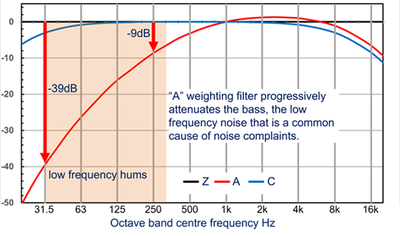
When compared to db(Z) and db(C) weightings, db(A) underreports low frequency hums which data centers emit (INVC)
To better understand how data center noise may impact local residences, schools, and livestock, the CDPHE should conduct an investigation of select data centers of varying sizes which are within three miles of any residential, school, or agricultural zones. This investigation may include use of infrasound microphones which meet industry standards (e.g. IEC) and include narrow band frequency analysis and target area analysis, as well as surveys and interviews with local residents and domain experts.
We expect this study to require one full time employee across two years. In the first year, this can be funded through a new one-time fee for all data centers owners and operators of a site of at least 10 MW of capacity. In the second year, this can be funded through fees associated with permits for generators, which CDPHE already requires, and for fines from non-compliance from data centers and industrial sites (as consistent with New York A09086). This application of fines is similar to Colorado’s Impact Cash Fund (§ 25-7-129). Future funding can also come from CDPHE annual emission fees.
Recommendation 4. Disclose data reporting and monitoring findings publicly
Rebuilding public trust requires transparent and independent disclosure. Therefore, we recommend the CDPHE collaborate with the Colorado Energy Office (CEO) to disseminate energy and water reports (Recommendation 1) and the CDPHE integrate fenceline monitoring data into existing platforms (Recommendation 2).
For monthly reporting of data centers’ energy generation, energy usage, and water usage, the CDPHE and CEO should conduct anonymization or aggregation (e.g. by county) required to protect industry secrets and make this data publicly available within 60 days through Colorado’s existing Open Data Portal. This data should be in a format which supports searching, filtering, data analysis, and downloading (e.g. a spreadsheet). Data should be publicly available for at least 10 years from reporting.
Fenceline air quality and temperature data should be made publicly available in approximately real-time through websites such as Colorado’s EnviroScreen and Love My Air. Historical data of at least 36 months should be available for download through public request to the CDPHE.
Regarding the noise pollution investigation (Recommendation 3), the CDPHE should produce publicly available updates every 4-6 months, and a final report within 24 months of receiving funding. This report can inform future standards for data center development and monitoring to mitigate negative impacts of noise pollution on residents, schools, wildlife and livestock. Specifically, local and municipal planning and zoning departments should use this data to inform decisions on data center sites (e.g. minimum distance from communities, farms, open spaces), resource allocation (e.g., grid power allocation, water allocation), and environmental impact mitigation requirements for new data center development.
Recommendation 5. Share data for Economic Development, Planning, and Research
The CDPHE should transmit this reporting and monitoring data to the Colorado Office of Economic Development & International Trade (OEDIT). Doing so will inform state research and development priorities for reducing the environmental impacts of data center operations while advancing economic opportunities. This data should be transmitted at regular intervals, jointly determined by CDPHE and OEDIT.
Conclusion
Data centers are crucial to advance AI innovation in the United States and an incredible opportunity for Colorado. Colorado could see an estimated $144 million in tax revenue and 28,000+ construction jobs and hundreds of permanent jobs across the next decade from 17 currently proposed data center projects.
However, these projects could also exhaust our water resources, compromise aging electricity infrastructure, increase utility rates, harm communities, wildlife and livestock, and violate the will of Coloradans. Monitoring and reporting managed by the CDPHE will ensure more transparency and build public trust, as opposed to asking data centers to voluntarily report or self-regulate. Through independent monitoring, reporting, and investigation on data centers’ environmental impacts, we can promote public trust, inform the allocation of natural resources, and enable responsible governance on future data center development.
Appendix 1. Relevant Legislation, Bills, and Memos on Monitoring and Reporting for Data Centers from other states
New York Senate Bill S9144A: Requires environmental impact reports for new data centers. This includes reporting current and maximum GW capacities and how energy is generated; total and daily water usage and how much water is lost; impact on farmland and prime farming soil; estimates on greenhouse gas and general air pollution emission, water and thermal pollution; noise pollution at half mile intervals from the property line; and health and general impacts on data centers.
Florida House Bill 1007: Any proposed large-scale data center within a 5 mile radius of a residential property or school would need to submit an independent study to ensure state and local law compliance, which may also include “low-frequency noise attenuation measures.” Any data center with an average daily usage of 100,000 gallons or more must report anticipated sources, amounts, and losses of water and a plan that incorporates water recycling.
Wisconsin LRB-6377/LRB-6391: Co-sponsorship memorandum calling for mandatory public reporting of electrical and water use, ensuring data centers do not invest in fossil fuels.
Vermont S0205: Requires the public utilities commission to investigate impacts of data center construction and operation on the state and report to legislative committees. Environmental impacts include “water quality and availability, air quality, local ecosystems, noise emissions, and the availability of surrounding land for other purposes, including farming, conservation, recreation, and housing.” Electrical reporting includes increases to electrical load, ways to strengthen grid reliability and security, ways to promote sustainable and efficient energy usage, and ways to reduce increased electrical costs on other customers. Water reporting include consumption of the cooling of computing equipment used.
Oklahoma SB 1488: Requires regulatory agency to investigate the impacts of data centers on the state’s water supply, utility rates, property rates within a 3 mile radius, and anything else determined necessary by the commission.
Nebraska LB1111: Requires annual reports on data center power usage for data centers using 20+ MW.
Appendix 2. Methodological notes
We assumed the stated energy capacity of data centers were their total facility capacity, not just IT capacity (known as critical megawatts, CMW). If the capacity reported was CMW, you have to multiply by the power usage effectiveness (PUE) ratio to calculate total facility capacity. PUE ≥ 1.0, where 1.0 is ideal and means 100% of power is used for IT. We also assumed facilities operate at their maximum capacity at all times, which AI data centers claim to but may not be true in common scenarios, such as when data centers’ IT usage is below capacity and/or when less cooling capacity is required. Water consumption was estimated based on energy consumption assuming a Water Use Efficiency (WUE) of 1.8L / kWh, a stated average for data centers, and that a data center is running at its stated maximum capacity at all hours. This equates to an annual water consumption of up to 4,165,857 gallons of water per MW (1 MW x 1,000 kW / 1MW x 1.8 L /kW x 1 gallon / 3.78541 L x 24 hrs/day x 365 days/yr). The minimum WUE is 0 (no water usage) which two data centers in Colorado Springs are working towards (Project Taurus and NOVVA). For reference, a three building data center totaling 60MW (CoreSite DE3) has a reported maximum water usage of 805,000 gallons a day. This translates to a WUE of 2.12 L / kWh.

We used 2020-24 census data to assume 2.42 people per CO household and 73 gallons of water used per resident daily (based on data from 15 CO cities in 2022). Therefore, an average CO household uses 64,481 gallons per year. To calculate the equivalent energy usage for Colorado households, we used a 2023 estimate of 8,302 kWh for an average household annually.
We used census estimates for 2025 to estimate the population. The population estimate for 1 July 2025 is 6,012,561, or 2,484,529 households assuming 2.42 people per household.
Data centers provide the most economic benefit during the construction phase. The 17 proposed data centers in Colorado could generate $144 million in tax revenue over 10 years and create 28,696 construction jobs, providing a boon to union labor and local economies. However, completed data centers have mixed permanent employment impacts. A hyperscale data center of 100 MW is estimated to result in 43 permanent jobs, with the number of jobs increasing at an unknown rate with the data center size. Most permanent jobs are typically low-wage, term-limited, non-technical positions (e.g. security, janitorial).
While tax breaks to incentivize data center development are becoming popular, they do not necessarily translate to significant permanent job creation. For example, a $77 million tax break in New Jersey resulted in one permanent high wage job. CO HB26-1030, a bill which lost in the 2026 legislative session, only required 10 permanent jobs for a $250 million minimum investment in data center development. Data centers are among the least labor-intensive structures in the economy, with typically no potential for further creation of permanent, high paying jobs without additional expansion.
Colorado’s climate goals include 80% of electricity coming from renewable sources by 2030. The three largest sources of renewable energy in Colorado are wind, solar, and hydroelectric. However, the federal government has cut more than $600 million in clean-energy funding, and droughts have hindered hydroelectric generation capacity in waterways such as the Gunnison River. As renewable energy generation faces challenges, data centers risk further impeding state climate goals. The five proposed hyperscale data centers which total 1,977 MW of capacity alone (see Table 1) could consume about 1/3 of all renewable energy estimated to be generated by 2030. This consumption does not consider the 68 existing data centers or other proposed data centers. It is therefore unlikely that Colorado can meet state climate goals with unregulated data center development.
To meet greater electricity demand, utility companies must add or upgrade transmission and generation infrastructure. This cost can be passed down to the consumer, resulting in increased utility rates. In Colorado, the Public Utilities Commission (PUC) must approve all rate changes. Alternatively, data center developers can pay for infrastructure upgrades. CO HB26-1030, a bill which lost in the 2026 session, proposed having data center developers invest in utility modernization in order to be eligible for tax incentives.
Establishing the Colorado Applied AI Workforce Initiative
The use of AI in the workplace is expanding and outpacing access to applied training, which remains inconsistent or unavailable altogether. Jobseekers, employees at smaller organizations, and local public workers need more than access to a model or a vendor course. They need practice choosing useful tasks, protecting data, testing outputs, and explaining where human judgment remains necessary. The Colorado Applied AI Workforce Initiative would provide 1,000 participants in one metropolitan and one rural region training through real or realistic workplace tasks. Each learner in the two-region pilot would build a bounded agent and receive a portable record of independently assessed skills. The result would be a broader pool of workers who can use AI responsibly, smaller employers better able to adopt useful tools, and public agencies better prepared to improve services without giving up accountability.
Challenge and Opportunity
In Q2 2026, Gallup reported that 52 percent of U.S. employees used AI in their role. That adoption creates an opportunity to improve efficiency, but it also creates risk when employee access to training, approved workflows, and review controls is either inconsistent or not available at all.
Access to a large language model is not evidence of job-ready skill. A county employee, for example, might use a bounded agent to retrieve policy, draft a sourced resident notice, flag missing facts, and stop for approval. The employee still has to decide whether AI belongs in the task, protect sensitive information, test difficult cases, correct errors, and explain the decision. That is the opportunity and the gap: people can use AI to handle routine work, but they need training to decide when it is appropriate and remain accountable for the result.
Among Colorado employer businesses that reported using AI in a business function, only an estimated 15.1 percent had trained current staff in the previous six months. While Colorado’s Office of Information Technology (OIT) has published AI guidance and training, it is limited to state employees and contractors. Colorado workforce centers already provide jobseekers with computer and internet access and training, while the state’s Digital Navigator pilot demonstrated how libraries and rural workforce centers can be used to address device, connectivity, and digital-skills barriers. The Colorado Applied AI Workforce Initiative would fill this gap and create a common applied standard for local workers.
Colorado must act before unequal access becomes a durable workforce divide. In the San Luis Valley, 15.5 percent of households lacked home broadband service, so applied training must include accessible, low-bandwidth, and in-person options. Workforce centers, colleges, libraries, and local partners can bring training closer to residents. Connecticut’s Tech Talent Accelerator shows how colleges and employers can develop applied AI programs, while New Jersey’s emerging library network shows how public libraries can serve as community access points. Colorado can adapt both structures while testing one common standard across metropolitan and rural conditions.
The need is immediate; as of January 1, 2027, SB 26-189 will require developers and deployers of automated decision-making technology to provide documentation for how these tools are used. Developers must provide technical documentation describing the tool’s intended uses, categories of training data, known limitations, and instructions for appropriate use and human review, and deployers will be responsible for providing consumers with a description of the tool’s role within a consequential decision. Yet, this legislation creates no corresponding program to train employees to do this work.
Plan of Action
Recommendation 1. Establish the initiative and make an individually built AI agent the core training artifact.
The next Colorado Governor should establish the Colorado Applied AI Workforce Initiative and direct the Colorado Department of Labor and Employment (CDLE) to develop the applied AI training standard, eligibility requirements, records protections, and evaluation process within 90 days. Eligible training participants should include Workforce Innovation and Opportunity Act (WIOA) adults, youth, and dislocated workers, along with other jobseekers, workers at organizations with fewer than 250 employees and no comparable training, and local government workers.
During the 90-day design period, CDLE would collaborate with the Office of the Future of Work to bring together workers, small employers, local governments, workforce centers, colleges, libraries, rural partners, and disability-access experts. It would use that group to identify real workplace tasks, surface access barriers, and recruit regional partners. CDLE would retain control of the standard, funding, procurement, provider selection, records, compliance, and evaluation.
The training should cover six competencies needed to apply AI at work:
- Task selection: Define the user, workflow, baseline, result, and whether the task calls for no AI, a hosted model, or a managed open-weight model.
- Data protection: Classify information, restrict sources and tool permissions, and keep protected data out of the agent.
- Output verification: Test held-out cases, source grounding, repeated runs, abstention, and escalation.
- Error and bias recognition: Find security failures, factual errors, and counterfactual disparities, then correct and retest them.
- Documentation and human review: Record choices, sources, cost, corrections, residual risks, and the human approval point.
- Supervised workplace application: Build and defend a bounded AI agent that performs a real or realistic workplace task under independent assessment.
Each learner would build an AI assistant for one clearly defined workplace task. The provider would supply a secure workspace, approved source materials, and up to three managed tools. The assistant could retrieve information or simulate an action, but it could not change live records or make a decision on its own. The provider would set limits on tool calls and run time. The learner would test the result, explain the design, and obtain human approval before use. Examples could include a hosted service such as ChatGPT or Claude and a provider-managed open-weight model such as Qwen3 running through Ollama.
The training should consist of six weekly sessions totaling 24 contact hours: 12 hours of instruction, eight hours of guided construction and testing, and four hours of testing, demonstration, defense, and feedback. Sessions would progress from the problem, baseline, data, and deployment approach through configuration, security, reliability, bias, and outcome testing. Learners would be required to submit the artifact package before the final session.
Possible projects include a resident-notice agent based on county policy, a safety-procedure agent using approved manuals, or an occupation-research agent using workforce sources. Regardless of the task, every artifact package should contain five parts:
- The problem statement, affected user, baseline workflow, success measures, and a no-AI alternative (e.g., traditional automation).
- A working bounded agent with approved sources, limited tools, stop conditions, logs, and a human approval point.
- A comparison of a hosted proprietary environment, a hosted or provider-operated open-weight environment, and the no-AI baseline using the same cases.
- Functional, security, and fairness tests showing results, failures, corrections, and retests.
- Measured results and a live demonstration.
To pass, a learner must demonstrate all six competencies in a working artifact. An independent assessor would score the work during a live demonstration and brief oral defense. Providers would give managed access for one revision within five business days, without requiring a personal device, account, or home connection. The portable record would report pass or fail for each competency.
Recommendation 2. Run a two-region pilot and test whether the training standard works under different access and labor-market conditions.
CDLE should launch a pilot to test the training program over 12 months. The pilot should enroll 1,000 people across one metropolitan and one rural region, with at least 300 rural seats. Training should be run with cohorts of 20 to 25 participants, and should be delivered in-person or through an instructor-led hybrid format. Workforce centers, colleges, local governments, libraries, adult educators, and schools should serve as access points. CDLE should select providers based on population reach, task validation, instructional and assessment capacity, accessibility, connectivity, safeguards, and scheduling, without regard to vendor affiliation.
Both regions would use the same case material, rubric, and independent scoring process. Delivery must meet applicable Colorado WCAG 2.1 A and AA requirements and provide low-bandwidth options, assistive technology, accessible documents, and equivalent tool paths.
For procurement, CDLE would compare proprietary hosted, open-weight hosted, and provider-operated configurations under the same performance, security, and accessibility requirements, maintaining a tool-agnostic approach. The state should own publicly financed core training components or hold perpetual rights to reuse and adapt the training, excluding third-party intellectual property. Before pilot launch, CDLE must identify providers with a compliant design within their budget. Cost constraints should not weaken the training competencies, accessibility, security testing, or independent assessment.
Prior to enrollment, CDLE must define evaluation measures for the pilot. These measures should include employment status, wages, career level, opportunity to apply AI in the workplace, and workplace use. Wage and advancement results, measured through changes in career level, would be descriptive rather than continuation conditions. An opportunity must include paid or supervised work, approved tool access, and a pre-mapped task. Documented use requires employer confirmation or evidence that the participant applied a pilot competency to a real task in the workplace. An independent evaluator would collect these measures at enrollment and 120 days after a participant passes every competency, then report them statewide and by region.
Training expansion would require at least 75 percent completion among all enrollees statewide and in each region, usable 120-day follow-up for at least 70 percent of verified completers, an opportunity to apply AI for at least 50 percent of verified completers, and documented workplace use by at least 60 percent of opportunity-qualified completers. Only completers with usable follow-up may count as opportunity-qualified, and nonresponse would not count toward any numerator. An unresolved material safety or privacy incident would independently block expansion.
Before the final evaluation, CDLE would review the first 200 final artifact deadlines, including at least 60 learners in each region. New enrollment should pause if fewer than 150 participants have passed, either region falls below 75 percent completion, or projected spending exceeds the $2.8 million ceiling.
The pilot would have a $2.8 million spending ceiling. This proposal would cap any Workforce Innovation and Opportunity Act Governor’s Reserve contribution at $1.5 million, subject to available funds, participant and cost eligibility, lawful procurement, and required reporting. Signed nonfederal commitments would cover the balance.
Recommendation 3. Assign post-pilot training ownership if final evidence supports continuation.
If the pilot meets every continuation condition in Recommendation 2, the Colorado General Assembly should decide whether to authorize and fund statewide expansion. CDLE should lead the pilot unless later law assigns the initiative to another agency. HB 26-1317 directs its transition committee to recommend how specified workforce functions could move to the Department of Higher Education, but the act does not itself transfer CDLE programs or WIOA duties. Any continuation law should name the permanent owner. The designated agency should maintain the training standard, curriculum, rubric, records, model approvals, task and test banks, scaffold, evaluation measures, provider standards, provider roster, reporting, and evaluation. State-agency use would remain subject to Office of Information Technology review.
Timing matters because HB 22-1350’s Opportunity Now is scheduled to be repealed on July 1, 2028. If lawmakers extend it, that legislation could authorize continuation of this initiative and designate its permanent owner. Expansion funding should remain unavailable until final pilot results meet every continuation condition.
Conclusion
Colorado has a chance to shape an AI-enabled workforce before access to applied training becomes another source of inequality. A focused pilot would help workers build evidence they can carry across employers, help smaller businesses adopt useful tools without bearing the full cost alone, and help public agencies improve routine work while keeping human accountability.
It would also give the state a controlled way to learn what works in metropolitan and rural communities. If the evidence is strong, Colorado can expand a standard that workers, employers, and agencies can trust. If it is not, the state can stop before committing to a larger system.
Vendor courses are useful, but Colorado needs a common applied standard. The pilot requires a working agent, documented testing, and independent results that travel across tools and employers.
The 24 hours are structured contact time. A managed scaffold and limited tools keep the project narrow. Learners submit work before the final session, demonstrate it live, and may revise once after independent scoring.
No. Learners compare hosted, open-weight, and no-AI approaches on the same task. Choosing conventional methods is sound judgment when they perform better on accuracy, cost, accessibility, or risk.
At least 300 seats serve the rural region. Local access points provide devices, low-bandwidth delivery, assistive technology, and accessible tool paths. Participants need no personal device, vendor account, or home connection.
Expansion requires regional completion, sufficient follow-up, verified workplace opportunities, and documented use. Withdrawals and nonresponse remain visible. Any unresolved material safety or privacy incident blocks expansion.
The amount is a pilot spending ceiling, not tuition. WIOA may contribute up to $1.5 million for eligible costs. Nonfederal commitments cover the balance, and wages remain separate. The state retains rights to core materials, while legislation assigns a permanent owner only if the evidence supports continuation.
How to Plan for Future Generations of Colorado Business Owners
Colorado faces two converging shocks: over 76% of Colorado’s 730,887 small businesses are owned by baby boomers, most without a succession plan and today 92% of small business exits occur through closure. At the same time, Artificial Intelligence (AI) is thinning the entry-level job market Colorado’s college graduates have always counted on. The Colorado Succession Through Apprenticeship (STA) Program turns two problems into one solution: a state-coordinated pipeline that trains graduates to evaluate and operate existing businesses, then connects them to owners ready to show them the ropes and eventually hand over the keys. It builds on assets Colorado already owns — its universities, its small-business density, and the Office of Economic Development and International Trade’s (OEDIT) economic development tools — to keep jobs and wealth in local communities and to position the state as the national model for the Great Ownership Transfer, a term used to signify the largest intergenerational wealth shift.
Challenge and Opportunity
The impact of the Great Ownership Transfer on the U.S. economy could lead to significant job losses. While small businesses account for 99% of all U.S. companies, they employ about half of the nation’s workforce and represent 43.5% of our GDP. “Today, an alarming 92% of small-business market exits occur through closure, while only 5% are completed as sales, and 3% are transferred to new owners”.
Over three-quarters of Colorado’s 730,887 small businesses are boomer-owned, and many have no succession plan. These businesses employ an estimated 1.2 million people. According to the Small Business Administration, the leading types of Colorado small businesses include:
- Professional, Scientific, and Technical Services
- Real Estate and Rental and Leasing
- Construction
- Transportation and Warehousing
- Other Services (except Public Administration)
- Health Care and Social Assistance
- Administrative, Support, and Waste Management
- Retail Trade
According to the Exit Planning Institute, a majority of business owners want to ensure their business remains financially viable, with 70% preferring an internal transfer, 17% seeking an external sale, and 13% unsure of next steps. A willingness to find a reasonable succession is evident, and college graduates open a new bridge for ownership transfer.
College graduates are experiencing a decline in entry-level career opportunities due to AI. A 2025 study found that entry-level job postings declined by 35%. Today, according to the Federal Reserve Bank of New York, about 5.6%–5.7% of recent college graduates are unemployed, up from 3.6% in March 2019. New college graduates are facing a career headwind.
The two trends create an uncommon opportunity to create new entry-level jobs while providing boomer-owned small businesses with a potential succession and ownership path for Generation Z. The window for intervention is open, but every year without a bridge means more businesses close and more value evaporates. Colorado has the university infrastructure, the small business density, and the policy tools to act.
The Colorado STA Program addresses both challenges simultaneously by creating a structured pipeline between university students and boomer-owned small businesses seeking new ownership.The program works in sequence across three components.
- Working with local chambers of commerce and Small Business Development Centers (SBDC) in coordination with OEDIT, small businesses whose owners are within a decade of exit will be identified.
- Universities design a dedicated small business curriculum that is distinct from traditional, startup-focused entrepreneurship programs. The STA Program curriculum trains students to evaluate, acquire, finance, and operate an existing small business.
- Selected universities host an annual STA Summit that brings both groups into the same room, creating a matching marketplace supported by legal, financial, and succession planning advisors. The annual conference can be supported by sponsor and exhibitor fees.
The combination of these components results in the STA Program, in which students begin work in a small business, the small business owner transfers knowledge and gains confidence in the potential new owner, and, in several years, a bridge is formed to begin the shift to a new owner.
The model is proven with medium-sized businesses with about $8 million in revenue and thirty-plus employees. Elite MBA programs at Wharton, Chicago Booth, and UVA Darden already offer Entrepreneurship Through Acquisition (ETA) programs for mid-market companies. Colorado also has a few emerging ETA programs. However, what doesn’t exist is a version designed for Main Street that is accessible to a broader range of graduates and aimed at continuity of small business rather than closure. The Colorado STA Program builds that model first and creates the opportunity to export it nationally. It creates a new program – Succession Through Apprenticeship.
Colorado STA Program Recommendations
Recommendation 1. The Governor drafts and signs an executive order to start the STA Program pilot, instructing OEDIT to begin the work.
The Governor should launch the Colorado STA Program by executive order, without waiting for legislation. They hold the authority to direct OEDIT’s priorities, convene state agencies, and partner with local SBDCs and chambers of commerce; each having critical stakeholder roles with a full set of responsibilities the pilot requires.
The STA Program overview
A state-coordinated pipeline in three components:
- identify boomer-owned businesses within a decade of exit, working with SBDCs and local chambers of commerce.
- develop a university curriculum that trains students to evaluate, finance, and operate an existing small business.
- host an annual STA Summit that matches the two groups. Students enter as apprentices, learn the business over three to five years, and transition into ownership. Small business owners learn succession planning requirements and responsibilities.
The Goal is to have measurable structural change. The fewer small businesses closing, more transfers of ownership, and more graduates on a path to own an existing small business.
The Key players include:
- The Governor’s Office directs; OEDIT implements.
- The Colorado Economic Development Commission can facilitate funding; the Colorado Employee Ownership Commission can guide design and implementation, building on OEDIT’s existing cooperative and employee-ownership programs.
- SBDCs, local chambers, and city economic-development offices supply the business pipeline; and pilot universities and community colleges deliver the curriculum and host the Summit.
The Cost would be an estimated $200,000 to $350,000 in seed funding across the three-year pilot, drawn from existing OEDIT economic-development resources rather than a new appropriation. Seed funds cover curriculum development, business identification and outreach, and the STA Summit. No funding is necessary for student tuition or acquisition financing, which are addressed separately. The Summit is designed to become self-sustaining through sponsor and exhibitor fees.
The executive order. Appendix A sets this in motion. It establishes the Program within OEDIT, assigns the three components and the interagency roles above, directs a Request for Proposals to pilot institutions, sets pilot KPIs (100 students, 150 businesses, 25 in-process transitions by Year 3), and calls for a Year-3 evaluation with a recommendation on statutory codification.
Recommendation 2. Identify two higher education institutions (e.g., business schools within universities and community colleges) to design a curriculum, pilot the program, and host a Colorado STA Summit.
The goal is to identify two pilot institutions — one urban, one rural or regional — to launch the STA Program curriculum and host an inaugural Colorado STA Summit. Example candidates include the University of Colorado Denver Business School, Colorado Mesa University, Pueblo Community College, Western Colorado University, and Fort Lewis College. The selected educational institutions should already have a focus on first-generation students, diverse students from Colorado communities, and non-traditional programs that support unconventional career paths.
In many cases, universities and community colleges may have existing small business courses that can be incorporated into the STA Program curriculum (e.g., accounting, marketing). Others may need to be developed, such as an introduction to acquiring a small business, small business strategies, and financing for small businesses (acquisition and operations). The two pilot universities/community colleges would conduct an assessment and return to OEDIT with a proposed curriculum track, including what already exists and the gaps to be filled.
The STA Summit would be a requirement for the selected universities and community colleges. The Summit should be a collaborative effort with key players to determine whether it should be hosted in one city or two as part of the pilot, or held in conjunction with the Rocky Mountain ETA Conference.
Recommendation 3. Map and evaluate the financial resources available to support the new small business owner in the succession plan.
New owners taking over an existing business can generally finance the purchase through a combination of SBA 7(a) debt, seller financing, and outside equity, layered with Colorado’s CDFI lenders (Colorado Enterprise Fund, B:Side), state credit-enhancement programs (Cash Collateral Support, the Colorado Revolving Loan Fund), and community bank and credit union SBA lending. The STA Program should map these resources across the federal, state, CDFI, and depository levels to align them around succession transitions and identify where a targeted state intervention would fill the financing gap.
After the evaluation, if additional tax incentives or financing programs are required, OEDIT should develop recommendations and work with the Colorado House Business, Labor, and Technology Committee. Additionally, funding ideas and recommendations should be coordinated and developed with the Governor’s office.
Recommendation 4. Connect and collaborate with Colorado SBDCs, local chambers of commerce, and city economic development teams.
Working and collaborating with local businesses and development centers is essential during the first year and then ongoing. In Year 1, the Governor directs OEDIT to work in partnership with credible sources (e.g., SBDCs, local chambers of commerce, and city economic development departments) to identify the owner(s) name, business type, location, planned time for succession (e.g., within 12, 24, 36, 48, etc. months), and preferred succession plan (e.g., family member, a general sale and acquisition process, or business ownership transfer through a structured program to a recent college graduate).
A critical objective is to educate local business and economic development centers about the STA Program, identify potential candidates, and host succession-planning seminars. Small business owners attending the seminars become prime targets for the STA program and can serve as key stakeholders in its early development and implementation.
As part of this effort, OEDIT should leverage its existing co-op and employee ownership programs designed to assist with succession planning. The work needs to be complementary and collaborative.
Recommendation 5. Evaluate the STA Program outcomes and recommend next steps for the Governor and state legislature.
As the three-year pilot program concludes, OEDIT publishes a formal program evaluation with a recommendation to scale, modify, or expand. A successful pilot positions Colorado as the national model for connecting the next generation of business owners with the legacy businesses that need them.
Key metrics for evaluating structural change are simple to measure: fewer businesses closing, more businesses transferring, and more graduates on a path to own an existing small business. Within the three-year pilot, other KPIs include:
- 100 students in the STA Program curriculum across a minimum of two higher education institutions.
- 150 small businesses interested in learning about STA and connecting with enrolled students.
- Year 3 target: 25 in-process ownership transitions.
At the end of three years, the STA Program should be evaluated, with recommendations for moving forward.
Conclusion
The cost of waiting is concrete: businesses close, jobs disappear, communities weaken, and graduates remain underemployed. Today, 42% of recent college graduates are underemployed, working in jobs that don’t require their degree. At the same time, Colorado’s small businesses generate more than $225 billion in annual economic output, a foundation now at risk as a generation of owners approaches retirement. We cannot afford to lose our young talent to underemployment, nor to let the value small businesses create slip away for want of a succession plan.
The cost of acting is far smaller: a pilot program that connects two assets Colorado already has — its higher-education institutions and its legacy of small businesses — and builds a bridge between them. New undergraduates gain the chance to learn a business and, in time, to own it; aging owners gain a ready-made succession plan and a capable successor. It is an ideal match: one that preserves the state’s economic foundation while keeping our next generation of talent rooted in Colorado’s opportunity.
Initially, the program would be designed for undergraduate students. The primary reason: it is expected that an undergraduate student would spend 3-5 years as an apprentice in the small business. The process would be:
- Students enroll in the STA Program curriculum. By enrolling in the track, they indicate their interest in eventually owning a small business.
- In their senior year, the students will identify the types of small businesses they would like to pursue as a career. Information will be shared on the types of businesses that have expressed interest in working with a student.
- A capstone project during the last semester before graduation is to complete a co-designed project with a small business owner. By doing this, the small business owner and the student could determine whether they could work together.
- Before graduation, a match will be made, and a succession agreement will be signed by the owner and the student, outlining expectations and potential outcomes.
- When the student begins work at the small business, they should receive a mutually agreed-upon salary and stock ownership plan.
- In the two years before the small business owner retires, the new owner (i.e., the former student) develops a financing plan to acquire the business.
- The new owner takes over the business as the succession plan ends.
Succession through apprenticeship occurs over a three- to five-year period.
ETA has a strong, well-documented record, mostly above Main Street. The 2024 Stanford GSB Search Fund Study, covering 681 funds since 1984, found that about 57% of searchers successfully acquire a company, with an aggregate pre-tax internal rate of return of 35.1%. Programs at Wharton, Chicago Booth, and Darden have built durable pipelines around the model.
Two caveats matter for Colorado. First, traditional search funds target mid-market companies — with a median acquisition enterprise value near $8.8 million — not the corner businesses at the center of the succession crisis. Second, the model centers on young entrepreneurs backed by mentorship and capital, but typically by experienced MBAs rather than undergraduates.
The STA Program’s job is to adapt a proven mechanism to a smaller deal size and an earlier-career operator, which is precisely why structured curriculum, vetted matching, apprentice-based learning, and a tailored financing pathway are essential rather than optional. Undergraduate students would begin working in the small business as apprentices to learn the business and gain the necessary expertise and knowledge.
Because for many owners, those other doors are already closed. The Exit Planning Institute finds that 70% of owners would prefer an internal transfer, and a new graduate joining the business as an apprentice can fill this preference. In a large share of cases, no family member wants the business, and the owner has no clear succession plan. That’s who the STA Program is built for: the owner staring at closure because the obvious successors don’t exist.
The STA Program doesn’t compete with family or employee transfer. It catches the businesses that those paths leave behind and gives a prepared, vetted graduate a reason for the owner to pick continuity over a liquidation sale.
During the last two years or so, Colorado has developed an ETA ecosystem, concentrated on the Front Range. CU Boulder’s Leeds School, through its Deming Center for Entrepreneurship, is building ETA courses, an executive-education program, and the Rocky Mountain ETA Conference, whose inaugural event drew more than 200 attendees in partnership with Colorado State University, the Colorado School of Mines, and the Denver ETA Meetup. The University of Denver’s Daniels College has added ETA to its Entrepreneurship@DU offerings, launching a one-credit ETA “sprint” for undergraduate and graduate students in early 2026. In short, the model has momentum here.
That activity and the STA Program serve different people, different businesses, and a different transaction. Colorado’s existing ETA is a graduate, MBA, and executive-education offering built on the search-fund model: A buyer with capital and operating experience raises money, searches for a target, and acquires an established business — often mid-market, and typically financed through a mix of SBA loans, seller financing, and outside equity. The STA Program is an undergraduate, apprenticeship-first pathway aimed at Main Street. A student works inside a small business for three to five years, learns how it runs, and transitions into ownership through a planned succession. Put simply, ETA is buy-then-operate; STA is apprentice-then-own. The apprenticeship model, along with the Main Street succession segment it serves, is uncontested.
That makes the STA Program complementary rather than competitive. The current ETA scene is buyer-side and skews toward businesses large enough to support a search fund and acquisition debt. STA addresses the other end of the market — the Main Street businesses that today close for lack of any buyer, and the graduates shut out of a thinning entry-level job market. It also creates natural partners rather than rivals. The annual Rocky Mountain conference is a ready-made channel for the STA Summit and its advisor network; and the SBA lenders and CDFIs already active in ETA can finance STA transitions.
The takeaway for timing: Colorado’s ETA momentum validates the demand behind STA rather than undercutting it. Capital, talent, and institutions are already mobilizing around the Great Ownership Transfer, but on the buyer side and the mid-market, leaving the undergraduate-to-owner pipeline and the Main Street succession gap unserved. The STA Program is the missing complementary piece, and building it now lets Colorado lead the full model rather than just the search-fund slice.
The three-year pilot is estimated to cost an estimated $350,000, funded from existing OEDIT economic-development and Future of Work funds rather than new appropriations. Planning estimates:
- Curriculum development seed, two institutions (Years 1–2): $105K–$220K.
- OEDIT program coordination, part-time (Years 1–3): $50K–$75K.
- STA Summit state backstop (Year 1; sponsor- and exhibitor-funded thereafter): $25K–$30K.
- Independent evaluation (Year 3): $20K–$25K.
That puts the full pilot at roughly $200K–$350K over three years. Only if the pilot meets its targets does the program seek multi-year legislative appropriation.
A collaborative funding model should be pursued. The selected universities and community colleges should invest in curriculum development, as it would be a key differentiator for the institutions in attracting students interested in small business ownership. Additionally, seminars and workshops could be hosted for existing small business owners (e.g., succession planning, financing an ownership transfer, mentoring business leaders).
It connects them; it doesn’t copy them. Each existing resource solves one piece and stops at the edge of the next. The SBA finances acquisitions but doesn’t train buyers or find sellers. The SBDC advises owners but doesn’t supply a pipeline of prepared successors. Private exit planners serve owners who can already afford them — a narrow slice of Main Street. None of them does the one thing that STA does: build the buyer pipeline and the matching marketplace that makes the rest usable.
The STA Program is the connective tissue, and every participant it produces becomes a customer for the SBA, SBDC, and exit-planning tools already in place. It increases the throughput of existing programs rather than competing with them.
Modernizing Colorado Permitting to Lower Housing and Construction Costs
Among states, Colorado ranks 50th of 51 states (including Washington, D.C.) as the least affordable housing market, reflecting high purchase prices, construction costs and regulatory friction. Why has housing “suddenly” become so expensive? One known contribution is permitting. For routine residential projects, delays increase the cost of repairs, replacements, panel upgrades, rooftop solar, and other household improvements.They also disrupt contractor scheduling, reduce the productivity of a construction, and repair workforce that is already stretched. Colorado’s permitting system is, as most individuals want, decentralized. Cities and counties administer building permits, while the state regulates selected activities and structures, resulting in different application requirements, review processes, technologies, and timelines across jurisdictions. The most important modernization challenge is not necessarily the technical building code itself, but the administrative fragmentation surrounding routine, standardized projects, such as those for HVAC, water heaters, or roof work.
Colorado is well positioned to modernize permitting for routine, low-risk residential projects by implementing a risk-based scoring system for faster review and approval. Permitting plays an important consumer protection role, so modernization should preserve inspections, documentation, enforcement, and penalties while eliminating avoidable administrative delay. Colorado should pursue three reforms:
- Private builders, in coordination with DOLA, should develop a risk-based framework that distinguishes projects requiring full review from those eligible for simplified or automated approval.
- The state should help and incentivize local governments to adopt fast-track pathways, tools, data standards, and transparent performance measures.
- The General Assembly should authorize a thoughtfully considered third-party certification pathway for eligible projects, subject to independence requirements, audits, inspections, and state oversight. Together, these reforms would reduce delays and household costs while preserving local code-enforcement authority and public safety.
Challenge and Opportunity
Colorado’s affordability challenge is characterized by a growing gap between household earnings and the cost of basic services, housing, insurance, transportation, utilities, and home maintenance. The pressure is especially acute for young families, first-time and middle-income homeowners, and employers trying to attract and retain workers in competitive markets. While the Front Range faces the most visible affordability strain, mountain, rural, and Western Slope communities also face rising costs and limited contractor capacity.
Permitting is not the only driver of these costs, but it is a practical and often overlooked administrative lever. Routine residential projects can be delayed by rules, inconsistent documentation requirements, manual intake processes, and local interpretations of similar project types. These delays increase financing costs, disrupt contractor scheduling, and raise prices for homeowners. They also reduce the productivity of a construction and repair workforce that is already stretched. The impact can be quantified in three ways:
- the number of households/projects affected
- the number of days added to routine work(
- the economic value of that delay.
Recent CSI research in Arizona found that permitting added about 23 days to residential project timelines on average, and each additional day of approval time was associated with roughly four additional days of total project time. Because the affected projects are high-frequency household improvements, HVAC replacements, water heaters, electrical panels, roof work, and rooftop solar, even modest delays can scale quickly across thousands of households. For example, if 25,000 routine residential projects in Colorado experienced only a 10-day avoidable delay, that would equal 250,000 household-days of delayed repairs or upgrades, before accounting for contractor downtime, rescheduling costs, financing costs, or higher consumer prices.
The opportunity is to distinguish between projects that genuinely require complex review and projects that can be safely processed through standardized pathways. A water heater replacement, like-for-like HVAC replacement, panel upgrade, or standardized rooftop solar installation should not face the procedural friction as complex replacements or developments.
When jurisdictions treat routine work as a custom administrative process, Colorado households pay for avoidable delay. For example, selected jurisdictions in Colorado already have a partial model in app-enabled permit processing for solar projects, which is available in Denver, several smaller jurisdictions, and through the state electrical permitting process for eligible solar projects. That system uses standardized criteria to move qualifying residential solar permits through faster front-end review while preserving inspection and code-enforcement authority.
Routine projects are a high-return starting point because they are common, standardized, and directly affect household costs. Faster permitting for repairs, replacements, panel upgrades, and rooftop solar can produce immediate benefits while building the infrastructure for broader permitting modernization over time.
The infrastructure can be built through pragmatic effort because each decision maker has a defined role: local governments run the permitting systems and/or work with a private provider while maintaining authority when it is needed, the Governor’s Office can convene agencies and create public performance pressure, the General Assembly can authorize legislation and one-time implementation funding, and state housing and regulatory agencies can provide model rules, technical assistance, and safety oversight.
Build from Existing Models
Colorado should not treat this proposal as starting from scratch. SB25-002, the 2025 regional building codes legislation for factory built structures, provides a useful template: it creates a state-led framework, accounts for regional conditions, limits inconsistent local treatment of factory built housing, allows third-party review and approval of final design and construction plans, and requires audits of third parties that review plans or conduct inspections. That model is directly relevant because it balances statewide clarity with local implementation and oversight rather than relying on broad preemption alone.
The state can also continue to build on its experience with SolarAPP+, an automated review platform for eligible residential rooftop solar projects. SolarAPP+ has been available to Colorado permitting authorities since its national launch in 2021, although adoption within Colorado has been gradual and remains limited to participating jurisdictions and eligible projects. SolarAPP+ demonstrates how standardized project information and objective eligibility criteria can move routine projects through front-end review quicker while leaving inspections and enforcement with the permitting authority. Its principal lesson for the broader proposal is that automation works best when project categories, required documentation, and code-compliance checks are defined in advance.
Colorado can also glean some insight from California. California’s AB 253, signed in 2025, allows an applicant to retain a private professional provider for residential plan check when the local review timeline exceeds 30 business days or when no applicable reviewer comments or sign-offs occur within 30 business days. San Diego’s implementation guidance illustrates the guardrails Colorado should emphasize: the private provider must be, in some way, credible of the trust offered by purchasers, must not have a financial interest in the permit or plan preparation, must submit an affidavit and plan-check report, and city inspections continue. The lesson is not to outsource safety; it is to offer a pressure release valve for delays while preserving public inspection and enforcement authority.
These examples suggest three design lessons for Colorado:
- start with clear project categories
- require independence and auditability for any third-party reviewer
- fund the data infrastructure needed to compare jurisdiction performance.
Without legislative direction and resources, a performance report may be difficult to implement because local permit data are often inconsistent, unavailable, or not reported in comparable formats.
Plan of Action
Recommendation 1. Establish a risk-based framework for routine residential permitting.
Before adopting statewide permitting standards, the Governor’s Office should direct DOLA’s Division of Housing to convene an official technical working group to develop a risk-based framework for routine residential improvements. At the same time, an independent private-sector group should develop and publish its own proposed framework using comparable project categories and safety criteria. The independent review would provide an external benchmark and identify areas in which government and private experts reach similar or different conclusions. After independently developing their recommendations, the two groups should develop a private-public technical working group with co-chairs from the private sector and one from DOLA to resolve disagreements. Although debatable whether independence would be the most effective path initially, an important aspect of the scientific process is independent verification, and as such, independent verification is what is suggested here. As a point of note, perhaps the most comparable example to what is proposed here is the National Renewable Energy Laboratory’s development of Solar APP+, built collaboratively with local governments, code-development organizations, and industry stakeholders to establish standardized criteria for automated residential solar permitting.
As a point left for debate, after considering both groups’ findings and the joint group’s work, and after publishing an explanation of how significant disagreements were resolved, policymakers may want to debate whether responsibility should lie with DOLA for the final recommended framework or with a private sector-led group. Lowering the cost of permitting may be better achieved through a joint effort, at least initially. After confidence is built, the process could potentially be improved by using just a private industry-led group, similar to the way the Motion Picture Association assigns movie ratings through its Classification and Ratings Administration. The General Assembly would determine which elements require statutory authorization, while DOLA would adopt administrative rules only within authority granted by law.
The framework should classify routine projects, such as HVAC replacements, water heaters, electrical panel upgrades, rooftop solar, roof work, and similar improvements, into permitting tiers based on risk, complexity, inspection needs, and consumer protection concerns. For example:
- Tier 0 could identify activities that do not require a permit;
- Tier 1 could cover instant or over-the-counter permits for low-risk, like-for-like replacements;
- Tier 2 could use expedited local review or independent third-party review for standardized but somewhat more complex work; and
- Tier 3 could preserve full local plan review for projects with structural, fire, electrical-load, life-safety, or consumer protection risk.
Each tier should specify minimum documentation, inspection requirements, audit rates, consumer notices, correction procedures, and enforcement consequences. Once developed, the tiered framework should become the basis for model rules, application checklists, public reporting measures, and future legislation that improve consistency across jurisdictions while preserving local authority over inspection, enforcement, and code compliance. The same working group should also define a phase-two option for selected larger residential or post-entitlement permit categories, so the state can move beyond routine home improvements without delaying the initial reform.
Although the proposed four-tier structure would be tailored to Colorado, its individual elements have established precedents. SolarAPP+ provides a model for automated review of standardized projects; California provides an example of independent professional review when local timelines are exceeded; and Colorado’s factory-built structure framework demonstrates how third-party review can operate under state standards and audits.
Recommendation 2. Incentivize fast-track approval pathways
The state should use DOLA’s Division of Housing as the lead agency for encouraging local governments to adopt fast-track review pathways for standardized, low-risk residential projects, with the Division of Local Government supporting grants, local-government outreach, and capacity building. DOLA should certify jurisdictions that adopt approved fast-track processes with the expertise of builders, economists, and other knowledgeable professionals insight, such as over-the-counter approvals, preapproved templates, automated review tools, instant permits, or shortened review timelines for projects that meet state-defined criteria. The Governor’s Office could support this through executive coordinated competition: setting statewide implementation goals, publishing comparable jurisdiction-level metrics, highlighting high-performing local governments, and making it politically and administratively easier for lagging jurisdictions to adopt proven workflows. The private sector and the state should encourage the sharing of regulatory resources so as to avoid recreating the wheel.
DOLA should pair certification with concrete incentives, including one-time implementation grants to cover software, staff training, consultant support, template development, and process redesign; priority access or scoring preferences for relevant housing, planning, and local government grant programs; and technical assistance for smaller or rural jurisdictions with limited permitting capacity, with the commitment amount of at least $2.5 million. Because comparable permit data are not always readily available, the General Assembly should fund a standardized reporting system and give DOLA clear authority to define data fields, reporting cadence, project categories, and compliance expectations for participating jurisdictions. This approach would use funding, eligibility, technical assistance, public reporting, and recognition as policy interventions while allowing local governments to choose the fast-track model that best fits their staffing, risk profile, and development review process.
Recommendation 3. Create a self-certified pathway backed by state review for self-certification and third-party review of low-risk residential projects
The Legislature should authorize a limited independent professional certification and third-party review pathway for clearly defined categories of routine residential work along the lines of California’s AB 253. To address the conflict-of-interest concern, Colorado should not rely on unrestricted contractor self-certification as the default model. For the lowest-risk, like-for-like work, a licensed contractor attestation may be appropriate only as one piece of documentation, paired with eligibility rules, homeowner notice, inspection rights, and audit exposure by the local government agency. For higher-risk categories, certification should come from an independent third-party reviewer or licensed professional who has no financial interest in the permit, the project contract, or the preparation of the plans being reviewed.
Under this model, qualified independent professionals or approved third-party reviewers could certify that eligible projects meet state-defined code, safety, documentation, and inspection requirements. The incentive for third-party certifiers would be a clear state-approved market for review services: contractors, utilities, and homeowners could pay certified reviewers or software-enabled review providers to move eligible projects through faster, predictable pathways. The consumer protection incentive is equally important: a homeowner would receive a standardized checklist, clear proof of what was certified, notice of inspection and complaint rights, and a defined enforcement pathway if the work fails to meet code or the certification is false. Certification would not eliminate local oversight; instead, it would allow local governments to issue permits more quickly for projects that meet predefined risk-based criteria while retaining authority to audit, inspect, revoke approvals, require corrections, and penalize false certifications.
Oversight should include a private registry of approved certifiers, training and renewal requirements, insurance or bonding requirements, conflict-of-interest rules, random audits, complaint tracking, public reporting, and removal from the program for poor performance or false certification. The state would provide its input and oversight through DOLA. The program should also require plain-language homeowner disclosures that explain what the permit does and does not cover, who performed the certification, how to request an inspection or file a complaint, and what remedies are available when a certified project fails audit or inspection. The program should begin with low- to medium-risk categories where code requirements are well understood, such as certain like-for-like equipment replacements, standardized rooftop solar projects, minor electrical or mechanical upgrades, roof work, and other routine residential improvements identified by the technical advisory group. The state could expand eligible categories only after reviewing audit results, inspection outcomes, complaints, and local implementation experience.
Conclusion
Colorado can reduce permitting delays without weakening safety by matching review requirements to project risk and aligning the decision makers that shape the permitting system. By establishing a risk-based framework, incentivizing fast track approvals, and creating a self-certified pathway and third-party review of low risk residential projects, Colorado will make routine residential work faster and more predictable. Colorado does not need to choose between local control and modernization: it can preserve local safety authority while creating clearer rules, faster pathways, and better oversight for projects that do not warrant intensive review.
It should not. Permits and inspections can save homeowners money by catching errors that they cannot reasonably detect themselves, such as roof, electrical, plumbing, mechanical, or structural defects. The proposal should therefore preserve inspections, documentation, audit rights, enforcement, and penalties. The reform is about speeding up predictable front-end processing for low-risk work, not eliminating the safety checks that protect homeowners.
Coordinated competition means the Governor’s Office and DOLA would create a common framework, publish comparable performance metrics, recognize high-performing jurisdictions, provide technical help to slower jurisdictions, and use grants or scoring preferences to reward adoption of proven workflows. It is “coordinated” because the state defines the framework and data, and it is “competition” because jurisdictions can compare their results and face public pressure to improve without the state taking over local permitting.
Yes. Colorado’s SB25-002 on regional building codes for factory-built structures provides an in-state model for state-led standards, third-party review, and audits while preserving local implementation roles. California’s AB 253 provides an out-of-state example of private professional plan check when local review exceeds specified timeframes, with guardrails such as licensing, certification, conflict-of-interest limits, affidavits, city review, and continued city inspections. Colorado also has fast-track review experience through Proposition 123 guidance and automated solar permitting through SolarAPP+ in selected jurisdictions.
The proposal is primarily a guided statewide framework, not a broad top-down preemption model. Local governments would continue administering permits, conducting inspections, and enforcing code compliance. The state role would be to authorize risk tiers, publish model rules, provide technical assistance, support public reporting, and offer grants or other incentives for jurisdictions that adopt approved fast-track pathways.
Routine projects are a high-return starting point because they are common, standardized, and directly affect household costs. Faster permitting for repairs, replacements, panel upgrades, roof work, and rooftop solar can produce immediate benefits while building the infrastructure for broader permitting modernization over time. The brief should acknowledge that the connection to housing supply is more indirect for small residential permits than for large housing developments. The stronger near-term claim is cost-of-living relief, homeowner service improvement, and administrative capacity building.
Yes, as an option. The first phase should focus on routine projects because they are easier to classify and safer to standardize. The legislation or executive framework should also authorize a second phase for selected larger residential or post-entitlement permit categories after the state reviews audit results, inspection outcomes, complaints, data quality, and local implementation experience.
Fast-track approval should apply to a broad definition of low-risk project categories with standardized requirements. Safety can be protected through consistent monitoring, required documentation, inspections, random audits, penalties for false certification, and local enforcement authority. For any third-party or certified-review pathway, Colorado should require independence, insurance or bonding, training, renewal, complaint tracking, public reporting, and removal from the approved-certifier registry for poor performance.
The state should track average approval times, total project timelines, permit-related delays, digital permitting adoption, administrative cost per permit, inspection outcomes, audit results, use of certified reviewers, grant participation, and user satisfaction among homeowners, contractors, and local governments. DOLA should publish comparable jurisdiction-level data so state leaders and local governments can identify where modernization is working and where additional technical assistance is needed. Because this data will not collect itself, the General Assembly should either use the private sector as the lead or fund the reporting system and authorize DOLA to define common data fields and reporting requirements. Tracking and measuring outcomes will help inform future phases of the work.
Fast-track approval does not mean eliminating permits or weakening code standards. It means matching the level of review to the risk and complexity of the project. For simple, routine work, local governments could use over-the-counter approvals, preapproved templates, automated review tools, or instant permits. Over-the-counter approval allows staff to approve straightforward applications quickly. Preapproved templates let contractors use standardized plans for common projects. Automated review tools screen eligible projects against objective criteria. Instant permits allow applicants to receive approval immediately when the project fits a defined low-risk category and the required information is complete. In each case, jurisdictions would retain inspection, enforcement, and code-compliance authority.
This depends on how much time and resources builders, risk experts, local government experts, and elected officials would be willing to contribute to a system that lowers the cost of repairs and replacements to existing property owners and thereby potentially impacting the cost of new supply of housing. It also depends on the amount of one-time and potential ongoing funding elected officials may be willing to put towards incentives. As an initial estimate, $2.5 million.
Modernizing Colorado’s Canals to Save Water Lost in Transit
About 86% of Colorado’s water is used for agriculture, but only about 30-60% of that water actually reaches crops. With historic drought, record-low snowpack, and the Colorado River nearing “system crash,” this proposal focuses on a critical and largely untapped source for Colorado’s water future: the water lost in transit. This may be Colorado’s most readily available tool for strengthening drought resilience and meeting Colorado River Compact obligations without further reducing agricultural production.
Many conservation programs try to reduce the amount of water used in agriculture by targeting consumptive use, i.e. the water actually consumed by crops, through changing irrigation practices, adjusting crop choices, or taking land out of production (“fallowing”). These efforts matter, but they place the burden of conservation squarely on farmers and face significant pushback.
This proposal shares that burden upstream. Conveyance systems consist of thousands of miles of century-old canals that transport water from rivers to farms. Irrigation districts and ditch companies (referred to as “districts” throughout this memo) typically manage these systems with operators driving around the clock to manually adjust wooden boards and heavy gates to control canal flow. These systems lose enormous volumes of water due to inefficiency, imprecise delivery, evaporation, and seepage during transit before water ever reaches a crop.
Infrastructure upgrades like automated gates, real-time measurement, lining, and piping can sharply cut conveyance losses, free water up for other uses, and substantially improve day-to-day district operations. Efficiency also makes water more reliable for farmers, especially in dry years. Most districts want to modernize, but face financial and legal barriers. The policy recommendations outlined in this memo address these challenges, simultaneously benefiting Colorado irrigation districts, farmers, and rivers by:
- Protecting water rights from legal challenges when diversions are reduced through efficiency improvements.
- Incentivizing districts to become more efficient by compensating water freed up through modernization.
- Enabling water savings to be flexibly used and reliably planned around to help meet Colorado’s water goals.
Challenge and Opportunity
Colorado is in the midst of a long-term water crisis. The Colorado Water Plan projects a shortage of 560,000 acre-feet (ac-ft) by 2050. The 2026 snowpack peaked at only 51% of average, and in June, Colorado entered a Statewide Drought Emergency. Summer runoff is forecasted at 21-37% of the median, and a Colorado River conference white paper warned of “system crash” as early as 2027.
This water crisis has drawn intense attention and effort, but agricultural water conservation has mostly focused on reducing consumptive use through measures like fallowing fields. While this is effective in reducing total water demand, these measures risk accelerating Colorado’s already-leading rate of farmland loss, put disproportionate responsibility on farmers, and impose real economic and cultural costs.
Less attention has gone to the significant portion of water lost in transit before reaching a field. Given that agriculture uses over 86% of Colorado’s water (Figure 1), and only 30-60% actually reaches crops, this means roughly a quarter to half of all water diverted statewide is lost in conveyance to evaporation, seepage, or unmanaged return flow. While some of this water is reused and returns to the river, much of it is tied up in inefficient canal systems and unavailable for other beneficial use or planning. Harnessing a fraction of these losses in the Colorado River basin would contribute significantly to the 200,000 ac-ft voluntary conservation goal for the Upper Basin detailed in the U.S. Bureau of Reclamation’s (USBR) Final Environmental Impact Statement (EIS).
Conveyance efficiency is also a powerful drought resilience strategy. For example, a canal system operating at 60% efficiency would require 167,000 ac-ft of river water to deliver 100,000 ac-ft of consumptive use to farms. At 80% efficiency, that system could meet the same demand with just 125,000 ac-ft, and withstand a 25% dry-year cut with no reduction in water deliveries. In a wet year, that extra 42,000 ac-ft could be left instream for rivers and habitats, banked in storage, or exchanged under the new Colorado River conservation framework.
The technical feasibility of conveyance efficiency gains has long been proven. For instance, in response to the Millennium Drought, Australia’s Murrumbidgee Irrigation Area completely modernized and was able to cut water losses by two-thirds. In Colorado’s Grand Valley, automated check structures on the Government Highline Canal cut the minimum flow needed to operate from 400 cubic feet per second (cfs) to 150 cfs. This freed up 250 cfs that once had to be diverted to keep the system running. Over the course of a typical irrigation season, that’s equivalent to roughly 32 billion gallons, or nearly half of the annual water consumption of Denver (calculated in Figure 2).
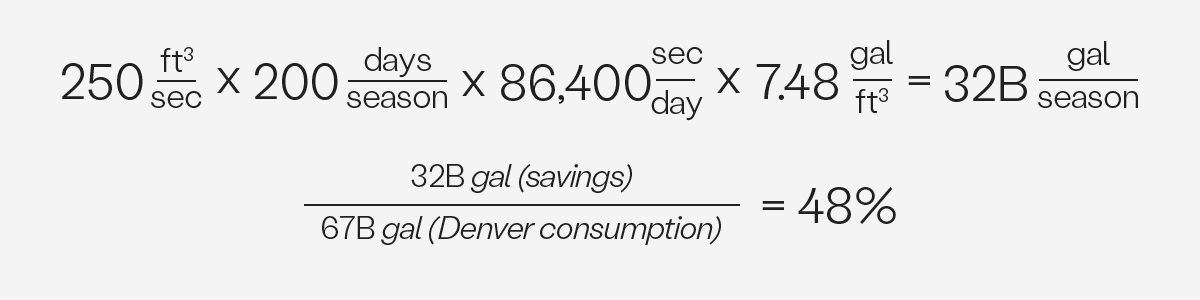
Figure 2. Government Highline Canal efficiency savings calculations based on data from Denver Water and Irrigation.org.
Is This Really Saving Water?
This is a common objection to efficiency-based conservation, and it’s worth addressing head-on. Reducing conveyance inefficiencies doesn’t necessarily shrink total water consumption the way fallowing does, since most of what’s “lost” isn’t permanently removed from the system, but eventually returns to rivers or aquifers as “return flows.” However, consumptive use isn’t the only thing that matters to water managers. Timing and location matter just as much as quantity. Water saved through efficiency can be metered and delivered to a specific reach or reservoir on a predictable schedule. Water that resurfaces later as diffuse, degraded return flow generally cannot. Tracking water through a modernized delivery system is also far easier than tracking it across thousands of miles of canals, farm runoffs, spills, and geologically complex aquifers. That distinction is critical for initiatives like the Colorado River Upper Basin’s voluntary conservation goal, which requires water to actually reach Lake Powell, not just exist somewhere in the system. Efficiency and modernization can deliver that kind of control and accountability, and they do so without asking farmers to reduce or change what they grow, unlike consumptive-use-focused programs.
Current Barriers to Efficiency
Several barriers discourage efficiency improvements even when the operational case is clear. The primary argument is that conveyance losses are harmless, or even necessary, since return flows are assumed to stay in the basin, and downstream users and habitats often depend on them. However, it’s an inefficient way to manage water. It’s comparable to leaving the tap running while you brush your teeth because the water comes back to the system through the drain. In reality, a portion of return flows is lost to disconnected groundwater systems or evaporation before returning to the river, and what does return is often mistimed or degraded. This status quo results in river depletions and salinity damages estimated at $332 million annually for the Colorado River alone. The fix is not to keep canals inefficient or to eliminate all return flows, but rather to distinguish critical return flows from nonbeneficial losses through the same no-injury review used in existing state programs like water leasing. Modern measurement and control can then precisely deliver critical return flows where and when they’re needed, while the extra water can stay in the river.
A second barrier is that “use it or lose it” legal fears persist among districts. While formal abandonment is rare, the more realistic concern is “diminishment”: a permanent reduction of a portion of a water right. A lower diversion pattern due to efficiency gains may be read as evidence that the right’s true extent is smaller than decreed. Even though these doctrines are meant to reduce waste, not discourage efficiency, districts are reluctant to show they can do more with less for fear of inviting a future challenge to their right. Districts need a statutory guarantee that investing in efficiency won’t threaten their water rights.
Third, modernization is expensive, and districts often lack the funds to pursue it. Upfront capital is hard to recover because districts have no way to monetize the water they save. As it stands, districts have no legal claim to water conserved through efficiency gains; if they don’t divert it, it simply flows to the next user in line. Despite water’s high value, districts receive no return on their investment. This is compounded by growing unpredictability in funding sources water projects have historically relied on, like federal grants and state severance taxes, and by farmers’ resistance to funding upgrades through higher water prices. Without a way to turn saved water into a new source of revenue, modernization will remain a pipe dream for most districts.
To address these barriers, Colorado already has a strong legal foundation. Existing state statutes protect historic consumptive use when diversions are reduced under approved conservation programs, and the Colorado Water Conservation Board’s (CWCB) Instream Flow (ISF) program provides a model for compensating saved water and streamlining no-injury review. Other prior appropriation states also offer precedent. In Idaho, Code § 42-223(9) protects the full extent of a water right for users who decrease diversions through efficiency gains, so long as the full beneficial use is maintained. In Oregon, the Allocation of Conserved Water Program has enabled districts to certify a legal claim on their efficiency savings since 1987, which they can then lease, sell, or in some cases, apply to new consumptive use.
Colorado came close to solving this problem before. In 2014, SB 14-023 passed both the Colorado House and Senate with broad bipartisan support. This bill would have allowed water users to receive compensation for efficiency savings transferred to the CWCB for instream flow protection. However, Governor Hickenlooper vetoed it at the last minute over water rights issues. This proposal takes the same core approach but resolves some of the earlier concerns by allowing flexible use of saved water rather than an instream-only design.
A Growing Sense of Urgency and Window to Act
The time to finally pass this legislation is now. Record drought, an historic state election cycle, and the expiration of the Colorado River operating guidelines have together created a sense of urgency that makes this common-sense, infrastructure-focused solution extremely timely and critical. Two recent announcements add concrete, immediate stakes. In mid-July 2026, CWCB announced a new state-run contribution program to save 100,000 ac-ft across the Upper Basin by 2028. Two weeks later, USBR’s Final EIS for Post-2026 Colorado River operations was released, setting a target of 200,000 ac-ft per year of voluntary Upper Basin conservation.
Both goals depend on the state’s ability to generate real, verifiable savings, which starts with modernization, control, and measurement. We can’t save what we can’t measure. State Engineer Jason Ullmann has called accurate measurement critical to protecting Colorado’s entitlement under the Colorado River Compact, and the Colorado Department of Water Resources (DWR) is already rolling out new basin-by-basin measurement rules. Colorado is on the right track, but gauges alone will not save water. This proposal builds directly on that foundation by treating measurement not as an endpoint, but as an essential step towards modernization and efficiency savings that support Colorado’s conservation goals.
The conditions for this proposal to succeed are as favorable as they have been in years. Heading into the 2026 elections, water security is a front-of-mind, bipartisan issue. Republicans emphasize water rights as property rights, while Democrats champion full funding of the Colorado Water Plan and an end to “buy-and-drys.” Conveyance modernization advances both agendas simultaneously. It expands water security without asking farmers to bear the cost of conservation, while also providing the legal and technical foundation to support the conservation, storage, and exchange objectives set out in the new Colorado River operating framework.
Plan of Action
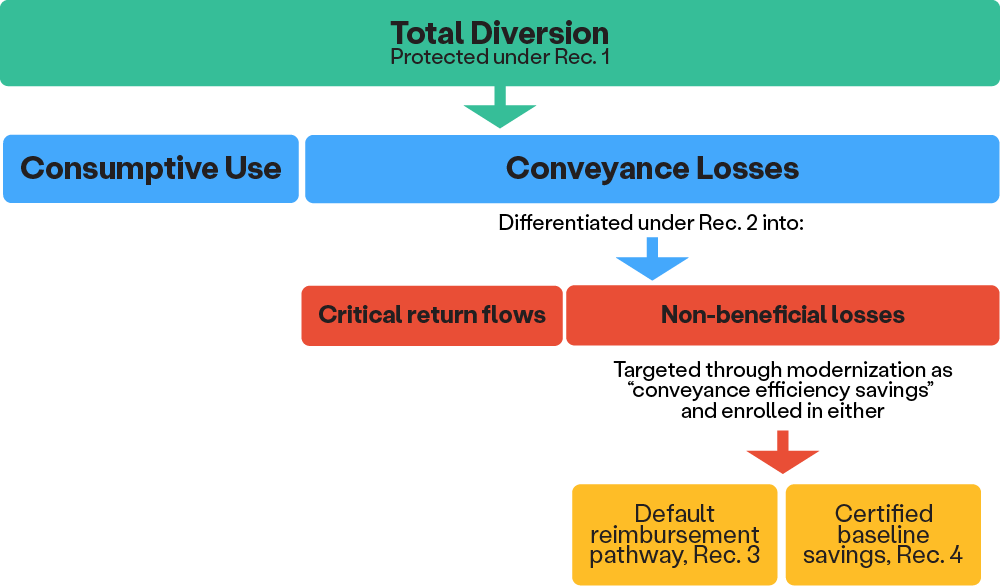
Figure 3. Recommendations 1-4 mapped onto a breakdown of a district’s total diversion.
Recommendation 1. Protect water users from legal challenges when diversion reductions result from conveyance efficiency savings.
The Colorado General Assembly should amend C.R.S. 37-92-103(2)(b) to suspend abandonment and diminishment when diversion reductions are the result of conveyance efficiency savings. Conveyance efficiency savings are the amount of water by which conveyance loss is reduced as a result of infrastructure and operational improvements. This definition excludes any reductions attributable to changes in consumptive use, cropping patterns, or weather. In other words, a district that can divert less water because it invested in efficiency should not risk losing the full extent of its water right. Districts must retain the ability to divert their full entitlement when needed, regardless of how much they previously diverted, since needs vary from year to year and efficiency measures may fail. This would extend the same tolling protection SB13-019 and HB17-1233 already provide for historic consumptive use under approved conservation programs, applying protection to the entitlement itself.
Recommendation 2. Create a no-injury administrative process to separate conveyance losses into two categories: 1) critical return flows that should be preserved, and 2) nonbeneficial losses that can be targeted and reduced through efficiency improvements.
The DWR (Office of the State Engineer) should develop an administrative no-injury review process that sets a ceiling on how much a district can reduce its conveyance losses without harming other water rights, ecosystems, or Colorado’s compact obligations. This process would identify where, when, and to what extent critical return flows must be preserved. This mirrors how DWR already handles no-injury review for other specific, temporary changes of a water right, such as Substitute Water Supply Plans, where a full water court proceeding is not required since no water right will be permanently transferred. The process would include public notice, comment periods involving basin roundtables, and technical determinations by Division Engineers.
Recommendation 3. Create a default reimbursement pathway for conveyance efficiency savings registration and compensation.
CWCB and DWR should create a program allowing districts to register conveyance efficiency savings for reimbursement. Districts would be compensated for voluntary reductions in diversions attributable to efficiency improvements, conditioned on all payments being reinvested in continued efficiency improvements. Under the reimbursement pathway, districts would be compensated post-season, based on metered savings against a verified pre-modernization baseline, with no pre-season savings commitments and no penalty for falling short of prior years. This structure reflects the reality that modernization unfolds over many years, and savings will vary while upgrades are underway. As a result, these savings volumes cannot yet be predicted ahead of time or relied upon by other water users for planning purposes, but still merit compensation. The saved water would simply not be diverted and remain in the priority system, like any unclaimed water today, and how savings were treated under the Upper Colorado River Commission’s System Conservation Pilot Program (SCPP).
Recommendation 4. Develop a certification pathway to give conveyance efficiency savings a defined legal status and enable flexible use.
The default reimbursement pathway under Recommendation 3 would not be the only option. Similar to Oregon’s certificate model, once a district has registered savings for several consecutive seasons, DWR would issue conservative baseline savings certificates that give districts a choice on how the water is to be used. Once certified, a district may opt to lease the savings to CWCB’s ISF program for instream protection, lease to other users at negotiated rates, simply leave them in the reimbursement pathway, or shepherd them downstream once the legal authority exists. No portion of the certified volume could be used to expand historic consumptive use. Leasing is an equal, fully voluntary option once savings are predictable enough to support it. Of a district’s total year-to-year savings, these certified baseline savings would be the only portion eligible for leasing to other users, and the priority date of the underlying right would be untouched. Everything saved beyond the certified amount would remain in the flexible, default reimbursement pathway described in Recommendation 3. As with the reimbursement pathway, all resulting revenue must be reinvested in continued efficiency improvements. Baseline savings certificates can be reevaluated and increased as districts continue to become more efficient.
Conclusion
Colorado’s water future is at a crossroads, and the window to act is now. The drought is real, and the political moment is rare. This proposal doesn’t require fallowed fields or further depleted rivers. It targets something simpler and largely overlooked: the water we’re already diverting but not putting to use, lost in transit through century-old infrastructure before it ever reaches a field. By addressing the legal risks and financial barriers that have kept irrigation districts and ditch companies from modernizing, this proposal transforms conserved water from a perceived loss into a tangible asset.
For districts, this means legal certainty and new revenue to modernize infrastructure that was overdue for investment a generation ago. For farmers, it means a more reliable water supply, even during drought years, without having to change their practices or dry-up their fields. For rivers, it means more water staying instream for ecosystems, recreation, and interstate compacts. For other water users like municipalities, it means increased water availability and security. For Colorado, it means a replicable and sustainable model of water stewardship for other states to follow.
Conveyance modernization won’t solve the water crisis alone. However, it is one of the clearest, most actionable steps available right now that protects agriculture, strengthens water rights, and puts more water back in the river.
This is an important concern, especially in Colorado, and this proposal takes it seriously. Not all conveyance losses are equal, and some return flows are genuinely critical to downstream ecosystems, junior water users, or compact obligations. No-injury technical review by Division Engineers must identify and protect critical return flows before any reductions in diversions or conveyance efficiency savings are approved or compensated. However, this proposal argues we shouldn’t keep systems inefficient for the sake of return flows. Instead, we should modernize them, measure what’s actually critical, and deliver it precisely where and when it’s needed. Many return flows are mistimed, degraded, or permanently lost, contributing to depletions along long reaches of Colorado’s rivers and salinity loading that affects water quality across state lines. If that water stayed in the river or in storage, rather than taking a long round-trip through a district, water quality would improve, and Colorado would gain a real ability to plan around that water.
By default, a district’s savings would remain in the river at the point of diversion, just like any unclaimed water today. The Upper Colorado River Commission’s System Conservation Pilot Program operated the same way, leaving voluntarily saved water to reenter the priority system. While this approach is most straightforward in early years when savings volumes are unpredictable, after several consecutive seasons of registered data, conserved volumes would become reliable enough to certify and plan around. At that point, districts could choose to keep the savings in the default reimbursement pathway, formally enroll them in a CWCB ISF lease, lease to a municipality, or share with junior users. These certified volumes are also strong candidates for shepherding once state legislation enables it. Efficiency savings cannot, however, be used to increase historic consumptive use within a district. How efficiency savings are treated in this proposal is one of the biggest departures from the vetoed SB 14-023, which designated savings for protected, instream use only.
Only the proposed default pathway, essentially unclaimed water, falls entirely outside expansion-of-use. Once a district certifies savings to lease to other users, that may be an expansion of use, but a narrowly bounded one. In fact, it’s narrower than Oregon’s program, which permits conserved water to be used toward new consumptive use on farms of participating districts. No recommendation here increases historic consumptive use of farms in Colorado. What does expand is who benefits from water that’s currently tied up in inefficient canals. The Colorado Water Plan projects a 560,000 ac-ft supply gap by 2050, and new supply is unlikely to come and help close it. Making better use of the water already diverted is one of the few options left that doesn’t entail drying up farms. Oregon’s own prior appropriation system has been successfully carving out exceptions to expansion-of-use limits to incentivize efficiency for nearly 40 years. Given that, this proposal is best understood not as a departure from prior appropriation’s principles, but as a practical, limited step toward making them work under conditions the system wasn’t originally designed for. This proposal offers a genuine win-win where farmers can continue farming, while cities, rivers, and other water users gain resilience that doesn’t currently exist under the status quo.
Conveyance losses are already a recognized part of districts’ total entitlement, and they can continue diverting that full amount (if available) until the moment they no longer need it. In other words, if they stay inefficient, they’re entitled to that water. If they become more efficient, they’re not. That’s the crux of the “use-it-or-lose-it” disincentive. Under current law, a district that voluntarily diverts less than its entitlement thanks to efficiency has no claim to the saved water. In this proposal, districts would not divert more water than they were historically entitled to; they’d take less and be paid for the difference. Compensating it isn’t a windfall; it’s recognition of the value the district created through their investment in modernization. Payments must also be reinvested in continued efficiency improvements, so the incentive compounds instead of stopping at one upgrade.
It is fundamentally different in that it does not ask farmers to change their operations or fallow their land. Demand management and fallowing reduce consumptive use by requiring farmers to grow less, change what they grow, or stop farming. This carries real economic and cultural costs and has contributed to Colorado losing more farmland than any other state from 2017 to 2022. (AgDaily, January 2026). Conveyance efficiency, on the other hand, reduces the total amount of water diverted by districts while enabling the same consumptive use and farming operations, even in drier years. There’s a strong perception in Colorado that reducing consumptive use is the only way to generate “real” water savings, but that view rests primarily on assumptions rather than concrete data. Efficiency generates real savings too, not just by cutting evaporative loss, but by capturing water currently assumed to return to the river or aquifer. In reality, no one has precise measurements on where, when, if, or how much return flow actually makes it back. Efficiency offers a path to help meet Colorado’s conservation goals while actually strengthening agriculture rather than scaling it back.