That’s what we’ll all be arguing along with any other constituency seeking political viability. Corruption too, yes. It turns out that does matter at the ballot box, but even the corruption argument played best when paired with how it affected American pocketbooks. The bottom line is that this election cycle was all about our bottom lines.
So what is science afforded in the 120th congressional agenda? Here’s what we’re tracking:
1. The Affordability and Corruption Election
Roughly half of voters called corruption and cost of living “crucial.” The return-on-investment on science is therefore a message more salient than ever to make and we’ll all look for more creative and effective ways to make it. The corruption half of this may be more interesting to think about right now, however, because of how Democrats will have to balance between oversight and legislating. Science funding has been subject to some of the most glaring examples of corruption and political overreach from the current Administration.
Four-in-five Americans (81%) see corruption in government contributing to raising costs, so Democrats will want to respond meaningfully. Addressing corruption looks like oversight hearings and subpoenas and flashy gotcha moments, maybe with posterboards if we’re lucky. The bandwidth allotted to oversight is bandwidth otherwise not allotted to legislating and that, depending on how heavy they lay it on, may affect the goodwill between parties to work together.
Recognizing that Congress is perfectly capable of walking and chewing gum at the same time, it will be an active exercise of restraint to channel that oversight into as pragmatic a form as possible. Not only does it take up time on the calendar, but the cumulative effect of raucous hearings and actions and the Twitter fights that follow sap members and staff alike of energy and capacity. What will the mix look like for strong-willed accountability versus the surfacing of pragmatic policy reforms? Will Democrats be more inclined to tar-and-feather (which is within their right) or to be more measured about how they reconcile the past two years by working in this new Congress to better insulate against corruption and misuse of appropriated funds going forward?
“The American people don’t want us to get even; they want us to get things done on their behalf.” — House Democratic Leader Hakeem Jeffries, MS NOW’s Morning Joe, Nov. 4
When it comes to science, expected House Science Committee Chair Zoe Lofgren laid it out: “We need to do two main things. One is oversight… We also need to do legislation to change policies that will better serve the American people.” She has also said that “in some cases, the damage can’t be undone… But we can prevent it from continuing,” and that the committee will “build protections for federal science and innovation programs so Trump-era corruption cannot happen again.” On AI, she argues the committee “can regulate and innovate at the same time, just as we always have.”
There are lots of worthwhile questions needing answers. At the same time, the House Science committee marked up ten bipartisan AI bills this Congress, and will have a massive CHIPS and Science Act reauthorization on their docket next year. There is just as much substantive bipartisan work to do as there is retributive oversight.
2. Congressional Leadership Changes for Science
Come January, Democrats will hold 56 Senate seats and at least 257 in the House. That’s big, but not veto-proof, and still not that magic 60 in the Senate so Democrats will still need Republicans to pass just about anything, and then it’s a guessing game on whether we get Mr. Veto or the Art of the Deal.
There is still lots to be settled out over December regarding leadership, including for Sen. Chuck Schumer as Democratic leader (spoiler alert: it will be Chuck). On the gavels that matter most for science, expect Rep. Zoe Lofgren at House Science, Sen. Patty Murray and Rep. Rosa DeLauro at Appropriations, and Sen. Maria Cantwell at Commerce. Across the aisle, Sen. Lisa Murkowski is the likely top Republican on Senate Appropriations, after Sen. Susan Collins, a longtime research champion, lost her seat.
An election result this big demands recalibration at every level from each party. Some of it is coming from Republicans in the form of willingness to critique the current Administration. A now-unshackled Senate HELP Chair Bill Cassidy canceled the committee vote on Jim O’Neill, the administration’s pick to lead NSF, saying O’Neill “did not do enough to stand up for science and against irresponsible decisions and statements” from Secretary Kennedy. He left a little extra mustard on it, too: “this time requires leadership and fortitude and standing up for what is right.” Sen. Thom Tillis called Stephen Miller’s appointment as White House chief of staff a “colossal mistake.” And Sen. John Curtis told his own party that if its response is “to blame the media, the polls, or the voters, we’ll have learned absolutely nothing.” A year ago, all of that would have been close to unthinkable.
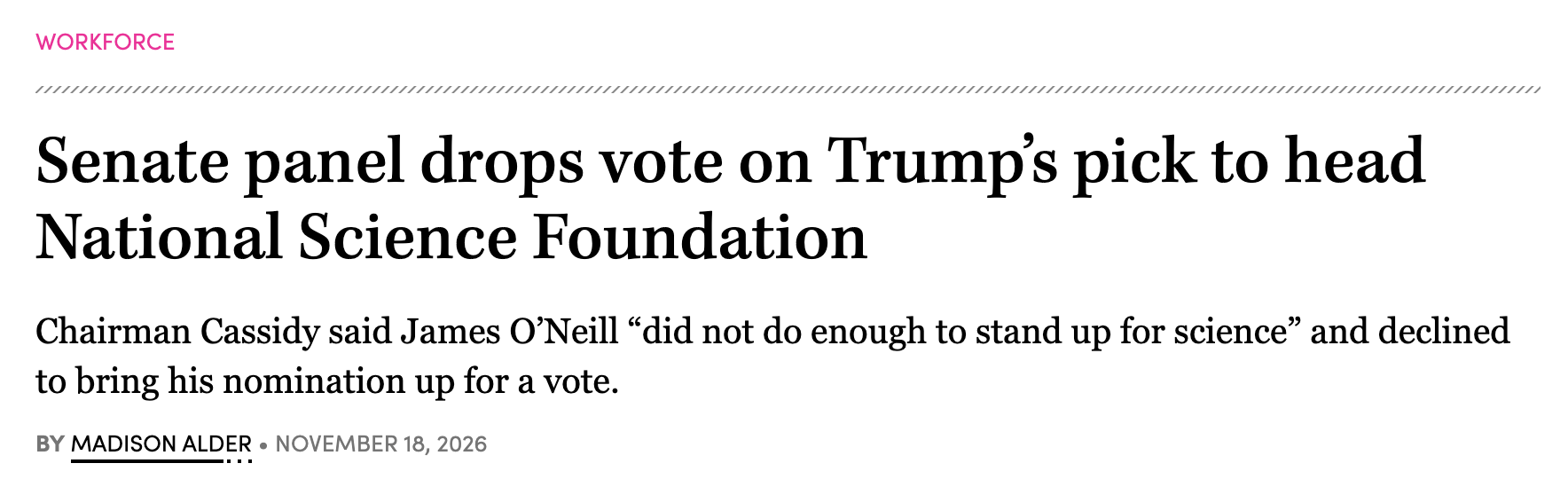
Screenshot: Cassidy’s statement canceling the O’Neill vote, “did not do enough to stand up for science” (FedScoop)
Shoutout: Sen. Dave McCormick. Sen. Dave McCormick (R-PA), could well be the top Republican on the Senate Energy and Natural Resources Committee. If so, he’ll be a critical voice regarding the future of national labs and the DOE Office of Science, and in a strong position to act on his comments regarding AI and data centers: “No American should face higher power or water bills.” In September he launched the bipartisan Senate Science and Innovation Caucus with Sen. John Hickenlooper (D-CO). Pennsylvania is home to important research institutions and dependent on a strong STEM workforce to keep up with its energy ambitions. He’s positioned to be an important science leader this next Congress.
3. Lame duck
A lot of us were expecting a much lamer duck than the one we’re getting. The Senate passed its sweeping permitting bill 62 to 33 on Nov. 19. The House takes it up after Thanksgiving.Then there’s the Dec. 11 funding deadline, which is also when the current block on OMB’s proposed grant rule expires. Expect another CR into January, and if they’re smart, they’ll just kick it straight to February and save themselves selves that extra vote. The two chambers are still far apart on FY27 science funding: $8.83 billion for NSF in the Senate bill versus $7 billion in the House, and $7.43 billion for NASA science versus $6 billion. Keep an eye on whether the OMB rule block rides along with whatever moves. And anything that doesn’t move by year’s end is dead and must be reintroduced next Congress.
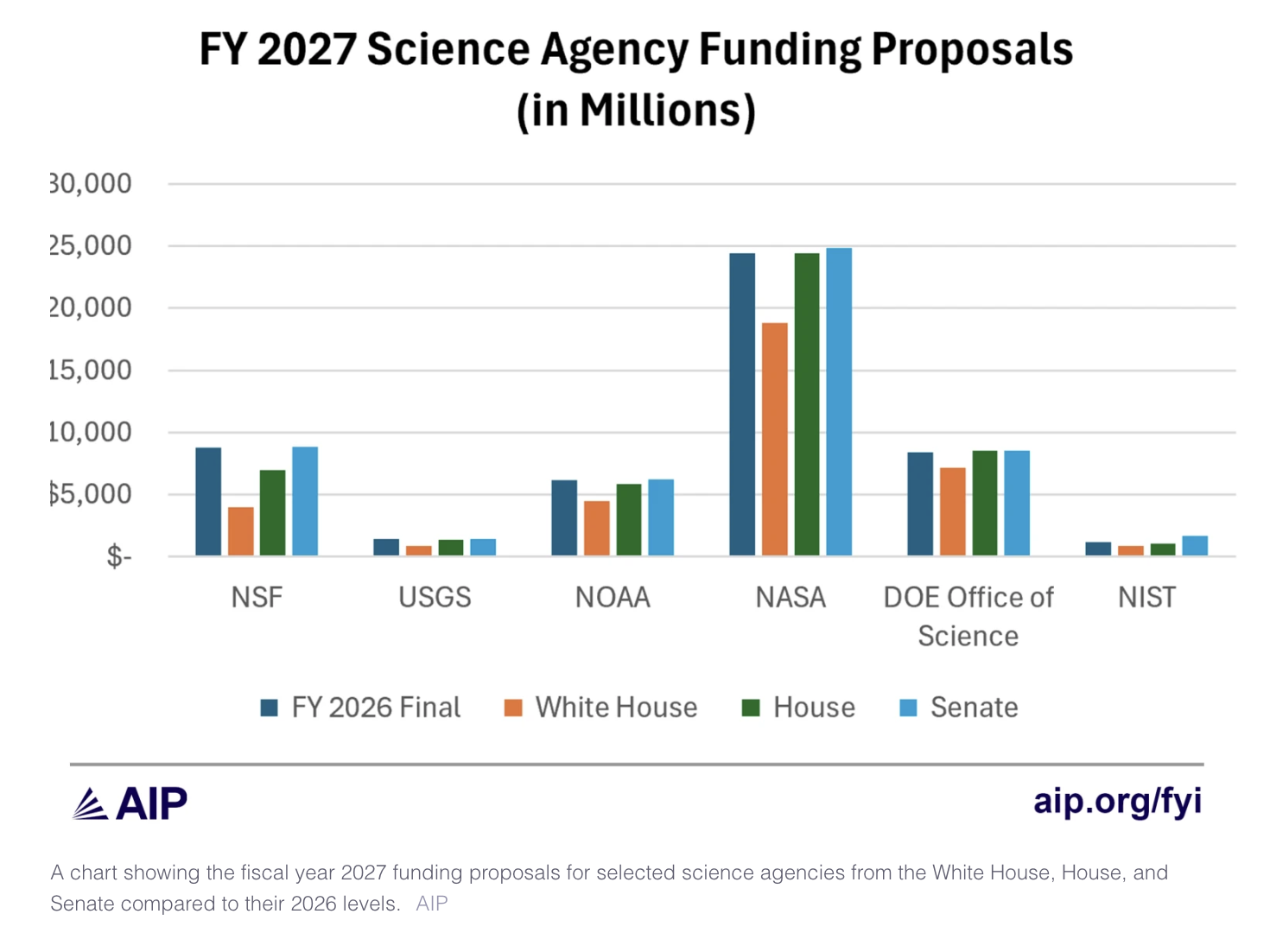
Screenshot: Senate Science Funding Proposals Revealed (AIP).
Shoutout: the Office of Technology Assessment. For more than two decades, Congress had its own independent source of technical expertise, until OTA was defunded in 1995. Aficionados of evidence-based policymaking have been trying to bring it back ever since, and every time we do we insist that this time is different. But this time it really is! AI companies have unprecedentedly massive resources to shape the policy debate, more than any set of NGOs and advocacy groups can ever hope to keep up with, and Congress needs an independent referee. OTA is still authorized, so it just needs money. Reps. Takano, Don Beyer, Sean Casten, Bill Foster and Jay Obernolte introduced the Congressional Office of Technology Improvement and Enhancement Act on Oct. 29 to restore and update it, and FAS endorsed it. As Takano put it, “Congress cannot continue flying blind into the future.” This is the minimum Congress can do for itself.

As leadership settles, we’ll be mapping the new gavels, subcommittee chairs and member assignments to the science in their states and districts. Who represents research universities, national labs and federal research facilities? Whose districts host semiconductors, energy, biotech or agriculture, and the workforces that come with them? Which new members are scientists, doctors or engineers themselves? Where are data center fights, grid costs or lost grants showing up locally? Those are tomorrow’s science champions and the frontlines of where the affordability case for science will be making itself. We have to help make that case now from the ground up.
Ta-ta for now!
Gil
Science funding has been subject to some of the most glaring examples of corruption and political overreach from the current Administration.
We are left with a climate problem that looks different, and worse, than we have recognized. The good news? Scientists are working on promising strategies to broaden and nuance our response, too.
A lot of the people who won in November promised voters a version of a government that works. Here’s how they can deliver.
Denice Ross, former U.S. Chief Data Scientist and Data Policy Institute lead at the Federation of American Scientists, will be honored for her stewardship of public data by the National Academy of Public Administration, where she has been named a Fellow.