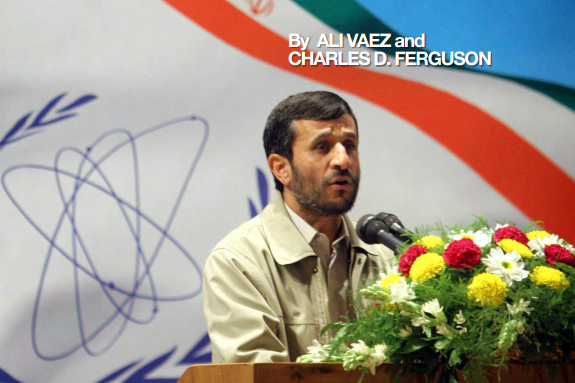
Towards Enhanced Safeguards for Iran’s Nuclear Program
Iran’s controversial nuclear program has been front and center on the international stage for more than eight years. Despite negotiations, sanctions, and political tug-of-war, the United States and its allies have yet to tame Iran’s atomic phoenix. At the center of this nuclear standoff is Iran’s controversial uranium enrichment program and efforts to obtain full nuclear fuel-cycle capabilities. To alleviate concerns about the intended nature of these activities, the United Nations Security Council (UNSC) has demanded -through six resolutions – that Iran suspend enrichment activities as well as construction of a heavy-water research reactor. Yet, Iran has opted to pay no heed to these resolutions and despite numerous proposals from different sides, the stalemate persists.
Dr. Charles D. Ferguson and Dr. Ali Vaez, authored a FAS report (PDF) analyzing the outstanding issues regarding Iran’s nuclear program, and provide recommendations to the major stakeholders in this debate including Iran, the United States, Russia and the International Atomic Energy Agency (IAEA).
Additionally, the report proposes a multipronged approach to resolving this deadlock, including enhanced safeguards and positive-sum diplomacy with incentives for Iran and other aspiring nuclear states.
“One thing became increasingly clear: AI doesn’t simply introduce a new category of risk. It changes the speed, scale, complexity, and interaction of risks that already exist.”
In the current environment of declining trust and magnifying strategic competition, banning debris-creating tests is a concrete step towards stability that favors interests of all states seeking to conduct space activities.
Google’s motto famously used to be “don’t be evil.” However, its latest feature has just made being evil a whole lot easier.
The bootcamp brought together more than two dozen next-generation open-source practitioners from across the world.