New Article On Obama Administration Nuclear Targeting Review
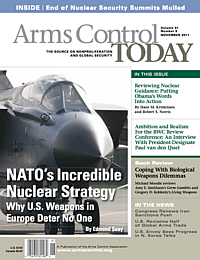 |
| New article published in Arms Control Today |
.
By Hans M. Kristensen
The latest issue of Arms Control Today includes a new article by Robert Norris and myself about the nuclear targeting review that is currently underway in the Obama administration.
In ordering the review, formally known as the Post-NPR Review, President Obama has asked the military to review and revise U.S. nuclear strategy and guidance on the roles and missions of nuclear weapons, including potential changes in targeting requirements and alert postures, in preparation for the next round of nuclear reductions beyond the New START treaty with Russia.
Our article describes the bureaucratic labyrinth the review will go through before new presidential guidance emerges to change the U.S. nuclear war plan. To that end, we offer a wide range of suggestions for how the review could reduce the requirements for U.S. nuclear forces to “put an end to Cold War thinking,” as President Obama said in his Prague speech in 2009.
Note: accessing the article requires subscription to Arms Control Today.
Further information: Obama and the Nuclear War Plan (FAS, 2010).
This publication was made possible by a grant from Carnegie Corporation of New York and Ploughshares Fund. The statements made and views expressed are solely the responsibility of the author.
It is difficult to assess from photos whether the Sentinel missile is longer or wider overall than the Minuteman, but the Sentinel clearly has a thicker second stage, which could potentially contribute to the missile’s extended range.
This is not the first time Google has agreed to censor imagery at the behest of governments, but be warned: obfuscation at this broad level poses a direct threat to the public’s ability to monitor and scrutinize government operations.
As humans expand our geographic reach, encroach on untouched natural territories, and interact more with animal populations, we will encounter novel zoonotic diseases that threaten the human body. The sooner we act to address these risks, the better.
“One thing became increasingly clear: AI doesn’t simply introduce a new category of risk. It changes the speed, scale, complexity, and interaction of risks that already exist.”