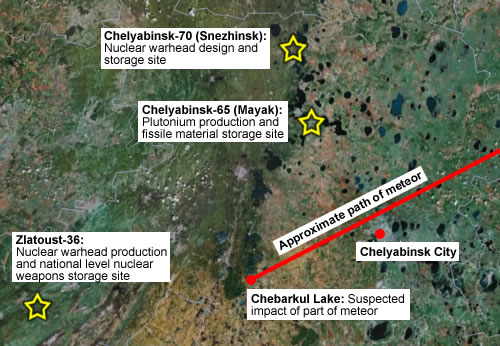
The meteor impacted near large Russian nuclear weapons facilities..
By Hans M. Kristensen
When the news media reported that a meteor had exploded over Chelyabinsk in Russia, the location name sounded familiar: the region is home to some of Russia’s most important nuclear weapons production and storage facilities.
Impact sites still have to be found but one reportedly was Chebarkul Lake, some 72 kilometers (45 miles) southwest of the city of Chelyabinsk. Another piece impacted near the town of Zlatoust some 80 kilometers (49 miles) to the northwest.
Approximately 88 kilometers (55 miles) northeast of Chebarkul Lake is Chelyabinsk-65 (Mayak), a plutonium production and fissile material storage complex. Another 40 miles to the north is Chelyabinsk-70 (Snezhinsk), a nuclear warhead design and storage complex.
Right in the meteor’s path, approximately 115 kilometers (72 miles) southwest of Chebarkul Lake, is Zlatoust-36, one of the two main warhead assembly and disassembly facilities in Russia. Adjacent to the facility is a national-level nuclear weapons storage site.
The odds of a meteor hitting one of these nuclear weapons production or storage site are probably infinitely small, but on a cosmic scale it got pretty close. Just how much damage a direct hit of a sizable chunk of the meteor could have caused is unknown, but the 17-meter (55 feet) meteor reportedly released energy equivalent to nearly 500 kilotons of TNT. That’s roughly the explosive yield of one of the W88 warheads carried on Trident II missiles onboard U.S. ballistic missile submarines.
This publication was made possible by a grant from the Ploughshares Fund. The statements made and views expressed are solely the responsibility of the author.
It is difficult to assess from photos whether the Sentinel missile is longer or wider overall than the Minuteman, but the Sentinel clearly has a thicker second stage, which could potentially contribute to the missile’s extended range.
This is not the first time Google has agreed to censor imagery at the behest of governments, but be warned: obfuscation at this broad level poses a direct threat to the public’s ability to monitor and scrutinize government operations.
As humans expand our geographic reach, encroach on untouched natural territories, and interact more with animal populations, we will encounter novel zoonotic diseases that threaten the human body. The sooner we act to address these risks, the better.
“One thing became increasingly clear: AI doesn’t simply introduce a new category of risk. It changes the speed, scale, complexity, and interaction of risks that already exist.”