US Nuclear Weapons Site in Europe Breached
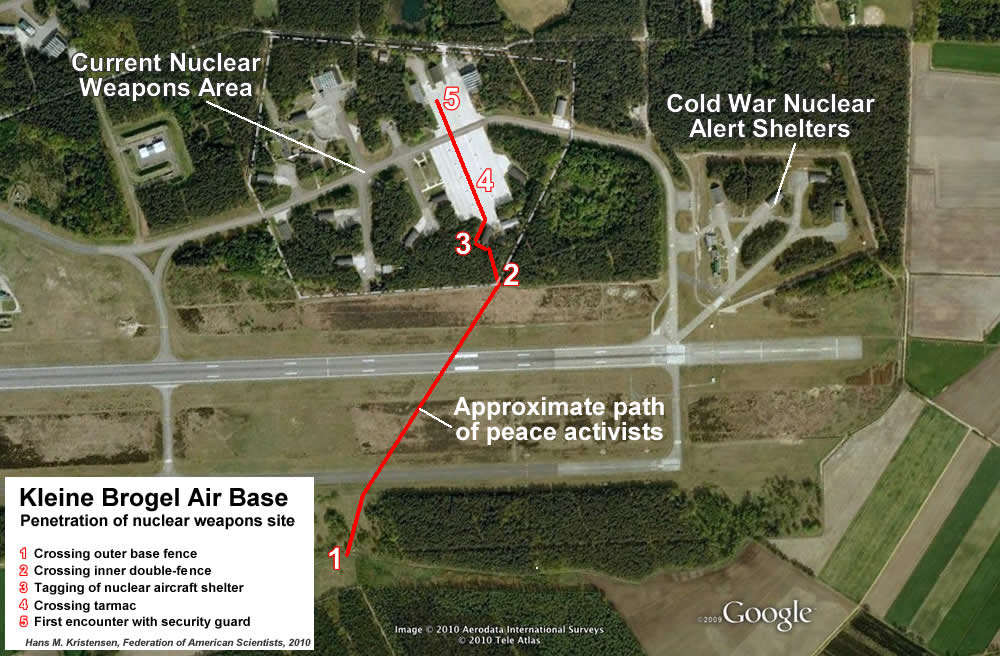 |
| Peace activists walked one kilometer onto a US nuclear weapons storage site in Belgium for more than one hour before security personnel reacted. Click image for larger version. (For an update to this map, go here) |
.
By Hans M. Kristensen
A group of people last week managed to penetrate deep onto Kleine Brogel Air Base in Belgium where the U.S. Air Force currently deploys 10-20 nuclear bombs. (For an update to this blog, go here)
Fortunately, the people were not terrorists but peace activists from a group known as Vredesactie, who managed to climb the outer base fence, walk cross the runway, breach a double-fenced security perimeter, and walk into the very center of the air base alongside the aircraft shelters where the nuclear bombs are thought to be stored in underground vaults.
A Nuclear Cake Walk |
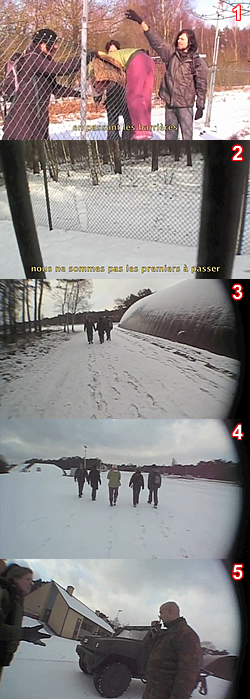 |
| The activists climbed the outer base fence (1), breached the inner double-fence (2), tagged a nuclear aircraft shelter (3), walked across the tarmac (4), before being arrested (5) after more than one hour inside the base. The numbers on the images correspond to the location of the numbers on the map above. |
The activists penetrated nearly one kilometer onto the base over more than an hour before a single armed security guard appeared and asked what they were doing. Soon more arrived to arrest the activists, who later described: “The military blindfolded for hours, they forced us to kneel in the snow, arms outstretched at 90° and threatened us if we intend to return to the base in the months to come.”
The activists videotaped their entire walk across the base. The security personnel confiscated cameras, but the activists removed the memory card first and smuggled it out of the base. Ahem…
In June 2008, I disclosed how an internal Air Force investigation had concluded that most nuclear weapons sites in Europe did not meet US security requirements. The Dutch government denied there was a problem, and an investigative team later sent by the US congress concluded that the security was fine.
They might have to go back and check again.
The nuclear bombs at Kleine Brogel are part of a stockpile of about 200 nuclear weapons left in Europe after the Cold War ended. Whereas nuclear weapons have otherwise been withdrawn to the United States and consolidated, the bombs in Europe are scattered across 62 aircraft shelters at six bases in five European countries. The 130-person US 701st Munitions Support Squadron (MUNSS) is based at Kleine Brogel to protect and service the nuclear bombs and facilities.
They might have to go back to training.
The activists will likely be charged with trespassing a military base but they should actually get a medal for having exposed security problems at Kleine Brogel. And this follows two years of the Air Force creating new nuclear command structures and beefing up inspections and training to improve nuclear proficiency following the embarrassing incident at Minot Air Force Base in 2007. Despite that, the activists not only made their way deep into the nuclear base but also discovered that the double-fence around the nuclear storage area had a hole in it! “We’re not the first,” one of the activists said.
NATO needs to get over its obsession with nuclear weapons and move out of the Cold War and the Obama administration’s upcoming Nuclear Posture Review needs to bring those weapons home before the wrong people try to do what the peace activists did.
This publication was made possible by a grant from Carnegie Corporation of New York and Ploughshares Fund. The statements made and views expressed are solely the responsibility of the author.
It is difficult to assess from photos whether the Sentinel missile is longer or wider overall than the Minuteman, but the Sentinel clearly has a thicker second stage, which could potentially contribute to the missile’s extended range.
This is not the first time Google has agreed to censor imagery at the behest of governments, but be warned: obfuscation at this broad level poses a direct threat to the public’s ability to monitor and scrutinize government operations.
As humans expand our geographic reach, encroach on untouched natural territories, and interact more with animal populations, we will encounter novel zoonotic diseases that threaten the human body. The sooner we act to address these risks, the better.
“One thing became increasingly clear: AI doesn’t simply introduce a new category of risk. It changes the speed, scale, complexity, and interaction of risks that already exist.”