
2026’s Roaring Start
We’re back! So much has happened in the first month of 2026. So much. January brought a jolt of game-changing national political events and government funding brinksmanship. If Washington, D.C.’s new year resolution was for less drama in 2026, it’s failed already.
As we reflect on 2025 and head into 2026, the question now is less about whether science and technology will stay rhetorically important (we saw that it will). Rather, it’s whether policymakers are willing to go beyond the platitudinous “China competition” or “AI leadership” talking points and invest in the unglamorous infrastructure that makes scientific and technological progress possible in the first place.
Appropriations and Shutdown Watch
So, what’s happening? Did Congress fund science? Will we shut down? What does it all mean for us? Here is where things stand at the time of writing.
Status. In November, Congress ended the longest government shutdown in history by extending its deadline for a funding deal to January 30th, 2026. That date has fast arrived, and Congress has fully passed 6 of 12 appropriations bills – Agriculture, Military Construction & Veterans Affairs, Legislative Branch, Commerce, Justice, & Science, Energy & Water Development, and Interior & Environment. No one wants a shutdown, least of all the agencies that are forced into a contingency mode that disrupts operations and destabilises long-term planning.
Things Were Going Well for a Minute. After a string of successive compromises on bundles of appropriations bills (“minibuses”) and final passage into law of the minibus for Commerce, Justice, and Science, Energy and Water Development, and Interior and Environment (CJS-E&W-Int), Congress finds their momentum abruptly halted ahead of voting on the remaining 6 bills with urgent calls for more Department of Homeland Security (DHS) oversight in the wake of the killing of Minneapolis ICU nurse Alex Pretti by a U.S. border patrol agent.
75% of Fed Funding Still at Stake. Furor over the Trump Administration’s immigration crackdown which now includes the killings of American citizens and other high-controversy incidents by DHS agents, on top of brewing tensions over the conflict in Venezuela and diplomatic standoffs over Greenland, have threatened an already-strained process that still needs the final passage of the full Congress for six bills which account for more than 75 percent of federal discretionary spending.
Oof, another shutdown…? Probably. There is a serious likelihood of a partial government shutdown as the Senate takes up its next votes on remaining funding bills ahead of the Jan 30th deadline. The House did its part, and 6 funding bills remain for final passage in the Senate – Defense, Labor-Health and Human Services-Education, Transportation-Housing and Urban Development (THUD), Financial Services, Homeland Security, and National Security-State. Republicans will need Democratic votes to pass it, and so far, not enough have indicated they will support it without DHS oversight.
Dems DHS Oversight Demands. DHS Oversight Senate Minority Leader Chuck Schumer wants DHS funding legislation changed, but the other five pending appropriations bills passed in the meantime. Several Democrats who crossed over with Republicans to end the previous shutdown plan to vote against the funding bills without the inclusion of more oversight for Immigration and Customs Enforcement (ICE) and Customs and Border Protection (CBP) in the bill.
Republican Concerns. Senate Republican leadership wants to vote on the six-bill package, including DHS, with no changes, and is pushing back against calls to “defund DHS.” President Trump has entered the negotiations with a push forRepublicans to pass a bill to “END Sanctuary Cities.” Republicans are voicing concerns about DHS actions and calling for an investigation.
Earmarks at Stake. A shutdown will have state and local communities anxiously awaiting the fate of their earmarks, or congressionally directed spending that sends federal funds directly to local projects. Part of the package (agreed to, but not voted on) includes $16 billion worth of earmarks for everything from construction projects to new police equipment to wastewater infrastructure.
Bottom Line. Midnight on Saturday, January 31, may yet see us hit another government shutdown, albeit partial yet substantial.
Science in Approps
There is positive news for the science and tech community as Congress passed and President Trump signed into law a full-year appropriations package that included accounts critical to science and technology at federal agencies. It may not be everything the science community wanted, but considering the Republican-controlled Congress and White House and their pledges to massively cut spending, the modest cuts in the final bill can be received in that context as a reprieve from the worst-case scenarios. It also means that these accounts (such as the National Science Foundation, Department of Energy, etc.) will not be directly impacted by the potential government shutdown. The funding bill, including the Department of Education and its programs, however, is still at risk, as well as countless other programs that touch the scientific enterprise.
Proposed Cuts vs Final in Minibus. In the bill considered most directly important for scientific research, the CJS-E&W-Int minibus rejected the Trump Administration’s cuts for the National Science Foundation by 57%, for the Department of Energy’s (DOE) Office of Science by $1.1 billion, and for NASA’s science budget by 47%. Instead, the package sustains research funding for NSF, provides $160 million more for the DOE Office of Science (which supports critical research being conducted by 22,000 researchers at our 17 national labs and over 300 universities), and provides $7.25 billion for NASA’s science budget.
Funding Oversight. The final CJS-E&W-Int minibus included hundreds of specific policy provisions to accompany the funding that detail how the funding should be spent. This is in response to the misuse of funds by the Trump Administration that many agree amounted to illegal impoundment. We’ll have to wait and see if it has the desired effect…
Indirect Costs. The minibus includes language blocking the imposition of a 15% cap on indirect cost reimbursement at the federal science research agencies funded in the package (NSF, the National Institute of Standards & Technology, NASA, and the Department of Energy’s Office of Science). This is on top of a federal appeals court ruling blocking the NIH from moving forward with a cap on research indirect cost payments. The administration has not announced whether it intends to appeal this ruling.
NDAA and Science
Appropriations is taking up a lot of attention, but it’s not all that Congress is up to. Most importantly, Congress passed the 2026 National Defense Authorization Act (NDAA), which includes important provisions for science, R&D, and national security. Maybe more importantly, it omitted several controversial provisions, too.
Research Security. The NDAA contains some controversial new restrictions on research collaborations with China and other “countries of concern.” It also drops other research security proposals that had drawn objections from the U.S. scientific community, and blocks a unilateral reduction of overhead payments to DOD grantees. Notably, the SAFE Research Act did not pass with the NDAA, and neither did a Senate provision to prohibit any higher education institution conducting research funded by DOD from entering into contracts with a covered nation or foreign entity of concern.
AI. Renewed efforts to restrict state regulation of AI landed flat once again as they did not make it into the final NDAA. It does, however, direct the Secretary of Defense to establish one or more AI research institutes, known as National Security and Defense Artificial Intelligence Institutes, at higher education institutions that conduct DOD-sponsored research.
Indirect Costs. (again!) Similar to language in the CJS-E&W-Int minibus, the NDAA blocks the Secretary of Defense from changing or modifying the indirect cost rates for DOD grants to research institutions until the Secretary certifies that DOD has developed an alternative model in consultation with the extramural research community that reduces the rate for all institutions and allows “adequate transition time” for affected institutions to adjust.
Executive Branch Highlights
Genesis Mission. A recent executive order from the White House establishes a “Genesis Mission” that aims to “mobilize the Department of Energy’s 17 National Laboratories, industry, and academia to build an integrated discovery platform.” According to the DOE press release, the platform will draw on the expertise of roughly 40,000 DOE scientists, engineers, technical staff, and private sector innovators.
NSF Tech Labs. We are thrilled about NSF’s launch of a new “Tech Labs” program that represents a new federal science funding paradigm: team-based, outcome-driven, independent labs, each targeted to receive between $10M and $50M a year. Overall, NSF expects to put up to $1B into this new program.
FAS is particularly excited about this, as it played a central role in introducing this concept in 2020 in the form of a proposal for Focused Research Organizations. Several FAS teammates have spent years evangelizing the concept across research agencies and Congress. Check out what FAS is saying about it:
- Team Science needs Teamwork: Universities should get in on the ground floor in shaping the vision for new NSF Tech Labs (from Erica Goldman)
- NSF Plans to Supercharge FRO-style Independent Labs. We Spoke with the Scientists Who First Proposed the Idea. (from Daniel Correa)
Higher Ed Watch
Universities and higher ed continue to deal with the dynamic state of politics and federal policies, yet a new R&D survey reminds us how valuable they remain to the nation’s research enterprise – $117 billion worth.
Education and Approps. The House passed the Labor-HHS-Education package by a margin of 341-88. Now we await Senate passage of theeducation funding bill that would allot $79 billion in discretionary funding. The legislation would flat-fund the Pell Grant, Federal Supplemental Educational Opportunity Grant (FSEOG), Federal Work-Study (FWS), the federal TRIO, and Gaining Early Awareness and Readiness for Undergraduate Programs (GEAR UP) programs at FY 2025 levels. The legislation also included a provision that would block funding for ED from being transferred to other agencies, unless specified in the appropriations law.
Higher education R&D expenditures reach $117 billion in FY 2024. The smart folks at SSTI have taken an informative look at Higher Ed R&D expenditures.
Higher Education R&D expenditures jumped 8%, or nearly $9 billion, from fiscal year (FY) 2023 to 2024, reaching an all-time high of over $117 billion, according to new Higher Education R&D (HERD) survey data. The funding sources of HERD expenditures remain proportionally unchanged from the prior year, with all sources increasing, and the federal government ($5 billion) and institution funds ($2.5 billion) accounting for the largest dollar increases.
Adjusted for inflation, overall HERD expenditures increased by 5%—the second largest year-over-year increase in the past decade—while all sources of funds except business increased.
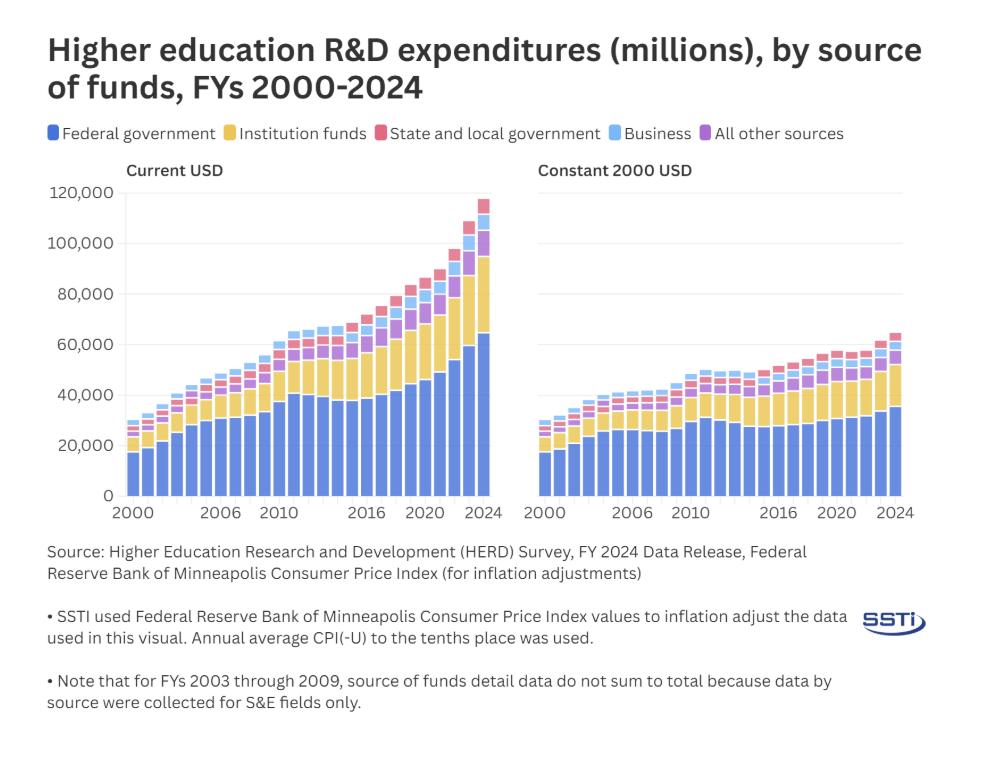
source: Higher Education Research and Development (HERD)
Ta Ta for Now!
2026 will be another landmark year for how we make an affirmative, public-interest case for science amidst turbulent political times. We’re looking forward to making that case together with you.
Right now, the premium is less on splashy tech announcements and more on signals of institutional commitment like stable funding, durable governance, and a willingness to invest in systems that do not produce immediate political wins.
Reach out for any shutdown questions or requests for topics next month! It’s going to be a fun year.