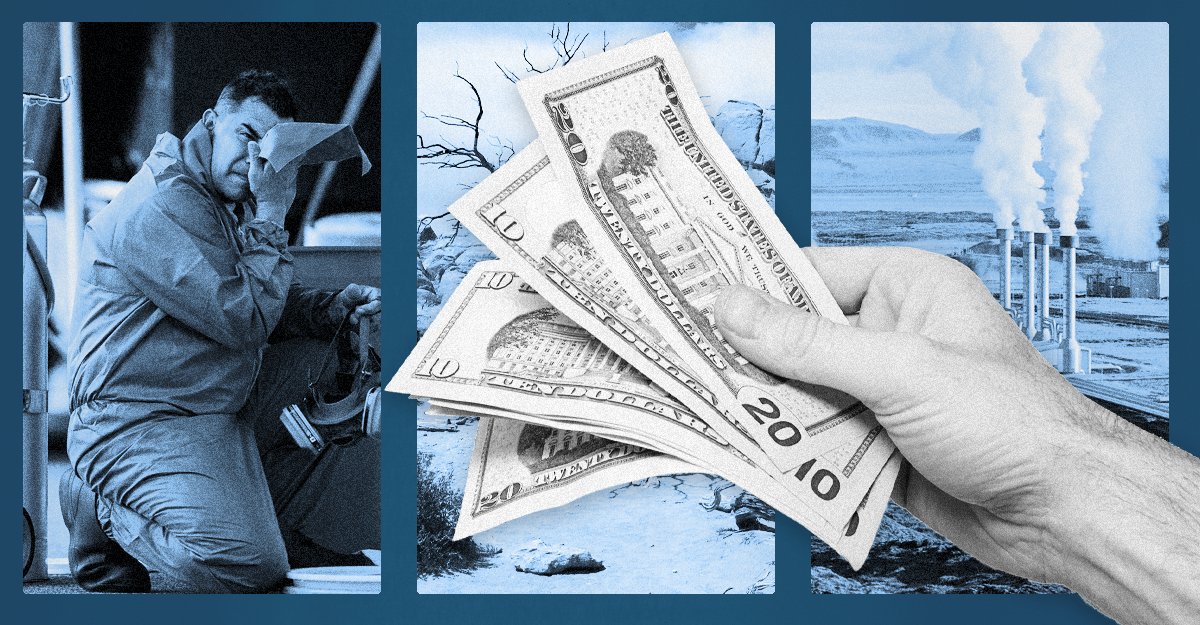
Hot Takes: What the FY27 Presidential Budget Request Means for Climate and Energy
President Trump released his FY27 budget plan last week. What should we think about it?
Once upon a time, the President’s budget was a realistic proposal to Congress about what the federal government should spend money on. These days, it’s essentially just a declaration of everything the President would do if Congress didn’t matter at all.
There’s an argument, then, that we shouldn’t take the President’s budget too seriously: after all, recent history shows us that Congress doesn’t. President Biden repeatedly asked for, and failed to receive, massive IRS expansion, housing investment, and tax hikes on the wealthy and corporations; President Trump last year suggested massive cuts to federal science funding that Congress essentially ignored.
Yet the current Trump administration has also shown that it’s not taking seriously Congress not taking it seriously: including by impounding funds and pursuing other avenues to push its spending (and cutting) priorities through using executive action.
The way to calibrate is by treating the President’s budget as a fever dream…albeit one that might come true. With that in mind, here are some of the key dream sequences we’re paying attention to from a climate, environment, and energy perspective. Warning: some may keep you up at night.
Topline numbers
In terms of non-defense discretionary spending, the $660 billion FY27 request is a 10% decrease from current levels – a smaller swing than last year’s $557 billion FY26 request, which proposed a 23% cut that Congress largely ignored. However, the difference can be attributed almost entirely to the fact that Congress reset the baseline upwards when it rejected those FY26 cuts, as well as to proposed increased spending at the Department of Veterans’ Affairs (for improving medical care) and Department of Justice (including funding for increased law enforcement in cities, funding FBI salaries, and re-opening Alcatraz).
For climate and energy policy specifically, FY27 largely runs the same plays as FY26: slashing line items related to climate change and advancing a fossil-oriented “Energy Dominance” agenda while rolling back clean energy and environmental justice investments from what this administration terms the Biden-era “Green New Scam”. As with FY26, the request targets climate, energy, and environmental programs with demonstrated bipartisan congressional support. One example is the CDFI Fund, which finances clean energy and community development lending in underserved communities and which Congress explicitly preserved last year after the administration first proposed eliminating it.
Overall, the President’s FY27 budget request is less a new proposal than a budget formalization of many climate- and environment-related cuts that the Trump administration has pursued over the past year through executive action and impoundment.
Energy
For the second year in a row, the Trump administration is requesting to cancel almost all remaining unobligated IIJA funding across the Department of Energy ($15.2 billion in total). What’s striking about these cuts is how indiscriminate they seem to be, including cuts to programs that align with this administration’s stated priorities (including critical minerals, geothermal energy, and hydropower). The throughline appears to be less about policy judgment than about demonstrating categorical opposition to anything passed under the IIJA banner.
Yet not all of this funding is being outright cancelled: some is being redirected. $4.7B of unobligated IIJA funding intended for Hydrogen Hubs is being steered toward baseload power and AI supercomputers instead. When you dig deeper into that redirect, it’s a mixed bag. $1.2B will go to new supercomputers at Argonne and Oak Ridge National Labs, as part of DOE’s new Genesis Mission. The remaining $3.5B would largely support coal, oil, and gas infrastructure upgrades and prevent 4 GW of coal plants from retiring as planned. The same tranche of funding will also support some genuinely needed improvements, such as strengthening grid reliability, installing new battery storage, and improving the power output of nuclear and hydropower facilities. Funding for geothermal, ostensibly an administration priority, is surprisingly absent given its status as a firm baseload power source.
Mixed messages around geothermal continue in the budget for the new Hydrocarbons and Geothermal Office (HGEO), created during DOE’s November 2025 reorganization by merging the Geothermal Technologies Office with Fossil Energy. The administration requests $676 million for the combined office, a 14.1% decrease from the FY26 enacted. The most striking line item within HGEO is a 329% surge in funding to modernize coal mining processes and extend the productive life of existing mines, including through the use of AI and robotics. Geothermal funding is preserved at $150 million, emphasizing pilots and R&D over commercial-scale projects. Again, what’s conspicuously missing – given the administration’s stated enthusiasm for geothermal as a firm baseload source – is any meaningful push toward commercial-scale deployment.
Beyond the IIJA cancellations, the administration is requesting a massive 63% cut to the budget of the new Office of Critical Minerals and Energy Innovation (CMEI) – the reorganized successor to the former Office of Energy Efficiency and Renewable Energy – compared to the FY26 budget of the offices folded into it. The only winner seems to be critical minerals, which receives a $281 million (339%) increase in funding compared to FY26. Similar to FY26, the request zeroes out the budgets for hydrogen, solar, and wind programs, as well as state and community energy programs and the Federal Energy Management Program. The request also nearly zeroes out budgets for bioenergy, vehicle, and building technologies, while making deep cuts to hydropower and industrial efficiency and decarbonization technologies.
Cuts continue for DOE offices responsible for keeping America’s lights on. The Office of Electricity (OE) and the Office of Cybersecurity, Energy Security, and Emergency Response (CESER) face cuts of 22% and 16%, respectively, from FY26 enacted levels: significant indeed at a moment when electricity demand is surging, extreme weather is straining grid infrastructure with increasing frequency, and the U.S. grid is already widely acknowledged to be aging and vulnerable. Underfunding these offices now carries real risk for the administration’s own energy dominance goals, let alone broader reliability and resilience.
Wildfire resilience
The two largest federal landowners – the Department of the Interior (DOI) and the U.S. Department of Agriculture (USDA) – are both slated for significant cuts under this budget, at 13% and 19% reductions from FY26 enacted levels, respectively. The takeaway: while the FY27 budget makes some new investments in wildfire resilience, it does so against a backdrop of overall austerity.
That said, the budget request acknowledges the escalating urgency of the wildfire crisis. Wildland fire suppression resources at DOI received a modest 3.5% increase; preparedness and fuels management at the agency also saw a slight bump. Additionally, the budget introduces a Fire Intelligence and Technology line item in DOI’s budget funded at $123.5 million. This includes $20 million to support a Wildfire Intelligence Center that appears broadly aligned with proposals such as those laid out in the bipartisan Fix Our Forests Act (S. 1462), which FAS endorsed.
The real-world efficacy of these wildfire-specific investments could be undermined by cuts to fire-relevant research and monitoring infrastructure. While the request states that “the USWFS will fund all wildland fire resources currently funded separately by [USDA and DOI],” proposed cuts to Forest Service programs such as State, Private, and Tribal Forestry and Forest and Rangeland Research could also impact fire resilience. Budget cuts and layoffs at FEMA, NOAA, NASA, and EPA could also materially compromise capacity for other critical wildfire tasks the government is responsible for (e.g., fire detection, fire response, weather forecasting, smoke monitoring, and post-fire ecosystem assessment). For example, the NASA/USGS Landsat program helps us understand the impact of wildfires on the landscape and support better management. NASA’s FY27 budget justification allocates $109 million “to support a phased transition of the Landsat program to a commercial solution” rather than continued government involvement. The justification offers no detailed rationale for why privatization is the right path forward.
Cuts to USDA Forest Service Wildland Fire Management accounts reflect the Administration’s intent to consolidate wildland fire functions across DOI and the Forest Service. Echoing an earlier Executive Order, the budget proposes fully unifying the USDA Forest Service’s wildland fire resources and operations into Interior’s newly created U.S. Wildland Fire Service (USWFS). While DOI has reportedly begun consolidating wildfire operations across its own agencies under the USWFS, integration of the Forest Service is on hold; FY26 appropriations bills directed Interior and USDA to contract a feasibility study of this approach. It is unclear how this reorganization would interact with the recent proposal to move Forest Service headquarters to Salt Lake City.
Environmental pollution
From an environmental protection standpoint, the most glaring single number in this budget is President Trump’s proposal to cut EPA’s budget by $4.6 billion — a 52% reduction that would bring the agency to its smallest budget since the Reagan administration. How does the administration propose slashing the EPA’s budget by more than half? By targeting specific programs that have historically done some of the agency’s most consequential work.
Among the casualties: the program that oversees Superfund site cleanup. Superfund sites are locations that are so contaminated by pollution that they’re considered dangerous to human health. Think sites of former mines, toxic waste dumps, and other nastiness that make the families that live around them very sick. There are more than 1,800 Superfund sites across the United States, concentrated heavily in Texas, California, Pennsylvania, New York, New Jersey, Florida, and Washington. Without the Superfund program, cleanup won’t happen, and families living nearby – who often can’t afford to move or don’t even know the risk exists – will just keep getting sick.
Like breathing clean air? Happy the ozone layer is healing? Too bad. If Congress follows the President’s proposed budget, then the Atmospheric Protection Program will be eliminated. The APP is the EPA office responsible for reducing air pollution, restoring the ozone layer, improving energy efficiency, and researching climate change. These aren’t marginal cuts. They’re core federal functions that have measurably improved air quality and public health over decades.
The contrast with what the EPA is being asked to invest in is telling. One notable increase in EPA’s budget is a $14 million boost for NEPAssist, the web-based tool that streamlines permitting under the National Environmental Policy Act. This boost reflects the administration’s vision of what EPA is for: making it faster to approve projects, but not study or reduce the pollution they might produce.
Energy affordability, extreme heat, and public health
The FY27 proposal once again tries to eliminate the only sources of funding to support families struggling with energy affordability. The proposed budget would fully defund the Low Income Home Energy Assistance program, which supports families with heating and cooling bills at a time when one in three American households are facing energy insecurity and electricity rates are surging across the country. The budget also zeroes out the Weatherization Assistance Program, which funds home retrofits that reduce energy consumption and help families stay safe during extreme heat and cold. Getting rid of both LIHEAP and WAP simultaneously leaves no federal backstop for the most vulnerable households at the precise moment that climate-driven temperature extremes are intensifying.
The FY27 proposal also targets research and data collection critical to evaluating extreme weather and heat’s risks and impacts. The proposed $1.6 billion cut to NOAA’s Office of Research and Development by $1.6 billion would eliminate programs to help communities prepare for and protect against extreme heat events, flooding, and other climate-linked weather hazards. The planned commercialization of NASA’s Landsat raises further concerns about data continuity and access, particularly for local governments and planners who depend on Landsat data to assess heat islands, drought conditions, and other environmental risks.
On the health system side, the budget would eliminate the Hospital Preparedness Program (HPP), the only program supporting health care systems ready for all hazards – including floods and storm surge that can inundate hospitals, and extreme heat waves that can overwhelm emergency rooms. HPP funding has helped regions such as the Pacific Northwest, where extreme heat has already been deadly, avoid repeating past disasters. The budget proposes redirecting these functions to the CDC’s Public Health Emergency Preparedness program, which experts have long identified as insufficient for the scale of the need.
Workers and families face additional exposure under this budget, which scales back prevention and enforcement dollars for workplace safety. The proposal budget cuts the Occupational Safety and Health Administration’s budget by 10%, with reductions focused on enforcement capacity and workplace safety training funding. And two of the primary federal vehicles to support community-level climate resilience would be eliminated. The Community Services Block Grant and the Community Development Block Grant, have both been backbone sources of funding to support efforts to prepare communities for extreme weather’s impacts. For example, the Community Services Block Grant provides the operational funding for Community Action Agencies, which are a key pass-through organization for implementing efforts like home weatherization.
Climate and environmental science
The FY27 budget doesn’t just target programs aimed at reducing emissions and cleaning up our environment. It targets the scientific infrastructure that tells us what’s happening and how to fix it. The President’s budget request would systematically defund the agencies, offices, and university programs responsible for climate observation, modeling, and research across the federal government. NSF has historically been the nation’s primary funder of basic research, including the university-based science that generates most of what we know about climate systems, ecosystems, and environmental change. The administration proposes cutting roughly 55% (~$5 billion) from NSF’s budget, with about a third (~$1.8 billion) of this coming from the parts of NSF (geosciences, biological sciences, engineering, and polar programs directorates) most directly relevant to climate and environmental science. AI and quantum computing are the only areas the administration proposes to protect or grow within the agency.
The DOE’s Office of Science would take a $1.1 billion hit, with just under half of that coming from the Biological and Environmental Research program, which funds atmospheric science, climate modeling, and ecosystem research. The administration’s own budget language is candid about the intent: these cuts will, it states, “stop wasting Biological and Environmental Research resources on climate change” and refocus funding toward “AI-enabled earth-energy system modeling to support the Energy Dominance agenda.” At the same time, $1.1 billion is being invested in the new Office of Critical Minerals and Energy Innovation (CMEI), though this number is both a cut compared to FY26 enacted levels from CMEI and is framed explicitly around supply chain security and domestic resource extraction rather than decarbonization.
For the second year in a row, the budget proposes eliminating NOAA’s Office of Oceanic and Atmospheric Research, which houses the nation’s core weather forecasting and climate modeling capabilities (including the Geophysical Fluid Dynamics Laboratory, the birthplace of modern climate modeling). What’s notable about the FY27 request, as analyst Alan Gerard points out, is that it doesn’t even acknowledge OAR’s existence despite Congress having essentially fully funded it in FY26. This illustrates the administration’s willingness to pursue its biggest priorities by hook or by crook.
Finally, EPA’s research and development budget would be reduced to only what federal law legally requires, effectively eliminating the agency’s in-house capacity for the modeling, technical research, and expert analysis that underpins national environmental regulation. An EPA stripped of scientific capacity is an EPA that can neither generate the evidence base for new rules nor credibly defend existing ones.
Once upon a time, the President’s budget was a realistic proposal to Congress about what the federal government should spend money on. These days, it’s essentially just a declaration of everything the President would do if Congress didn’t matter at all.
For International Year of the Woman Farmer and International Women’s Month, we spoke to five women farmers in America about planting the next generation.
From California to New Jersey, wildfires are taking a toll—costing the United States up to $424 billion annually and displacing tens of thousands of people. Congress needs solutions.
FAS is launching the Center for Regulatory Ingenuity (CRI) to build a new, transpartisan vision of government that works – that has the capacity to achieve ambitious goals while adeptly responding to people’s basic needs.