North Korea has renewed its planning for the likely succession of leadership from the ailing Kim Jong Il to his youngest son Kim Cho’ng-un (or Kim Jong Un), according to a deeply researched assessment by the DNI Open Source Center (OSC).
“Pyongyang last autumn reinvigorated a nuanced propaganda campaign that it apparently began eight years ago to prepare for the emergence of a hereditary successor to Kim Jong Il,” the OSC said. “The recent signals have been extremely subtle, suggesting that they are designed to inform internal audiences without alerting outsiders.”
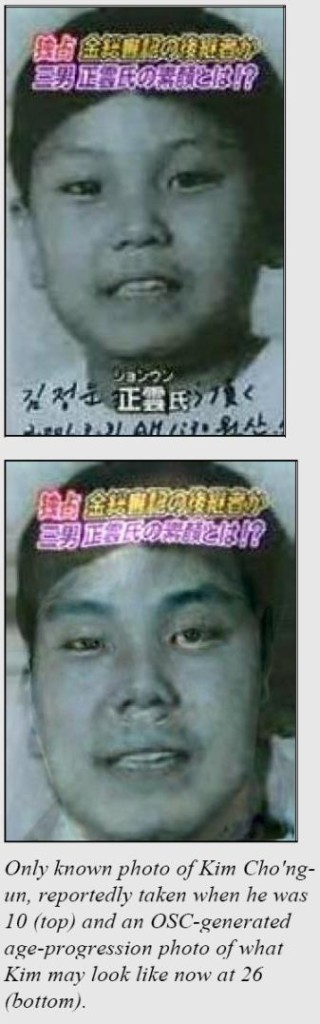 The OSC report (pdf) is a virtuoso piece of analysis that includes rich detail on the three generations of Kims, the development of the unfolding information campaign on leadership succession, and background on the little-known Kim Cho’ng-un. It even presents “an OSC-generated age-progression photo” that extrapolates from the only available photograph of the younger Kim, taken at age 10, to show what he may look like now at age 26. And it shows an amazing familiarity with obscure facets of North Korea’s notoriously secretive society.
Thus, it finds a possibly significant allusion to Kim Cho’ng-un, who is his father’s third-born son, in the recent broadcast of “a children’s program entitled ‘Good Heart of the Third Child,’ which emphasized the moral virtue of the youngest of three brothers in his adherence to socialist principles.” This is something of a departure from the Confucian tradition which favors the eldest son, the OSC explains.
The OSC analysis, marked “for official use only,” has not been approved for public release, but a copy was obtained by Secrecy News. It was mentioned in “Who Will Succeed Kim Jong Il?” by Andrew Higgins, Washington Post, July 16, 2009. See “North Korean Media Campaign Suggests Long-Term Planning for Hereditary Successor,” Open Source Center, 6 May 2009.
For all of its detail and sophistication, the OSC assessment is inconclusive. A Russian analyst this week told Gazeta.ru that the anticipated selection of Kim Cho’ng-un is merely “conjecture and rumor” (Interview with Vasiliy Mikheyev, Gazeta.ru, July 21, 2009, translated by OSC). He recalled witnessing the ascension of Kim Jong Il to power in 1975 when Kim was publicly presented together with his father Kim Il Sung in joint portraits and official news stories. But “nothing of the sort is happening now… If only speculation is occurring, I think the successor has still not been chosen.”
The potential implication of these evidence gaps becomes more consequential when you look at how institutions actually make decisions day to day.
Every new institution inherits something – existing incentives, existing staff, decades of prior investment that shaped what’s possible.
This is not the first time Google has agreed to censor imagery at the behest of governments, but be warned: obfuscation at this broad level poses a direct threat to the public’s ability to monitor and scrutinize government operations.
America’s affordability problem is bigger than home prices and rents. The best housing policies make it easier to build homes, and recognize how housing connects to other domains.