What Does it Take to Deliver a New Golden Age?
The vision outlined in Science: A New Golden Age is a serious reimagining of the structure of the scientific enterprise and its relationship to society. Michael Kratsios, Director of the Office of Science and Technology Policy (OSTP), ambitiously frames the report as an update to Vannevar Bush’s pivotal Science: The Endless Frontier, which set the general tone of federal R&D post-war. The structures and institutions formed under Bush’s vision helped position the United States as a global science and technology superpower, but prior success should not prevent an honest reflection on our ability to meet today’s needs and to regain the public’s trust. Kratsios’s report is a timely, constructive contribution to the ongoing debates on the direction of scientific inquiry, the technical merits of AI in research, and the role of metascience (the application of scientific methods to science itself). While refreshing to see these ideas in a policy document of this level, lessons from the last decade of federal science policy show that the next era ultimately hinges on what federal agencies can actually accomplish.
Bold visions have high implementation costs—agencies need to translate vision into organizational structure, funding models, and hiring practices. For example, FAS and the report both champion using metascience methods to evaluate scientific performance to inform better program design and funding decisions. Embedding metascience units within agencies gained traction through inclusion in NSF’s FY2027 budget request, but structural issues around authority, funding, and professionalization could threaten this promising idea. FAS’s recommendations to Director Kratsios on accelerating science are rich with examples on how to build that durable capacity, such as an interagency subcommittee that reviews and approves agency metascience pilots; a federal fellowship that embeds term-limited experts inside agencies; and a designated testbed agency where new grantmaking approaches can be tried without threatening a core mission. Vision becomes practical through the details of a well-designed metascience learning loop.
The same pattern holds for another major focus of the report, AI for science as embodied in the Genesis Mission. The promise of AI depends on the data, infrastructure, and integration into specific aspects of research processes. The flagship success story, AlphaFold, relied on training data curated and built over decades. Since many scientific fields have no equivalent, FAS’s recommendations to Director Kratsios include funding the creation of AI-ready datasets, establishing benchmarks and evaluation standards, and building the interdisciplinary workforce required for integration. Forging ahead without this infrastructure, or without testing the benefits of integration, risks failing to deliver on the vision.
These examples demonstrate the scale of implementation challenges which are largely ahead of us. While the report calls for a lighter, faster, and more capable research enterprise, the Office of Management and Budget’s (OMB) proposed revisions to the Uniform Guidance that governs how federal grant funding is administered, runs counter to that goal. As one example, it would make publication costs unallowable unless preapproved by Congress or the agency through yet-to-be-determined processes, even as the Gold Standard Science directive calls for transparency that open publication models enable. In both FAS’s public comment to OMB on the rule and our recommendations to Director Kratsios, we argue that major reform attempts should be supported by regulatory impact analysis to evaluate costs against stated benefits, and that reforms must be sequenced so that agencies and institutions can adapt with durability.
The public will judge the next era of American science by the innovation that touches their lives through the new cures, products, and opportunities created within their communities. FAS will keep pressure-testing good ideas, naming the costs honestly, and translating visions into programs and plans that agencies can adopt. If you have a tangible idea on strengthening the scientific enterprise, consider sharing it with us through our Day One Project Open Call. We would love to partner on shaping what comes next.
International Collaboration to Strengthen Domestic Critical Minerals Efforts
Despite most people not being able to name a single one, critical minerals are fundamental to the advanced technologies that underpin U.S. economic competitiveness and national security. Think microchips, electric vehicles, and life-saving medical devices. However, as well-documented by FAS, the United States remains dependent on exports from a limited number of countries that mine and process them. This is despite efforts to onshore and diversify supply chains through major initiatives like the Bipartisan Infrastructure Law, Inflation Reduction Act, and targeted trade policies. The consequences of failing to meet this domestic demand, and meet it promptly, will be passed onto American consumers: inflationary risks, supply chain disruptions, and the possibility of the U.S. being “exposed to the leverage of resource-rich countries or market incumbents abroad.” That’s flowery speak for the U.S. being held hostage by our reliance on rocks.
We’re not the only country dealing with this. And given the scale of this challenge, no single nation will be able to address it solely through domestic policy. Rather, it will require significant collaboration and cooperation amongst allied nations through vehicles of international science and technology engagement.
Since late last year, we have seen the Trump administration’s willingness to address export promotion, supply chain security, and technology leadership for other national priorities through a flurry of bilateral technology prosperity deals:
- In October 2025, the U.S. signed a technology prosperity deal with Japan focused on AI, quantum, 6G telecommunications, fusion energy, and space exploration.
- That same month, the U.S. formalized a technology prosperity deal with Korea, focused on AI, 65 telecommunications, quantum, pharmaceutical supply chains, space exploration, and basic research and STEM exchange.
- In September 2025, the U.S. announced a technology prosperity deal with the United Kingdom focused on AI, civil nuclear energy, quantum, 6G telecommunications, and research security; however, just a short time later, in December, implementation was suspended over frustration over a lack of progress, but restarted back in February 2026 with a more narrow focus on nuclear energy.
- Most recently, in May 2026, the U.S. signed a technology prosperity deal with Sweden focused on AI, 5G/6G connectivity, biomedical research, advanced manufacturing, nuclear energy, space exploration, quantum, and research security.
These technology prosperity deals reflect the administration’s approach to science diplomacy as focused on economic and security returns for the United States, first and foremost. But more importantly, while signaling intent to cooperate on shared interests, all these agreements explicitly state that they do not create legally binding obligations, and that nothing commits the participants to the expenditure of funds, thus rendering them effectively toothless. Rather than attempting to tackle critical minerals through bilateral technology prosperity deals that commit nothing and bind no one, the U.S. needs a dedicated, properly resourced device for international science and technology cooperation with real authority, funding, and accountability.
The Strategic Technology and Resilient Alliances Act of 2026 (STRATA Act) would do exactly that. This new bipartisan bill by Representatives Young Kim (R-CA-40) and Ami Bera (D-CA-06) would establish a Critical Minerals Innovation Partnership program within the Department of State, to be led by a Senate-confirmed director reporting to the Under Secretary of Economic Affairs. Unlike the toothless technology prosperity deals, the STRATA Act would create real mechanisms for cooperation: binding partnership agreements with specific objectives, quantitative benchmarks, multiyear funding plans, and intellectual property protections. The Director would be empowered to issue joint solicitations with partner countries, coordinate demand aggregation across allied governments and the private sector, and establish International Centers of Excellence for innovative extraction and processing technologies in partner nations. A public-facing digital platform would connect U.S. startups, universities, and research institutions to funding opportunities and collaborative projects. Crucially, the bill also amends the Foreign Assistance Act to explicitly authorize financing for critical minerals S&T cooperation, giving the program the legal and budgetary backbone that bilateral deals have lacked. The program would sunset after ten years, providing a built-in accountability horizon while allowing existing agreements to run their course. There are historical and contemporary analogous efforts that can serve as models of success.
The Soviet Nuclear Threat Reduction Act of 1991 established and authorized the Cooperative Threat Reduction program to facilitate “cooperation between the United States, the Soviet Union, its republics, and any successor entities to (1) destroy nuclear weapons, chemical weapons and other weapons, (2) transport, store, disable, and safeguard weapons in connection with their destruction, and (3) establish verifiable safeguards against the proliferation of such weapons.” 25 years into the program, the Defense Threat Reduction Agency (DTRA) documented the program’s significant accomplishments, including the destruction of 2,532 missiles, the decommissioning of 1,300 delivery systems, the destruction of over 4,700 tons of chemical weapons agents, and the employment of 22,000 former WMD scientists.
More recently, the CHIPS and Science Act of 2022 authorized the International Technology Security and Innovation Fund (ITSI). It provided the Department of State $100 million per year over five years “to promote the development and adoption of secure and trustworthy telecommunications networks and ensure semiconductor supply chain security and diversification.” ISTI awards have included a $13.8 million cooperative agreement in 2024 with Arizona State University to expand semiconductor workforce capacity and strengthen supply chain infrastructure across partner countries in the Americas and Indo-Pacific. That same year, through the ITSI Fund, the State Department collaborated with the Inter-American Development Bank to launch the CHIPS ISTI Western Hemisphere Semiconductor Initiative, to enhance “semiconductor assembly, testing, and packaging (ATP) capabilities in key partner countries, beginning with Mexico, Panama, and Costa Rica.” Additionally, the fund enabled a partnership between the State Department and the India Semiconductor Mission, Ministry of Electronics and IT, Government of India, focused on assessing India’s semiconductor ecosystem, including its regulatory framework, workforce, and infrastructure needs, to inform potential future joint initiatives.
When Congress provides dedicated authority and real funding, the State Department can serve as an effective vehicle for technology-focused international partnerships. The same model should be applied to critical minerals. As Congress considers broader packages to advance critical minerals production and supply chain resilience, science diplomacy vehicles must be part of that conversation. It cannot be an afterthought; rather, it must be an intentional pillar of any strategy.
FAS Comment RE: Proposed Rule: Regulation for Federal Financial Assistance (2026-10817)
Read the full comment with footnotes as a PDF here.
The federal research and development (R&D) enterprise has delivered extraordinary returns on public investment, from the power grid, to the internet, to synthetic insulin and the foundations of modern AI. These public investments have measurably improved the lives of all Americans and allowed the United States to become a global science and technology superpower. It is in part due to this success, and the challenges we still face, that we must take a clear-eyed accounting of how federal R&D infrastructure will serve the needs of this Nation far into the future.
The Federation of American Scientists (FAS) shares the view that we must renew these systems by improving transparency and fairness in how federal dollars are administered, reducing unnecessary bureaucracy that slows the pace of innovation, and increasing the public’s trust that their investment will provide meaningful public benefit.
We urge you to reconsider implementing the proposed rule changes. At minimum, we urge OMB to complete the regulatory impact analysis of this proposed rule and to publish an implementation plan that sequences the transition responsibly. These foundational steps are prerequisites to sound rulemaking at this scale, regardless of the final provisions OMB adopts. Our recommendations, which are not exhaustive, are summarized in the following table and discussed in turn below. FAS’s multidisciplinary team, including former government officials and subject matter experts, is available to provide technical assistance on any of these recommendations.
Foundational Recommendations
OMB should attend to two prerequisites that apply regardless of which specific changes are ultimately adopted. First, given that the estimated economic impact exceeds $100 million, it should be supported by the regulatory impact analysis, so that OMB, Congress, and the public can evaluate its costs against its stated benefits. Second, the transition from current practice to the final rule should be sequenced so that agencies, institutions, and recipients can adapt without a period of avoidable confusion and inconsistency.
FR1. Conduct regulatory impact analysis, including the more rigorous cost-benefit analysis required under Executive Order 12866 for regulatory actions meeting the $100 million economic effect threshold.
The absence of regulatory impact analysis (RIA) and cost-benefit analysis (CBA) through the classification of the proposed rule as not economically significant under §3(f)(1) of Executive Order 12866 is difficult to reconcile. For example, applying the National Institutes of Health’s (NIH) July 2025 per-publication cost analysis to the National Science Foundation’s (NSF) research award volume, and assuming similar publication rates, yields an estimated $125–185 million in annual publication costs for NSF research awards alone under §200.461, exceeding the $100 million significance threshold under Executive Order 12866. The regulatory impact analysis does not account for new potential burdens created, and a pattern of stating rationale that consistently undercuts the operative text has been historically treated by courts as evidence that the stated rationale may not be the real one.
The provisions that eliminate fixed-amount awards and create additional processes around pre-issuance may create additional costs. The scale of what remains unquantified can be approximated using existing NIH and NSF data:
OMB Circular A-4 requires quantification whenever underlying data permit it. Under State Farm, a rule fails reasoned decisionmaking review if the agency “entirely failed to consider an important aspect of the problem.”
Unaccounted burden can discourage participation in the research system. A competitive federal grant application represents months of researcher and administrator time, institutional matching commitments, subrecipient agreements, and in many cases hiring and graduate student enrollment structured around multi-year funding. Under proposed §200.340(a)(2), which allows for termination for reasons entirely outside the grantee’s control or performance, this investment becomes risky. We have not identified where the regulatory impact analysis accounts for this form of recipient burden in the termination provision. This could create a chilling effect on applications as a researcher or institution that concludes the risk-adjusted return on a federal grant is no longer worthwhile is a loss to the research enterprise.
Finally, active multi-year awards were structured under the assumption that completion is possible absent noncompliance. Researchers hired staff, enrolled graduate students, signed subrecipient agreements, and committed institutional matching funds on that basis. The preamble does not acknowledge these reliance interests or the estimated cost of disrupting them. An agency reversing longstanding policy must acknowledge the change, provide reasoned justification, and weigh significant reliance interests against the new policy rationale.
FR2. Publish an implementation and sequencing plan that (a) sets the effective date after agencies have completed their own conforming guidance through public comment and (b) harmonizes comment timelines so the public can evaluate agency implementing guidance against a final baseline.
Well-designed reforms falter when the systems, staff, and timelines needed to implement them are an afterthought. This rule changes the baseline beneath every agency’s grants policy manual, every institution’s compliance systems, and every award’s terms and conditions, simultaneously, on an eighteen-week timeline.
Individual agencies bridging the gap through supplements and policy notices produce exactly the fragmented, hard-to-navigate landscape the rule’s uniformity objective is meant to eliminate. For example, NSF is currently governing through supplemental policy notices while soliciting public comment on a complete rewrite of the Guidance on Financial Assistance. The comment period on the implementing guidance is open now through August 24, 2026, before the governing baseline is final. NSF’s volume alone, more than 43,000 proposals and roughly 8,300 awards annually across some 3,000 institutions, indicates the scale of systems change compressed into a single quarter. An unsequenced transition is likely to produce instability and is counter to the goal of uniformity.
Consider the following inconsistencies within NSF’s Draft Guidance on Financial Assistance:
- Guide 12’s Summary of Changes disallows publication costs (page 7)
- Guide 12’s text permits charging allowable publication costs before closeout (page 130)
- Guide 4 lists page charges and illustrations as an allowable budget item (page 50)
- Guide 21 states that third-party publication fees remain allowable expenses on NSF awards (page 188)
- Guide 23 requires prompt publication of findings (page 192)
- Guide 13 incorporates Executive Order 14303’s Gold Standard Science criteria requiring transparency and peer review (page 140)
The references above illustrate that more implementation coordination is needed. Where the regulatory text leaves key standards undefined, each agency must improvise its own interpretation on the same compressed timeline, creating further divergence in federal grantmaking.
Provision-Specific Recommendations
R1. Do not add pre-issuance political review of discretionary awards (§200.205); if retained, require a defined timeline, published criteria, and written explanation.
Since World War II, competitive federal grantmaking has produced a documented, challengeable record—peer reviewers apply stated criteria, expert program officers document their rationale, and funding decisions are traceable to technical merit. The proposed rule requires pre-issuance review of every discretionary award by political appointees who are prohibited from deferring to peer review recommendations. FAS believes the merit review process has calcified to become slow and risk-averse. While reform is needed, pre-issuance political review adds a process layer that undermines evidence-based determinations and has no defined timeline, predictable standards, or appeal mechanism.
The provision introduces additional uncertainty into application timelines and decision processes. For applicants, the uncertainty itself creates a form of administrative burden as the organization cannot rationally plan a research program, staff a project, or commit institutional resources around an award that may be blocked. The Gold Standard Science benchmark does not provide the amount of guidance needed for applicants or agencies. The provision will likely redistribute burdens unpredictably.
If the agency retains pre-issuance review despite these concerns, the final rule should at minimum include a defined timeline, published criteria specific enough that applicants can assess compliance before submitting (including on Gold Standard Science), and a right to written explanation when an award is blocked. These are a floor, not an endorsement of the proposed revision.
Sample language:
(x) Pre-issuance review; timeline, criteria, and explanation. Where an agency head designates a senior political appointee to conduct pre-issuance review of a discretionary award under this section, the following requirements apply:
(1) Timeline. The designated appointee must complete pre-issuance review and issue a decision not later than 30 days after the award is referred for review. If the appointee has not issued a decision within that period, the award proceeds to obligation on the terms recommended by the peer review process, unless the agency head extends the period in writing for good cause and notifies the applicant of the extension and its basis before the original deadline expires.
(2) Published criteria. The agency must publish, in advance of any application deadline to which this section applies, the specific criteria the designated appointee will apply in pre-issuance review, including any definition of “Gold Standard Science” or similar benchmark referenced in this section. Criteria published under this paragraph must be specific enough that an applicant can assess its likely compliance before submitting an application. The agency may not apply a criterion in pre-issuance review that was not published under this paragraph before the applicable deadline.
(3) Written explanation. Where an award is not issued, or is issued on materially different terms than recommended through peer review, as a result of pre-issuance review under this section, the agency must provide the applicant a written explanation stating the specific criterion or criteria under paragraph (2) that the award failed to satisfy and the factual basis for that determination. The explanation required by this paragraph is not satisfied by a general reference to the President’s policy priorities or to Federal agency priorities without identification of the specific, published criterion at issue.
(4) Relationship to peer review. Nothing in this paragraph requires an agency to treat peer review recommendations as binding. It requires that where an agency departs from those recommendations under this section, the departure be timely, based on criteria the applicant could have anticipated, and explained in writing.
R2. Do not replace the existing termination standards with convenience termination (§200.340–.342); if retained, require a factual finding, 90-day notice, and a right to appeal.
The final rule should not replace the bounded termination standards with convenience termination modeled on federal procurement law. Under current rules, a Federal award may be terminated for noncompliance, failure to make satisfactory progress, a reduction in funding by Congress, or, where expressly included in the award terms at issuance, failure to effectuate program goals. Proposed §200.340(a)(2) replaces those bounded standards with convenience termination modeled on federal procurement law, permitting termination whenever an award “does not effectuate program goals, Federal agency priorities, or the national interest as they exist at the time of the termination.”
This will have negative consequences for transparency and accountability. The existing standard produces a documented, reviewable record because the agency must make a finding, state its basis, and defend that basis on appeal. Proposed §200.341(c) requires only a “brief summary of the reason or reasons” for termination, with no standard of proof, factual-basis requirement, or minimum evidentiary showing, and proposed §200.342 provides no appeal for priority-based terminations. A termination authority operating under undefined standards is unaccountable. The uncertainty is compounded for the hundreds of thousands of active multi-year awards now in performance, whose exposure to this standard turns on the applicability question addressed in Recommendation 4.
If the agency retains convenience termination despite these concerns, the final rule should at minimum require, for any termination under §200.340(a)(2), a written finding supported by a specific factual basis, not less than 90 days’ written notice, and a right to appeal. These requirements are a floor, not an endorsement of the proposed standard.
R3. Do not prohibit international collaboration (§200.220, §200.202(e)); if retained, adopt a disclosure-based framework drawing on NSPM-33 and the CHIPS and Science Act’s foreign-entity-of-concern standard.
The final rule should not adopt a blanket prohibition on international collaboration. International scientific collaboration through multilateral efforts with allied nations is often essential to scientific progress, especially for fields that require significant experimental facilities, such as the Large Hadron Collider or the International Thermonuclear Experimental Reactor (ITER). Internationally coauthored U.S. papers are more highly cited, indicating collaboration is associated with higher-impact research. The proposed rule replaces sustained engagement, of which the U.S. has a strong ability to influence the terms, with a prohibition on collaboration. This relocates the risk of international collaboration rather than eliminating it. Absent contractual and legal safeguards through continued U.S. engagement, that work and those collaborations may transfer to other countries, including competitors. Furthermore, a decline of international student enrollment has significant economic impacts. By one estimate, a 30–40 percent drop in international student enrollment would result in a 15 percent overall drop in enrollment, $7 billion in lost revenue and 60,000 fewer jobs.
The proposal’s paragraph on exceptions to the prohibition does not provide a timeline for approval decisions, an appeal mechanism, or guidance on what subsidiary or affiliate relationships trigger the rule’s “covered foreign entity” definition. This ambiguity is likely to produce overcompliance resulting in institutions withdrawing from international collaborations preemptively to avoid losing an award in the future. This dynamic has already been documented under the much narrower Wolf Amendment, where the burden of seeking an exception has been shown to discourage beneficial collaboration with China.
Disclosure requirements consistent with NSPM-33 are already established policy and should be strengthened and applied consistently, independent of whether OMB adopts any entity-based mechanism. This disclosure-based model, which OMB and Congress have already used to manage this risk at scale, seeks to balance openness and security through disclosure requirements and institutional security programs rather than blanket prohibitions, and OMB should build on it. If OMB elects to go further and condition award eligibility on entity status despite the concerns above, for identifying which foreign entities present genuine risk, one example is the CHIPS and Science Act’s “foreign entity of concern” standard, as implemented through the Department of Commerce’s guardrails regulation, which treats an entity as a foreign entity of concern where a covered-nation government holds 25 percent or more of its voting interest, board seats, or equity interest. A defined, quantified standard of this kind allows institutions to assess their own compliance, and is preferable to the proposed rule’s undefined “covered foreign entity” standard, but it remains a status-based screen rather than a risk-based one, and should not be read as our preferred approach to managing collaboration risk.
Should OMB proceed with an entity-status mechanism, the framework should include an appeal mechanism and a defined approval timeline so that institutions face one consistent, predictable process rather than open-ended discretionary review.
Sample language:
(x) International collaboration; disclosure-based review. A Federal award may include a foreign collaborator or foreign subrecipient unless the collaborator or subrecipient is a “foreign entity of concern” as defined in 42 U.S.C. § 19237(3). For purposes of applying paragraph (C) of that definition (entities owned by, controlled by, or subject to the jurisdiction or direction of a covered-nation government), an entity is treated as so owned or controlled where the government of a covered nation holds, directly or indirectly, 25 percent or more of the entity’s outstanding voting interest, board seats, or equity interest, consistent with the standard the Department of Commerce adopted at 15 C.F.R. § 231.104. Institutions must disclose foreign collaborations and affiliations consistent with the disclosure requirements of National Security Presidential Memorandum 33 and applicable agency research security programs. Nothing in this paragraph authorizes the disclosure of information classified under Executive Order 13526, which remains subject to all applicable classification controls. The Federal agency must act on a request for approval of a foreign collaboration or subrecipient within 45 days of submission, must provide a written explanation supported by a specific factual basis for any denial, and must afford the applicant a right to appeal the denial.
R4. Modify §200.110 to include an explicit transition provision applying new requirements only to federal awards issued on or after the effective date, and clarifying that non-competing continuations are not amendments.
The preamble states that the October 1, 2026 effective date ensures only a single set of government-wide requirements applies to federal awards made during fiscal year 2027, implying the rule reaches new awards only. The proposed rule does not expressly address whether new requirements reach existing awards at renewal, and analyses have diverged between applicability only to new awards and new incremental funding through existing awards. If non-competing continuations count as “amendments,” then every active multi-year award would be pulled under the new cost rules within twelve months. Under this uncertainty recipients cannot assess their exposure.
Applying new requirements prospectively is a common practice because mid-stream changes to federally approved budgets are impractical. A recipient in year three of a five-year award cannot retroactively renegotiate a budget the government already approved. Prior revisions of the Uniform Guidance in 2014, 2020, and 2024 applied new requirements to new awards only. The proposed rule encourages multi-year awards to give recipients stability and predictability, and that objective is undermined if new provisions apply to awards already in progress. Absent an explicit transition provision many active multi-year awards face triage, amendment, and audit-exposure costs, increasing burden to recipients and agencies.
Sample language:
(x) Applicability to existing federal awards. The requirements of this part, as revised effective October 1, 2026, apply only to federal awards issued, and to amendments executed, on or after that date. For a federal award issued before that date, the requirements in effect at the time of issuance continue to apply through the end of the award’s current period of performance. For purposes of this paragraph, a non-competing continuation, incremental funding action, or administrative amendment is not an amendment that subjects an existing federal award to the revised requirements.
R5. Modify §200.461 to include an exemption for publication costs incurred to comply with federal public access requirements.
Article processing charges (APCs) are required for publication in most peer-reviewed open-access journals. The proposed rule makes all publication costs unallowable unless expressly pre-approved by Congress or the agency. This conflicts with OSTP’s 2022 public access mandate requiring that federally funded research be immediately accessible to the public and under no embargo period. Many grantees and institutions have already structured their compliance programs around this mandate, which required renegotiating journal agreements, updating award management systems, and retraining grants administrators. Executive Order 14303, signed by President Trump in May 2025, commits the federal government to ensuring federally funded research is transparent and reproducible. This position was reinforced by OSTP’s June 2025 implementing guidance that operationalizes these tenets across agencies.
Since the aforementioned guidance has not been rescinded, the proposed changes to §200.461 create conflicting policies with no path to simultaneous compliance. Researchers already spend nearly half their working time on administrative and compliance tasks. In the absence of this exception, the proposed rule would disrupt existing systems, potentially increasing compliance costs.
The final rule should resolve this conflict by exempting publication costs incurred to comply with federal public access mandates.
Sample language:
(x) Exception for compliance with federal public access requirements. Notwithstanding paragraph (a) of this section, publication costs, including article processing charges and similar fees, are allowable without separate prior approval where such costs are incurred to comply with a federal public access requirement applicable to the federal award. Federal public access requirements include an agency public access plan or policy implementing Office of Science and Technology Policy guidance (including the August 25, 2022 memorandum, Ensuring Free, Immediate, and Equitable Access to Federally Funded Research) or Executive Order 14303, as reflected in the terms and conditions of the federal award or the funding agency’s published policy. Costs allowable under this paragraph must be reasonable, must be allocable to the federal award from which the publication resulted, and are limited to the amount necessary to make the peer-reviewed scholarly publication and its supporting data freely and publicly accessible in accordance with the applicable requirement.
R6: Modify §200.329 and §200.204 to require reporting of research results, including null or negative results, and to allow applicants to publicly share grant proposals—ideally through common, agency-hosted repositories.
Two changes would make the research system more transparent by turning currently invisible work into a public resource, at low cost to OMB’s objectives and to recipients. This could significantly increase public trust through clear throughlines of investment and results, and spur innovation by allowing ideas that may not be funded to be shared with a broader technical community.
To further increase transparency within the research community and with the taxpayer, agencies can require the publication of study results, including null or negative research results, ideally through cost-conscious or agency-hosted platforms. Publicly linking grants to results can create a more complete picture of what has been tried in any given field, reducing duplication of effort. Negative results go unpublished across every federal research funder, creating an opportunity within this rulemaking to address the problem at scale. Including this in the proposed changes to the Uniform Guidance furthers OMB’s objectives while preventing inconsistencies in agency-specific award terms.
Second, agencies should let applicants publicly share their proposals. Open grant proposals make the research system more transparent and turn a large and currently invisible body of work into a public resource. FAS research finds that approximately 70% of proposals are never funded, which is a massive volume of ideas that could benefit other researchers or funders outside of the federal government. Agencies can facilitate the sharing of grant proposals to further increase transparency with taxpayers and encourage collaboration and productivity within research communities. Including this in the proposed changes to the Uniform Guidance furthers OMB’s objectives while preventing inconsistencies in agency-specific award terms.
The final rule should require the publication of results, including negative results, ideally through agency-hosted repositories with consistent data elements, and allow applicants to share proposals, ideally through common agency-hosted repositories with consistent data elements.
Sample language:
(x) Reporting of research results. For research awards, the recipient must ensure that the results of each funded project are made publicly available, regardless of whether the results confirm or fail to confirm the project’s hypotheses. The recipient satisfies this requirement by either:
(1) publishing the results in a peer-reviewed venue that accepts reports of null or negative results; or
(2) submitting to the federal agency, for deposit in a publicly accessible repository designated by the agency, a report stating the project’s hypotheses, methodology, and results, including null or negative results. The recipient must comply no later than 12 months after the end of the period of performance, and must use OMB-approved government-wide data elements to the extent practicable.
Sample language:
(x) Optional public availability of applications. The Federal agency must provide a mechanism within the application process by which an applicant may elect to make its application publicly available, in whole or in part. The mechanism must:
(1) be incorporated into the existing application framework and impose minimal additional burden on the applicant;
(2) allow the applicant to opt in or out, to designate portions as confidential to protect intellectual property or proprietary information, and to select an embargo period (for example, 2, 5, or 10 years) and whether availability is conditioned on the award decision; and
(3) where the applicant has so elected, make the application available through an existing public reporting system or, for applications that do not result in an award, through a publicly accessible repository designated by the agency, at no additional cost to the applicant.
Conclusion
The provisions in the proposed OMB rule create conflicts with existing federal requirements, remove the documented, reviewable standards that make termination and award decisions accountable, reduce transparency and efficiency across the federal research enterprise and shift administrative burden onto the recipients least equipped to absorb it, all without the regulatory impact analysis that would allow OMB or the public to weigh those costs against the rule’s intended benefits. FAS urges OMB to conduct the cost-benefit analysis of this proposed rulemaking to ensure that the benefits outweigh the costs.
This Proposed Rule Could Change American Science Forever. We Read It So You Don’t Have To.
On May 29, the Office of Management and Budget (OMB) dropped a 108 page (single-spaced) proposed rule to “revise the Guidance for Federal Financial Assistance to improve government-wide policies and requirements related to the management of grants, cooperative agreements, and other forms of assistance.” If you are not a dyed-in-the-wool wonk, here’s a translation: this proposed rule would change the way the federal government funds scientific research. And state energy programs. And community health grants. And the local governments trying to modernize how they deliver services. Like a lot.
Aside: there is something wrong with the way we fund science in this country — the list of flaws is long and we have to own them. We also have to build something durable, not treat our principles like a suicide pact.
Rule changes like this thrive in tall weeds: the language is arcane, esoteric even, meant to be understood by lawyers and policy experts. Here’s what’s actually in them.
How we got here
There is a crisis of trust in science. Trust in science is still lower than before the COVID-19 pandemic reshaped our reality, with trust in federal science lower still. This trust is also partisan: Democrats are more likely to have confidence in scientists than Republicans are. Many people struggle to trust scientific processes and activities, to have faith in government as an interpreter of scientific findings, to feel public science priorities represent their needs. The federal research funding apparatus feels distant from most people’s lives, and the connection between public investment and public benefit isn’t easily traceable by the people whose taxes make it happen.
The federal execution of science has real problems too. Administrative burden, convoluted workflows, a funding system that concentrates awards among the already-large and already-connected, a merit review process that has calcified in ways that make it slow and risk-averse. As a community we have to own that. The fish psilocybin study wasn’t taxpayer-funded, but some real head-scratchers were (for the record: some of them were worth it).
Backstopping all of this is a weakening of Congress’s role in R&D. While there is bipartisan support for research in Congress (like the many Democratic and Republican lawmakers who have championed investment across AI regulation, wildland fire, and on emerging technologies like biotech and quantum computing), Congress has been relegated to a rump when it comes to their fiduciary duty to scientific research. Money expressly authorized and appropriated by the people’s house is being held up, research agencies are being starved of their necessary funds, and there is hardly anyone left to do the work.
In that context, the Trump administration has been establishing a policy lineage for major change in how the federal government invests in many areas, including R&D. The 2025 Restoring Gold Standard Science executive order directed political appointees to oversee agency scientific decisions and resolve GSS “violations,” inserting politics into processes where existing scientific integrity policies had specifically been designed to keep it out. Agency implementation plans followed across multiple science agencies. This proposed rule is the next step.
Back to these rules
How much have you heard the phrase “gold standard science” in the last year? As a concept, it was reaching for something important: accountability in how research dollars get spent, scrutiny of whether peer review had become a closed loop, a question about whether federally funded science was delivering for the public that funds it. What it became in practice is something different.
Is it, for example, the systemic weakening of career staff at science agencies to replace their blood-sweat-and-tears expertise with political appointees? Is it firing the National Science Board en masse over email on a weekend? Is it gagging the NSF watchdog meant to uncover research misconduct and fraud? This doesn’t begin to cover the politicking that has diminished our national public health apparatus, or the bed bugs in the Animal and Plant Inspection Service building.
What gold standard science became in practice is a mechanism for political appointees to override scientific judgment and frame ideological interference as methodological rigor. This proposed rule puts that mechanism into binding regulation, government-wide: mandatory political review of every discretionary grant before it’s awarded, expanded authority to terminate awards mid-stream, new restrictions on what funded researchers can publish, say, or collaborate on internationally.
Science is not the only thing at stake. The federal grants system funds an enormous range of what government actually does: states building out energy infrastructure, local health departments running maternal care programs, nonprofits delivering workforce services, cities trying to modernize how they serve residents. OMB’s proposed rule governs all of it: billions in federal grants, every dollar now subject to the same appointee review and presidential priority test. A political appointee gets to decide, mid-stream, that the work no longer matters. That’s not a grants system anyone can build anything ambitious in.
Replacing expert peer review with political appointees doesn’t make federal financial assistance of any kind more accountable to the public, it makes it accountable to whichever political team won the last election and their appointees’ desire to micromanage. Every grantee in America is now operating on that assumption.
The proposed change to §200.205 would formalize prior guidance for senior appointees – not career scientists, not program officers, not people who know how to do this thing – to review every discretionary grant before it’s awarded (science and beyond).
For science specifically, it goes further: appointees expressly prohibited from deferring to peer review [read: experts] on the matter. Since WWII nearly every science agency has emphasized independent expert peer review as THE measure of scientific merit. Even your 8th grade science teacher emphasized this. Under the change to §200.205(d), a political appointee can override the scientific community’s judgment just because. Discretionary awards must also “advance the President’s policy priorities” – not national security, or public health, nor foundational science priorities. Presidential ones.
Under current rules, terminating a grant requires a finding of noncompliance or fraud, which is a high bar because multi-year awards require multi-year commitments. You can’t build a cutting edge research program or radically transform a grid on a one-year horizon. The proposed change to §200.340(a)(2) drops that bar entirely. No finding required; termination is available whenever an award no longer aligns with agency priorities or the national interest. Yes that could mean almost anything. There are currently 150,000 active multi-year awards operating under the assumption that finishing what they started is possible. The chilling effect on applications may be as significant as the terminations themselves: why spend months on a competitive grant application, or structure your organization around a multi-year award, if the whole thing can evaporate at will?
Then there’s the elimination of fixed-amount awards. Smaller organizations, the ones without teams of grants managers and compliance lawyers, depend on fixed-amount awards because they’re manageable. Kill them and you’ve told a significant chunk of the grants ecosystem that they’re no longer in the running.
Proposed changes to §200.421, §200.432, and §200.461 restrict the use of federal funds for publications, press communications, and conference attendance. For researchers, this directly conflicts with a longstanding OSTP mandate requiring federally funded research to be published open-access. You can’t comply with one federal requirement without violating another. But the restrictions aren’t limited to science: any federally funded practitioner sharing findings, any state agency presenting at a national conference, any nonprofit documenting what their grant actually accomplished runs into the same wall. In other words: you can’t do public work that the public can see and learn about.
The proposed changes to §200.220 and§200.202(e) would require case-by-case approval for international research collaborations — a domestic-first framework that treats standard scientific practice as a special exception. (We did just bring a Canadian to the moon with us, for the record.) International cooperation is standard practice across many scientific disciplines; fruitful, peaceful scientific collaboration has been the norm with any number of countries (that we are already engaged in multilateral collaboration with)? A domestic-first framework that requires case-by-case approval would be detrimental to international public health efforts, where foreign scientists are leading research into treatments and containment.
Changes to §200.206 look a lot like a loyalty test and not just for science. Any organization applying for a federal grant would be subject to eligibility review based on its affiliations, activities, and perceived alignment with administration priorities. Congress tried this one in 1949 when they tried to sneak in a loyalty test affidavit into the National Science Foundation Bill. We said it in 1949 and we’ll say it again: “Its sole justification for inclusion is concession to current fears and hysteria. Totally ineffective in detecting actual enemies of the U.S., it is significant only in its indication of the state of mind of the country – one of unreasoning insecurity and fear. To fail to oppose the provision is to accept this state of mind and permit it to go on to even more dangerous manifestations.”
The provision that should worry everyone is in §200.202(a)(iii): a requirement that federal programs “align with administration policies and priorities.” Science funding has always been political and anyone telling you otherwise is selling something. Democratic legitimacy matters for public investment, and the federal government should be accountable to the people whose taxes fund it. But there’s a meaningful difference between federal priorities and administration priorities that this rule deliberately erases. The federal government is a massive institution with a general mandate to serve the public across generations. An administration comes and goes every four to eight years, with narrower ideological agendas and a much shorter time horizon. Requiring every grant dollar to align with the current administration’s priorities isn’t accountability, it’s a different thing entirely.
Two things can be true
To be fair, a few things in this rule are worth having. NOFO streamlining and encouragement of multi-year awards are real improvements to a pre-award process that has frustrated applicants for years. The rule also comes down hard on merit review as a source of stagnation, and to an extent that’s not wrong. We’ll take those. (Further FAS insights into merit review are forthcoming, but traditionalists be forewarned: we make a many-pronged call for reform.) As a scientific community we have to own the current flaws. We also have to build something durable, not treat them like a suicide pact.
Step back from the individual provisions and the systemic problem becomes clear: this rule is a demand signal and institutions will respond to it rationally. Universities, nonprofits, state agencies, and local governments will look at these conditions — arbitrary termination authority, political pre-clearance, loyalty reviews — and make reasonable decisions about what’s worth pursuing. You cannot have loyalty tests and a scientific effort the size of the Manhattan Project or in new areas of discovery where the trajectory is unknown. Smaller institutions without the legal and administrative capacity to manage the new compliance burden will exit the market; larger ones will self-censor. The portfolio of federally funded work will get narrower because the risk calculus changed.
There’s an irony here for anyone who believes in competent government: a system that can override expert judgment at will has less use for experts. That’s a demand signal too. There is a world beyond merit review emerging, like the NSF X-Labs initiative, team science models, Tech Labs built on baked-in independence. Exciting constructions, none of them ready for prime time. We can’t throw the baby out with the bathwater. Better results from federal grants are a legitimate goal, and the path there isn’t complicated to describe: grants systems that actually reflect the communities and problems they’re meant to serve, and that are designed to learn from what happens after the money goes out the door. We don’t have that now and this proposed rule doesn’t get there either.
So what’s next
Many of our peers are outraged. AAAS CEO Sudip Parikh calls these proposed changes “a brazen power grab,” while Irene Ngun, Assistant Director of Policy and Advocacy at Stand Up For Science, plainly calls it a “weaponization.” Across the science and technology policy community, there is a feeling that this represents the final bell toll of an apocalyptic-level event for American science. Whether or not that is your read on the situation, this is as significant as a change as can be. Independence is the source of scientific integrity. (And those outside of this community should care too: OMB’s proposal would govern billions in federal grants. Every dollar everywhere will be subject to the same appointee review and need to meet presidential priorities.)
There is no question this is a Big Deal. If you are a university or research lab, or aspire to work in one, or are simply an enthusiast of federally-funded research (the kind that gave us the internet!), what’s next will matter. It is likely these changes will lead to litigation. When that time comes, we will offer dispassionate analysis, giving primacy to facts and figures. But before that, we are exploring every avenue available to us to revert this threat.
- We’re in constant contact with science advocacy groups, industry, scientists and innovators, and policymakers to stay on top of the latest dynamics and opportunities for action.
- We’re reaching out to congress and the executive branch with substantive oversight priorities. We need members from both sides of the aisle to act on these. Raise your hand if this is you. Some of these include:
- Conflicting mandates between this rule and other rules throughout government (like the Office of Science and Technology Policy’s open access publishing guidance),
- Clarification about how this rule affects existing and multi-year awards, and
- A Government Accountability Office study request.
- We’re preparing a public comment and encourage you and your institution to do the same.
Trump’s DPA Play: Turning Energy Infrastructure Into a National Defense Priority
Over the past few months, the Trump administration has been laying the foundation to expand the use of the Defense Production Act (DPA) for energy infrastructure and supply chains. This started back in March when the Trump administration issued an Executive Order extending to the Department of Energy (DOE) the authority to directly engage in contract allocation for energy needs under DPA Title I.
A month later, on April 20th, the Trump administration released a series of Presidential Memoranda establishing presidential determinations for grid infrastructure, equipment, and supply chain capacity; large-scale energy and energy related infrastructure; natural gas infrastructure; coal supply chains and baseload power generation capacity; and domestic petroleum production, refining, and logistics capacity and delegating DPA Section 303 authorities to DOE. These actions are reminiscent of the series of presidential determinations that the Biden administration issued in June 2022 for energy materials and technologies, which also included transformers and electric power grid components.
So what does this all mean and why does it matter?
DPA Doing the Heavy Lifting
The DPA grants the President a unique set of authorities designed to direct, expand, and expedite the domestic industrial base for materials, technologies, and energy crucial to national defense when the private sector cannot be expected to meet the nation’s needs on its own. For example, DPA authority was used during the COVID-19 pandemic to expand production of medical supplies and vaccines.
DPA has a few titles that give different powers when invoked, with Title I and Title III being the most frequently used. Title I gives the President power to require private companies and contractors to prioritize certain contracts and orders over others for national defense purposes, including for materials, equipment, and services needed to “maximize domestic energy supply”. Using Title I, the government can, for example, require that manufacturers prioritize orders for the federal government or domestic customers over foreign exports.
Title III gives the President powers to expand domestic production and supply of goods, materials, and critical technologies needed for national defense and allows the President to use an array of financial mechanisms to do so. To use Title III authorities, the President must first issue a presidential determination ascertaining that the requirements to use the authority have been met and then delegate the authority to an agency to implement. Hence, the series of presidential determinations issued last week.
Breaking the Bottlenecks
Notably, both the Trump and Biden administrations have issued presidential determinations to address vulnerabilities in grid component supply chains. The Trump administration’s determination states that the United States’ deteriorating grid infrastructure, constrained by long lead times and shortages of grid components, is detrimental to national defense; industry cannot alleviate these supply chain bottlenecks without government intervention; and the authorities provided in DPA Section 303 are “the most cost-effective, expedient, and practical alternative methods for meeting this need”. DPA Section 303 authorities invoked by Trump include “purchases, purchase commitments, financial support for the development of production capabilities, or other action” necessary to alleviate supply chain vulnerabilities.
Through these DPA determinations, the Trump administration is explicitly tying the U.S. energy system to national security and making energy supply chains a national priority. In the context of grid supply chains, this is absolutely crucial given domestic shortages of components like transformers and breakers and an overreliance on imported goods in a time of geopolitical competition and fracturing relations.
Grid equipment, however, was not the only focus of Trump’s actions. Three of the other determinations support expanding fossil fuel infrastructure for natural gas, coal, and petroleum production. The last determination, focused on “large-scale energy and energy-related infrastructure”, appears to be a catch-all for any other energy projects that the administration wants to support. The memorandum invokes Trump’s prior Executive Order 14156, which declared a “National Energy Emergency” due to the U.S.’ “current inadequate and intermittent energy supply.” This suggests that intermittent renewables like wind and solar will likely be excluded from eligibility.
Such a large number of determinations raises questions about which ones will take priority. Can the U.S. government simultaneously support the expansion of natural gas, coal, petroleum, grid supply chains, and other large-scale energy infrastructure all at the same time? Trump’s DPA determinations explicitly direct the Secretary of Energy to implement them, adding a level of urgency and accountability. Yet, executing on all of these determinations will require significant coordination, staffing, and funding that has not yet materialized.
Show Me the Money
As we have written before on grid supply chains, federal policies like DPA can help correct for market failures, derisk the construction of new manufacturing facilities, and unlock faster grid modernization, but issuing a presidential determination is only the first step. Without a clear funding mechanism to implement the directives, we can only speculate where the money will come from.
Three possible sources currently exist. First, funding could come from whatever remains of the $1 billion that was appropriated in the One Big Beautiful Bill Act (OBBBA) to carry out DPA activities. Some amount of these funds may have already been committed to the DoD and MP Materials deal, and it is unclear how much remains unallocated or what the administration plans to do with the remainder.
The other alternative options could be FY27 appropriations or an FY27 reconciliation bill. The Department of Defense (DoD) is requesting an eye-watering $30.4 billion in DPA funding for FY27, nearly 100 times the amount appropriated by Congress for FY26. $30 billion of the requested amount is in mandatory funding, which would have to be appropriated through a budget reconciliation bill that the Trump administration is pushing for. Historically, the Pentagon has served as the manager of DPA funds, allocating funding to other agencies as necessary and directed by the White House, so while DoD is the agency requesting this funding, some amount could potentially be transferred later to DOE.
Complementing these funding sources is the $375 million in appropriations from FY26 to DOE to “enhance the domestic supply chain for the manufacture of distribution and power transformers, components, and materials, and electric grid components.” Typically only funds that Congress explicitly appropriates for DPA can be used to implement DPA authorities, but DOE could use the $375 million for supporting activities to help plan for DPA implementation (e.g. analysis and stakeholder engagement), especially since the goals of the appropriated money overlap with the goals of the DPA determination.
Now what?
These determinations are just the beginning. Now, it will be up to the administration and Congress to either find existing funding or appropriate new funding. DOE will then need to create and follow through on an implementation plan. We at FAS will be keeping an eye on whether these developments actually materialize over the coming year.
Allies or Adversaries? Science Diplomacy’s Calibration in the President’s Budget Request
The White House released its Fiscal Year 2027 budget request last week, with sweeping implications for science, technology, and innovation policy. Nestled in the cuts and investments of interest to the S&T community is a more complex story of how the administration is approaching the practice of science diplomacy–leveraging science as a bridge between countries in order to build trust, open dialogue, advance shared interests, and participate in discoveries that benefit the American people.
Headlining the budget request are deep reductions in funding for programs and initiatives traditionally responsible for providing science diplomacy capacity. While those programs languish, and the administration is requesting investments in new and existing initiatives, a coherent reoriented strategy emerges: one that shifts away from traditional, cooperation-based, institution-building models of science and technology engagement and instead embraces a more transactional posture that prioritizes U.S. strategic competition and national security.
The Cuts
First, the administration has requested significant program cuts and eliminations across agencies, with implications for science diplomacy capacity and priorities.
Department of Commerce
NOAA operations, research, and grants are cut by $1.6 billion, affecting international research partnerships such as Argo, which powers global weather forecasting through a global network of thousands of profiling floats; the Global Ocean Monitoring and Observing Program (GOMO), which provides one million ocean observations per day to “understand our changing ocean and its impact on the environment”; and the Partnership for Sustainably Managed Fisheries, which supports efforts to prevent illegal, unreported, and unregulated (IUU) fishing. In addition, National Institute of Standards and Technology (NIST) funding is cut by $993 million, with implications for the ability of NIST to credibly function as a world-class international standards organization. Finally, there is a $150 million reduction for the International Trade Administration (ITA), reducing America’s scientific and trade presence in what the administration has characterized as “low-value markets,” and potentially leaving a vacuum for a U.S. adversary to fill instead.
Department of Energy
Cuts to the Office of Science by $1.1 billion, affecting research programs that have historically anchored international scientific collaboration, such as the international fusion flagship the International Thermonuclear Experimental Reactor (ITER). Cuts to ITER imperil the domestic fusion research enterprise, as ITER is currently the only long-pulse fusion experiment with U.S. investment where some of the most difficult basic research challenges will also take place. In addition, the administration also calls for a prohibition on the use of federal funds for subscriptions to academic journals and for publishing costs, which can mean that federal researchers lose access to international journal databases, federal researchers may be less able to publish in high-visibility international venues, and foreign researchers will see fewer U.S. voices in shared academic spaces.
Department of Health and Human Services
The budget request proposes a $5 billion reduction in funding to the National Institutes of Health (NIH), and specifically, the elimination of the Fogarty International Center, which advances NIH’s mission by “supporting and facilitating global health research conducted by U.S. and international investigators, building partnerships between health research institutions in the U.S. and abroad, and training the next generation of scientists to address global health needs.” Fogarty has a history of training biomedical researchers around the globe to defend against emergent health threats, including Dr. Sikhulile Moyo, who sequenced and identified the first major vaccine-resistant strain of COVID-19 in Botswana; and Dr. Christian Happi, who led efforts diagnosing and confirming Ebola in Nigeria which ended up saving millions of lives.
Department of State and International Programs
The President’s request calls for a reduction of $4.3 billion for global health programs, with a restructuring of the President’s Emergency Plan for AIDS Relief (PEPFAR) towards more bilateral health assistance under the America First Global Health Strategy (AFGHS). In addition, it calls for a $2.7 billion reduction in funding for international organizations like the United Nations. President Trump has not shied away from critique of the UN in the past, remarking that “not only is the UN not solving the problems it should, too often, it is actually creating new problems for us to solve.” Instead, the administration proposes supporting peacekeeping missions through more flexible funding in the America First Opportunity Fund (referenced later in this analysis under investments). The budget request also calls for a reduction of $642.4 million for Treasury’s international programs, with total cuts to multilateral financial institutions such as the African Development Bank and Global Environment Facility.
National Aeronautics and Space Administration
The administration proposes $3.4 billion in cuts to NASA’s science program, with implications for the SERVIR program, a joint venture with USAID which “provides satellite-based Earth observation data and science applications to help developing nations in Central America, East Africa, and the Himalayas improve their environmental decision making.” In addition, it calls for $1.1 billion in cuts to the International Space Station (ISS), considered a premier example of international science diplomacy and collaboration. The Administration has also canceled U.S. involvement in NASA flagship programs, like the Lunar Gateway, which are only possible through cooperation with dozens of countries. When the United States unilaterally withdraws from projects without consulting our partners, it can damage the reputation of the United States due to the hundreds of millions of dollars in unrecoverable effort spent by those countries. This undermines the credibility and reliability of the United States, making similar undertakings dramatically more difficult in the future.
National Science Foundation
The National Science Foundation (NSF) is requesting a dramatic cut to funding for its Office of International Science and Engineering (OISE), requesting just $2.74 million, down from $48 million in FY25. While NSF characterizes its overall budget request, down significantly from previous years, as a reflection of a “strategic alignment of resources in a constrained fiscal environment,” OISE programs like Accelnet and MultiPlex provide funding for U.S. institutions to participate in international networks, giving American researchers access to specialty knowledge, platforms, and talent that is necessary to advance American discovery and innovation. This includes funding to ensure American leadership in international organizations like the International Science Council and ensuring access to extreme laser platforms currently only located in Hungary, Czechia, and Romania. At the requested level, OISE would be unable to support grant programs and maintain minimal staff.
The New Investments
At the same time, the budget also proposes significant new investments, whose shape is equally telling to the administration’s approach to science diplomacy.
Department of Commerce
The administration touts an unprecedented $215 million budget increase request for the Bureau of Industry and Security to protect American innovation and national security from the threat of “malign actors.” The DNI’s Foreign Malign Influence Center defines malign influence agents as potentially being “foreign government officials, intelligence services, cyber actors, criminal groups, state-run media organizations, social media actors, and businesses with close ties to government officials.” Despite targeting malign actors in theory, in practice, this orientation has historically also implicated legitimate scientific exchange. While export controls may limit foreign competitiveness in the short term, once foreign governments adapt, they can also undermine the competitiveness of American companies.
Department of Energy
A $394 million investment to drive American dominance in critical minerals production, and the insulation of critical mineral production and processing supply chains from potential threats posed by adversaries. Notably, critical minerals are essential inputs for clean energy technologies, such as electric vehicles and battery storage, that the budget simultaneously eliminates funding for, even as it expands support for coal and fossil fuel production.
Department of State and other international programs
$5 billion in funding for the America First Opportunity Fund, which would replace several accounts–including Development Assistance (DA), Democracy Fund (DF), Economic Support Fund (ESF), and Assistance for Europe, Eurasia, and Central Asia (AEECA)–with a more flexible pool of money oriented towards bilateral partnerships and initiatives that, according to Secretary of State Marco Rubio, will advance “US diplomatic, security, and economic goals.” In addition, the budget requests $13 billion in funding for critical mineral supply chains, complementing similar investments at the Department of Energy.
This is not simply a story of cuts; rather, it is a story of whole-of-government reorientation towards science diplomacy that has consequences not just for American innovation and competitiveness, but critical interests that we share on a global scale. How Congress responds to the President’s budget request with its own appropriations legislation, and how the broader S&T community engages with that process, will determine whether this shift represents a temporary recalibration or a more durable transformation of how the United States shows up as a partner on the world stage, and, equally important, how it is seen by its allies and adversaries.
Science & Technology Funding Uncertainty Impacts Regular People, Too
The Federation of American Scientists urges the U.S. government to release holds on Congressionally-appropriated funding for scientific research, education, and critical activities at the earliest possible time. This includes removing new or additional administrative processes that create additional layers of review and approval for federal funding opportunities, consistent with the Administration’s stated commitment to reduce administrative overhead in science and technology.
Funding disruptions and delays can create additional uncertainty for scientific programs, forcing individuals to change plans, cancel work, or seek other opportunities. According to a recent survey published by STAT:
- 23% of laboratories funded by NIH have laid off staff and rescinded offers made to graduate students as a result of funding changes, threatening the viability of the country’s talent pipeline (especially impacting women scientists and scientists from marginalized communities, and early career researchers);
- 68% reported their institutions increased administrative processes for spending and hiring as a result of federal policy changes, despite the government’s commitment to relieve administrative burden;
- 43% of researchers canceled planned research;
- 54% of researchers reduced the scope of their research, diminishing the impact and efficiency of their work;
- 56% redirected funding from other projects; and
- 53% of researchers advised their students to consider opportunities outside the United States.
When the economic dynamics of any industry change, those with the talent and ability to change direction are often the first to do so. We are already seeing increasing competition for international funding opportunities from American scientists. The prestigious European Research Council, whose grants are awarded if researchers agree to establish their team in Europe, has seen a fourfold increase in applications from Americans for the program’s Advanced Grants. Last year, a survey by Nature suggested that 75% of American researchers were considering moving overseas.
Changes in the viability of proposals as a result of funding delays and lengthy approval processes also wastes the government’s time and money, forcing program officers to reevaluate proposals, often under new direction, when projects being considered for funding are no longer considered viable.
What seem like esoteric considerations that impact only a small fraction of the population is, in fact, a much larger concern: historically, funding for science and technology has significant ripple effects that boost the American economy and offer real solutions that improve people’s daily lives. If the National Institutes of Health expenditure is limited to that provided in the Fiscal Year 2026 President’s Budget Request, the projected economic impact would cost the U.S. economy approximately 46 billion dollars and over 200,000 jobs (not including NIH jobs already terminated). Cuts to research-performing agencies can lead to losses of capacity, reduced ability to develop and deploy critical and emerging technologies, and diminished capability to maintain datasets that are essential for the functioning of the American economy, as noted in FAS’s ongoing “Dearly Departed Datasets” project.
“Recapturing the urgency that propelled us so far in the last century”, as the President’s letter to OSTP Director Michael Kratsios directs, requires approaching our changing competitive landscape, including federal support for science and technology, with the same level of urgency.
At FAS, we believe that collaboration produces the strongest policy solutions in pursuit of a government that delivers real results for the American people. This includes engaging directly with key stakeholders across the S&T ecosystem who are deeply connected to, impacted by or implicated in federal policymaking decisions around S&T funding and infrastructure. We also engage directly with members of the public who may have ideas or input about the impact of changes to the structure and level of the federal S&T ecosystem, but may not be in a position to directly impact it.
If you are interested in this topic, want to offer your perspective, or have ideas for policy solutions to this challenge, we invite you to connect with our team by responding to our open call.
DOE 4.0: Rethinking Program Design for a Clean Energy Future
DOE’s mission and operations have undergone at least three iterations: starting as the Atomic Energy Commission after World War II (1.0), evolving into the Department of Energy during the 1970s Energy Crisis to focus on a wider range of energy research & development (2.0), and then expanding into demonstration and deployment over the last 20 years (3.0). The evolution into DOE 3.0 began with the Energy Policy Act of 2005, which authorized the Loan Programs Office (LPO), and accelerated with the infusion of funding from the American Recovery and Reinvestment Act of 2009. Finally, the Bipartisan Infrastructure Law (BIL) and the Inflation Reduction Act (IRA) crystallized DOE 3.0’s dual mandate to not only drive U.S. leadership in science and technology innovation (as under DOE 1.0 and 2.0), but also directly advance U.S. industrial development and decarbonization through project financing and other support for infrastructure deployment.
While DOE continues to support the full spectrum of research, development, demonstration, and deployment (RDD&D) activities under this dual mandate, the agency is now undergoing another transformation under the Trump administration, as a large number of career staff leave the agency and programs and budgets are overhauled. The Federation of American Scientists (FAS) is launching a new initiative to envision the DOE 4.0 that emerges after these upheavals, with the goals of identifying where DOE 3.0 missed opportunities and how DOE 4.0 can achieve the real-world change needed to address the interlocking crises of energy affordability, U.S. competitiveness, and climate change.
Crucial to these goals is rethinking program design and implementation to ensure that DOE’s tools are fit for purpose. BIL and IRA introduced new types of programs and assistance mechanisms, such as Regional Hubs and “anchor customer” capacity contracts, to try to meet the differing needs of demonstration and deployment activities compared to R&D. Some were a clear success, while others faced implementation challenges. At the same time, the majority of funding from these two bills was still implemented using traditional grants and cooperative agreements, which did not always align with the needs of the commercial-scale projects they sought to support. Based on lessons learned from the Biden administration, this report provides recommendations to DOE to improve the implementation of different types of assistance and identifies opportunities to expand the use of flexible and novel approaches. To that end, this report also advises Congress on how to improve the design of legislation for more effective implementation.
The ideas and insights in this report were informed by conversations with former DOE staff who played a role in implementing many of these programs and experts from the broader clean energy policy community.
Distribution of BIL and IRA Funding
Before diving into program design, it’s helpful to first understand the range of technologies and activities that BIL and IRA programs were meant to address, especially where that funding was concentrated and where there may have been gaps, since programs should be tailored to the purpose.
Authorizations and Appropriations
Congress intentionally provided the lion’s share of BIL and IRA funding to demonstration and deployment activities. The table above shows the distribution of BIL and IRA authorizations and appropriations for DOE. The table excludes DOE’s revolving loan programs – the Tribal Energy Financing Program (TEFP), the Advanced Technology Vehicles Manufacturing Loan Program (ATVM), the Title XVII Innovative Energy Loan Guarantee Program (Title 1703), the Title XVII Energy Infrastructure Reinvestment Financing Program (Title 1706) – which are discussed in the following section.1 The Carbon Dioxide Transportation infrastructure Finance and Innovation program (CIFIA) was included in the table above because that program’s appropriations could be used for both grants and loan credit subsidies.
The technology areas that received the most DOE funding from BIL and IRA (excluding loans) were building decarbonization, grid infrastructure, clean power – combining solar, wind, water, geothermal, and nuclear power, energy storage systems, and technology neutral programs – carbon management, and manufacturing and supply chains, which each received over $10 billion in funding.
Below is a breakdown of the funding distribution for each sector/technology.
Grid Infrastructure received a total of $14.9 billion, second only to building decarbonization. All of the funding went towards demonstration and deployment programs, the majority ($10.5 billion) of which went towards the Grid Resilience and Innovation Partnerships (GRIP) program. The remainder of the funding went towards Grid Resilience State and Tribal formula grants, the Energy Improvement in Rural and Remote Areas, Transmission Facilitation Program, and transmission siting and planning programs. No funding went to R&D or workforce programs. Grid infrastructure was also eligible for the Title 17 and Tribal loans programs.
Power Generation received a total of $13.2 billion, with funding unevenly distributed across technologies and stages of innovation. Nuclear power received the largest share, with over $9.2 billion allocated to the Advanced Reactor Demonstration Program and the Civil Nuclear Credit Program, supporting demonstration of advanced reactors and production incentives to maintain existing nuclear plants, respectively. Geothermal energy received the least funding among power generation technologies, with only $84 million allocated to the Enhanced Geothermal Systems (EGS) Demonstration Program and no other support for R&D or deployment.
Modest amounts were provided for RD&D in solar ($80 million), wind ($100 million), and water power technologies ($146 million). For deployment, hydropower also received production and efficiency incentives to support existing facilities ($754 million); wind energy received funding for Interregional and Offshore Wind Electricity Transmission Planning and Development ($100 million); and solar qualified for the Renew America’s Schools program ($500 million). To complement these technologies, $505 was provided for energy storage demonstration programs to enable reliable deployment of variable renewables.
Power generation was also eligible for the Title 17 and Tribal loan programs.
Manufacturing and Supply Chains received $10.8 billion in funding from BIL and IRA. The majority of that funding, $6.3 billion, went towards battery supply chains, primarily for the Battery Materials Processing Program ($3 billion) and the Battery Manufacturing and Recycling Program ($3 billion). Additional focus areas for funding included EV manufacturing ($2 billion), advanced energy manufacturing and recycling ($750 million), high-assay low-enriched uranium (HALEU) supply chains for nuclear power plants ($700 million), and heat pump manufacturing ($250 million). Energy manufacturing and supply chains are eligible for Title 1703 loans, while EV and battery manufacturing and supply chains are eligible for ATVM loans.
Critical Minerals received a total of $6.9 billion, of which $6 billion was allocated for the Battery Materials Processing Program and the Battery Manufacturing and Recycling Program, which funded demonstration and commercial-scale critical minerals processing and recycling projects. The remainder of the funding went to R&D programs on mining, processing, and recycling technologies; technologies to recover critical minerals from coal-based industry, mining and mine waste, and other industries; and technologies that use less critical minerals or replace them with alternatives. Critical minerals were also eligible for all of DOE’s revolving loan programs, except for CIFIA.
Industrial Decarbonization and Efficiency received a total of $7.5 billion. Six ($6.0) billion of this funding went towards the Industrial Demonstrations Program (IDP), which was sector and solution agnostic and accepted projects for both new facilities and retrofits, making the money extremely flexible. Much smaller funding amounts were allocated to deployment and workforce programs like rebates for energy efficient technologies and systems, decarbonizing energy manufacturing and recycling facilities, and Industrial Training and Assessment Centers. No funding was allocated to R&D programs.
Hydrogen and Clean Fuels received $8 billion for the Regional Clean Hydrogen Hubs program to support near-term demonstration and commercialization of hydrogen production, transportation, and usage. Hydrogen and clean fuels were also eligible for all of the loan programs, except for CIFIA. Investment across the full research-to-deployment (RDD&D) continuum was lacking. Dedicated funding for clean fuels besides hydrogen was also missing.
EVs and Transportation funding from BIL and IRA was largely focused on light-duty personal EVs. By contrast, investments in medium- and heavy-duty vehicles and urban transportation were limited.
EV manufacturing and supply chains received $8.3 billion in funding. The largest single allocations went to the Battery Materials Processing and Battery Manufacturing & Recycling Programs ($6 billion), strengthening domestic battery supply chains for EVs. Domestic Manufacturing Conversion grants ($5 billion), further supported downstream manufacturing of advanced EV technologies. Additional funding supported R&D for battery recycling and second-life applications. EV and battery manufacturing were also eligible for ATVM loans.
A notable new focus for DOE under BIL was the deployment of EV charging infrastructure. Charging infrastructure was eligible for $1.05 billion in DOE funding through the Renew America’s Schools program and the Energy Efficiency and Conservation Block Grant Program. DOE played a key role in the Joint Office of Energy and Transportation’s implementation of the National Electric Vehicle Infrastructure (NEVI) Formula Program, funded by DOT ($5 billion), and other charging programs. This marks a shift from DOE’s previous focus on developing vehicle technologies and fuels to a broader focus on all of the technology and infrastructure needs for widespread EV adoption.
Building Decarbonization and Efficiency received the most non-loan funding from BIL and IRA at $15.2 billion. The largest share of this funding, $12 billion, went towards deployment and affordability programs such as the Home Energy Efficiency Rebate Program, High-Efficiency Electric Home Rebate Program, and the Weatherization Assistance Program – all of which aim to reduce energy costs for low-income households by increasing the energy efficiency of their homes. Additional funding supported workforce training and the improvement of building codes. Little to no funding went to R&D and demonstration programs, signaling the relative maturity of building decarbonization and efficiency technologies compared to other sectors. District heating and cooling facilities are eligible for TEFP loans.
Carbon Management received a total of $11.6 billion. The majority of the funding went towards demonstration and deployment activities, of which $2.1 billion went towards CIFIA to support the deployment of transportation infrastructure, $2.5 billion went towards carbon storage validation and testing, $3.0 billion went towards carbon capture pilots and demonstrations, and $3.5 billion went towards the development of Regional Direct Air Capture (DAC) Hubs. Carbon management was also eligible for loans from the Title 17 programs.
Loans
DOE’s loan programs operate differently from the way authorizations and appropriations work for traditional assistance programs, which is why they are not included in the chart above. These programs receive both a certain amount of loan authority, which set limits on the size of their portfolios, and appropriations for program administration and credit subsidies, which allows the office to provide low-cost financing. The IRA appropriated $13.8 billion total for these four programs and provided an additional $310 billion in loan authority for Title 1703, Title 1706, and TFP. CIFIA was established in the IRA without a cap on its loan authority. The IRA also repealed the cap on ATVM’s loan authority, which remains uncapped.2
During the four years of the Biden administration, the Loan Programs Office (LPO), now renamed the Office of Energy Dominance Financing (EDF), issued a total of 24 loans and 28 conditional commitments, worth over $100 billion in total. Energy storage, battery manufacturing, clean power, and the grid received the greatest number of loans and conditional commitments, while nuclear energy, carbon management, and non-battery or EV manufacturing received the least. No loans were issued for CIFIA, which is why that program is not shown in the following figures.
Program Design & Implementation
Flexible Contracting Mechanisms: Grants vs. Other Transactions
The majority of BIL and IRA funding (excluding loans) was implemented in the form of grants and cooperative agreements governed by 2CFR 200 and 2CFR 910. Even for programs for which the legislation did not specify the exact type of assistance mechanism that DOE should use (i.e., unspecified or “financial assistance”), the agency largely defaulted to those grants and cooperative agreements. One argument for this approach was that program officers and contracting officers are trained and experienced in using these mechanisms, which may have helped programs deploy faster.
However, these grants were originally designed for R&D programs and faced some drawbacks when used for demonstration and deployment programs. 2CFR 200 and 2CFR 910 are almost 200 pages long, requiring extensive compliance that smaller organizations and organizations new to federal applications may not be equipped to navigate. Additionally, some terms and conditions required by those rules (e.g. for intellectual property, real property, and program income) were not compatible with private sector needs for demonstration and commercial-scale projects. Most consequentially, they require a termination for convenience clause, which allows the government to cancel an award without providing a reason. The Trump administration is now using that clause to terminate awards.
Alternatively, DOE could have more frequently used its Other Transaction Authority (OTA) to enter into contracts without 2CFR regulations, allowing the agency to negotiate contracts more like the private sector would, developing terms and conditions as they make sense for the purpose of the specific purpose. This can enable DOE to design and implement more creative arrangements, such as for demand-pull or market-shaping mechanisms. DOE could have also leveraged OTs to make process improvements, rethink the traditional solicitation and evaluation process, and potentially accelerate implementation.3
DOE 3.0 missed a major opportunity to leverage these benefits of OTs. The few exceptions were the Hydrogen Demand Initiative (H2DI), the Advanced Reactor Demonstration Program, and Partnership Intermediary Agreements. Towards the end of the Biden administration, DOE discussed transitioning some of OCED’s awards to OT agreements, but did not get a chance to follow through before the presidential transition.4
DOE 4.0 should pick up where DOE 3.0 and deploy OTs more broadly among demonstration and deployment programs to overcome the challenges of traditional financial assistance regulations and processes. Congress should ensure that future authorizing legislation is designed to enable this flexibility–for example, by not specifying the type of assistance that DOE should use to implement new programs.
Flexible Funding
BIL and IRA authorized and appropriated funding for a wide range of programs, many with very specific goals and eligible uses. That approach allows Congress to provide detailed direction to DOE on legislators’ priorities. However, DOE should also be able to respond dynamically to industries and markets as they develop. For example, when BIL and IRA were being developed, next-generation geothermal technologies were still quite nascent and received very little funding from these bills. Within two years though, the technology rapidly advanced, thanks to the success of the first few demonstration projects, and now shows enormous potential for meeting clean, firm energy demand, but DOE has limited funding available to support the industry.
In future legislation, Congress should consider establishing a few flexible funding programs that would give DOE a greater range of options to support the development of energy technologies and infrastructure as the agency’s experts know best. This could look like a pooled pot of funding with broad authority for DOE to use across technologies and/or activities, such as a single fund for demonstration and deployment activities broadly, or a single fund for grid infrastructure needs. If Congress is wary about this, legislators could start with creating flexible funding programs designed to fit within the scope of a single DOE office, before testing programs that cross multiple offices, which may come with intra-agency coordination challenges.
Program Design: Regional Hubs
The Hydrogen Hubs and Regional Direct Air Capture (DAC) Hubs were a new type of program established by BIL, designed to fund clusters of projects located in different regions rather than individual, unrelated projects. BIL invested $7 billion and $3.5 billion in these programs, respectively, and they made some of the largest awards by dollar amount – on the order of $1 billion per award – out of all of the BIL and IRA programs.
The hub approach aimed to foster an industrial ecosystem, including not only multiple projects aiming to deploy the technology, but also future suppliers, offtakers, labor organizations, academic partners, and state, local, and Tribal governments. Concentrated regional investment and greater coordination would not only accelerate commercialization of hydrogen and DAC technologies but also help distribute the benefits of new clean energy industries across the nation.
Due to the ambitious size and complexity of their goals, the Hydrogen Hubs and DAC Hubs required, and still require, a long timeline to develop. The structure and oversight DOE applied to the hub development process also extended timelines further. When the Trump administration began re-evaluating Biden-era programs and Congress started looking for funds to rescind, these two programs became appealing targets because of the large amount of funding they held and the lack of on-the-ground deployment progress – even though that was to be expected based on the program timeline.5
Project cancellations and funding rescissions are a massive waste of both federal and private sector resources. In the future, before creating any other large-scale programs modeled on the Hydrogen Hubs and DAC Hubs, policymakers should first determine whether there is long-term bipartisan commitment to the program’s goals to avoid the possibility that a change of administration will jeopardize the program. If that commitment isn’t guaranteed, this model may simply be too risky to use; other types of assistance may be easier to implement or more resilient to changes in administration.
An alternate regional hub model that Congress and DOE could consider is the CHIPS and Science Act’s Regional Technology and Innovation Hubs and NSF Engines. These programs had a much lower level of ambition, providing awards – on the order of tens of millions instead of one billion – to seed early-stage innovation, build a research ecosystem, and support workforce development, rather than deploying specific technologies.
Program Design: Demand-Pull
Demand-pull mechanisms have emerged in conversations between FAS and former DOE staff as a very underutilized but promising tool for enabling the scaling and deployment of clean energy technologies and large-scale infrastructure projects. Confidence in long-term offtake is a requirement for private lenders to provide financing at a viable rate for projects. DOE can help provide that certainty through a wide range of tools, including purchase commitments and capacity contracts, contracts-for-difference, and other financial arrangements.
By unlocking private sector investment, demand-pull mechanisms can reduce or eliminate the need for DOE to provide additional financing for project construction. However, public sector funding is still useful for pre-construction stages of project development, such as planning, siting, and permitting, which can be hard to get private sector financing for when other risks to a long-term revenue model have not been addressed yet.
There are three primary use cases for demand-pull mechanisms: building shared infrastructure, demonstrating innovative technologies, and expanding industrial capacity.
Shared infrastructure projects require a large number of customers and can sometimes struggle with securing them: customers are afraid to commit without the developer demonstrating that they’ve secured other customers first. DOE can help address this challenge by serving as an anchor customer for these projects and help attract additional customers. This also makes it easier to finance the project.
A successful example of this from BIL is the Transmission Facilitation Program, which authorized DOE to purchase up to 50% of the planned capacity of large-scale transmission lines for up to 40 years. Once the transmission line is built, DOE can then sell capacity contracts to actual customers who need to use the transmission line and recoup the agency’s investment. This approach could be used for other types of shared infrastructure, such as hydrogen or carbon dioxide transportation, or even large clean, firm power plants (e.g., nuclear) for their generation capacity.
First-of-a-kind projects often struggle to secure offtakers due to the unproven nature of their technology and the lack of a pre-existing market. For example, H2DI was designed to complement the Hydrogen Hubs program by directly supporting demand for select hydrogen producers and also helping establish a transparent strike price for the nascent market that would benefit all hydrogen producers. Other demonstration programs (e.g. IDP) would have also benefited from DOE support for demand and market formation.
Lastly, the development of new industrial capacity for producing energy technologies and their inputs can also face demand challenges because while there may be a pre-existing global market, the domestic market may be small or nonexistent, and existing offtakers may not be willing to reroute their supply chains without market or policy pressure to do so. This was most obvious with the critical minerals and battery supply chain projects that DOE tried to support.
One successful model from the IRA was the HALEU availability program. DOE set up indefinite delivery, indefinite quantity contracts with companies developing HALEU production capacity and set aside $1 billion to procure HALEU from the five fastest movers. The purchase commitment created demand certainty, while the competitive model incentivized faster project development and ensured that the DOE’s funding would only go towards the most viable projects. More programs like this would be transformative for domestic supply chain development.
In designing demand-side support programs for these latter two categories, DOE must tailor the programs to the unique challenges of different technologies or commodities, and whether or not there are additional goals of domestic market formation and/or market stabilization. For example, auctions are a great tool for price discovery, while contracts-for-difference can help projects hedge against price volatility and overcome domestic price premiums.
There are also double-sided market maker programs where DOE serves as an intermediary between producers and buyers, entering into long-term offtake commitments with project developers up front to provide demand certainty, and then reselling the product to buyers on a shorter-term basis when the project comes online This helps make supply chain connections and address mismatches between project developer vs. buyer timelines. For example, for low-carbon cement and concrete, buyers typically procure building materials on a short-term basis as needed for each project, but developers of first-of-a-kind production facilities require long-term offtake commitments in order to secure project financing.
Authorizing language and/or appropriations can be a barrier to DOE using demand-pull mechanisms. To address this issue, Congress should factor the following considerations into the design of legislation:
- Flexible Authorities. Due to the variety of demand-pull mechanisms and the need to tailor them to the unique market challenges of different technologies or commodities, they are best implemented using OT agreements. Statutory language that prescribes the exact type(s) of assistance (e.g., grants) for a program can prevent DOE from using demand-pull. Instead, Congress should provide clear goals for a program to achieve and leave DOE with the flexibility to determine the best type of assistance mechanism.
- Budget Scoring and Timelines. Demand-pull mechanisms often involve multi-year advance commitments of funding, but the exact amount and timing of transactions may be uncertain, since it is conditional upon project performance and overall market conditions (e.g. contracts-for-difference payments are based on the market price at the time of the transaction). This results in budget scoring issues. Legally binding commitments of money can typically only be made if the agency has enough funding to obligate the full amount of the contract when it is signed, even if that funding probably won’t be paid out until much later.6 This results in the need for a significant amount of upfront funding, which can be difficult to obtain from Congress, and long timelines before the outcome of that funding is fully realized, which can make it difficult to manage congressional expectations. These long timelines also mean that no-year funding is ideal for DOE to be able to run demand-pull programs without the funding expiring.7
- Revenue Management. Some demand-pull mechanisms are designed with the potential for revenue generation, so legislation should ideally be designed to include the authorization of a revolving fund to allow revenue to be reused for program costs. Alternatively, DOE may contract with an external entity to manage the program funds, as it did with H2DI, so that the revenue can stay with the partner entity and be reused.
Program Design: Prizes
Unlike most financial assistance, which operates on a cost-reimbursement basis and requires cost-share, prizes reward performance and are awarded after activities are completed and criteria have been met. This means there are no strings attached to the funding and no IP requirements, making these programs easier for applicants to work with.8 Prizes are also of a fixed amount, which incentivizes innovators to find least-cost solutions in order to maximize revenue from the award. On the flip side, innovators are responsible for any cost overruns, and DOE is not required to shoulder that risk.
In the past DOE has used prizes wrongly to try and reach potential applicants that struggle with the application process for traditional assistance. It’s important to keep in mind the best use cases for prize programs. For example, prize programs rely on clear milestones, but are agnostic on the approach, making them great for interdisciplinary innovation. They can be beneficial for incentivizing new innovators to get involved with problem areas that don’t have many pre-existing solvers. They are also well-suited for small dollar amount awards that otherwise may not be worth the administrative overhead, since the overhead costs for prize programs are lower than traditional assistance programs once they have been designed.
Moving forward, DOE should keep in mind best practices for designing equitable prize programs. Prize programs should ideally be designed as stage-gated competitions with incremental prize payments for each phase, rather than one big payment at the end, so that innovators with fewer financial resources can participate. For example, the first stage could be the submission of a whitepaper with a proposed plan for developing and testing the technology, then the second stage could be lab work, and so on. Participants would be whittled down between each stage to hone in on the most competitive projects.
Program Design: Loans
DOE 4.0’s loan programs could be improved by setting clearer expectations on risk, clearer guidance on State Energy Financing Institution (SEFI) projects, and a strategy for using additional tools such as equity.
Risk Tolerance. Discrepancies between statutory language and congressional oversight for DOE’s loan programs have historically made it difficult for the agency to determine the right balance of risk. For example, Title 1703 is designed by legislation to fund innovative, higher-risk, hard infrastructure projects that the private sector is typically reluctant to fund. A high-risk, high-reward program should, by nature, be allowed to have some failed projects and still be considered a success. However, Congress has historically been extremely critical of any defaulted loans, making DOE hesitant to use Title 1703 and ATVM to its full potential.
DOE 3.0 made some attempts to improve communications on its approach to risk management, but the agency could do more to communicate the success of its loan programs. Congressional authorizers should help the agency by building risk into the statute of DOE’s loan programs and budgets and better managing the expectations of oversight members.
State Energy Financing Institution (SEFI) Projects. Another area of reform that DOE 4.0 should tackle is the SEFI-supported projects under Title 17, authorized by BIL, which allows DOE to finance any energy project that also receives “meaningful financial support” from a SEFI, such as state energy offices or green banks. However, ambiguity in the statute behind this new carveout caused confusion among states on how exactly to partner with DOE’s loan program. What is considered meaningful financial support? What qualifies as a SEFI? To clarify these questions from states, either DOE 4.0 should create model SEFI guidance or Congress should amend the statute with clear definitions.
Equity and Other Financing Tools. The Trump administration’s restructuring of the Lithium Americas Thacker Pass loan to include an equity warrant, which gives DOE the right to acquire equity of the company at a set price in the future, has raised questions as to what DOE’s role should be if it were to become an equity owner in a company and what guardrails and visibility is needed in such a scenario.9 Policymakers may also want to consider the risks and benefits of expanding DOE’s loan program authorities to include direct equity investments and other financing tools that agencies like the International Development Finance Corporation (DFC) have access to.10
Program Design: Technical Assistance
DOE 4.0 should expand its technical assistance offerings in three primary ways: technical advising and verification, navigating federal funding, and talent and workforce needs.
Technical Advising and Verification. DOE’s in-house scientific and engineering expertise is a major draw for funding applicants. For example, according to FAS conversations with former agency staff, the project developers behind Vogtle Units 3 and 4, which received a loan guarantee from DOE, would seek advice from LPO engineers when they had engineering questions. Private investors, who may lack the expertise needed for technical due diligence, often use DOE awards as a proxy for assessing project risk. As a result, some project developers will apply for DOE funding to prove their credibility to private financiers and negotiate lower financing rates.
In the face of potential budget cuts, DOE 4.0 could leverage this strength by offering project certifications that would entail the same technical support and verification as a demonstration award or loan, without the funding support. This would provide a similar market signal to private investors, without costing DOE as much – just staff time. And since DOE is not taking on any project risk, the application and negotiation process could also be simplified and streamlined to align better with private-sector timelines.
Navigating Federal Funding. DOE should dedicate increased resources to conducting outreach to underserved communities, small businesses, innovators, and new applicants about funding opportunities and shepherding them through the application process. For example, despite awareness of available funding opportunities, some Native American tribal organizations in Alaska were unable to pursue them due to a lack of bandwidth or expertise to participate in resource-intensive (and often times confusing) application processes, and the awards sizes were too small to make them worth the costs of external private consultants to support. Community Navigator Programs and other forms of technical assistance could help communities overcome these barriers to accessing federal support. PIAs can also help with reaching small businesses and new applicants to apply for programs.
Talent and Workforce Needs. DOE has had success with placing talent at state energy offices and other critical energy organizations like public utility commissions through the Energy Innovator Fellowship to embed expertise in under-resourced offices. DOE should consider expanding this program or establishing new programs to place experts at other institutions, such as grid operators, investor owned utilities, and local governments, to advise and support them in adopting new energy technologies and accelerating infrastructure deployment.
Program Design: Community Benefit Plans
For all of its demonstration and deployment programs, DOE 3.0 introduced a new requirement that awardees create community benefit plans (CBPs) to ensure that communities would share in the benefits of local clean energy projects. CBPs have been both lauded and criticized by community and labor organizations: they praised their intent, but expressed frustration over their limited influence on companies’ plans and that allowable cost limits constrained what could be included in awards. Where CBPs were most effective, they encouraged developers to consider local communities and jobs, though this often required significant internal coordination to use DOE’s funding contracts as leverage. At the same time, CBPs were seen as an additional administrative burden on program implementation, contributing to delays. Under the Trump administration, CBPs will no longer be enforced and are no longer required for future funding opportunities.
DOE 4.0 presents an opportunity to restore and improve CBPs as a mechanism for both distributing the benefits of federally-funded projects and improving project quality. To maximize impact, DOE 4.0 should focus on a smaller set of high-priority outcomes with clear, measurable success metrics. DOE 3.0’s broad mandate, which spanned jobs, justice, climate, and deployment across multiple programs, sometimes diluted effectiveness and created confusion for staff managing both program design and operations. In DOE 4.0, these outcomes should be closely linked to actual project success, whether through facilitating social license to ease permitting, or supporting workforce development to train and retain workers, as developers themselves emphasized when aligning with program goals. Providing actionable guidance, including templates and real-world examples of successful community benefits plans, can further improve project outcomes. The advocacy community can help lay the groundwork for DOE 4.0 by documenting successful case studies and model agreement language. Congress could help embed key priorities in statute, providing clear, practical guidance that reflects DOE’s administrative capacity and enhances the likelihood of successful implementation.
Additionally, it is critical that future CBP mechanisms account for community preferences, including local prohibitions on certain technologies and other expressions of community priorities. By proactively respecting local concerns, DOE can foster trust and strengthen the long-term impact of projects. DOE 4.0 will also need to navigate tensions around labor preferences. While the department cannot explicitly require union labor, questions about labor practices may signal preferences that vary across states, including right-to-work contexts. This underscores the importance of sensitivity to local norms and expectations.
Where resources allow, DOE 4.0 should hire and dedicate staff with expertise in labor engagement and community partnerships to review applications and provide technical assistance, supporting applicants in navigating the CBP process and designing high-quality, community-centered projects. Technical assistance needs to be done carefully though to avoid perceptions of bias and influencing the award selection process.
Lastly, clear and consistent guidance across DOE offices is essential. For example, applicants have reported a lack of clarity about what activities qualify as “allowable costs” in CBPs, and different offices have applied inconsistent standards. Establishing a unified, expansive approach to allowable costs—including activities that indirectly support clean energy workforce development, such as community child care programs—can unlock transformative opportunities for local communities. This standardization should be done for other aspects as well. In general, official guidance needs to find a better middle ground between the overly technical, lengthy documents and vague webinars produced by DOE 3.0, so that ideally applicants can understand requirements without staff intervention.
Conclusion
Good program design is fundamental to effectively engaging with researchers, industry, state and local governments, and communities, in order to realize the full potential of DOE funding. Though much of the real-world impact of BIL and IRA is still yet to come, DOE can already begin learning from the challenges and successes of program design and implementation under the Biden administration. The recommendations in this report are just as applicable to the remaining funding from BIL and IRA that DOE has yet to implement, as they are to future programs. Moving forward, Congress has the opportunity to reconsider the way that programs are designed in future legislation, especially those targeting demonstration and deployment activities, and make sure that DOE has clear direction and the right authorities and flexibility to maximize the impact of federal funding.
Acknowledgements
The authors would like to thank Arjun Krishnaswami for coining the idea of DOE 4.0 and his insightful feedback throughout the development and execution of this project. The authors would also like to thank Kelly Fleming for her leadership of the clean energy team while she was at FAS. Additional gratitude goes to Claire Cody at Clean Tomorrow, Gene Rodrigues, Keith Boyea, Kyle Winslow, Raven Graf and all the other individuals and organizations who helped inform this report through participating in workshops and interviews and reviewing an earlier draft.
Appendix A. Acronyms
Appendix B. BIL and IRA Funding Distribution Methodology
The funding distribution heat map at the beginning of the report includes all of the BIL and IRA programs with funding authorized and/or appropriated directly to DOE, excluding loan programs. The following were not included in this table:
- Loan programs, which are funded differently than traditional programs;
- Tax credits that DOE helped design (e.g., 45X), which are also funded through a different mechanism; and
- Programs implemented by DOE, but funded by other agencies’ appropriations, such as the Methane Emissions Reduction Program funded by the Environmental Protection Agency.
Programs were tagged according to their sector or technology area, their activity area, and type of assistance based on key words in their statutory language. Programs could be tagged with multiple sectors/technologies, activity areas, and/or types of assistance.
To determine the amount of funding for each sector/technology and activity area combination, all of the programs with the corresponding tags were included in the sum. Because of this duplicative counting, the sum of the dollar amounts in the table exceeds the total amount of funding for all of these programs. Sector/technology totals were calculated without this duplication, which is why those amounts are less than what one would obtain by summing all of the activity area amounts for a sector/technology.
Activity area categories:
- “R&D” includes funding for programs covering research, development, and/or pre-commercial pilots.
- “Demonstration” includes funding for demonstration and commercial pilot programs using innovative technologies.
- “Deployment” includes funding for project planning, financing, and offtake; siting and permitting; and the development of standards or codes.
- “Workforce” includes educational outreach, training programs, apprenticeships, and other workforce development programs.
- “Energy Access and Affordability” refers to funding to lower the cost of energy for low-income households and to support the development or improvement of energy infrastructure for rural and remote areas and tribal nations. Some of these programs involve multiple sectors/technologies (see below).
- “National Labs Infrastructure” refers to programs funding construction and facility upgrades at national labs.
Sector/technology categories:
- “Grid infrastructure” refers to programs focused on any part of the transmission network between power generation facilities and consumer households or facilities, plus the planning, operations, and management of grid and the interconnection of new generation or loads to the grid. These were primarily programs implemented by the former Grid Deployment Office or the Office of Electricity.
- “Power: Technology Neutral” refers to programs supporting power generation or storage that any zero-emission generation technology was eligible for.
- “Power: Solar Energy”, “Power: Wind Energy”, “Power Hydro and Marine Energy”, “Power: Geothermal Energy”, “Power: Nuclear Energy”, and “Power: Energy Storage Systems” refers to programs focused on the underlying technologies and the demonstration and deployment of power generation and storage facilities using these technologies. Demonstration and deployment programs for the manufacturing of these energy technologies and input materials and components (e.g. battery manufacturing or HALEU fuel) were not included in these categories, but rather under the “Manufacturing and Supply Chains” category.
- “EV Charging Infrastructure” refers to programs supporting charging infrastructure for EVs of any weight class.
- “Critical Minerals” refers to programs supporting the mining, processing, recycling, and recovery from non-traditional sources of materials on either DOE’s Critical Materials List or the U.S. Geological Service’s Critical Minerals list.
- “Manufacturing and Supply Chains” refers to programs supporting the manufacturing of energy technologies and their input components and materials, as well as advanced manufacturing technologies in general. This category can overlap with both “Critical Minerals” (e.g. the Battery Materials Processing Program) and “Industrial Decarbonization/Efficiency” (e.g. the Advanced Energy Manufacturing & Recycling Grants Program)
- “Industrial Decarbonization & Efficiency” refers to programs supporting the reduction or elimination of carbon emissions from manufacturing industries.
- “Building Decarbonization & Efficiency” refers to programs supporting the reduction or elimination of carbon emissions from building heating, cooling, and electricity consumption. The manufacturing of building technologies was not included in this category, but rather the “Manufacturing and Supply Chains” category.
- “Hydrogen and Clean Fuels” had only one program, the Regional Clean Hydrogen Hubs.
- “Carbon Management” refers to programs supporting the capture (point source and direct air), transportation, utilization, and storage of carbon dioxide.
- “Cross-cutting” refers to programs that are not specific to any one sector or technology.
One Year into the Trump Administration: DOE’s FY26 Budget Cuts and the Path Forward
This piece is the last in a series analyzing the current state of play at DOE, one year into the second Trump administration. The first piece covers staff loss and reorganization; the second piece looks at the status of BIL and IRA funding and the impact of award cancellations.
Overview of DOE Funding for FY26
On January 15th, Congress passed the FY26 E&W Appropriations as part of a second minibus along with the Commerce, Justice, Science and the Interior and Environment Appropriations (bill text and joint explanatory statement). Assuming the President signs this package into law, it will dictate DOE’s funding through the rest of FY26, which ends in September, and potentially into FY27 if any continuing resolutions are passed in the next appropriations cycle.
Though the administration originally requested drastic cuts to all of DOE’s offices involved in clean energy RDD&D, the FY26 E&W Bill takes a much more restrained approach to budget cuts and reprograms some BIL funds to bolster EERE, NE, FE, and SC budgets. Notably, Congress increased appropriations levels for SC, NE, and SCEP, despite DOE’s request to zero out the budget for SCEP. Overall, compared to FY25, the FY26 Appropriations enact a 1.4% cut to the agency’s budget – a modest amount compared to DOE’s original request for a steep 7.0% cut.
The passage of the FY26 E&W Appropriations is a major accomplishment for Congress, especially given the short timeline over which the conferenced bill came together and the rejection of the deep cuts advocated for by this administration. Nevertheless, even minor cuts threaten to decelerate progress on energy innovation, manufacturing, and infrastructure necessary for the United States to meet energy demand growth, reliability, affordability, and security challenges – precisely when we need it the most. As we begin the FY27 appropriations process this year, it’s all the more important that Congress not only maintain stable funding levels for DOE, but also begin to rebuild momentum for energy innovation and technological progress.
Reallocation of Unobligated BIL Funds
Section 311 of the FY26 E&W bill repurposes $5.16 billion in unobligated funding from BIL for the following programs:
- $1.28 billion from the Civil Nuclear Credit Program;
- $1.5 billion from the Carbon Dioxide Transportation Infrastructure Finance and Innovation program (CIFIA);
- $1.04 billion from the Regional Direct Air Capture (DAC) Hubs;
- $950 million from the Carbon Capture Large-Scale Pilot Projects and the Carbon Capture Demonstration Projects; and
- $394 million from BIL programs funded through EERE’s account, including those implemented by MESC and SCEP.
The Civil Nuclear Credit Program is a new addition that was not present in either the House or the Senate’s original versions of the E&W bill. The other programs targeted for reallocation and the corresponding amounts were all proposed in either the House and/or the Senate’s original versions of the E&W bill. Notably, funding for the Hydrogen Hubs was spared after conferencing, despite previous inclusion in both chambers’ E&W bills.
The reprogrammed funds are to be used as follows:
- $3.1 billion for NE to be used for the Advanced Reactor Demonstration Program;
- $375 million for the Grid Deployment Office “to enhance the domestic supply chain for the manufacture of distribution and power transformers, components, and materials, and electric grid components, including financial assistance, technical assistance, and competitive awards for procurement and acquisition”;
- $1.15 billion for EERE activities;
- $100 million for NE activities;
- $140 million for FE activities;
- $150 million for SC activities; and
- $150 million for Title 17.
These moves reflect Congress’ emphasis on advanced nuclear demonstration projects, growing concern over grid supply chain bottlenecks, and continued commitment to funding EERE activities, as well as skepticism about the goals and execution of carbon management demonstration programs.
Zooming in: EERE Suboffices
DOE’s FY26 budget request proposed a major contraction of the EERE portfolio, explicitly requesting zero funding for four sub-accounts Hydrogen and Fuel Cell Technologies, Solar Energy Technologies, Wind Energy Technologies, and Renewable Energy Grid Integration. For the first three, the Department argued that these technologies had reached sufficient market maturity to rely primarily on private capital—which is definitely not the case for hydrogen and fuel cell technologies, and inconsistent with DOE’s continued funding for more mature technologies such as nuclear, coal, and gas. For Renewable Energy Grid Integration, DOE argued that the work would be absorbed into other programs. DOE also sought to near-eliminate the budget for the Building Technologies Office (BTO) and the Vehicle Technologies Office (VTO) by requesting only $20 million and $25 million, respectively, signaling a broader retreat from technologies that would support electrification, energy efficiency, and affordability.
Congress largely rejected wholesale eliminations in the FY26 bill they passed. Compared to FY24 and FY25 enacted levels, the deepest cuts for FY26 were for Solar Energy Technologies (31%) and Wind Energy Technologies (27%). Hydrogen and Fuel Cell Technologies was also targeted for deep cuts in the original House and Senate appropriations bills, but ended up with only a 6% budget cut after conferencing and passage, putting the office in a better position than many of the other EERE suboffices that lost more than 10% of their annual budget. The only two offices that received budget increases were Geothermal Technologies (27%) and Water Power Technologies (10%), reflecting Congress’ prioritization of clean firm energy technologies.
EERE suboffice funding amounts are dictated in the Joint Explanatory Statement, a report that accompanies annual appropriations bills and provides detailed guidance on how funds are to be allocated within the topline account numbers set by the appropriations bill. Historically, agencies have always adhered to report language; even under full-year continuing resolutions, agencies would still follow the funding guidance set in the prior fiscal year’s report language.
The second Trump administration broke this precedent: DOE’s FY25 spend plan – released more than three-quarters of the way through the fiscal year – shifted more than $1 billion away from core clean energy programs under EERE, disregarding Congressional direction in the FY24 appropriations report.1 DOE moved funding away from Vehicle, Hydrogen and Fuel Cell, Solar, Wind, and Building Technologies, towards Renewable Energy Grid Integration and Water Power, Geothermal, Industrial, and Advanced Materials and Manufacturing Technologies. These actions have raised concerns about whether the administration will attempt to do the same in FY26.
Zooming in: National Labs
The Joint Explanatory Statement does not provide guidance on how DOE allocates funding to national labs, though there tends to be a trickle down effect depending on which offices labs are reliant on funding from. DOE proposed drastic cuts to the FY26 budgets of many national labs, particularly those that get a significant amount of funding from EERE. Under the proposed budget cuts, the national labs would reportedly plan to lay off 3,000 or more scientists and other staff.
The National Renewable Energy Laboratory (NREL) – recently renamed the National Lab of the Rockies, or NLR for short – faces the largest proposed budget cut of 72% because it’s affiliated with EERE and gets the majority of its funding from that office. Such deep cuts would require NLR to lay off up to a third of its staff and shut down many of its facilities and ongoing activities.
With the passage of FY26 appropriations, hopefully, DOE will reconsider funding for national labs and adjust budgets upwards to reflect the much milder cuts that Congress passed.
Long-Term Impacts
Sustained budget cuts to DOE pose significant long-term risks to the nation’s scientific enterprise and ability to compete globally. Because DOE is the federal government’s primary engine for energy research and advanced technology commercialization, reductions in funding have both immediate operational consequences, as well as lasting structural ones.
Budget cuts translate directly into workforce attrition across DOE program offices, national laboratories, and partner institutions. When staffing levels fall, the federal government’s capacity to execute world-leading scientific research diminishes. Essential functions like managing user facilities, overseeing complex R&D portfolios, and ensuring the continuity of long-term research programs are all jeopardized, slowing the pace of innovation and limiting the nation’s ability to respond to emerging scientific and energy challenges.
Loss of program funding and workforce capacity raises a broader strategic concern: the U.S. may no longer retain the scientific and engineering talent necessary to develop next-generation energy technologies. DOE plays a critical role in cultivating and sustaining technical talent pipelines through early-career research programs, national lab fellowships, university partnerships, and long-term R&D initiatives that span decades. When the continuity of these programs is disrupted, students, postdocs, and mid-career researchers may exit the field entirely or shift their expertise abroad, diminishing the domestic talent base. These losses cannot be quickly reversed as rebuilding a skilled scientific workforce takes sustained investment, stability, and opportunity signals that cuts fundamentally undermine.
Attrition is not limited to DOE itself. The broader U.S. science and innovation workforce – spanning clean energy startups, universities, private-sector R&D, and communities that host national laboratories – absorbs the shock of federal retreat. Reduced research funding forces universities to shrink labs, scale back graduate cohorts, and limit collaborations with DOE facilities. National laboratory communities, often in rural or specialized high-tech regions, face economic consequences when jobs disappear or major facilities reduce their operating capacity. The ripple effects of lost researchers, technical staff, and support personnel weaken the entire innovation ecosystem that underpins clean energy deployment.
Quantifying these long-term losses is essential. Each scientist or engineer who leaves the field takes with them years of specialized training, intellectual and institutional capital, and future contributions to technological advancement. The economic value of these foregone innovations – from delayed commercialization timelines to missed breakthrough discoveries – can be substantial. A shrinking innovation pipeline also slows private-sector investment domestically and increases dependence on imported technologies at a moment when global competition in clean energy, advanced computing, and critical minerals is accelerating.
In the long run, sustained budget cuts compromise the United States’ ability to remain a global leader in science and innovation. They jeopardize advancements in energy innovation, undermine national competitiveness, and reduce the nation’s capacity to deliver affordable, secure, and clean energy solutions. Protecting DOE’s workforce and research infrastructure is therefore not only a matter of annual appropriations, but also a long-term investment in America’s economic strength and technological leadership.
Conclusion: The Path Forward
As we begin the second year of the second Trump administration, DOE sits upon the precipice of transformation. Over the past year, the rapid pace and unprecedented scale of changes to the agency’s staff, organizational structure, programs and awards, and budget have generated waves of uncertainty and volatility that has rippled out across the energy sector, destabilizing commercial projects worth billions of dollars, as well as DOE’s relationship with the private sector, state and local governments, its own career staff.
After all these changes, whether DOE transforms for better or worse will depend on the decisions this administration makes over the next three years. Realizing this administration’s priorities of energy dominance and abundance will require DOE to rebuild its technical and organizational capacity to design and implement programs, oversee loans and awards, and engage in public-private and intergovernmental partnerships.
This should start with carefully managing the agency’s reorganization and providing clearer, more detailed explanations to the public on the mandate and internal structure of new offices and where existing programs and activity areas have been moved, and guidance to employees about how the reorganization will impact their roles and the programs on which they work. DOE leadership should then evaluate the functions and capacities missing under the new organizational structure and rehire for those roles, ideally with the reinstatement of remote work flexibility.
As the agency rebuilds internal capacity, it should reorient efforts away from reacting to the previous administration and towards actions that will build the infrastructure necessary to modernize and expand the energy system, ensure reliability and affordability in the face of demand growth, secure energy supply chains, and maintain U.S. leadership in energy innovation. The wave of funding opportunity announcements for BIL critical minerals programs over the past few months was a good start, but that is not DOE’s only mandate. DOE must also restart activities across other technologies and sectors. Luckily, the agency still has $30 billion plus in funding from BIL and IRA that has yet to be awarded. In implementing the remaining funding, DOE can learn from the many lessons learned reports on the previous administration’s experience and adopt internal reforms. The agency should also make sure to adhere closely to the statutory intent behind this funding.
Lastly, stable year-to-year funding is essential for progress. As Congress begins the FY27 appropriations process this month, congress members should also turn their eyes towards rebuilding DOE’s programs and strengthening U.S. energy innovation and reindustrialization. Higher DOE funding levels will be necessary to put the United States back on a growth trajectory with respect to global energy leadership and competitiveness.
Acknowledgements
The authors would like to thank Megan Husted and Arjun Krishnaswami for their pivotal roles in shaping the vision for this project, planning and executing the convenings that informed this report, and providing insightful feedback throughout the entire process. The authors would also like to thank Kelly Fleming for her leadership of the project team while she was at FAS. Additional gratitude goes to Colin Cunliff, Keith Boyea, Kyle Winslow, and all the other individuals and organizations who helped inform this report through participating in workshops and interviews and reviewing an earlier draft.
One Year into the Trump Administration: DOE Awards Cancelled and Programs Stalled
This piece is the second in a series of analyzing the current state of play at DOE, one year into the second Trump administration. The previous piece on staff loss and reorganization can be read here.
Introduction
$25.8 billion in BIL appropriations, over a third of the total amount, have yet to be awarded, plus up to $4.3 billion in IRA funding left after OBBBA rescissions. Yet, for the entire first year of the Trump administration, DOE has focused primarily on undoing the work of the prior administration. Politically motivated award cancellations and the delayed distribution of obligated funds have broken the hard-earned trust of the private sector, state and local governments, and community organizations. DOE also carried out a significant internal reorganization that eliminated many of the commercialization and deployment focused offices and moved their programs into other offices, leaving their futures unclear.
The implementation of remaining BIL and IRA funding has been stalled across the board (except for critical minerals-related programs), and the administration has attempted to push the limits of legislative interpretation by redirecting funds for carbon capture and rural and remote energy improvements towards bringing inactive coal power plants back into service and/or extending the life of coal plants near retirement.
Overview of BIL and IRA Funding Status
BIL and IRA appropriated $71 billion and $35 billion, respectively, in funding for DOE clean energy programs. Once appropriated, DOE funding moves through three phases before being received by awardees:
- First, funding is awarded when DOE selects and announces the recipients for a program. Only 57% of BIL funding and 52% of IRA funding was awarded by the end of the previous administration.
- Then, funding is obligated when DOE legally commits the amount to the recipient through a contractual agreement. Obligations may be made in phases over time, especially if the award is of a large amount. Thirty-three percent (33%) of BIL funding has been obligated as of December 17th, 2025.
- Finally, funding is outlayed when the money is paid to the recipient(s) and officially transferred out of the federal government’s account. This can occur in installments over the course of the period of performance or through a single up-front payment. Four point eight percent (4.8%) of BIL funding has been outlayed as of December 17th, 2025.
Under the current administration, at least $11 billion, or 32%, of unobligated IRA funding was rescinded through the One Big Beautiful Bill Act (OBBBA), including the IRA credit subsidy appropriations for DOE’s loan programs, while $5.16 billion in BIL funding was transferred for other purposes by the Fiscal Year 2026 (FY26) Energy and Water Development (E&W) bill. Mass rescissions and reallocations of funding on this scale have been unheard of in the past.
A further $6.8 billion in BIL awards and $2.5 billion in IRA awards have been cancelled by the Department of Energy, primarily because they do not align with the new administration’s priorities. For BIL, the cancellations will impact 17% of awarded funding, 14% of obligated funding, and 3% of outlayed funding. For IRA, the cancellations will impact 7% of awarded funding. While DOE has in the past made one-off cancellations of individual awards for various reasons, mass cancellations on this scale are unprecedented and uniquely destructive to the relationship between DOE and the private sector, not to mention state and local governments and community organizations.
Award Cancellations
The first round of DOE award cancellations were announced in May 2025. The 24 cancelled awards, worth $3.7 billion, all came from OCED programs funded by BIL and IRA. The Industrial Demonstration Program (IDP) was the most severely impacted: 18 awards worth $3 billion, half of the total for the program, were cancelled. The other primary targets from this round of cancellations were the Carbon Capture Demonstrations Program and the Carbon Capture Large-Scale Pilots Program.
In early October 2025, DOE announced the cancellation of another 321 awards, worth over $8 billion. Of those awards, five from the IDP were duplicates from the May announcement. Once again, OCED’s programs were the most heavily impacted, with GDO a close second. The largest awards cancelled were the two west coast Hydrogen Hubs, each worth at least $1 billion and three of the Grid Resilience and Innovation Program (GRIP) awards located in California, Minnesota, and Oregon. Unlike the first round, other DOE awards not funded by BIL or IRA, roughly half of the list, were also cancelled. These awards primarily came from EERE and FE.
Only about 1.5% of the funding for these BIL and IRA awards was outlayed before they were cancelled. Non-BIL and IRA awards fared slightly better, with 38% of funding outlayed before they were cancelled. As a result of these cancellations, awardees may decide to abandon their projects entirely, which would end up wasting the hundreds of millions of dollars of federal funding that has already been spent.
The most direct impact of these cancellations is that communities that were promised jobs and other benefits will no longer get them. DOE is breaking its commitment to companies, workers, and other stakeholders, taking away the economic opportunity that new investments provided.
Moreover, federal funding would not be the only funding wasted: many of the canceled awards came with matching private-sector investments, totaling over $5.7 billion. In order for those private-sector investments to be put to use, project developers would need to seek additional funding to close the gap left by cancelled DOE awards. Even in the best case scenario, that process requires additional time and effort, resulting in delays and higher overall project costs.
The vast majority of these private-sector investments were intended to fund grid resilience and modernization projects. In the face of demand growth and grid reliability challenges, particularly from data centers, it seems counterintuitive to pull funding from these projects rather than doubling down on investments to improve and expand our grid infrastructure. These cancellations also run counter to the administration’s stated priority of “unleashing American energy” and will make it harder to provide the electricity needed to power the AI applications and innovations touted by this administration.
An additional list of projects has been circulating since the beginning of October, said to contain an additional $16 billion worth of projects being considered by DOE for cancellation. In late October 2025, Politico’s E&E News reported that DOE confirmed the cancellation of five of the projects on that list, totaling $718 million in funding, because they were not “economically viable.” All of the projects were funded by the Office of Manufacturing and Energy Supply Chains (MESC), which had been largely spared by the previous rounds of cancellations. Four of the cancelled awards were from the Battery Materials Processing and Battery Manufacturing Grant Programs, while the other award came from the Advanced Energy Manufacturing and Recycling Program. Since then, at least one of the projects, a lithium iron phosphate plant in Missouri, has folded, partially as a result of the DOE award cancellation.
In response to the cancellations, most companies are challenging the decision and seeking as much compensation as they can through the courts. The Supreme Court has ruled that challenges to the termination of specific awards must be filed through the U.S. Court of Federal Claims, which is understaffed and struggling with significant backlogs and delays. However, while large companies may be able to wait six months or up to one year for compensation, many small businesses and startups will go under if they cannot get recourse in time and run out of funding to keep paying their employees. Furthermore, the Federal Claims Court does not have the authority to reinstate terminated grants or contracts, which is what companies actually want.
A coalition of energy and environmental organizations filed a lawsuit over seven of the cancelled grants and won, arguing that DOE’s termination decisions were politically motivated and thus illegal, targeting awards primarily because they were located in blue states and/or funded clean energy technologies that the administration opposes. Those seven award cancellations have now been blocked by the judge’s decision, but the hundreds of other cancellations will continue unless additional lawsuits are brought forth.
All of this has resulted in a growing belief across the private sector (and also local governments and community organizations) that federal grants and contracts are no longer guaranteed to survive a change in administration. This destroys the trust built by 50 years of DOE upholding its contracts and commitments to the private sector. The Biden administration expanded this partnership with the private sector further, conducting significant outreach to improve interest from top tier companies in BIL and IRA programs. Now, all of that hard-won trust has been undone.
Members of Congress from both sides of the aisle have been watching these cancellations with concern. Section 301 of the FY26 E&W Bill introduces a new requirement that DOE must notify both the House and Senate Appropriations Committees at least three full business days before the agency issues a letter to terminate a grant, contract, other transaction agreement, or lab call award in excess of $1 million. The same requirement applies to any letter to terminate nonoperational funding for a national lab if the total amount is greater than $25 million.
Loan Cancellations, Delays, and New Terms
In addition to reevaluating and cancelling awards, DOE leadership also reevaluated the loans and conditional commitments made under the Biden administration, slowing down the evaluation process. So far, DOE has publicly terminated a $4.9 billion conditional commitment for the Grain Belt Express transmission. DOE was also reported to have plans to cancel six more conditional commitments and one active loan, totaling $8.5 billion. Former LPO staff have shared that these terminations were mutually agreed upon between the borrowers and DOE due to project economics. Some of this administration’s policies (e.g. the permitting ban on wind energy projects) may have indirectly contributed to worsening project economics.
Under the current administration, DOE has moved some projects that align with the White House’s priorities from conditional commitment to close – namely, AEP’s transmission upgrades and Wabash Valley Resources’ Coal-Powered Fertilizer Facility – and fast tracked a loan to restart the Three Mile Island Crane nuclear unit directly to close. However, for other projects less aligned with this administration’s priorities, DOE appears to be delaying the process to move conditional commitments forward and close out the loans. Former agency staff from the office claim that this is a way to softly cancel loans by putting timelines in limbo and waiting out the borrower, since conditional commitments have a maximum window of two years to either move to close or be rejected.
Changes to the term sheet when closing a loan is another way to force applicants out of the pipeline. Applicants typically receive an initial term sheet with the conditional commitment and then a final term sheet when closing the loan; applicants may not be able to accept or accommodate drastic changes between the two.
Notably, this administration restructured Lithium Americas’ Thacker Pass loan after it was closed, but before funds were disbursed. LPO has the right to restructure loan terms and get new conditions or concessions to protect taxpayer resources if there are concerns, but this is rarely done. LPO negotiated the right to 5% equity in Lithium Americas and 5% equity in the Thacker Pass joint venture in the form of a warrant. The agency statement points to LPO’s loan to Tesla in 2010 as precedent for using warrants. This move raises the question of whether LPO will be negotiating additional equity stakes in future loan agreements, given this administration’s many other equity deals.
Remaining BIL & IRA Funding and Awards
Loans are not the only thing DOE has slow-walked: recipients of active BIL and IRA awards have complained that DOE also delayed the distribution of obligated funds and was not paying invoices in a timely manner. This issue was especially acute in the beginning of 2025, when many grants and contracts were frozen and recipients were told to stop all work while new DOE leadership reviewed their funding. While some projects were allowed to move forward, some remained in limbo even towards the end of 2025, causing significant uncertainty and financial stress to awardees.
As for the remaining unobligated BIL and IRA funds, DOE has not issued any new funding opportunity announcements (FOAs), except for critical minerals-related programs, which have been favored by this administration, and a repurposing of BIL funding to support coal power plants:
- FE issued two FOAs for piloting byproduct critical minerals and materials recovery and mine technology proving grounds. MESC issued an FOA for a rare earth elements demonstration facility and a notice of intent to issue an FOA for round three of the Battery Materials Processing and Battery Manufacturing and Recycling Grant Program.
- FE issued an $525 million FOA “to expand and reinvigorate America’s coal industry.” Up to $175 million of funding would come from BIL funding for energy improvements in rural and remote areas. The remaining $350 million would come from BIL funding for the Carbon Capture Demonstration Projects Program and the Carbon Capture Large-Scale Pilot Projects, which both have unobligated balances as a result of prior award cancellations. Critics have questioned the legality of repurposing the carbon capture program funds in this way, since the FOA allows federal funding to be used for near-term reliability upgrades “without requiring immediate Carbon Capture Utilization and Storage (CCUS) installation,” even though the Congress specifically directed this funding to be used “to demonstrate the construction and operation of six facilities to capture carbon dioxide from coal electric generation facilities, coal electric generation facilities, natural gas electric generation facilities, and industrial facilities” and specifically two of each kind.1
Acknowledgements
The authors would like to thank Megan Husted and Arjun Krishnaswami for their pivotal roles in shaping the vision for this project, planning and executing the convenings that informed this report, and providing insightful feedback throughout the entire process. The authors would also like to thank Kelly Fleming for her leadership of the project team while she was at FAS. Additional gratitude goes to Colin Cunliff, Keith Boyea, Kyle Winslow, and all the other individuals and organizations who helped inform this report through participating in workshops and interviews and reviewing an earlier draft.
Appendix: Methodology for BIL and IRA Funding Analysis
Data on total BIL and IRA appropriations and award amounts was obtained from the archived Invest.gov website created by the Biden administration’s White House. Loan amounts were not included, since loan authority is separate from appropriations. The archived Invest.gov website has not been updated since the end of the Biden administration. As of December 17th, 2025, the Trump administration has not made any new awards yet with BIL or IRA funding, so the data should be accurate up to that date.
Data on obligations and outlays came from the Department of Treasury’s USA Spending database. The total amount of obligations and outlays of BIL funding for DOE was determined by filtering for the Disaster Emergency Fund Codes for Infrastructure Spending associated with BIL and DOE as the Awarding Agency. All assistance awards and contracts that resulted from these filters were included in the total amounts.
The obligations and outlays for cancelled BIL and IRA awards in October were determined by searching the database for each unique award ID found in the list obtained by Latitude Media. The total amount of obligations and outlays for cancelled BIL and IRA awards in May was determined by searching the database for the awardees in the list reported by The New York Times and matching the award amounts, award location, and/or award description. All available data up until December 17th, 2025 was included. USA Spending tracks the amount of obligations and outlays for each award that came from BIL; this data was used to determine whether or not a cancelled award was funded by BIL. Whether or not a cancelled award was funded by the IRA was determined based on whether or not the award description explicitly mentions IRA and/or searching official DOE announcements and other public documents for the specific award using the recipient name and award description available on USA Spending. Any remaining awards were assumed to be funded by neither BIL nor IRA.
In this report, the total amount of unobligated funding rescinded by OBBBA is a minimum estimate. The minimum rescission amount for every loan program listed in Section 50402 of the OBBBA was determined by subtracting the total funding obligated from the loan program account between FY23 and FY25 (found on USA Spending) from the total appropriations for the program from the IRA (found in the bill text). The minimum rescission amount for every other program listed in Section 50402 of the OBBBA was determined by subtracting the total funding awarded for the program from the total appropriations for the program (both obtained from Invest.gov).
What’s New for Nukes in the New NDAA?
At the time of publication, the NDAA had passed both chambers of Congress but had not yet been signed by the president. The Act, S. 1071, was signed into law on December 18.
Congress’ new annual defense spending package, passed on December 17, authorizes $8 billion more than the Trump administration requested, for a total of $901 billion. The FY2026 National Defense Authorization Act (NDAA) paints a picture of a Congress that is working to both protect and accelerate nuclear modernization programs while simultaneously lacking trust in the Pentagon and the Department of Energy to execute them. Below is an overview of provisions of note in the new NDAA related to nuclear weapons.
Sentinel / Intercontinental Ballistic Missiles
Every year since fiscal year (FY) 2017, Congress has inserted language into the NDAA prohibiting the Air Force from deploying fewer than 400 ICBMs (an arbitrary requirement put in place by pro-ICBM members of Congress fearful of any reductions in the force). The FY26 NDAA does not break this streak; in fact, it entrenches the requirement deeper into US policy. Rather than repeating the minimum ICBM requirement as a simple provision as previous NDAAs have done, Section 1632 of the new legislation inserts the requirement into Title 10 of the United States Code (the US Code is the official codification by subject matter of the general and permanent federal laws of the United States. Title 10 of the Code is the subset of laws related to the Armed Forces). This change means that Congress will no longer have to agree to and insert the requirement into the NDAA year after year. Instead, the requirement becomes the permanent standard and will require an affirmative change in a future NDAA to undo. Beyond requiring the Air Force to deploy at least 400 ICBMs, the new defense spending act additionally amends Title 10 of US Code to prohibit the Air Force from maintaining fewer than the current number of 450 ICBM launch facilities (essentially meaning that the Air Force cannot decommission any of the 50 extra launch facilities in the US inventory).
This change is indicative of a desire by Congress to bolster its protection of the ICBM program in response to increased scrutiny prompted by the ever-growing budgetary and programmatic failures of the Sentinel ICBM program. Interestingly, a provision in the Senate version of the defense authorization bill that would have established an initial operational capability (IOC) date for the Sentinel program of September 30, 2033, did not make it into the final text, suggesting a lack of confidence in the Air Force’s ability to achieve the milestone. With an original IOC of September 2030, the September 2033 date would have aligned with the Pentagon’s 2024 announcement that the Sentinel program was delayed by at least three years. The omission may thus indicate Congress’ anticipation of potential further delays to Sentinel’s schedule beyond the Air Force’s most recent estimate.
Nuclear Armed Sea-Launched Cruise Missile (SLCM-N)
In addition to protecting the most politically vulnerable nuclear weapons programs, the FY26 NDAA also aims to speed up US nuclear modernization and development, in some cases even beyond the requests of the administration. Despite the fact that the Pentagon’s FY26 budget request requested no discretionary funding for the nuclear-armed, sea-launched cruise missile (SLCM-N), the NDAA authorized $210 million for the program — on top of the $2 billion to the Department of Defense and $400 million to the National Nuclear Security Administration (NNSA) included in the July 2025 reconciliation package to “accelerate the development, procurement, and integration” of the SLCM-N missile and warhead, respectively.
Most notably, the new defense authorization act speeds up the SLCM-N’s deployment timeline by two years. Section 1633 of the act repeats the IOC date of September 30, 2034, established by the FY24 NDAA, but also requires DOD to deliver a certain number of SLCM-N — a number to be determined by the Nuclear Weapons Council — by September 30, 2032, to achieve “limited operational deployment” prior to IOC.
Future nuclear development
In addition to speeding up the deployment timeline for SLCM-N, the FY26 NDAA initiates and accelerates the development of new nuclear weapons by creating a new NNSA program in addition to the stockpile stewardship and stockpile responsiveness programs: the rapid capabilities program. The new program — established by section 3113 of the NDAA via insertion into Title 50 of the US Code (War and National Defense) — is tasked with developing new and/or modified nuclear weapons on an accelerated, five-year timeline (compared to the traditional 10-15 year timeline for new weapons programs) to meet military and deterrence requirements.
Numerous provisions in the new NDAA reflect a lack of trust by Congress in DOD and DOE’s ability to execute and deliver nuclear modernization programs. The creation of stricter and more detailed reporting requirements and action items for making progress on various nuclear weapons related programs constitute an increased effort by Congress to micromanage nuclear modernization programs.
One example of nuclear micromanagement in the act are Sections 150-151 regarding the B–21 bomber. Section 150 mandates the Air Force to submit to Congress:
- An annual report on the new B–21 nuclear bomber including:
- An estimate for the program’s average procurement unit cost, acquisition unit cost, and life-cycle costs,
- “A matrix that identifies, in six-month increments, plans for and progress in achieving key milestones and events, and specific performance metric goals and actuals for the development, production, and sustainment of the B–21 bomber aircraft program” (with detailed requirements for how the matrix should be subdivided and what information it must include),
- A cost matrix (also in six-month increments and including specified subdivisions),
- A semiannual update on the aforementioned matrices.
In addition, the provision requires the US Comptroller General to “review the sufficiency” of the Air Force’s report and submit an assessment to Congress. The following section of the NDAA additionally requires the Air Force to submit to Congress — within 180 days of the act’s enactment — “a comprehensive roadmap detailing the planned force structure, basing, modernization, and transition strategy for the bomber aircraft fleet of the Air Force through fiscal year 2040” (once again, including detailed requirements for what information the roadmap must include).
In a similar fashion, Sections 1641 and 1652 lay out strict reporting and planning requirements for sustaining the Minuteman III ICBM force and developing the Golden Dome ballistic missile defense program, respectively.
Such efforts by Congress to increase its management of US nuclear weapons programs could be in response to repeated and ongoing delays, cost overruns, and setbacks, or could simply reflect Congress’ desire to seize more control over the nuclear enterprise to get what it wants (or, likely, a bit of both). To be clear, Congressional scrutiny into nuclear programs is welcome amidst a trend of over-budget and behind-schedule procurement of unnecessary weapon systems by the Pentagon. Congress can and should play an important role in ensuring that the Departments of Defense and Energy are not handed blank checks for nuclear modernization.
That said, with this legislation, Congress authorized nearly $30 billion in spending for select nuclear weapons programs in FY26 alone. The tables below, developed by the Center for Arms Control and Non-Proliferation, show a breakdown of Congress’ authorizations for these programs:
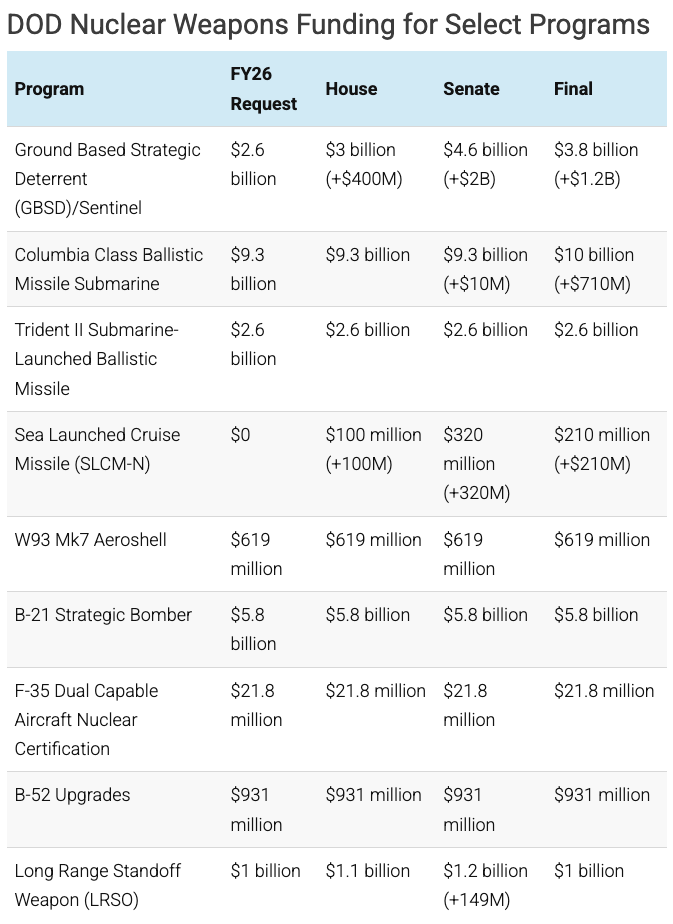
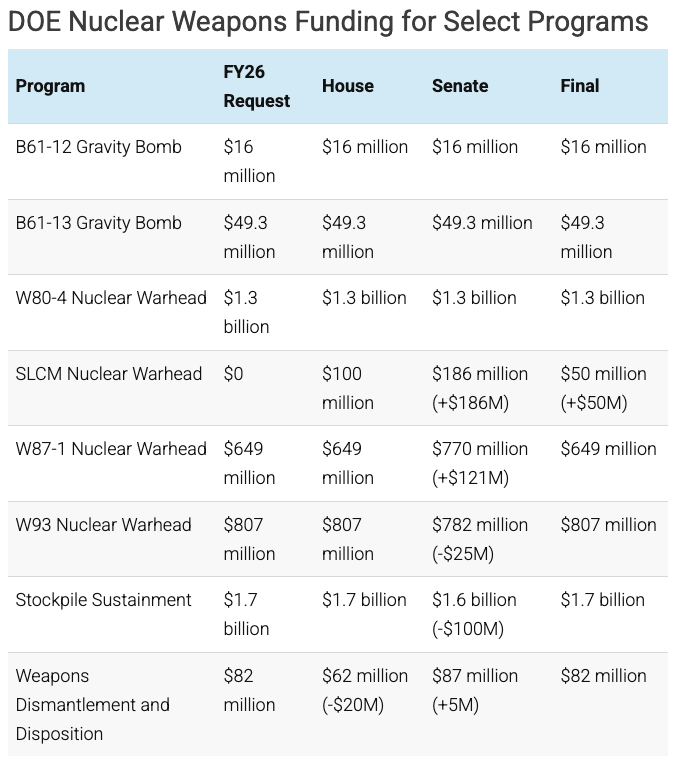
This article was researched and written with generous contributions from the Carnegie Corporation of New York, the New-Land Foundation, Ploughshares, the Prospect Hill Foundation, and individual donors.
Demystifying the New President’s Management Agenda
By design, the Office of Management and Budget’s (OMB) work follows a predictable, seasonal rhythm: budget guidance to agencies in the spring, strategic management reviews in the late summer, passback in the fall, shutdown saber-rattling in late September, release of the president’s budget request in the winter, and so on. A giant novelty clock in the building counts down the days until the end of the fiscal year, each year, whether Congress has done its work to appropriate money for the next one or not. Presidents, Congresses, crises, political movements – all of these come and go, but OMB’s work largely continues to cycle.
This week, OMB completed one such ritual: it released the President’s Management Agenda (PMA). The PMA–closely watched by federal employee groups, contractors, public administration academics, and the handful of general-public bureaucracy-enjoyers–is the vehicle with which each president outlines policy priorities on how the government manages itself. Each 21st-century president has had one, after George W. Bush’s Administration issued the very first one in August of 2001–and President Trump is the first to have issued two discrete ones.
Not familiar with this ritual? You’re not alone. Though not statutorily required, a PMA is meant to be a blueprint for improving how the federal government delivers policy, whether hiring, buying, designing services, listening to Americans, measuring performance, or delivering financial assistance. A PMA is also load-bearing, one of the few levers capable of coordinating action across the enormous machinery of government, aligning budgets, capacity, and accountability behind long-term modernization rather than the short-term crisis response that often drives management changes.
In a year when management issues like human capital, IT modernization, and improper payments have received greater attention from the public, examining this PMA tells us a lot about where the Administration’s policy is going to be focused through its last three years. As we did for a major policy release on hiring earlier this year, the Federation of American Scientists and the Niskanen Center are teaming up to break down and contextualize this year’s PMA.
The Structure of the PMA
As OMB noted in an accompanying memo to this PMA release, the core of the PMA has for many years, been a set of cross-cutting “priority goals” that OMB is required to establish under the Government Performance and Results Act Modernization Act (GPRAMA) of 2010, which codified much of what the Bush and Obama Administrations had done to focus on performance-based goal setting and reporting. Over the years, the PMA has grown to be the organizing principle for these priority goals, explaining how they relate to one another and are part of a broader coherent whole.
This current iteration of the PMA (reproduced below) is organized – like the Biden Administration’s was – as something of a nesting doll. It has three broad priorities, each with a few goals, and a series of objectives within each of those goals:
Unlike previous iterations of the PMA, it appears this new one won’t be accompanied by the type of long narratives and explanations typical of the Bush, Trump I, and Biden PMAs. It also differs somewhat from the Obama Administration’s approach, which focused on a series of detailed “Cross-Agency Priority (CAP) Goals that largely cohered into a formal PMA after the fact as GPRAMA was passed during the term and codified the modern process mid-stream.
Regardless of how they start, however, previous administrations have largely committed to providing ongoing reporting on their progress towards achieving each objective or goal throughout the remainder of the term. It is not yet clear whether the second Trump Administration intends to do this–Congress should inquire about their GPRAMA obligations–but in general this practice has been valuable both to keep agencies accountable for making progress and so that interested third parties can get a window into how the government is changing over time.
In the meantime, this week’s release gives us enough insight into the contours of this term’s PMA to assess how it compares with previous efforts and with what we’ve learned from observing and managing past PMAs.
What’s Promising: A Renewed Focus on Some Hard Problems
Normally, the PMA contains two types of initiatives. The first are evergreen topics —such as the perennial need to hire federal employees more quickly and efficiently—which have appeared in every PMA to date. The second category consists of more idiosyncratic or extremely timely “hard problems” that either haven’t received attention or where past reform has stalled. In the Biden PMA, for instance, this included integrating lessons from the pandemic’s disruption of work life. In the first Trump Administration, it included an ambitious overhaul of personnel vetting transformation on the heels of the massive OPM security clearance data breach in 2015.
Occasionally, these hard problems “graduate” out of the PMA once sustained focus produces results. The PMA’s emphasis on personnel vetting, for example, has largely given way to a multi-year, bipartisan Trusted Workforce 2.0 strategy that has and is making progress despite its challenges.
This year’s PMA includes several such issues, offering the second Trump Administration an opportunity to spotlight underappreciated but consequential aspects of federal management, including:
- Offloading unnecessary leases and buildings: Federal facilities and real estate have never truly been managed as a portfolio with all the transparency, tradeoffs, accountability and management that entails. Before the pandemic, many agencies had significant excess office space and struggled to offload unneeded square footage, even as the average age of federal facilities climbed north of 50 years old and many buildings are no longer suitable for modern work. Rationalizing and right-sizing this portfolio is a worthy and important initiative but it will be difficult: Congress has historically underfunded agencies that are aiming to reconfigure or move, and individual members of Congress frequently oppose specific office closures among their constituents. Any effort to responsibly modernize these real estate holdings will take a lot of patience and willingness to take on sacred cows, but has the potential to earn significant savings and efficiencies.
- Holding contractors and grantees accountable for performance: Most indirect federal spending flows through intermediaries and, too often, the outcomes agencies define for their work are unclear, don’t meet intent, cost more than they should, or aren’t set up for other stakeholders to learn from. Many agencies are captured technologically, intellectually, and psychologically by vendors, leading to a type of learned helplessness where their inability to technically manage contracts leads to an inability to hold them accountable for their performance. Fighting these entrenched forces and inertia is not easy, however, and will require arming agencies with the federal experts, tools and training necessary to change their approach to vendor and grantee management but also give them top-cover to push back on powerful, politically-connected awardees that fail to deliver again and again without consequence.
- Eliminating data silos: While data protections necessarily inhibit privacy and security violations, too much federal data sits in silos built by habit, culture, or old technology. Driving responsible interoperability could have a meaningful impact on service delivery, including for two of the thorniest issues in public service delivery: identity regulation and eligibility verification. However, prior actions and whistleblower complaints about misuse of personal citizen data put an imperative on the Administration demonstrating its commitment to data security under this PMA initiative. It presents an opportunity to right the ship and build the type of trust that will be required from Congress and the public to make good on the transformative power of better data management.
- Removing poor performers: The federal government has long struggled to swiftly remove poor-performing employees. The system we have today was never intended to be permanent or perfect—it was meant to provide incremental improvements toward processing removals quickly but fairly. Nearly every former deputy secretary, in administrations of both parties, has wished they could establish a simple, actionable, repeatable framework for performance management that includes reasonable safeguards. This Administration has an opportunity to chart that path. But proceeding without those safeguards—particularly protections against arbitrary or partisan dismissals—risks undermining good-faith reforms that are crucial for cross-partisan credibility and for helping managers manage well.
- Building the most agile and efficient procurement system: The Revolutionary FAR overhaul underway at OMB and the General Services Administration (GSA) is a concrete opportunity to modernize federal buying at its foundations by paring back the FAR to just its “statutory” requirements and allowing agencies to buy more flexibly. But the regulation update is at best only half the battle: the administration will need to dedicate time, people, and championship to making them stick in training, norms, culture, and leadership. It also needs to resist the temptation to add back its own non-statutory clauses, an impulse that led to the FAR’s bloated and unwieldy state in the first place.
Ideally, success in these areas means they will eventually fade into the background of standard management practice. Agency leaders may not earn themselves splashy press coverage or public adulation by improving procurement or tackling data silos. No agency head wants to spend time grappling with underutilized buildings. Genuine progress here, however, would allow future leaders to remain focused on mission delivery.
What’s Returning: Places to Learn from the Past
This brings us to the evergreen PMA topics. To GPRA veterans, some of the things in here are expected and represent the evolution of years of work by Republicans, Democrats, and nonpartisan civil servants to make the government run better. Many of these reflect years–or even decades–of work to address some of the core challenges of managing a large organization in any sector (how to hire the right people, how to buy effectively, how to build and secure systems, etc.)
But there’s a deeper reason these issues recur, beyond aspirations for bipartisan comity. Adding an item to the management agenda is only a starting point. Meaningful progress requires far more than a talking point, executive order, or regulatory tweak. Leadership attention and cover, technical capacity to actually understand, teach, and monitor reform, oversight partnerships that orient their activities to the new model, administrative data that’s accurate, real-time, and actionable, and central funds to resource pilots too edgy to get agency support or toolkits that no one agency wants to own.
In this PMA, some of these evergreen topics include ones this Administration can learn from its predecessors and accelerate towards success, including:
- Tackling improper payments, fraud, waste, and abuse: The Trump Administration inherits a solid foundation in this area from its predecessor, which invested serious effort into tackling the surge in improper payments in the COVID-19 era. That work included investing in upfront controls, fraud prevention, and collaboration between agencies and their oversight communities. The Government Accountability Office, Agency Inspectors General, and others have also long offered suggestions about how to continue to reduce the government’s improper payments rate. Groups like the Payment Integrity Alliance are developing new technology-powered tools to support this work from outside government. These are evidence-based solutions that are likely to work, as opposed to arbitrary, highly-partisan, and ultimately untrue declarations of fraud that marked the early days of this Administration, in addition to counterproductive efforts to cut or constrain the oversight community. As OMB looks towards 2026, it should take into account these models.
- Streamlining the federal workforce and eliminating duplicative programs: While this year’s efforts are the first in a couple decades to seek to dramatically reduce the size of the federal workforce, they are not without precedence in American history. Following both World Wars (and especially through the late 1940s), the federal government had to demobilize hundreds of thousands or millions of civilian employees in a way that both treated them with dignity and economized on taxpayer dollars. More recently, in the 1990s, the Clinton Administration also conducted large-scale downsizing, with decidedly mixed results because the cuts came before changes to agency to-do lists that never materialized. It will be important for this Administration to learn lessons from the past to avoid some of the long-term damage wrought by the Clinton years, for which agencies are still paying.
- Hiring exceptional talent for key presidential priorities based on skills and merit: All presidents have priorities and many of those involve some kind of hiring surge: following 9/11, the Bush Administration had to rapidly create and staff up the Department of Homeland Security for new mission sets–for example, like airport security. More recently, the Biden Administration conducted several surges around topics like the Bipartisan Infrastructure Law and artificial intelligence. To make this work, previous efforts have succeeded by setting up dedicated teams that focused on specific, measurable goals and bought-in mission area leadership to champion the effort. As OMB and OPM consider their efforts this time, they should explore common data standards to ID bottlenecks, interagency approaches to share resources and talent, and investing in all the accoutrement to new and updated career paths and roles – and doing their best to embed these practices in the system, not just as part of a special effort.
They might also consider reactivating networks and programs that were successful in previous eras, like Tech to Gov, which worked across sectors to hire technologists into government. On merit and skills based hiring, implementation appears to be under way with a variety of initiatives that have promising goals, but will require significant investment of resources and leadership attention to complete, as we’ve written about.
- Buy as one entity: smarter, faster, cheaper: Successive administrations, dating back several decades, have tried to strike the right balance between decentralized and centralized procurement. The Clinton team, for example, called for greater decentralization to agencies because it “allows strangers-often thousands of miles away-to make purchasing decisions.” More recently, however, administrations have gone in the other direction, including a discrete goal to drive category management in the first Trump PMA, though agencies often still complain about being forced to use government-wide vehicles that don’t meet their exact custom needs.
To avoid the pendulum swinging back and forth between centralization and decentralization, efforts to implement this PMA should learn from efforts to achieve savings by transparent use of procurement data that were pioneered in the Biden Administration like the Procurement Co-pilot, Hi-Def initiative, and the strategic acquisition data framework. Rather than mandates from above, these initiatives help drive savings and get “spend under management” by solving information asymmetries and transparently helping agencies understand “what’s in it for them” when they use best-in-class contracts.
- Consolidate and standardize systems, while eliminating duplicative ones: The federal government has long operated on a system of both shared, government-wide, and also bespoke agency systems. The Bush, Obama, and first Trump administrations had OMB focusing on consolidating duplicative systems across government through shared services. This model, while promising in many cases, is difficult to pull off in practice – of those initiatives, the Bush Administration’s payroll consolidation is far and away the most successful, while efforts to adopt standard payment system (e.g., e- and g-invoicing) and innovative payroll solution have languished, as did GSA’s NewPay program.
This PMA should take to heart the lessons of its predecessors: agencies must be resourced up front to execute their part of any migration to shared systems, and OMB must ruthlessly prioritize and rigorously validate any requests for deviations from the standard product. In most cases, it will be far easier—and considerably cheaper—to adjust policy to fit a modern, standard solution than to customize that solution to accommodate every agency’s unique requirements.
Leaders should also address the internal politics of these transitions directly. Champions of bespoke systems often have deep attachment to their legacy tools, and their resistance can be stronger and more personal than expected.
- Defend against and persistently combat cyber enemies: Reactive and proactive cybersecurity has been a central federal government focus as long as government systems have been connected to the internet. Of all the discussed areas, continuity is perhaps most crucial to cybersecurity, with the need for sustained attention to legacy system replacement, identity management, continuous monitoring, secure architectures, and the significant talent demands that come with all of those. This Administration should heed the lessons of its predecessors, which lost valuable time to bureaucratic reshuffling and inconsistent “carrot vs. stick” approaches in its engagement with the private sector.
It’s never going to be possible to truly “solve” these issues that are core parts of ongoing management in any large enterprise. However, because progress is incremental, this PMA can accelerate its own impact by learning from what has and hasn’t worked in the past.
What’s Missing: Outcomes for Americans
There is, however, one “evergreen” PMA topic that we’re surprised to see missing from this iteration: Customer Experience (CX).
The previous two PMAs featured big customer experience pushes to modernize and centralize how the government designs, delivers, and updates benefits based on customer needs. These delivered favorable results for veterans’ benefits, disaster survivors, new families, travelers and more, and fostered innovative approaches to benefits delivery like the cross-agency “life experience” program that reconceptualizes the way the government engages with people who need its support. In recent years, the bipartisan success of these initiatives has led to four straight years of improvements in the industry-standard American Consumer Satisfaction Index, with the government closing out last fiscal year at an impressive 19-year high.
While this PMA does mention “digital-first services” that are “built for real people, not bureaucracy,” that principle sits inside a technology-and-efficiency frame rather than a clear commitment to outcomes for the public. What’s missing is an explicit stance that service delivery, burden reduction, and trust-building are core measures of government performance and are not encompassed by a positive government IT experience or a more fetching website design. Plenty of core users of government services–seniors, for example–do not interface with the government in a “digital-first” way, further complicating this as a focus for customer experience.
Hopefully this absence will still allow for the bipartisan CX agenda to continue in other spaces, such as the new National Design Studio. It’s not enough to declare that the government will deliver high-quality services to the people who rely on them. Agencies need the ability to collaborate and know that the White House will back them when they need to request incremental funding to conduct user research or A/B test a new form before rolling out.
A real test of any PMA isn’t how well it modernizes, it’s whether people notice government working better on their behalf. In that way, CX is what we might call the “love language of democracy” and it’s important that OMB is attentive to building that.
What’s Concerning: The Culture War is Coming for Management
The Biden Administration received criticism for attaching progressive goals from environmental standards to equity to labor onto every possible management tool (procurement, grantmaking) until the weight of implementation is slow, diffuse, or nearly impossible. Its PMA embodied that instinct: broad, values-aligned expansive goals that had great intentions but struggled to operationalize.
The new PMA both reacts against and mirrors that instinct: it pairs standard management reforms with culture-war directives that seek single-minded discipline, accountability, and ideological alignment.
At times, it reads like two agendas stitched together: one technocratic, aimed at federal administrators, and one ideological, aimed at unofficial commissars and social media. Alongside modernization goals you might find in any PMA sit directives to:
- Eradicate woke and weaponized programs across government, which is a sweeping slogan with unclear scope at odds with the usual evidence- and performance-based mandates embedded in GPRAMA and past PMAs.
- End discrimination by government, which is a superficially unobjectionable shibboleth, but incorrectly implies that the government has been discriminating in how it carries out its management functions, despite the fact that its equity programs largely only follow the rules Congress has set out in offering employment preference to veterans or procurement preference to certain categories of small businesses.
- Defund DEI, gender ideology, K-12 indoctrination, child mutilation, and open borders, which are culture war buzzwords with no obvious relation to government performance or management issues.
And scope creeps further into territory historically outside PMA (or OMB) control, such as a set of general goals with choose-your-own-adventure interpretation and murky implementation paths, written at a strange distance from the government the Administration oversees:
- Find and annihilate government censorship of speech, which is perhaps the first time annihilate has ended up in an OMB memo and implies that there are “hidden” examples of censorship while the administration pursues overt censorship in other areas.
- Reverse malicious schemes to hide information from Americans, which gestures at a conspiratorial approach to government management that seems at odds with the Administration’s claim that it’s fully in control of the executive branch. It’s difficult to simultaneously claim that there are truths hidden from the public while also deprecating transparency, as in Federal data sets.
- Abolish abusive intelligence activity targeting unwitting Americans, which is certainly a laudable goal for any civil libertarian in a democracy but doesn’t necessarily have any resonance with normally much-duller management functions like HR and finance, which have struggled to accomplish even their overt functions in recent years, nevermind anything more nefarious.
As we’ve written before, hijacking these normally low-temperature operational processes to fight the culture war not only raises the partisan pressure on normally bipartisan issues, but it also “needlessly politicizes our institutions, snarls our civil servants in red tape, and usually fails to achieve even those unrelated objectives.”
Nowhere is this danger greater than in implementation of the PMA’s objective to “[p]ut political appointees in control of grant process to deliver results,” which supposes that political control and, by implication, alignment with the President’s partisan priorities is a main factor in how Congressionally-authorized grants are executed. The President certainly gets to set some overall parameters for grantmaking across the federal government, and politically-appointed agency heads are ultimately accountable for the money they spend.
But this priority implicates a much more arbitrary and politically-motivated process for determining how public funds are spent that strikes at the heart of what makes government action legitimate: the fair application of rules that are defined ahead of time and apply equally to all. Like a similar requirement in the Merit Hiring Plan, this also creates an obvious bottleneck in agency processes as recommendations stack up for political review, reducing efficiency and elongating the path to “results.”
Perhaps including these initiatives–which largely fall outside of the normal OMB management purview–was the price OMB had to pay to get the rest of the PMA through the hyper-partisan (even in normal order) communications processes of the White House. If that’s the case, agencies should be able to largely proceed with the rest of the agenda unbothered by also having to separately organize around these initiatives. But if not, it will be critical to ensure that directing agencies into partisan goose chases does not pull time and attention away from the harder—and ultimately more rewarding—work of genuine management reform.
Declaration is not Implementation
Publicly releasing the PMA is the easy part. The real work goes into changing government. As the Bush Administration’s first PMA noted: “Government likes to begin things—to declare grand new programs and causes. But good beginnings are not the measure of success. What matters in the end is completion. Performance. Results. Not just making promises, but making good on promises.”
Many of the objectives outlined in the PMA are sound ideas with long track records across different administrations. We largely agree with many of them and they echo our policy priorities and those of partner organizations. But their appearances on multiple PMAs underscores how hard these problems are to solve. Category management,real property portfolio rationalization, and cybersecurity, were problems for many years because of the inherent difficulty of tackling them.. This is doubly true for the ideas that are fresh from the front lines of the culture war, which lack both a track record of successes and failures to learn from and the bipartisan support that more established issues—like improper payments or IT modernization—typically receive in Congress.
To actually impact the entire government – one of the largest and most complex enterprises in human history – it’s not enough to just declare that it’s the policy of the Administration that X or Y happens, or even convene regular gatherings of deputies. We’ve seen that approach fail repeatedly: agencies cannot and will not implement a PMA just because OMB issues it.
Real success requires disciplined implementation. That means selecting strategies that genuinely move the needle; setting aggressive but achievable measures and timelines; incentivizing leaders to invest time, attention, and talent in relentless follow-through; maintaining up-to-date metrics and feedback loops to know what’s working and what isn’t; and sustaining clarity of focus all the way to the finish.Without that, it becomes all too easy for OMB and agencies to skate by on superficial changes that check boxes but result in no real systems change–a PMA of performance art, where everyone claps but nothing changes. Amid all the swirl of any White House, this work of sticking the landing is the hardest part.
That’s because the PMA – like any strategy – itself isn’t really valuable on its own. It can, however, cut through the noise, clarify what the priorities are, and provide a framework for holding agencies and leaders accountable as they do their work. Any PMA will rise and fall based on how well it manages to do this. The way this term’s PMA is structured at the outset makes this task supremely difficult because it’s pulling in several directions all at once: it’s trying to simultaneously pass as a deeply partisan political document, a check-list for agencies of recent EOs, and a sober management policy agenda.
The real danger is that this lack of clarity and flurry of culture war buzzwords means nothing changes. That the same broken systems of human capital, procurement, IT modernization, security clearances, and user feedback, that have contributed to what OMB refers to as “accumulating perils” persist for yet another presidential term because OMB’s own management approach mistook a policy memo for progress and failed to chart a path forward. “Declare success and move on” is how these hard problems survive for decades.
This failure mode is easy to imagine: as humbling as it is to admit when you sit at OMB, reform requires changing the habits of work in agencies, sub-agencies, offices, and teams for whom policy memos about HR and procurement are the last thing on their mind (or even in their inbox). This is the hardest work of governance – rewiring workflows, seeding change in budgets, resetting culture – and demands management be treated as a core, can’t-fail function rather than a sideshow of dashboards and Powerpoint.
As they should be, agency implementers are more focused on the day-to-day administration of their programs: achieving their particular program objectives, responding to requests from Congress, serving the public, tracking their own budgets, and managing their own chaotic work lives. If the PMA can’t provide them with clarity, a limited number of clearly articulated goals, and a simple on/off ramp for change, it will be hard to change the direction of travel – not because of some deep state conspiracy, but because they don’t know what to focus on or how they’re going to be measured. What gets implemented, and what people experience, is what counts; everything else is decoration.
What We’re Watching
As with all broad, whole-of-government strategies like this, it will only be obvious in retrospect whether this administration is successful at achieving those goals. However, there are some things to watch out for that will clue close-watchers in about how things are going:
- First, will OMB continue the type of detailed, quarterly status reports that were the hallmarks of previous PMAs and allowed the public to see how things were progressing?
- Second, are there key metrics that OMB and its partner agencies will commit to tracking, reacting to, and publishing to measure their success?
- Third, are agencies resourced to actually accomplish many of these ambitious goals and what do they prioritize (and indeed, since agencies are not mentioned in the PMA itself, what ownership do agencies feel over it)?
Finally, and more abstractly, we’re also going to be looking out for how OMB and others engage with the rest of the PMA-interested community, including career federal employees, good government groups, congressional staffers, think tanks, academics, and others who have trod this same path. The permanent institutions of the federal government don’t serve any one president exclusively; instead, they represent a deep and important investment that the American people have made in themselves as a bedrock of our democracy. While reasonable disagreements about how to do so will certainly always exist, this community can, should, and will embrace a government asking for help. OMB would do well to welcome them in.