New Nuclear Notebook: Pakistani Nuclear Forces, 2018
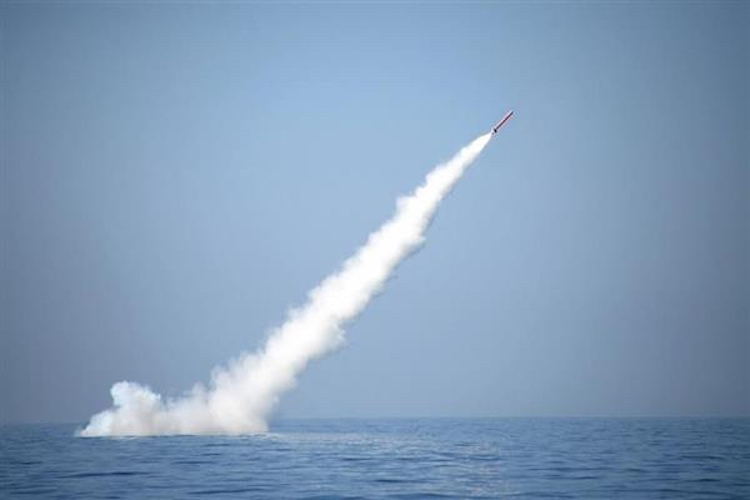
A Babur-3 dual-capable SLCM is test-launched from an underwater platform in the Indian Ocean on January 9, 2017.
By Hans M. Kristensen, Robert S. Norris, and Julia Diamond
The latest FAS Nuclear Notebook has been published in the Bulletin of the Atomic Scientists: Pakistani nuclear forces, 2018 (direct link to PDF). We estimate that Pakistan by now has accumulated an arsenal of 140-150 nuclear warheads for delivery by short- and medium-range ballistic and cruise missiles and aircraft.
This is an increase of about ten warheads compared with our estimate from last year and continues the pace of the gradual increase of Pakistan’s arsenal we have seen for the past couple of decades. The arsenal is now significantly bigger than the 60-80 warheads the U.S. Defense Intelligence Agency in 1999 initially estimated Pakistan might have by 2020. If the current trend continues, we estimate that the Pakistani nuclear warhead stockpile could potentially grow to 220-250 warheads by 2025.
The future development obviously depends on many factors, not least the Pakistani military believes the arsenal needs to continue to grow or level out at some point. Also important is how the Indian nuclear arsenal evolves.
The Pakistani government and officials initially described Pakistan’s posture as a “credible minimum deterrent” but with development of tactical nuclear weapons later began to characterize it as a “full spectrum deterrent.” Moreover, development is now underway to add a sea-based leg to its nuclear posture, and a flight test was conducted in 2017 of a ballistic missile that Pakistani officials said would be capable of carrying multiple warheads to overcome missile defense systems.
Additional information can be found here:
FAS and FLI partnered to build a series of convenings and reports across the intersections of artificial intelligence (AI) with biosecurity, cybersecurity, nuclear command and control, military integration, and frontier AI governance. This project brought together leaders across these areas and created a space that was rigorous, transpartisan, and solutions-oriented to approach how we should think about how AI is rapidly changing global risks.
AI is already consequential, but its future trajectory remains contested. Policymakers should make their assumptions explicit, focus on what can be shaped rather than what can be perfectly predicted, and build institutions that can learn and respond as evidence changes.
From grassroots community impacts to global geopolitical dynamics, understanding developing data center capacities is emerging as a critical analytical challenge.
The last remaining agreement limiting U.S. and Russian nuclear weapons has now expired. For the first time since 1972, there is no treaty-bound cap on strategic nuclear weapons.