Study Calls for New U.S. Nuclear Weapons Targeting Policy
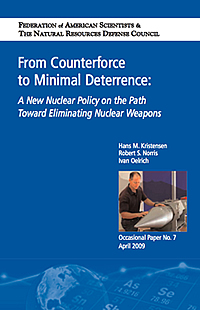 |
| Click on image for PDF-version of full report. |
By Hans M. Kristensen
The Federation of American Scientists and Natural Resources Defense Council today published a study that calls for fundamental changes in the way the United States military plans for using nuclear weapons.
The study From Counterforce to Minimal Deterrence: A New Nuclear Policy on the Path Toward Eliminating Nuclear Weapons recommends abandoning the decades-old “counterforce” doctrine and replacing it with a new and much less ambitious targeting policy the authors call Minimal Deterrence. [Update: see Washington Post – Report Urges Updating of Nuclear Weapons Policy]
Global Security Newswire reported last week that Department of Defense officials have concluded that significant reductions to the nuclear arsenal cannot be made unless President Barack Obama scales back the nation’s strategic war plan. The FAS/NRDC report presents a plan for how to do that.
The last time outdated nuclear guidance stood in the way of nuclear cuts was in 1997, when then President Clinton had to change President Reagan’s 17-year old guidance to enable U.S. Strategic Command (STRATCOM) to go to the START-III force level that the Bush administration subsequently adopted as the Moscow Treaty force level. The series of STRATCOM force structure studies examining lower force levels is described in The Matrix of Deterrence.
Resources: Full Report | US Nuclear Forces 2009 | United States Reaches Moscow Treaty Warhead Limit Early | Press Conference Video
It is difficult to assess from photos whether the Sentinel missile is longer or wider overall than the Minuteman, but the Sentinel clearly has a thicker second stage, which could potentially contribute to the missile’s extended range.
This is not the first time Google has agreed to censor imagery at the behest of governments, but be warned: obfuscation at this broad level poses a direct threat to the public’s ability to monitor and scrutinize government operations.
As humans expand our geographic reach, encroach on untouched natural territories, and interact more with animal populations, we will encounter novel zoonotic diseases that threaten the human body. The sooner we act to address these risks, the better.
“One thing became increasingly clear: AI doesn’t simply introduce a new category of risk. It changes the speed, scale, complexity, and interaction of risks that already exist.”