  |
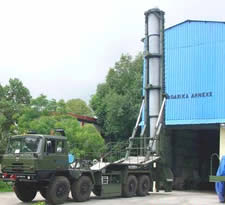
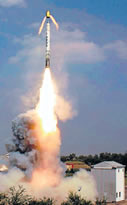
| Mystery missile: widely reported as a future sea-launched ballistic missile, is the Shourya launch in November 2008 (right) a land-based mobile missile (left), a silo-based missile, or a hybrid? Images: DRDO |
.
By Hans M. Kristensen
A decade after India officially crossed the nuclear threshold and announced its intention to develop a Triad of nuclear forces based on land-, air-, and sea-based weapon systems, its operational force primarily consists of gravity bombs delivered by fighter jets. Short of the short-range Prithvi, longer-range Agni ballistic missiles have been hampered by technical problems limiting their full operational status [Update Feb. 2, 2009: “Defense sources” quoted by Times of India appear to confirm that the Agni missiles are not yet fully operational]. A true sea-based deterrent capability is still many years away.
Despite these constraints, indications are that India’s nuclear capabilities may evolve significantly in the next decade as Agni II and Agni III become operational, the long-delayed ATV nuclear-powered ballistic missile submarine is delivered, and warhead production continues for these and other new systems.
Our latest estimate of India’s nuclear forces is available from the Bulletin of the Atomic Scientists.
It is difficult to assess from photos whether the Sentinel missile is longer or wider overall than the Minuteman, but the Sentinel clearly has a thicker second stage, which could potentially contribute to the missile’s extended range.
This is not the first time Google has agreed to censor imagery at the behest of governments, but be warned: obfuscation at this broad level poses a direct threat to the public’s ability to monitor and scrutinize government operations.
As humans expand our geographic reach, encroach on untouched natural territories, and interact more with animal populations, we will encounter novel zoonotic diseases that threaten the human body. The sooner we act to address these risks, the better.
“One thing became increasingly clear: AI doesn’t simply introduce a new category of risk. It changes the speed, scale, complexity, and interaction of risks that already exist.”