New Report: US and Russian Non-Strategic Nuclear Weapons
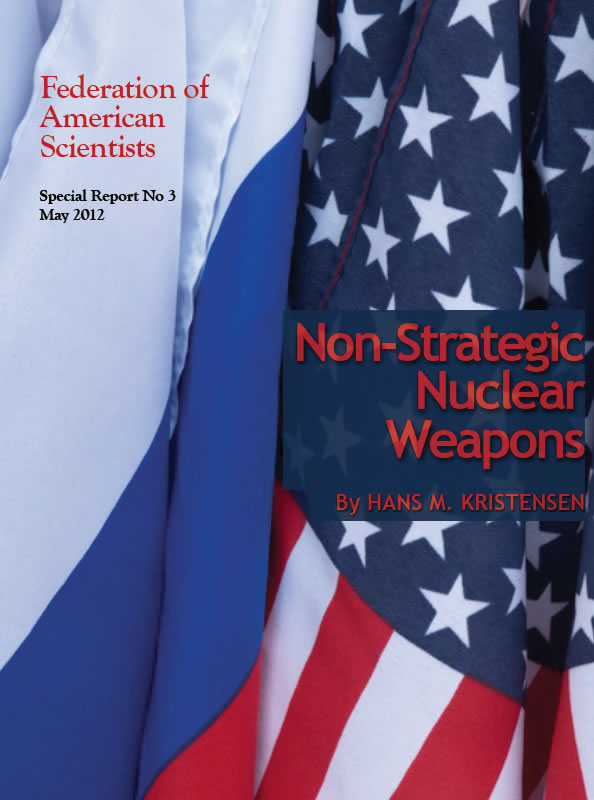 |
| A new report describes U.S. and Russian non-strategic nuclear weapons |
.
By Hans M. Kristensen
A new report estimates that Russia and the United States combined have a total of roughly 2,800 nuclear warheads assigned to their non-strategic nuclear forces. Several thousands more have been retired and are awaiting dismantlement.
The report comes shortly before the NATO Summit in Chicago on 20-21 May, where the alliance is expected to approve the conclusions of a year-long Deterrence and Defense Posture Review that will, among other things, determine the “appropriate mix” of nuclear and non-nuclear forces in Europe. It marks the 20-year anniversary of the Presidential Unilateral Initiatives in the early 1990s that resulted in sweeping reductions of non-strategic nuclear weapons.
Twenty years later, the new report Non-Strategic Nuclear Weapons estimates that U.S. and Russian non-strategic nuclear forces are deployed at nearly 100 bases across Russia, Europe and the United States. The nuclear warheads assigned to these forces are in central storage, except nearly 200 bombs that the U.S. Air Force forward-deploys in almost 90 underground vaults inside aircraft shelters at six bases in five European countries.
The report concludes that excessive and outdated secrecy about non-strategic nuclear weapons inventories, characteristics, locations, missions and dismantlements have created unnecessary and counterproductive uncertainty, suspicion and worst-case assumptions that undermine relations between Russia and NATO.
Russia and the United States and NATO can and should increase transparency of their non-strategic nuclear forces by disclosing overall numbers, storage locations, delivery vehicles, and how much of their total inventories have been retired and are awaiting dismantlement.
The report concludes that unilateral reductions have been, by far, the most effective means to reducing the number and role of non-strategic nuclear weapons. Yet now the two sides appear to be holding on to the remaining weapons to have something to bargain with in a future treaty to reduce non-strategic nuclear weapons.
NATO has decided that any further reductions in U.S. nuclear weapons in Europe must take into account the larger Russian arsenal, and Russia has announced that it will not discuss reductions in its non-strategic nuclear forces unless the U.S. withdraws its non-strategic nuclear bombs from Europe. Combined, these positions appear to obstruct reductions rather facilitate reductions. Russian reductions should be a goal, not a precondition, for further NATO reductions.
Download the full report here: /_docs/Non_Strategic_Nuclear_Weapons.pdf
Slides from briefing at U.S. Senate are here: /programs/ssp/nukes/publications1/Brief2012_TacNukes.pdf
See also our Nuclear Notebooks on the total nuclear arsenals of Russia and the United States.
This publication was made possible by a grant from Carnegie Corporation of New York and Ploughshares Fund. The statements made and views expressed are solely the responsibility of the author.
This is not the first time Google has agreed to censor imagery at the behest of governments, but be warned: obfuscation at this broad level poses a direct threat to the public’s ability to monitor and scrutinize government operations.
As humans expand our geographic reach, encroach on untouched natural territories, and interact more with animal populations, we will encounter novel zoonotic diseases that threaten the human body. The sooner we act to address these risks, the better.
“One thing became increasingly clear: AI doesn’t simply introduce a new category of risk. It changes the speed, scale, complexity, and interaction of risks that already exist.”
In the current environment of declining trust and magnifying strategic competition, banning debris-creating tests is a concrete step towards stability that favors interests of all states seeking to conduct space activities.