Gil on the Hill: Congress is Back. Science Policy is About to Get Messy
Congress emerges from a sluggish, humid August recess into a raucous, sweltering September session. For now, it’s ahead of schedule, with the Senate passing a Continuing Resolution (CR) to fund the government past the September 30th deadline to December 11th (and safely beyond the midterms). Now the House must act. They may end up needing every minute of negotiation time, however, as major Trump administration priorities come to a head with congressional realities.
The science policy community has been active all summer, with a new NSF X-Labs program, an OSTP “Science: A New Golden Age” Report, and FAS Chief Science Officer, Dr. Jedidah Isler’s testimony on “American Global Competitiveness” in front of the House Energy and Commerce Committee (humble brag), to name just a few. As we head into the fall and the end of the 119th session, we face significant S&T issues of concern. Here is what we’re tracking:
1. Continually Resolving (& Gas Station Weed)
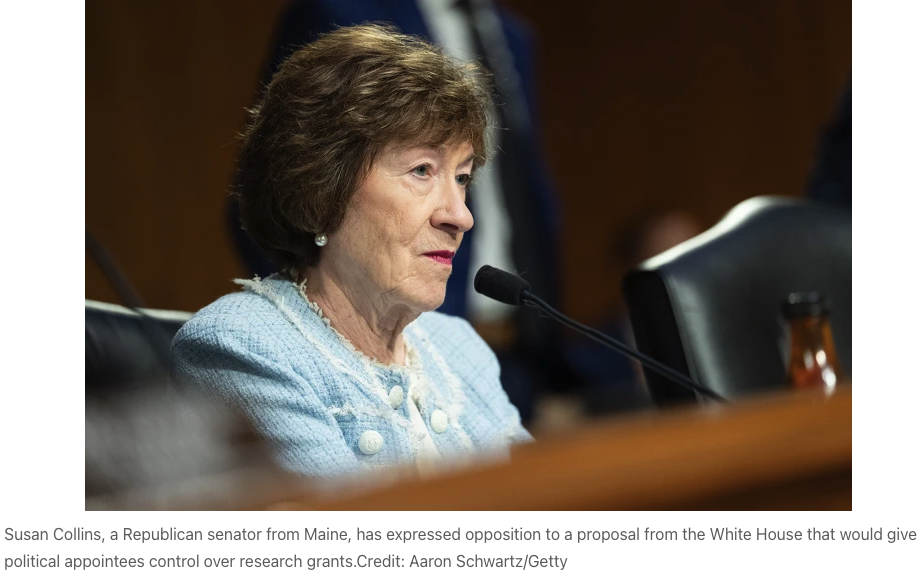
Before breaking for August, the Senate passed a CR to kick the government funding can down the road to December 11th and provide for some choice anomaly funding and policy riders. Most importantly for us, Appropriations Chair Susan Collins (R-ME), who pressed for changes to the rule in a July 6 letter, said the agreement “prevents the Office of Management and Budget (OMB)’s proposed rule regarding federal financial assistance from taking effect” and “avoids any poison pills.” Senator Collins and her colleagues demonstrated tremendous leadership by heeding the call from the science community (and many more constituencies) and asserting congressional authority over the power of the purse.
If your life is impacted by federal grantmaking (it is), then you care about the OMB rule. FAS has done some explaining before, but the TL;DR is that it allows for significant, unprecedented influence from political appointees on how federal funding decisions get made. It would put political appointees in charge of federal grant review, allow termination of active grants at any time for shifting priorities, and restrict international research collaboration. FAS called for a delay and filed our comment, arguing among other things that “a termination authority operating under undefined standards is unaccountable.”
The issue is not settled, however, and we’re set for another September shutdown showdown as all eyes are on the House to pass the Senate’s CR with the OMB Rule delay attached. Senator John Kennedy (R-LA) claims President Trump is “comfortable” with the bill, which notably only delays the OMB rule implementation and does not eliminate it, but even if the administration decides not to pick that fight right now, there are other pain points that could become excruciating. The Senate CR included a delay of a ban on sales of certain intoxicating hemp-derived products, which has House Republicans uneasy about “gas station weed.” Add on to this midterm developments, a trade war, a real war, and more, and it becomes clear all the ways this can go wrong between now and then.
The House has options – it could bring the CR up under “suspension of the rules,” which bypasses a key initial voting hurdle without needing to acquiesce to smaller factions on select issues, but requires two-thirds of members voting to pass. We’ll see how creative they have to get.
What matters: The Senate-passed CR must be passed by the House before September ends, and it contains at least one high-profile provision that could cause trouble. It’s the last chance to address the OMB proposed rule before it goes into effect.
2. The OMB Rule & Impoundment
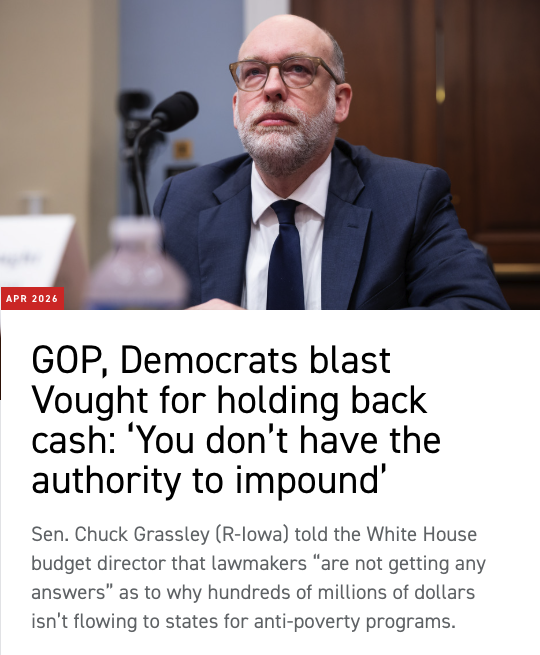
There is compelling evidence that the administration has been engaged actively in impoundment – the illegal withholding of congressional funds. Yes, this is still happening, and it’s still a massive deal. The OMB proposed rule is the administration’s attempt to formalize and endure tactics the administration has already been using to exert as much control as it can on federal funding at the individual award level.
Taken together, it is clear that the administration has been overreaching on federal funding decisions big and small, including and especially on programs specifically appropriated by Congress (which is law). The OMB proposed rule stands on a roof and shouts to the world what so many in the science community have been documenting for over a year: the Administration is testing the limits of the American taxpayer’s tolerance for unprecedented control of federal funding by the executive branch. The final theater of this fight will be in the courts.
As we track and respond to individual grantmaking decision changes and are still licking wounds from DOGE cuts (GAO isn’t buying the “savings” claims), in the big picture, agencies are still dealing with major budget shifts and withholdings. Recent reports suggest NSF will award roughly 46% fewer research grants than the 2021–24 average, and the lowest count since the early 1980s. Spending across nearly all eight of NSF’s main directorates is down 20% to 40% year over year despite Congress directing that no directorate be cut more than 5% against FY2024. Congress is flexing oversight muscles, and if Democrats expectedly take over at least one chamber next year, they’ll be doing much more than flexing.
In early August, Reps. Zoe Lofgren (D-CA) and Rep. Gabe Amo (D-RI) referred Energy Secretary Chris Wright to the Justice Department, alleging he testified falsely in June that $7.5 billion in clean energy grant terminations were not politically motivated. In July, DOJ itself acknowledged in a federal lawsuit that hundreds of terminations were “based solely on the political identity of the grant recipient’s state,” and 283 of the 284 were states that voted for Harris. According to Secretary Wright’s June 10 testimony: “…no decisions were made on politics.” Expect more, and more emboldened, oversight action like this these next two years.
What matters: We spent a year arguing about whether appropriated funds would be spent at all. Now we’re debating the basic structure of awarding individual federal grants. Next we need to know whether anyone will say out loud where the money is going and what Congress and American taxpayers want to do about it.
3. Science Leadership and the Midterms
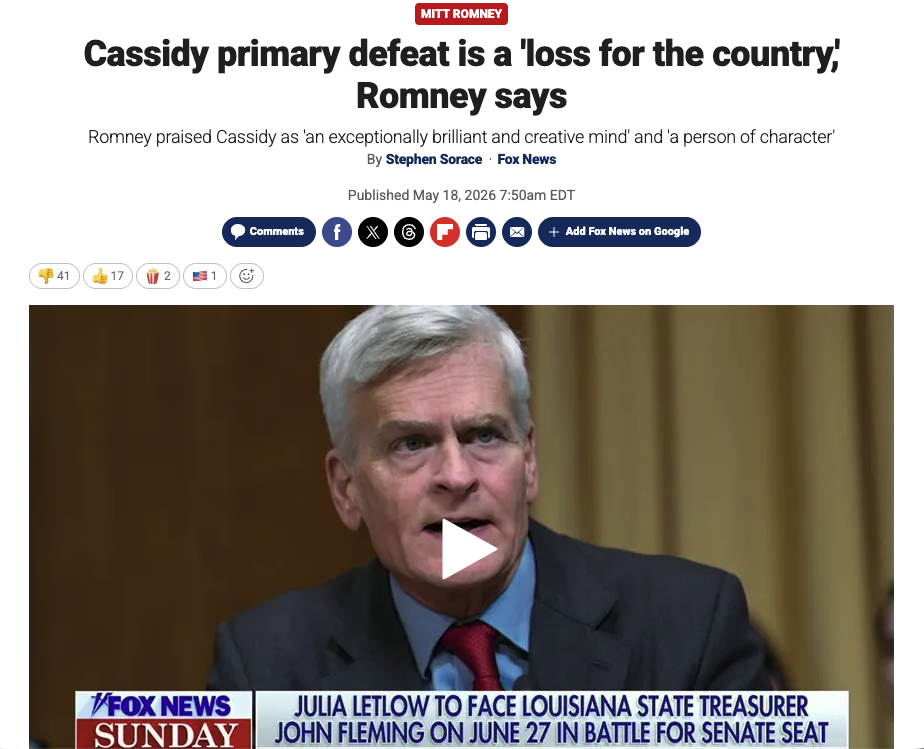
Midterm primaries are coming to a close, and with it consequences for scientific leadership in Congress. Some notable science and health leaders were removed by their own party’s voters this cycle:
- Sen. Bill Cassidy (R-LA), chair of the Senate Health, Education, Labor, and Pensions Committee. Sen. Cassidy is a physician, noted science champion, and one of my personal favorite legislators. He lost his May primary to a MAGA/MAHA-aligned candidate and joins the list of Republican members who vocally opposed President Trump and lost.
- Rep. Haley Stevens (D-MI), ranking member of House Science’s Research and Technology subcommittee and a CHIPS and NSF reauthorization principal, lost Michigan’s Senate primary on August 4. Rep. Stevens was also a member of the Select Committee on the Strategic Competition Between the United States and the Chinese Communist Party, and a co-chair of important S&T caucuses such as the Future of Work Caucus.
- Rep. Raja Krishnamoorthi (D-IL), ranking member of the Select Committee on the CCP and member of the House Intelligence Committee, lost Illinois’s Senate primary in March.
Add the retirements, and you have up to ten science and technology leadership positions vacating before a November general election vote is counted:
- Sen. Mitch McConnell (R-KY) as Chairman on the Senate Appropriations Subcommittee on Defense,
- Sen. Joni Ernst (R-IA) as Chair on the Senate Armed Services Subcommittee on Emerging Threats,
- Rep. Don Bacon (R-NE) as Chair of the House Armed Services Subcommittee on Cyber, IT and Innovation,
- Sen. Gary Peters (D-MI) as Ranking Member of the Homeland Security and Government Affairs Committee,
- Rep. Jan Schakowsky (D-IL) as Ranking Member on the House Energy & Commerce Subcommittee on Commerce, Manufacturing, and Trade, and
- Sen. Steve Daines (R-MT) as Chairman of subcommittees on the Senate Energy and Natural Resources and Foreign Relations Committees.
One of the most consequential races for science leadership concerns the aforementioned Senator Collins in Maine. As Chair of the Appropriations Committee, she has maintained her status as one of the most high-profile members of Congress, and her centrist and bipartisan profile cast her as a key figure in every major congressional negotiation. On top of that, as recently demonstrated by her leadership in opposition to the OMB rule, she has been a stalwart champion and defender of science and technology priorities in Congress. Polls are classifying this race as a toss-up and essentially tied against Troy Jackson, who only became the nominee on July 25 after the widely reported Graham Platner controversies forced Platner’s dropout.
What matters: if you work a science portfolio, your customer list is about to change more than at any point since 1992. At least 83 members will not return, and 58 House retirements are the second-highest total in history.
4. Looking Ahead – Closing of the 119th Congress
Congress is running out of track to deliver on key priorities that have been in negotiation throughout the 119th session. There are really only three legislative vehicles left (that could become one by December) – the CR funding package, the follow-up bill on December 11th for full annual funding (if the CR passes), and the yearly National Defense Authorization Act. Everything else – NASA reauthorization, National Quantum Initiative, Fix Our Forests Act, permitting, the farm bill, the Export-Import Bank reauthorization, and so much more – is cargo looking for a ride on one of these must-pass vehicles.
That’s a lot to squeeze in, but we know when Congress really wants to do something, they will. And even while it may feel fraught and intractable, somehow they find a way to get the necessary done in the end. Many of these items may well fall off and into the next Congress, but many too will pass into law (if I may provide such an uninspired expert take). External factors like wars, trade policies, and election security all loom large over all of it, however, and a month is a long time in Washington, D.C.
We’ll check back then! Ta-ta for now.
As we head into the fall and the end of the 119th session, we face significant S&T issues of concern. Here is what we’re tracking.
Colorado faces a projected shortage of more than 2,400 physicians by 2030, alongside the growing shortage nationwide, particularly in rural and certain underserved urban communities.
The Colorado Skills Map would define the technical and durable skills employers expect by sector and occupation, then attach a common skill identifier to ensure that credentials, courses, and work-based learning experiences are recognized as equivalent and portable across the state.
Only through independent monitoring, reporting, and investigation on data centers’ environmental impacts, can we promote public trust, inform the allocation of natural resources, and enable responsible governance on future data center development.