  |
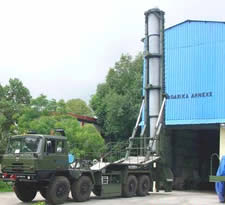
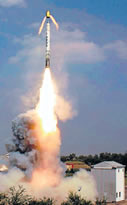
| Mystery missile: widely reported as a future sea-launched ballistic missile, is the Shourya launch in November 2008 (right) a land-based mobile missile (left), a silo-based missile, or a hybrid? Images: DRDO |
.
By Hans M. Kristensen
A decade after India officially crossed the nuclear threshold and announced its intention to develop a Triad of nuclear forces based on land-, air-, and sea-based weapon systems, its operational force primarily consists of gravity bombs delivered by fighter jets. Short of the short-range Prithvi, longer-range Agni ballistic missiles have been hampered by technical problems limiting their full operational status [Update Feb. 2, 2009: “Defense sources” quoted by Times of India appear to confirm that the Agni missiles are not yet fully operational]. A true sea-based deterrent capability is still many years away.
Despite these constraints, indications are that India’s nuclear capabilities may evolve significantly in the next decade as Agni II and Agni III become operational, the long-delayed ATV nuclear-powered ballistic missile submarine is delivered, and warhead production continues for these and other new systems.
Our latest estimate of India’s nuclear forces is available from the Bulletin of the Atomic Scientists.
The United States’ biosecurity governance system is structurally incapable of detecting and responding to certain classes of threats. U.S. biosecurity tools have not kept pace with technological advancements or a changing threat landscape.
FAS and FLI partnered to build a series of convenings and reports across the intersections of artificial intelligence (AI) with biosecurity, cybersecurity, nuclear command and control, military integration, and frontier AI governance. This project brought together leaders across these areas and created a space that was rigorous, transpartisan, and solutions-oriented to approach how we should think about how AI is rapidly changing global risks.
AI is already consequential, but its future trajectory remains contested. Policymakers should make their assumptions explicit, focus on what can be shaped rather than what can be perfectly predicted, and build institutions that can learn and respond as evidence changes.
From grassroots community impacts to global geopolitical dynamics, understanding developing data center capacities is emerging as a critical analytical challenge.