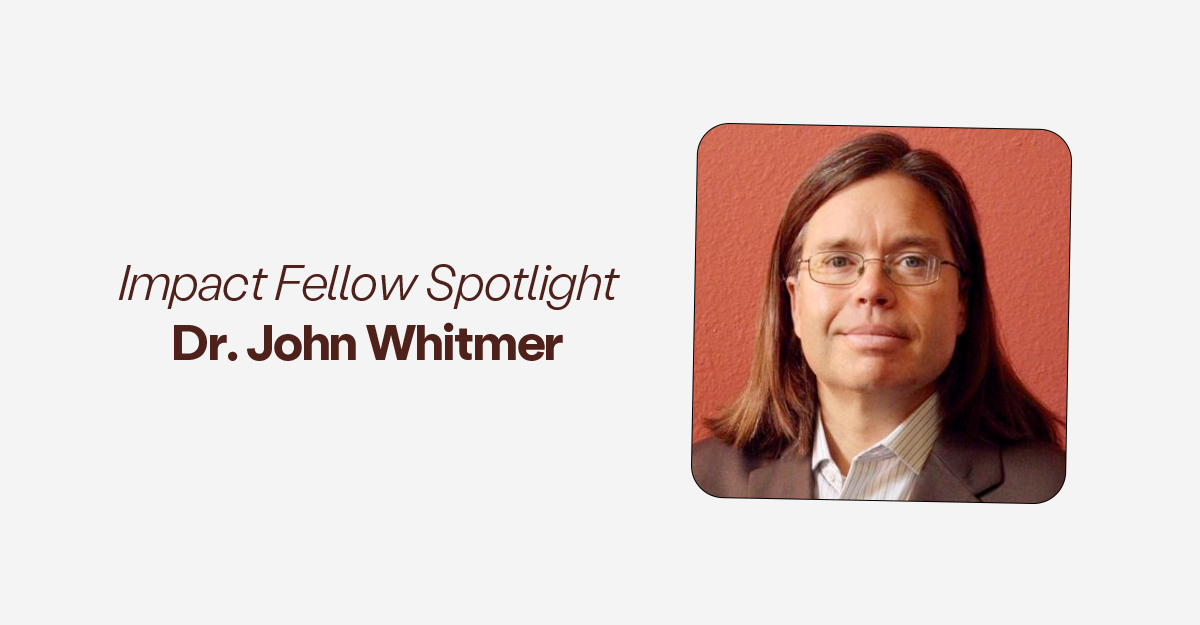
“I’ve always been around people who make a living by caring”: an interview with Impact Fellow John Whitmer
The Federation of American Scientists was founded on November 30th, 1945. For our 80th birthday, we have been reflecting on the innovation and impact the organization has made in the world. One of the ways we have made tangible contributions in the realm of science and technology is with the FAS Talent Hub’s Impact Fellowship.
Since its launch in March 2021, the Impact Fellowship has provided a pathway for federal leaders to access leading industry experts interested in a “tour of service” in the federal government. Our first Impact Fellow to serve in the federal government was Dr. John Whitmer. Dr. Whitmer served the Director of the Institute for Education Sciences (IES), the research and development agency for the U.S. Department of Education, evaluating the potential for using Artificial Intelligence (pre-ChatGPT!) for automated scoring of the NAEP exam, among other projects.
For Dr. Whitmer, working in public service was natural. “I’ve always been around people who make a living by caring. My mother was a Psychiatric Nurse, and my wife is a social worker,” he said, “while I’ve always been a ‘techie.’ I’ve also been interested in work that has an impact to improve people’s lives.”
However, for Dr. Whitmer, working in education was a surprise. “I didn’t like school when I was younger, I wasn’t engaged until I started studying computer engineering – Turbo Pascal.” During the “dot-com boom,” he took an alternative route, teaching computer software in a low-income housing community and teaching the queer and trans community how to build websites. This work nurtured his interest in the intersection of data, learning, and societal impact.
In addition to receiving his Master’s Degree in Sociocultural Anthropology and his Doctorate in Educational Leadership from UC Davis, Dr. Whitmer then spent over 20 years working in the EdTech industry. Then he came across an opportunity that he saw as a perfect next step – an Impact Fellowship within the Department of Education’s Institute of Education Sciences (IES).
At IES, Dr. Whitmer focused on generating actionable policy insights from ED’s data sources that can support evidence-based policy on tutoring, learning acceleration, and identifying effective strategies to address interrupted learning due to the COVID-19 pandemic. One of the first, and most important lessons he learned as an outsider entering public service? He learned that the Department of Education had always been doing innovative work, and there was no shortage of that work happening.
“My time at IES gave me insight into how decisions are made within government systems, and the very real barriers to innovation and change that are often rooted in good intentions and concerns to mitigate harm. They also showed me that there are pockets of innovation where you might least expect it, and to not underestimate the resilience of federal employees and civil servants.”
Dr. Whitmer is currently Senior Research Scientist & founder of Learning Data Insights, a technical services and software product agency providing support to education technology companies, philanthropic foundations, and other organizations seeking to build and evaluate AI-powered applications and solutions in education. Additionally, John co-chairs the AI in Measurement Subcommittee of the National Council of Measurement in Education.
This rule gives agencies significantly more authority over certain career policy roles. Whether that authority improves accountability or creates new risks depends almost entirely on how agencies interrupt and apply it.
Our environmental system was built for 1970s-era pollution control, but today it needs stable, integrated, multi-level governance that can make tradeoffs, share and use evidence, and deliver infrastructure while demonstrating that improved trust and participation are essential to future progress.
Durable and legitimate climate action requires a government capable of clearly weighting, explaining, and managing cost tradeoffs to the widest away of audiences, which in turn requires strong technocratic competency.
FAS is launching the Center for Regulatory Ingenuity (CRI) to build a new, transpartisan vision of government that works – that has the capacity to achieve ambitious goals while adeptly responding to people’s basic needs.