Making Rural Communities Visible in Artificial Intelligence Through Rural Proofing in Kansas and Beyond
A road can show connection, but not access. Rural communities might appear in data and public systems, yet still remain invisible when AI systems do not reflect distance, transportation barriers, service gaps, workforce constraints, smaller data sets, and local strengths. Rural proofing gives Kansas and other rural states a practical way to make these realities visible in the AI-driven decisions already shaping health and social services.
Artificial intelligence (AI) is increasingly shaping decisions across public health systems, including how needs are identified, how resources are distributed, and how services are delivered. As a result, AI will play an important role in the future of healthy rural communities. When designed and governed carefully, AI can improve access, resource planning, coordination, and service delivery. When rural contexts are overlooked, AI systems can reproduce uneven outcomes and risk deepening existing disparities. In rural areas, where health systems often operate with fewer providers, thinner infrastructure, and less margin for error (meaning fewer backup resources when something goes wrong), these risks can be especially significant.
This memo examines rural invisibility in AI-related health systems, defined as the underrepresentation of rural communities in data, system design, validation, and governance. It explains why these gaps matter and why AI should be developed, tested, and governed with rural communities in mind. The term “rural” can be defined in a variety of ways, but this memo leans on the shared understanding of rural places as those with fewer people, less population density, and greater distance to services. While each rural community has a different history, strengths, resources and challenges, this memo – and the concept of “rural-proofing”, explained within – recognizes there are many shared challenges commonly faced by rural communities.
At both the national and state levels, there is an opportunity for more intentional action to recognize rural invisibility in AI systems as a policy issue. States can position themselves as proactive leaders in rural AI governance by aligning with federal frameworks while developing practical, state-level approaches. Kansas can become a leader in developing and implementing practical rural-proofing approaches that can serve as a model for other rural states. To do so, the state should take five connected steps: 1) make rural context a required part of any Kansas AI task force; 2) require rural proofing before agencies adopt or expand high impact AI tools; 3) institutionalize rural listening through trusted local partners; 4) document the Kansas model as a public blueprint other states can adapt; and 5) build a statewide rural AI literacy framework for residents,students, frontline workers, and public agencies.
Challenges and Opportunities
Rural communities have strong social connectedness, local knowledge, community leadership, and deep relationships that support resilience and innovation. Yet, they often face lower population density, greater geographic dispersion, and more limited access to services and infrastructure. In these settings, AI decisions in one domain can quickly affect others, making locally grounded context and community-level oversight especially important. As AI adoption grows, its effects on rural communities reach well beyond any single tool or system. What’s at stake is broader: how rural needs are represented in data, who has a voice in how AI decisions are made and governed, and how the benefits and burdens of AI systems and infrastructure are distributed across communities. These dynamics raise important questions about whether AI systems adequately account for rural conditions, populations, and lived experiences.
Rural Invisibility in AI Systems
Rural invisibility in AI systems occurs when rural communities are underrepresented in the data, assumptions, design, validation, and governance that shape how systems are built and used. That can make rural needs harder to see and rural harms harder to detect. In practice, it means that AI systems may be built on assumptions that do not reflect rural realities, leaving rural communities overlooked in decisions about resources, services, and policy.
The body of evidence, including the 2025 scoping review, illustrates how this invisibility carries into practice. It highlights that rural AI research is underdeveloped and that models underperform in rural settings, and the consequences of those failures are rarely studied where they are felt most. As the 2025 National Rural Health Association policy brief notes the challenge is not simply whether rural systems use AI, but whether technologies reflect the realities of fragmented records, thin staffing, and delayed care pathways. When those realities remain invisible in design and implementation, the consequences can include missed, delayed, or incorrect diagnosis, misallocation of resources, and greater strain on rural providers.
Gaps in AI Governance Frameworks
It is important to assess how well current governance approaches perform across different contexts. Current AI governance frameworks, including the National Institute of Standards and Technology Artificial Intelligence Risk Management Framework and Organization for Economic Co-operation and Development (OECD), provide a strong foundation by emphasizing fairness, transparency, accountability, and risk mitigation, but they provide limited guidance on how to operationalize these principles in rural environments. These frameworks often do not fully account for differences across settings. For example, communities and organizations vary in data availability, institutional capacity, and service infrastructure. They also differ in their ability to evaluate and govern AI tools, especially when staffing, technical expertise, and resources are uneven. Most frameworks do not require testing across small or geographically distinct populations, which can make it harder to see how AI performs in rural areas and allow disparities to go unnoticed.
In addition, current frameworks do not specify how local knowledge, professional judgment, or community perspectives, particularly those from rural communities, should be incorporated into AI oversight and decision-making, which can both algorithmic invisibility and broader forms of rural invisibility in AI. While they emphasize stakeholder engagement, they leave implementation largely undefined, which can limit the ability to identify context-specific risk. These gaps also matter because AI already shapes public benefits, legal navigation, housing, and service coordination. When trained on data shaped by past inequities, AI can deepen disparities rather than reduce them. This is why AI governance must move beyond general principles and explicitly incorporate rural proofing, accountability, and meaningful community involvement.
Federal policy remains an important lever because it can help push state policy forward by signaling priorities, shaping governance expectations, and giving states a stronger foundation for action.Current federal guidance provides a foundation for responsible AI use but offers more limited practical direction for rural settings, where sparse data, limited staffing, and fragmented service systems can affect how AI works in practice. Even though the recommendations in this memo focus primarily on actions at the state level, federal guidance on addressing rural invisibility in AI across health, education, and social systems can help create the conditions for states to act more effectively and equitably on behalf of rural communities.
The White House Office of Science and Technology Policy (OSTP) or the Domestic Policy Council (DPC) is well positioned to lead coordination across federal agencies, ensuring that rural AI implementation challenges are recognized in efforts affecting health, education, and social systems. Building on that coordination, the Office of Management and Budget (OMB) is well positioned to reinforce this work through its existing governance and procurement role to clarify how existing expectations for artificial intelligence procurement, validation, monitoring, oversight, and accountability apply in rural-serving settings. The Department of Health and Human Services (HHS), the Department of Agriculture (USDA), and the Department of Education (ED) should then help translate that guidance into practice for artificial intelligence systems and programs that directly affect rural communities. The National Institute of Standards and Technology (NIST) should provide supplemental examples showing how artificial intelligence risks can present differently in rural settings. This would strengthen implementation under existing frameworks without requiring the development of a separate framework.
Federal agencies should use existing programs to strengthen rural data infrastructure, technical assistance, and workforce readiness, and governance capacity needed for responsible AI implementation in rural communities. HHS, USDA, and ED can support rural-serving institutions directly, while NIST and other federal partners can provide tools, guidance and practical examples to help organizations implement AI responsibly and effectively.
The Need for Rural Proofing
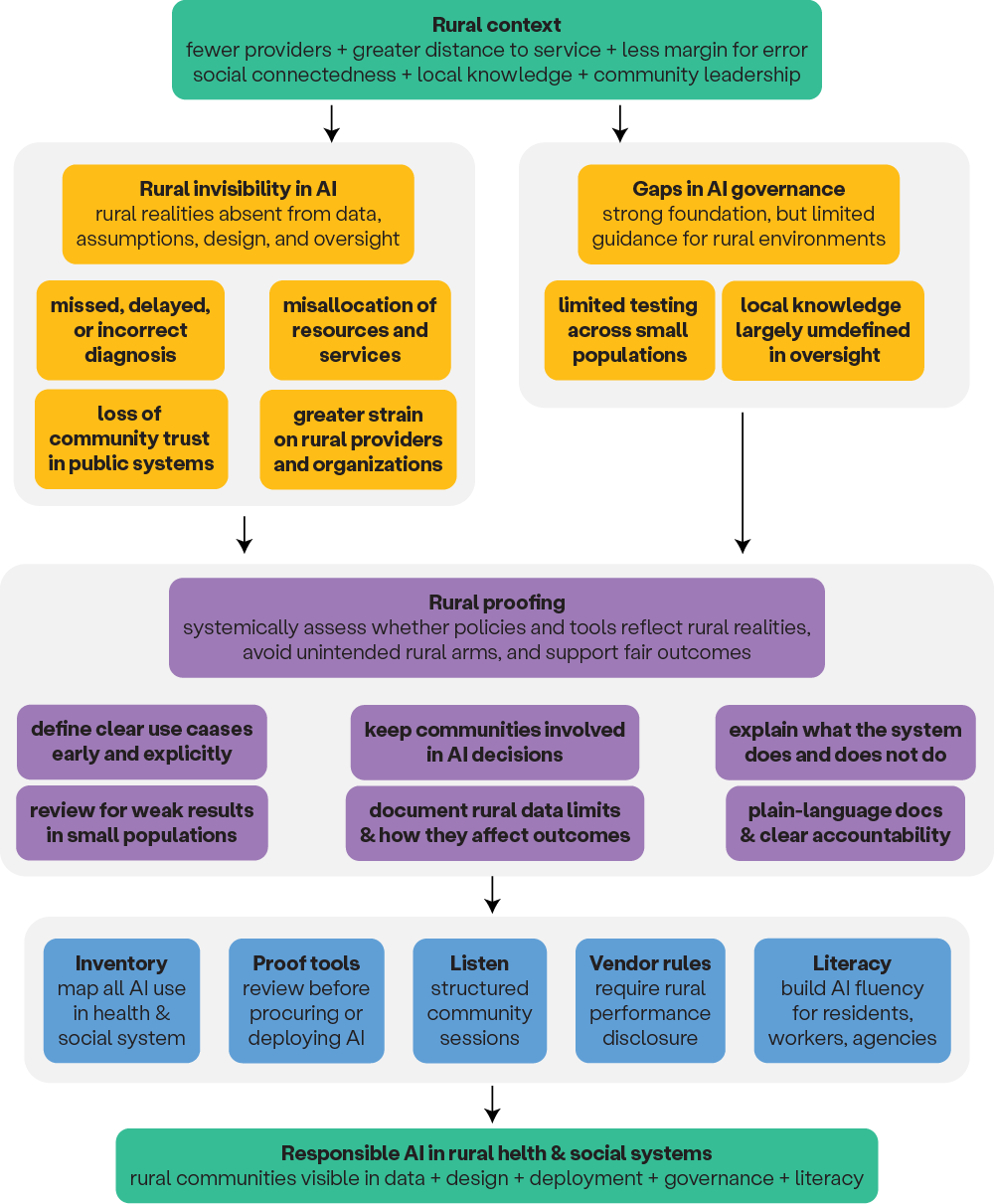
Rural proofing is the process of systematically checking whether policies, tools, and investments reflect rural realities, avoid unintended rural harms, and support fair outcomes for rural communities. In practice, it means asking early and explicitly how a policy or AI system will function in places with lower population density, greater distance from services, thinner infrastructure, smaller administrative capacity, and different patterns of need and service use.
When applied to AI, rural proofing makes rural conditions visible across system design, data, deployment, and oversight. This includes defining clear use cases, keeping communities involved in decisions about AI, explaining what the system does and does not do, and regularly reviewing whether it creates unequal results. It also means regularly reviewing system performance, checking for weak results in small or low-volume populations, documenting when rural data is limited, and being transparent about how those limitations affect outcomes. Rather than treating rural impact as an afterthought, rural-proofing makes rural context and rural strengths a core part of design, implementation, oversight, and evaluation. Within governance processes, it also helps ensure that policies and decisions are informed by rural needs, contexts, and strengths rather than assumptions developed elsewhere.
Because many rural systems operate with limited staff, tight budgets, and shared regional responsibilities, AI governance requirements must be practical. Federal and state agencies should give rural-serving organizations the time, funding, and support needed to review systems, raise concerns, and participate in oversight. They should also provide plain-language documentation so local leaders, frontline staff, and community members can understand how decisions are being made. Finally, rural proofing requires clear accountability. When AI systems cause harm or fail to work fairly in rural communities, agencies and vendors should have a clear process to identify the problem, respond to it, and fix it (see Figure 1).
Plan of Action
Addressing rural invisibility in AI algorithms and systems across health and social sectors requires coordinated national attention and action, including the integration of rural proofing into national AI governance efforts. Because national frameworks often serve as guidance for states, progress at the national level is needed to provide the standards, expectations, and resources that support states in adapting AI governance to their specific contexts.In the meantime, states can begin building their own pathways by aligning with existing frameworks, piloting approaches in priority areas, and strengthening internal capacity.
Kansas as a Blueprint
As one of the nation’s rural states, Kansas has a strong interest in ensuring that AI systems work effectively for rural communities. As AI becomes increasingly integrated into sectors that are important to rural Kansan, including health care, education, transportation, agriculture, emergency response, public benefits, and other public services, rural-proofing can help ensure that AI tools are responsive to rural contexts.
For Kansas, this could include leveraging existing rural health infrastructure, engaging local stakeholders, and testing practical approaches that can be scaled as clearer national direction emerges. The Center for Medicare and Medicaid Services (CMS)’s Rural Health Transformation Program offers one practical pathway for aligning rural technology investment and technical assistance in Kansas with rural AI proofing principles. The Kansas Legislative Artificial Intelligence Task Force should explicitly include rural context as a defined part of its charge, membership, and workplan. The Kansas Office of Information Technology Services (OITS), the Information Technology Executive Council (ITEC), the Kansas Department of Health and Environment (KDHE), the Kansas Department for Aging and Disability Services (KDADS), and the Kansas Department for Children and Families (DCF) should work collectively to translate broad AI governance principles into practical oversight and implementation for rural health and social systems.
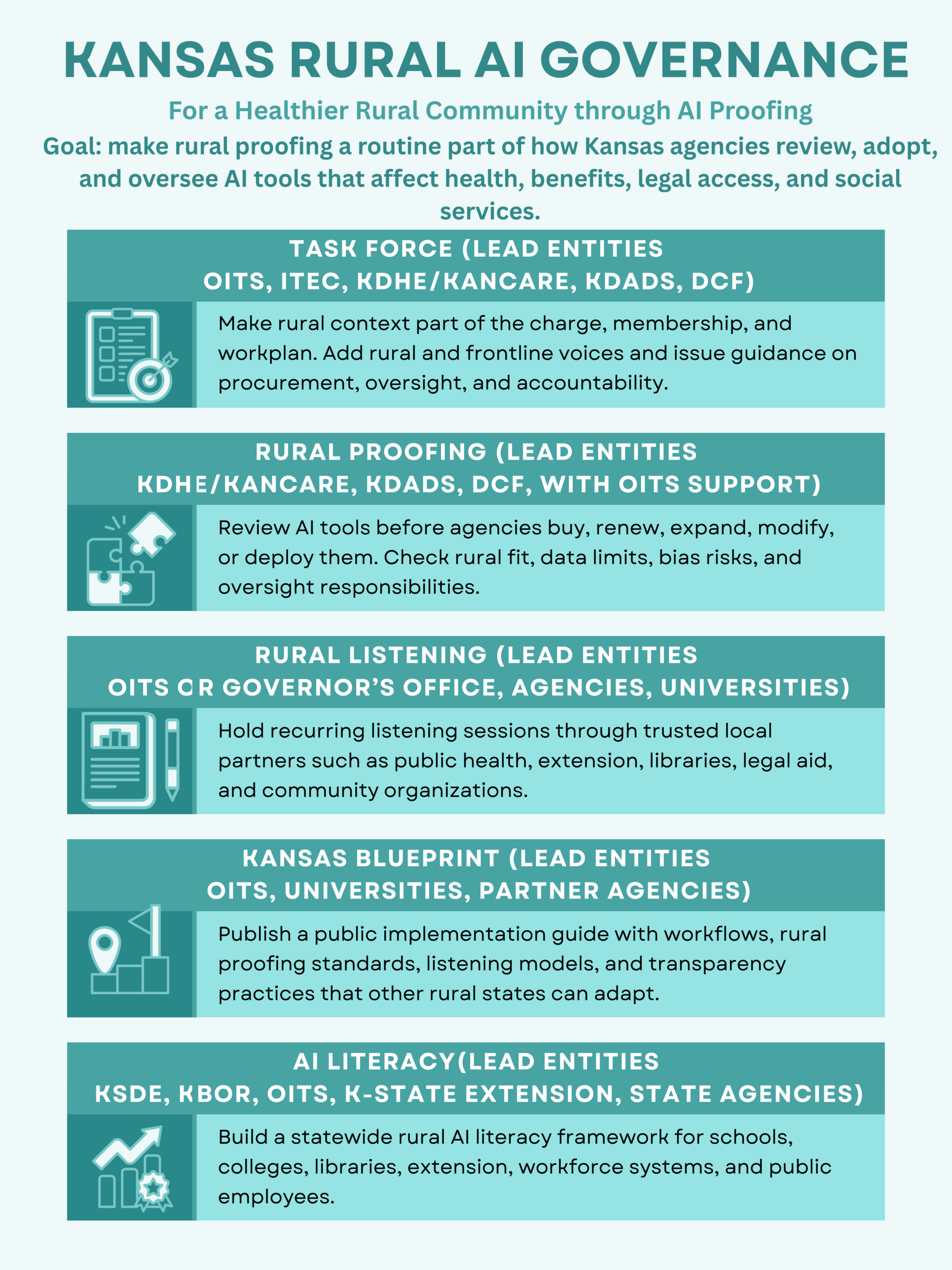
Furthermore, implementation of these recommendations can be staged based on current capacity, allowing agencies to begin with foundational actions and progressively build toward a more coordinated, statewide approach over time (see Figure 2).
Recommendation 1. Ensure The Kansas Legislative Artificial Intelligence Task Force and Any Future State-Level Task Forces Explicitly Include a Focus on Rural Context and Health
The Kansas Legislative Artificial Intelligence Task Force, given its role in shaping AI policy and direction, should explicitly include rural context as a defined part of its charge, membership, and workplan. The current task force already includes legislators, executive branch leadership, universities, health systems, agriculture, and private sector technology members. The taskforce’s scope could include reviewing AI use in rural contexts, incorporating rural and frontline voices into decisions around AI procurement and deployment, and issuing guidance on procurement, oversight, and accountability in rural health and social systems.
In practice, Kansas can build on the existing role of OITS by extending its coordination function to include AI-specific responsibilities, such as setting standards for evaluation, interoperability, and responsible use across agencies. ITEC can provide statewide governance direction by aligning AI efforts with broader IT strategy and policy. Service agencies, including KDHE, KDADS, and DCF would implement these efforts within health and social systems. This structure gives Kansas a practical model that other states can adapt by pairing a statewide IT authority with the agencies that directly manage public benefits, care, and social services.
- Define Scope. State-level Kansas AI task forces, working groups, and advisory bodies should explicitly include AI use and governance in rural contexts as a core scope of work, embedding rural considerations directly into the charge, membership, and workplan rather than treating them as secondary or optional.
- Coordinate Governance. Cross-agency coordination should occur through OTIS with statewide governance direction set through ITEC, while agencies including KDHE, KDADS, and DCF should identify and document where AI affects health and social service access.
- Establish Structure. Kansas should establish a clear governance structure that translates national AI principles into practical oversight, procurement, and implementation decisions tailored to rural conditions.
Recommendation 2. Require Rural Proofing for AI Used in Kansas Health and Social Service Programs
AI-enabled tools are expanding across eligibility decisions, care coordination, analytics, and service delivery. Because of this, Kansas should strengthen AI governance within the agencies that directly shape health and social outcomes. In practice, this work should begin with KDHE, KDADS, and DCF with cross-agency coordination support from OITS. Rather than relying only on broad fairness principles, these agencies should use a practical rural-proofing process to assess whether AI tools work reliably in rural settings with different staffing levels, service access, broadband conditions, data volume, and administrative capacity. Taking these steps now would help Kansas clarify oversight responsibilities, procurement standards, and rural risk before AI becomes more deeply embedded in public systems.
- Inventory. KDHE, KDADS, and DCF should identify and document current and planned uses of automated decision tools and AI systems used in decision-making that affect eligibility, benefits, care access, case management, service coordination, navigation, and enforcement. Agencies should require vendors to inventory AI used in care management, prior authorization, utilization management, member outreach, and provider network decisions. Kansas can then expand this inventory approach to other agencies that shape health, including housing, transportation, workforce, education, justice, and environmental systems.
- Rural AI Proofing. Agencies should apply rural-proofing review before they procure, renew, expand, modify, or deploy high-impact AI systems. This review should assess whether the tool performs reliably in rural settings, whether rural data are sufficient for validation, whether lower service use is being misread as lower need, and whether the system creates added burdens in places with limited staff, broadband, transportation, or service infrastructure.
Governance and Coordination. Kansas should establish a centralized cross-agency approach to AI governance to ensure consistency and avoid fragmented implementation across agencies. A coordinated structure—led jointly by OITS and state procurement—should define statewide oversight, reporting expectations, and minimum standards for the use of AI and automated decision tools. - Strengthen and Formalize AI Governance. Within this structure, agencies should strengthen and formalize AI governance by assigning clear oversight responsibility, documenting risk management and vendor review practices, incorporating transparency and explainability requirements, and building internal and community-level AI literacy. Agencies should also implement consistent oversight and reporting expectations for vendor AI use, including requirements for rural proofing, audit, and review mechanisms. OITS, in coordination with state procurement, should provide cross-agency technical guidance, ensure consistency in procurement standards, and align AI use with state IT and data governance policies. Individual agencies should retain program-level oversight within their statutory authority while operating within this coordinated governance framework.
- Vendor Requirements. Require vendors to explain how their AI tools perform in rural settings, disclose known data and performance limits, identify human review points, and provide plain-language documentation on system purpose, intended use, and potential failure points.
Recommendation 3. Institutionalize Rural Listening through Trusted Intermediaries
Meaningful engagement with rural communities is especially important in this context because AI systems are often designed and evaluated far from the places where their effects will be felt. However, engagement alone is insufficient. This recommendation draws a deliberate distinction between consultation, where agencies ask communities what they think, and co-governance, where rural communities hold real influence over AI decisions that affect them. Kansas should aim for co-governance, not just input collection In rural areas, where access to care, public services, transportation, broadband, and legal support may already be limited, even small design flaws or inaccurate assumptions can have outsized consequences. Regular listening with rural residents and trusted local partners can help surface needs, barriers, and unintended harms that may otherwise remain invisible in statewide decision-making.
- Support. OTIS or the Governor’s Office should coordinate recurring AI listening sessions, with participation from KDHE, KDADS and DCF, and with research and facilitation support provided by Kansas public universities.
- Leverage Partners. OITS and KDHE, KDADS, DCF should engage Kansas public universities to support session design, facilitation, documentation, synthesis of findings, and evaluation to ensure structured feedback and continuity across sessions.
- Conduct Sessions. KDHE, KDADS, DCF in partnership with county and local public health agencies, behavioral health providers, university extension networks, libraries, legal aid and court self-help programs, and community-based organizations, should conduct sessions using a shared calendar and unified feedback process.
- Apply Findings. KDHE, KDADS, DCF should use listening sessions as a rural-proofing mechanism to assess how AI-enabled tools in health, benefits, and social service programs affect access to care, legal protections, and social determinants of health in rural settings.
- Integrate Oversight. OITS and KDHE, KDADS, DCF should integrate findings into state oversight by documenting recurring rural issues, flagging systems for review, and using insights to strengthen procurement, monitoring, and accountability for AI systems used in Kansas programs.
Recommendation 4. Establish a Kansas ‘Rural AI Health Governance Blueprint’ for Other Rural States to Replicate
Clear leadership at the state level matters because rural proofing is unlikely to be applied consistently if agencies and vendors are left to interpret it on their own. A statewide approach creates shared expectations, strengthens accountability, and makes clear that rural context should be built into procurement, oversight, and evaluation from the beginning. This approach is also replicable because it relies on documented processes, practical tools, review steps, and implementation lessons that other rural states can adapt to fit their own governance structures, service systems, and community conditions. The framework should also incorporate AI infrastructure impacts, including data center siting, to ensure rural-proofing standards address the distribution of resource, environmental, and land use burdens associated with AI development.
- Document Framework. OITS, in coordination with the Information, ITEC and participating agencies such as KDHE, KDADS, and DCF, should document Kansas’s rural AI governance framework in a public implementation guide, including rural-proofing standards, shared workflows, listening session models, and transparency practices.
- Assess and Evaluate. KDHE, KDADS, DCF should partner with Kansas public universities to assess outcomes, identify lessons learned, and produce evidence-based recommendations to strengthen rural AI governance over time.
- Share and Scale. OITS and participating agencies should share implementation tools, templates, rural-proofing checklists, and model policies through interstate networks such as the National Governors Association, the National Conference of State Legislatures, and state rural health associations so other states can adapt the Kansas model.
- Pilot Collaboration. OITS, with support from Kansas public universities and partner agencies, should pilot cross-state collaboration with at least two predominantly rural states to test whether the Kansas workflow can transfer across different governance structures, agency arrangements, and service systems.
- Demonstrate Practice. OITS, state service agencies, and university partners should position Kansas as a practical demonstration state by showing how rural proofing can translate broad AI governance expectations into workable state practice that reflects rural conditions, administrative limits, and community realities.
Recommendation 5. Establish a Standardized and Contextualized Kansas Rural AI Health Literacy Framework
Kansas should complement the upstream AI governance framework with a statewide Rural Health AI Literacy Framework to ensure residents, students, and frontline workers can engage AI systems critically. Unlike general AI literacy, which often focuses on basic awareness of AI tools and digital skills, rural health AI literacy should prepare residents, students, frontline workers, and public institutions to understand how AI can shape health access, eligibility, referrals, triage, service coordination, and related decisions in rural communities. Governance structures alone are insufficient if communities lack shared standards for understanding how AI affects eligibility, health access, agriculture, transportation, and legal services in rural settings. The Kansas State Department of Education (KSDE), in coordination with the Kansas Board of Regents (KBOR) and the Kansas Office of Information Technology Services (OITS), should lead development of tiered, age-appropriate AI literacy competencies spanning K–12, postsecondary education, and public-sector roles.
To operationalize this framework, Kansas should:
- Integrate Curriculum. KSDE should integrate AI literacy into digital literacy, civics, agricultural education, and career and technical education standards, with support from Regional Education Service Centers for teacher training.
- Embed in Higher Education. KBOR should embed AI literacy modules into general education requirements and first-year seminars across public universities and community colleges, aligning with Higher Learning Commission expectations.
- Establish Rural Hubs. Kansas State University and Cooperative Extension should serve as rural AI literacy hubs delivering applied programming for health, agriculture, and local government sectors.
- Expand Community Delivery. State agencies and education partners should collaborate with public libraries, Tribal education departments, workforce development boards, and community-based organizations to deliver multilingual AI literacy programming statewide.
- Train Public Workforce. State agencies should implement baseline AI literacy training for employees in health, eligibility, and human service roles.
Conclusion
As AI becomes more embedded in public systems affecting health and social outcomes, it is important to account for rural context, particularly in Kansas, where many communities operate under conditions that differ from those assumed in typical AI development and deployment environments. These conditions include greater data sparsity, lower service density, and constrained institutional capacity for oversight. The proposed recommendations aim to operationalize responsible AI principles through coordinated cross-agency governance, integration of rural proofing into existing structures, and stronger community engagement in AI decision-making. By acting now, Kansas can build a more accountable model for rural AI governance and offer other rural states a practical path forward.
Rural health refers to the health outcomes, service access, and community conditions that shape well-being in rural communities. It includes access to healthcare, behavioral health, substance use treatment, prevention, workforce capacity, transportation, and the social determinants of health that affect whether rural residents can receive timely and appropriate care.
Common federal rural definitions include those developed by the U.S. Census Bureau, the Office of Management and Budget, and the U.S. Department of Agriculture Economic Research Service. The ideas, challenges and recommendations presented here within, but are not limited by, common rural definitions used across public health and health care. While rurality exists on a spectrum, definitions often use some combination of population thresholds, population density, housing density, and proximity to dense urban areas to define levels of rurality and urbanicity.
They should establish AI governance structures and policies, inventory current and planned AI use, assess whether tools are necessary and can function effectively in rural settings, document rural data limitations and oversight responsibilities, require vendor disclosure, and provide plain-language information about how systems work and how human review and oversight are incorporated into decision-making.
AI vendors should explain how their systems perform in rural settings, disclose known data and performance limitations, identify human review points, and provide plain-language documentation on system purpose, intended use, and conditions under which performance may vary.
Listening sessions help state agencies hear directly from rural residents, frontline workers, and local organizations about how AI affects access to care, benefits, legal navigation, and other services in practice. The memo recommends using those findings to improve procurement, monitoring, and accountability.
Ending Rural Teacher Shortages: What Federal, State and Local Government Can Do
Rural communities face unique barriers to providing every student with a well-rounded, excellent education. Chief among them are staffing shortages: rural communities often struggle to recruit and retain qualified teachers. Recent shifts to the federal policy landscape threaten to worsen this challenge. This memo recommends action steps for federal, state and district policymakers to end rural teacher shortages.
Challenge and Opportunity
When I left my job as an elementary STEM teacher in rural North Carolina, I gave each of my students an envelope, pre-labeled with my family’s address, and told them to write me a letter with their good news. A year later, an envelope arrived from a student who wrote to tell me that he missed science class; he hadn’t had a science teacher all year. My heart sank, remembering his enthusiasm and interest in science, and knowing that a year without science class put him off track for more advanced courses later, courses he would need if he wanted to pursue a STEM major in college.
This is hardly a unique story. The Organisation for Economic Co-operation and Development (OECD) recently made headlines warning of an increasing teacher shortage crisis across the world. In the U.S., teacher shortages are a well-documented problem in certain subject areas and locations. In rural communities like the one where I taught, educator shortages are longstanding and to many, feel intractable.
What do we know about rural teacher shortages?
Rural schools serving low-income students and those serving mostly students of color have the highest rates of teacher turnover nationally–markedly higher than schools serving similar groups of students in urban and suburban areas.
A 2020 study of California school districts found that rural districts posted an additional twelve teacher vacancies for every 100 teachers compared to their urban counterparts. These rural California districts also struggled more to fill vacancies with qualified staff, hiring twice as many emergency certified educators.
And while this pattern may not be consistent across all rural communities, rural schools appear to struggle more with the impact of shortages. In the 2023-2024 school year, a national sample of rural school administrators actually reported lower rates of teacher vacancies than non-rural schools: 69% of rural schools said they were fully staffed compared to 56% of all public schools reporting. But rural schools in this same survey who experienced vacancies were more likely to report that they impacted the day-to-day experience of students and teachers.
Rural schools struggle to recruit educators, with fewer applicants and fewer qualified candidates, and fewer teacher preparation programs nearby from which to recruit teacher candidates. Teacher preferences may work against rural schools’ efforts to recruit from outside the community: national research shows that teachers are more likely to teach within fifteen miles of their hometown, and by virtue of smaller local populations, administrators have a smaller pool of candidates to draw from who fit that profile. Instead, rural schools often find themselves working against the grain of teacher preferences, recruiting from outside of rural communities.
Recruiting from outside the community presents its own share of challenges, and for these and other reasons, rural schools also struggle to retain teachers. New research studying rural teacher mobility between 1987 and 2018 found that rural teacher shortages across the country were driven much more by turnover than by other causes that are often responsible for open positions (such as retirement, or growing student enrollment). Teachers were over twice as likely to move out of rural schools and to urban or suburban schools as they were to move from urban or suburban schools to rural schools.
Non-rural schools may be able to offer some benefits and resources that rural schools cannot, but compensation may not be the main reason educators are leaving rural schools. While thirty-four percent of teachers who left rural schools did cite salary and benefits as their reason for leaving, the most significant reported causes of rural teacher turnover had to do with school culture and working conditions, particularly issues with school leadership.
Plan of Action
In the face of these challenges, rural schools have tremendous assets to draw on in building, hiring and retaining a strong teaching workforce. For local community members in small rural labor economies, teaching can be an attractive job, particularly to community members who don’t want to leave to access economic opportunity. Rural schools that have cultivated positive, close-knit relationships to their school communities can also be attractive to teachers looking for a supportive environment, and many rural schools offer the chance to live in a small, interconnected community with access to nature and affordable cost-of-living.
But rural schools can’t do it alone. In order to leverage these assets and end teacher shortages, local, state and federal leaders play a critical role. What can leaders at each level of government do to end teacher shortages? We recommend action at the district and school, state, and federal levels.
Recommendation 1. District and School-Level Actions to Attract and Retain Teaching Talent
Identify your school community’s strongest assets: what attracts teachers to teaching in your community? Use these as a starting point to inform your recruitment strategy.
Gather data to find the root causes of teacher recruitment and retention issues in your community, and design your teacher recruitment and retention strategy based on these root causes. If your state does not offer a shared teacher exit survey, districts can use their own exit surveys to gather data on teachers’ reasons for leaving, and use that data to narrow in on solutions. Alaska’s Lower Kuskokwim School District, for example, has historically struggled to recruit and retain new teachers, and wanted to know why educators were leaving. As part of a Regional Education Laboratory (or REL)-supported project, the district used exit survey data to identify substandard educator housing (which is provided by the district to educators at a subsidized rate) as a key barrier to working conditions, and has since partnered with a local vocational education program to build additional housing for educators.
A critical step in this process is gathering and monitoring data and pivoting when solutions are not having their intended impact. For example, many rural districts have turned to four-day school weeks in the hope of solving a host of challenges, including teacher shortages, budget shortages and long student commute times. But early evidence suggests that four-day school weeks are not having the intended impact on teacher recruitment and retention, and in fact, may result in additional turnover. Armed with this evidence, districts can adjust course.
Put current students’ and local community members on a path to become educators and school staff. While recruiting from outside the community may still be necessary in the short and medium term, preparing the next generation of local communities for jobs that allow them to stay in the community provides a benefit to both current and future students. Grow-Your-Own programs and high school pipeline programs into teaching jobs are a powerful potential tool. As part of regular reporting, publish data on program outcomes.
Share teachers (and services) across districts. For the hardest to staff roles and roles where student enrollment is too low to support a full-time teacher in a certain subject area, rural districts can work together in cross-district consortia to share access to courses–sometimes virtually, sometimes in person. Some districts also use this shared services model to provide professional learning to educators.
Recommendation 2. State Actions to Support Rural Teacher Recruitment and Retention
Target solutions based on demonstrated staffing shortages. Too often, states fund one-size-fits-all solutions to teacher shortages that direct limited resources too broadly, often to roles that schools don’t actually struggle to fill, or to schools that don’t have any shortage of qualified applicants. Prioritizing the highest-need areas is especially critical when working with limited resources: with a limited amount of money, a state can do more to solve teacher shortages by targeting incentives to the teacher roles where they are most needed. Both Alaska and Colorado, for example,provide incentives to teacher preparation candidates to teach in rural schools.
Fund educator pipeline programs targeted to rural communities with demonstrated shortages. States have made significant recent investments in Registered Apprenticeship, Grow Your Own, post-baccalaureate and high school pipeline programs to recruit and train new teachers. States can prioritize rural districts with demonstrated shortages to pilot and expand these programs. Ensure timely evaluation and publication of outcomes for these programs.
Fund rural schools fairly. Rural districts have lower enrollment, face higher overall costs to deliver student services, can’t reduce costs through economies of scale, and have fewer local resources in the form of local tax dollars and ability to levy local bonds. Rural districts rely more on state and federal funds for this reason, and state education funding formulas are critical to ensure rural schools have enough money to provide critical services. To ensure local schools can fund competitive salaries and support recruitment and retention initiatives, states should evaluate whether or not their current funding formulas are sufficient to meet rural schools’ needs.
States nationwide have taken this on, with Utah recently revising its school funding formula to provide rural schools up to 1.5 times the per-pupil funding rate of non-rural schools. Both Wisconsin and Massachusetts provide schools with supplemental aid specifically for rural schools; Wisconsin’s program has made a demonstrated impact on rural students’ college enrollment and completion.
Some states are committing new state money directly to educator salaries, working to close the gap between rural and non-rural districts. In 2023, Arkansas funded a statewide raise of the state’s minimum teacher salary from $36,000 to $50,000, and provided all K-12 public educators with a raise of at least $2,000. Research from the first year of implementation found that it had substantially increased funding for both rural and urban schools. Rural schools, which had provided average starting pay of $2,400 less than urban districts, cut that gap to $48 in the initiative’s first year.
Give districts the flexibility to share staff and resources. Increasingly, rural school districts are working across districts to share limited staff and resources. Forming local consortia, districts may give students the opportunity to enroll in advanced or specialized coursework across districts. States can ensure that state policy reduces barriers to this approach; Texas, for example, passed state legislation to remove barriers to this approach and support growth through a new Rural Pathway Excellence Partnership Program, which currently serves ten consortia made up of thirty rural districts. Massachusetts’ Rural School Aid Program specifically prioritizes district spending to “increase regional collaboration, consolidation, or other strategies to improve long-term operational efficiency and effectiveness.”
Provide access to virtual courses. When rural districts cannot hire enough teachers or muster enough students to provide specialized or advanced courses, states can also work creatively to provide access to these courses statewide. Montana’s legislature created the Montana Digital Academy, which has provided statewide access to virtual courses since 2009. The classes, taught by certified Montana educators, ensure that students anywhere in the state (which boasts the most one-room schoolhouses of any state), can take Advanced Placement, dual enrollment and specialized courses like Indigenous Languages or Artificial Intelligence.
Gather and publish the data to better understand shortage patterns. States should give themselves, districts and the public the ability to understand shortage patterns at a detailed level, including by rurality. States should collect data that allows leaders to understand, at a minimum, how rural schools are experiencing shortages:
- At the school and district level
- Disaggregated by teachers’ certification area and subject taught
- Disaggregated by teachers’ demographics
- Disaggregated by teachers’ years of experience
Gather data on teachers’ reasons for leaving through statewide teacher working conditions surveys and exit surveys for departing teachers. Systematize this data by requiring collection at the state level through a single survey, deliver data back to district and schools, and provide facilitated opportunities to analyze data and act on feedback. Publish disaggregated data by rurality to understand the unique issues facing rural schools. Tennessee’s statewide teacher working conditions survey, for example, provides detailed statewide data on teachers’ and administrators perspectives on working conditions year over year; the survey’s research partner published analysis of results for rural schools.
Recommendation 3. Federal Actions to Support Rural School Funding and Success
Maintain access to federal education funds that rural schools rely on to support teachers. Federal funds are a critical source of funding for rural schools, who rely on them for a host of core functions, including many that directly support teachers: paying salaries, providing supportive professional learning, and funding innovative approaches to recruit new teachers. As the Trump administration has impounded allocated funds, released promised formula funds late, proposed cutting funds for future budget years, and abruptly begun moving funding programs to other agencies that lack the capacity or expertise to run them, rural schools have been left to plan for the worst. This has created an atmosphere of chaos and uncertainty, leaving rural schools struggling to plan ahead for the months and years ahead. (For more on how cuts to these programs impact rural schools, see the table, “Using federal education funds to end rural teacher shortages.”)
Increase access to discretionary grant funding by including rural schools in the Secretary of Education’s Supplemental Priorities. Rural schools often struggle to apply for and effectively compete for discretionary federal grants that could be used to support teacher recruitment and retention. With a Supplemental Priority, the Secretary could ensure rural schools are prioritized in future grant competitions.
Release guidance on how federal funds can be blended and braided to end teacher shortages. The Department of Education has historically provided a wide range of federal funds that can be used in concert to fund teacher recruitment and retention strategies; it is critical to maintain access to these funds. If, in the future, the Department’s role in funding and providing technical assistance to states is restored, the agency could work to ensure that more schools are making strategic investments to meet their goals around the teacher workforce. The Department could provide guidance to states and districts highlighting how schools have successfully brought these funding streams, along with state, local and philanthropic dollars, together to end teacher shortages. For more on current funding sources that states and districts can use to solve teacher shortages, and how cuts to these programs will impact rural schools, see the table, “Using federal education funds to end rural teacher shortages.”
Build a real-time national teacher labor market data system. Currently, very little detailed, timely data exists to understand the national landscape of teacher hiring and persistent vacancies. The Department of Education should spearhead a collaboration between the National Center for Education Statistics (NCES) and the Department of Labor’s Bureau of Labor Statistics (BLS) to provide better national teacher labor market data. States and local communities would be able to use this data to support secondary research to understand where rural communities are having success in lowering teacher vacancies and where others are struggling. Research suggests that the prevalence of rural teacher shortages may vary by state, and the field would benefit from understanding why.
Build the evidence base for teacher recruitment and retention practices, and fund rural-specific research. Much of the research on effective practices for attracting and retaining teachers does not specifically test the effectiveness or implementation challenges of a specific intervention in rural contexts. The federal government has an important role to play in funding action-oriented research to solve these urgent problems. At a minimum, it is critical that Congress continue to invest in programs like the Department’s Education Innovation Research grants (which include a specific priority for rural research).
Using federal education funds to end rural teacher shortages
A range of federal education funds can be used to combat rural teacher shortages, including, but not limited to:
- Title I, Part A
- Title II, Part A
- Rural Education Achievement Program (REAP)
- Teacher Quality Partnership Grants
- Career and Technical Education State Grants
For rural school serving high populations of Native students, the following funds can also be used:
- The Indian Education Professional Development Grant
- The Native Hawaiian Education Program
- The Alaska Native Education Program
- The Native American Career and Technical Education Program
- The Native Hawaiian Career and Technical Education Program
- The Tribally Controlled Postsecondary Career and Technical Institutions Program
Access to the funds listed here have been threatened by the Trump administration, through revoking current awards (such as Teacher Quality Partnership Grants), proposed cuts to future spending, and proposed consolidation of funding streams into block grants to states at drastically lower funding levels (such as REAP and Title II, Part A). At the same time, the administration has begun to transfer administration of many of the programs above to other agencies, which are ill-equipped to quickly stand up complex programs that send billions to states and districts nationwide. In the wake of these disruptions and potential cuts, rural schools will have little support available from the federal government to solve critical teacher shortages, and will likely face worsening challenges in an increasingly strapped budget environment.
Conclusion
The impact of teacher shortages impacts hundreds of thousands of young people like my former student each day–students who may go a whole year without a certified teacher, or graduate high school without ever having access to the advanced classes that unlock their future aspirations. Rural students of color and those living in high-poverty rural areas bear the brunt of this long-standing problem.
States, districts and the federal government each have a critical and distinct role to play in supporting rural schools. And while rural schools are used to being scrappy and doing more with less, without state and federal support, districts will be hard-pressed to close teacher workforce gaps on their own.
Impacts of Extreme Heat on Rural Communities
46 million rural Americans face mounting risks from temperature extremes that threaten workforce productivity, raise business operational costs, and strain critical public services. Though extreme heat is often portrayed in research and the media as an urban issue, almost every state in the contiguous U.S. has rural communities with above-average rates of vulnerability to extreme heat. To protect rural America, Congress must address extreme heat’s impacts by repairing rural health systems, strengthening the preparedness of rural businesses, and hardening rural energy infrastructure.
Extreme heat exacerbates rural communities’ unique health vulnerabilities
On average, Americans living in rural areas are twice as likely as those in urban areas to have pre-existing health conditions, like heart disease, diabetes, and asthma, that make them more sensitive to heat-related illness and death. Further compounding the risk, rural places also have larger populations of underinsured and uninsured people than urban areas, with 1 in 6 people lacking insurance.
Limited healthcare infrastructure in rural places worsens these vulnerabilities. Rural areas have higher shortages of healthcare professionals who provide primary care, mental health, and dental services than urban areas. Over the last decade, 100 rural hospitals have closed, and hundreds more are vulnerable to closure. Finally, many rural communities do not have public health departments, and those that do are underfunded and understaffed. Because public health systems and healthcare professionals are the first responders to extreme heat, rural residents are severely underprepared.
Congress should provide flexible resources and technical assistance to rural hospitals to prepare for emerging threats like extreme heat. Additionally, Congress should continue to enable the U.S. Department of Agriculture and the Department of Health and Human Services to provide loans or grant assistance to help rural residents retain access to health services and improve the financial position of rural hospitals and clinics. And because Medicaid expansion correlates with better rural hospital financial performance and fewer closures, Congress should invest in Medicaid to protect rural healthcare access.
Extreme heat puts rural businesses and workers at risk
Rural economic health relies on the outdoors (e.g., recreation tourism) and outdoor labor (e.g., agriculture and oil and gas extraction). Extreme heat in many of these places makes it dangerous to be outside, which impacts worker productivity and local business revenues. Indoor workers in facilities like manufacturing plants, food processing, and warehouses also face heat-related safety threats due to the presence of heat-producing machines and poorly ventilated buildings with limited cooling. These facilities are rapidly growing components of rural economies, as these sectors employ almost 1 in 5 rural workers.
Simple protections like water, rest, shade, and cooling can improve productivity and generate returns on investments. But small-to-medium rural enterprises need support to adopt affordable cooling systems, shade and passive cooling infrastructure, and worker safety measures that reduce heat-related disruptions. Congress should help rural businesses reduce heat’s risks by appropriating funding to support workplace heat risk reduction and practical training on worker protections. Additionally, Congress should require OSHA to finalize a federal workplace heat standard.
Extreme heat threatens rural energy security
When a power outage happens during a severe extreme heat event, the chance of heat-related illness and death increases exponentially. Extreme heat strains power infrastructure, increasing the risk of power outages. This risk is particularly acute for rural communities, which have limited resources, older infrastructure, and significantly longer waits to restore power after an outage.
Weatherized housing and indoor infrastructure are one of the key protective factors against extreme heat, especially during outages. Yet rural areas often have a higher proportion of older, substandard homes. Manufactured and mobile homes, for example, compose 15% of the rural housing stock and are the one of the most at-risk housing types for extreme heat exposure. When the power is on, rural residents spend 40% more of their income on their energy bills than their urban counterparts. Rural residents in manufactured housing spend an alarming 75% more. Energy debt can force people to choose between paying for life-saving energy or food and key medications, compounding poverty and health outcomes.
To drive the energy independence and economic resilience of rural America, Congress should support investments in energy-efficient and resilient cooling technologies, weatherized homes, localized energy solutions like microgrids, and grid-enhancing technologies.
Alaska Statewide Mentor Project is Reaching Rural Teachers
Abigail Swisher, Rural Impact Fellow at FAS, served in the Office of Elementary and Secondary Education, with a focus on STEM education. This post was originally published at HomeRoom, the official blog of the U.S. Department of Education.
Spanning 37,000 miles across Alaska, the Northwest Arctic Borough School District has struggled to hire and retain enough new teachers. The eleven villages within the district – many of them above the Arctic Circle – are sparsely populated and remote. The winters are long, and without easy connection to roads, teachers new to the area often feel the isolation of remote village life.Alaska’s Northwest Arctic Borough

Early-career and out-of-state teachers tend to be most heavily concentrated in Alaska’s rural schools, where they face a steep curve in adjusting to a new way of life while learning the ropes of teaching. As Northwest Arctic Borough Superintendent Terri Walker explains, “Our new teachers really have to learn everything: a new culture, sometimes a new language, new teaching skills, a new curriculum, customs and traditions of our kids, and the culture of our schools,”
But Northwest Arctic has found one approach to help their new teachers thrive in the classroom: A mentoring program that pairs new teachers with experienced educators from across Alaska.
The Alaska Statewide Mentor Project (ASMP) connects new teachers often isolated by physical distance with experienced mentor teachers who help them learn the skills to fit their unique cultural context. Mentors and mentees connect virtually each week and in-person several times per year, which usually requires long journeys involving travel by bush plane, boat, dog sled and/or snowmobile.
Mentors help new teachers develop culturally responsive practice, building on Alaska’s statewide standards for culturally responsive teaching. Roughly seventy percent of new teachers in Alaska’s rural and isolated schools come from out of state, so the program focuses on helping teachers learn their students’ cultural context and work to integrate into their community.
Cultural knowledge is crucial for new teachers in Northwest Arctic Borough, whose student population is ninety percent Inupiaq. Superintendent Walker says that the district’s work is deeply centered in preservation of the unique heritage and values of Inupiaq culture; their motto is “Atautchikun Iñuuniałiptigun (Through Our Way of Life Together as One).”
In the 2023-24 school year, ASMP served roughly 140 new teachers across the state. Many schools share the cost of participation for their new teachers with ASMP; in previous years, Northwest Arctic Borough has used federal dollars through the Rural Education Achievement Program (REAP) to fund teachers’ participation. “It’s a very popular program with our new teachers, and one we try to continue even as our district is operating at a ten-million-dollar deficit,” said Superintendent Walker. “We continue to work to support the program because we believe in it.”
And the program is getting results: rigorous evaluation (funded by an ED Education Innovation Research grant) shows that new teachers who participate in the program make larger student learning gains in reading and math, and stay in the classroom longer than new teachers without a mentor.
The Alaska Statewide Mentor Project’s results are heartening against a larger backdrop of challenges in attracting and retaining new teachers in rural and geographically isolated schools across the United States and its territories. With an additional expansion grant from ED’s Education Innovation and Research (EIR) program, the mentoring program is broadening its reach to teachers in the state of Montana, and to expand the existing program within Alaska to all teachers who are new to the state of Alaska, regardless of their years of experience.