To scale up climate solutions, local governments need to accelerate system changes
When I ran for city council in Boulder, Colorado in 2023, everyone talked about climate change. Forum after forum, all ten candidates spoke up for the climate.
And cities saying climate change matters is typical. The number of US cities with adopted climate action plans is in the hundreds.
That’s what we need, since cities drive the bulk of greenhouse gas emissions and are on the front lines of climate havoc.
More specifically, for large-scale climate solutions to work, cities have to really stretch. That’s according to the Intergovernmental Panel on Climate Change (IPCC), which says cities need to rapidly become compact, efficient, electrified, and nature‑rich urban ecosystems where we take better care of each other and avoid locking in more sprawl and fossil‑fuel dependence.
Yet, big-picture progress in the United States is critically insufficient. Those are the words of Climate Action Tracker, an independent scientific analysis evaluating climate commitments. The US has pledged to reduce 2030 GHG emissions levels by 50–52% below 2005, yet the latest projections show we are on track to achieve at best only 29–39%—assuming no further backsliding.
And earlier this month, the Trump administration withdrew our federal government from the international climate agreement process.
So when local governments say “we’re on it,” what is a concerned citizen to think?
What local government climate solutions look like
Climate advocates are used to talking about climate action. But for local governments, the measuring stick for climate progress isn’t simply action. What counts is measurable progress towards specific, substantive transitions.
Transitions to walkable, compact neighborhoods where abundant, space-efficient middle housing near jobs and services let most residents meet daily needs within a short walk or bike ride, reducing trip lengths and housing and transport costs.
To transit-rich, highly bikeable towns where frequent, accessible service and a connected, protected network allow seniors and youth travel independently and where per-capita car dependence falls.
To fully-electrified communities in which homes and transportation run on clean, distributed power, working efficiently, that delivers lower bills, healthier indoor air, and outage resilience, with benefits accruing equitably to residents.
To enhanced landscapes of bioswales, permeable streets, restored wetlands, and drought- and fire-resilient shade trees that cool neighborhoods, absorb stormwater, and buffer heat, flood, and smoke risks.
To resilient local food systems that blend urban agriculture with regional producers, food hubs, cold storage, and compost-to-soil loops to deliver reliable, affordable, nutritious food even during heat, drought, or supply disruptions.
There is good news: The transitions we need, and the solutions and capacity we need to implement them, are showing new signs of life. That’s evident in two trends.
One trend is local governments playing a bigger role in climate solutions. The number of U.S. cities reporting to the CDP, a global system for disclosing climate progress, has grown to over 150. Now more than 200 US cities have committed to 100 percent clean electricity. And cities’ climate action plans are showing a visible shift from a focus on municipal operations to community‑wide impacts of buildings, transportation, and waste, and more sophisticated thinking about resilience.
As the federal government has retreated, advocates are increasingly realizing cities and counties have tools to lead. Local governments manage streets, land use, buildings, public fleets, transit, and major service contracts. They can strongly influence state-level actors, like energy utilities and air quality programs, and be providers of those services directly.
There is proof of this awakening in the large numbers of people suddenly running for local office on climate. Political organizing coalitions such as Run on Climate and Climate Cabinet helped elect more than 50 local leaders running on climate in 2025. One of the year’s most high-profile candidates, Zohran Mamdani, won with “fast and free” buses–one of the measures IPCC has highlighted as a meaningful mitigation measure that saves more money than it costs–as a centerpiece of his campaign.
The other trend is a greater focus on wellbeing. Research included in the latest IPCC report shows demand-side measures can cut end-use emissions by roughly 40 to 70 percent by 2050 while improving daily life and making communities stronger. And wellbeing is the currency of local governments and local politics. Concrete quality of life issues dominate local elections and policymaking, which is where climate action takes root—or doesn’t.
Climate action prompted by a desire for healthier, happier, and less expensive lives is happening. People are adopting electric cars, e-bikes, heat pumps, and induction stoves because they work better, are cheaper to operate, and healthier. The intersection of climate solutions and wellbeing is central to a 2025 bestseller Abundance and to the national conversation it kicked off about defining and achieving “abundance.” The topic of wellbeing was a bright spot at the COP30 climate talks via the World Health Organization’s report, “Delivering the Belém Health Action Plan.”
These two trends reinforce each other. Local governments oversee the services where wellbeing, decarbonization, and resilience meet. When those services are designed as a system, investments can compound to create more value for more people, who then have a stake in continuing the transition. And the importance of rallying around local governments to carry climate solutions forward is becoming clearer as U.S. national policy looks structurally less reliable than most experts used to think.
Difficult conditions for change
But local governments face headwinds. Existing policies and markets, like those that have created widespread car dependence and extensive natural gas systems, create momentum that favors the status quo and encourages continued investments that lock us in further. Simply put, it’s easiest to keep doing it the way we’ve done it before, and then we dig ourselves in deeper.
Local governments purposefully design systems to keep things stable. Most likely, whatever your town or county is doing is based on the direction of long-term plans, from departmental plans to bigger comprehensive plans. Those plans often come up for renewal only every few years or longer, and if you miss that window or fail to follow procedures, making big change is nearly impossible. Related, local governments tend to have policies and practices for conducting community engagement that deliberately create a high bar for making major turns.
On top of all that, local governments in the U.S. are suffering a long-term decline in investment that leaves them with significant and growing cash flow constraints, heavy workloads, limited time to deliberate, and pressure to deliver. The pandemic and recent national political forces reduce their maneuverability even more.
Political will necessary but not sufficient—concrete transitions are needed
In order to drive climate transitions under such tough conditions, political will is necessary but it is not sufficient. For local governments to scale up climate solutions, they need to take tangible, visible steps to change systems, consistent with evidence-based recommendations, outlined by institutions like the IPCC.
Here is what that can look like – and what advocates can look to encourage:
1. Transition plans
Climate issues touch everything, so all local governments can point to doing climate things. But the difference between lists of activities and high-reward strategic commitments that make good use of time is everything. The latter requires a clear plan to make transitions happen, with defined outcomes and milestones, and dogged pursuit.
Ambitious climate action at the local government level means being clear about the transition(s) the community is focused on, which could include the previously mentioned examples, along with what successful completions looks like and by when. This involves working on at least two tracks concurrently—both integrating ambitious transformations into long-term planning exercises, for which adopting changes may or may not be available right away, and taking whatever more tactical action is possible now to support such planning and concrete action to the fullest extent possible.
- Transition plans might consider: What needs to be different? Who are the elected officials and partners needed to make the transition work? What barriers could inhibit progress, and what is the strategy for overcoming them? What are the key inflection points in behavior adoption, and what is the change model to reach them?
2. User experience
Cities often add a bike lane in one place or restore a bus line in another. What truly changes behavior is a complete experience that makes the pro-climate option the intuitive choice. Kids can bike around town without parents fearing they could be hit by a driver. You can count on bringing a large electric bike anywhere and park it safely. Buses are within a 10-minute walk of home and arrive every 10 minutes. Utility investments in electrification actually lower monthly bills. To make climate transitions attractive and sticky, we have to confront gaps that get in the way of people’s experience from their vantage point.
A practical opportunity for local governments is to use the tools of user experience (“UX”) and be responsible for how the ecosystem works and feels from the immersive standpoint of users. UX is an interdisciplinary field that uses research, psychology, and design to remove friction and ensure a seamless journey for users.
- Some questions for managing the user experience: Who is/are the transition(s) for—who are the “users” involved that will experience change? What do they need to do and stick with to make the transition work? What performance measures are needed to constitute progress, and how do we get elected officials and executives to care about them? Where are there persistent, hard-to-reach gaps that can be spotlighted as “known issues” for partners and other jurisdictions to see and possibly be helpful with? What are the gaps between our intent and reality, and how can we overcome them?
3. Public service delivery
One of the core jobs of local government is to provide public services like zoning, safe transportation, building standards, air quality protections, and emergency management. Providing services is also generally the justification for spending public money. And services are where the planning activities that local governments tend to be so careful about materialize in the real world. So if local governments are going to be engines of climate action, then day-to-day service delivery—their core product—is where most of that action will show up. Climate action will appear in what gets approved, funded, built, maintained, enforced, measured, and improved.
Local governments already deliver public services. So the opportunity is to evaluate how core local government services can or should be tuned and/or reorganized to drive climate and resilience outcomes. This includes formal adoption in comprehensive plans, capital improvement programs, and strategic plans, and clear alignment with budget priorities. When leaders routinely report on progress and adjust course publicly, it signals that climate transitions are a core organizational responsibility rather than a side project.
- An evaluation of services might consider: How is climate action aligned with where money is actually spent? What changes in standards, contracts, and operations are needed to lock in better outcomes? How can the thinking and tools of service development improve user experiences?
4. High-level ownership
Plans only come to life when people who have the right level of power and accountability own delivery. Inside local government, that means both the elected body (mayor, city council, and/or their equivalents) and executives (city manager, their deputies, and in the case of a “strong mayor” form of government, the mayor) adopt the initiative as their own. Roles and accountability are defined and gaps are addressed. Resources are allocated through direct investments and through partnerships that expand capacity.
High-level ownership of climate solutions in local government happens when transitions are included in the agency’s highest-level plans and strategies.This includes formal adoption in comprehensive plans, capital improvement programs, and strategic plans, and clear alignment with budget priorities. It also looks like leaders routinely communicating to the public about the transitions under way, the progress against them, and how community members can help support the journey.
- Some ways to gauge high level ownership: Do staffing, partnerships, procurement, budgets, and intergovernmental advocacy support transition intent? Is change management happening as needed, with a clear vision and ongoing communication expressed to the public? Is the work of transitions integrated into core functions and the day-to-day responsibilities of staff necessary for success? How are electeds supporting and leading?
5. Playbook of procedures
Local government commitments are heavily shaped and constrained by procedure, like protocols for what gets a hearing and when, annual or biennial work plans, and comprehensive plans that may come around only every few years or longer. Communications between elected officials and staff may be limited by city ordinance, and communications among elected officials may be very limited by state law. There are also often arcane, highly-localized meeting customs. Getting things done requires working through these procedures and often landing decisions in small windows that are easy to miss.
A playbook for how climate transitions are going to make their way into staff proposals, planning processes,and budgeting is fundamental to turning a good idea into something real. Such a playbook is needed to spell out who does what, when, and through which formal channels, so that key decisions do not depend on heroic one-off efforts. It also helps new staff and elected officials quickly understand how to use existing procedures to advance climate goals, rather than be derailed by them.
- Some questions to ask: What are the relevant scheduled planning processes and upcoming meetings, and who is required to fully elevate the work there and how? What learning systems or listening structures exist, and how are they being used to surface discrepancies and continuously drive improvement?
Conclusion
To scale up climate solutions through local government, we need at least two things. First, political will, which is familiar to most advocates. Looking into 2026 and beyond, climate advocates have great opportunities to continue increasing the proportions of elected local bodies who are led by politicians serious about climate solutions. Everyone has a role to play: run for local office, support local climate candidates, use whatever powers of creativity and persuasion you have–from writing to speaking to organizing and beyond–to help make climate action a core election issue in your community.
The second—and where we need greater shared focus—is to make local governments responsible for specific, strategic commitments to systems change. To do that, help build transition plans that commit to providing great user experiences, an approach to public service delivery that is aligned with those objectives, ownership by city council and the city manager or mayor, and a clear playbook for how strategic climate commitments are going to be adopted and rolled out.
Not everything is going right for the climate movement. But there are some fantastic bright spots, and one of those is big new local government innovations that are starting to unfold.
Looking into 2026, I’m excited to be a part of the movement to help local governments drive the next generation of climate progress. And a big hat tip to FAS with its regulatory rethink and government capacity work as well as ICLEI USA, both partnering with local officials like me to map out how cities can translate ambitious climate goals into durable systems change.
There are great things ahead, and so much room to work together.
Barriers to Building: A Framework for the Next Era of Electricity Policy
The American power grid in 2025 faces a set of challenges unlike any in recent memory. The United States is deploying clean energy far too slowly to meet load growth, avoid spikes in electricity prices, and combat climate change. To get within striking distance of the Paris climate goals and plan for the lowest electricity costs, we must build 70 to 125 gigawatts of clean energy per year, much higher than the record 50 gigawatts built in 2024.
Grid upgrades, too, are proceeding far too slowly. To meet growing electricity demand and integrate new clean power at lowest cost, transmission capacity must more than double within regions and increase more than four-fold between regions by 2035. But large transmission projects frequently take 7 to 15 years from initial planning to in-service operation and only 322 miles of new high-voltage transmission lines were completed in 2024—the third slowest year of new construction in the last 15 years.
Even before the One Big Beautiful Bill Act (OBBBA) gutted federal clean energy incentives, non-cost challenges like uncertain and lengthy interconnection and siting processes, local restrictions on development, and supply chain bottlenecks led to lower levels of clean energy deployment than projected and slowed down grid upgrades. Now, clean energy and transmission face additional cost and financing barriers from Congressional rollbacks and permitting restrictions from the Trump Administration.
Past federal and state clean energy policies, including the Inflation Reduction Act (IRA) and the Bipartisan Infrastructure Law (BIL) as well as state renewable portfolio standards, have leaned heavily on financial incentives to drive deployment and incentivize grid upgrades and expansion. These incentives successfully attracted massive investment in clean energy projects, but they largely did not grapple with non-cost challenges—like siting restrictions—to building projects.
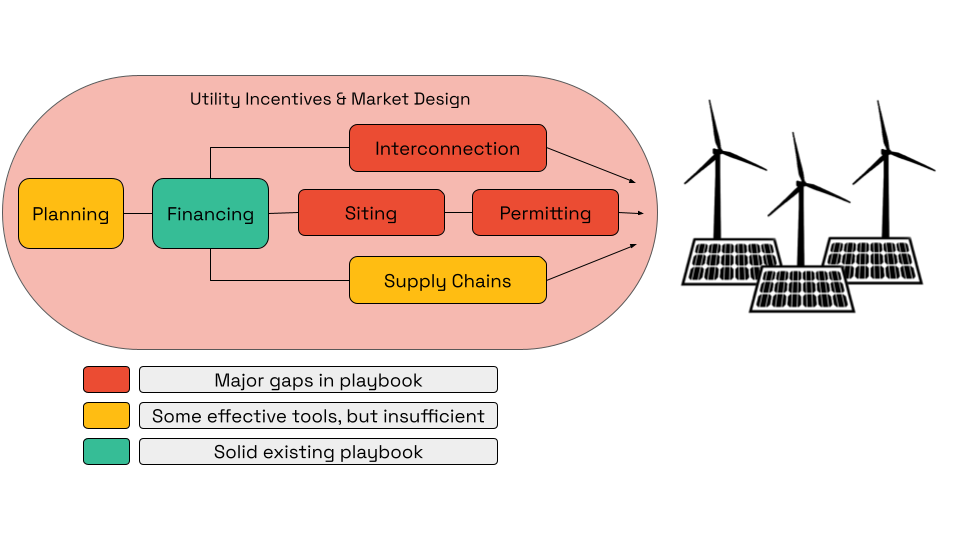
Political challenges have made it difficult to pass, implement, and defend clean energy policies. A mismatch between public needs, government programs, and industry incentives has led to unsatisfactory outcomes and degraded public trust in the government.
Now, policymakers, industry, and the advocacy community are paying more attention to non-financial issues that can impede deployment, like siting and permitting. The abundance movement, for example, has identified two causes of America’s building problem: ineffective government programs and burdensome permitting processes. This diagnosis is incomplete. Getting to a world where we can build things quickly and make government work will require us to identify the full suite of problems, not just these convenient two.
To maximize clean energy deployment, we must address the project development barriers that slow down investment and construction. And to build more durable and effective energy policies, we must interrogate and address the political barriers that have held us back from smart policymaking and implementation that can withstand political change. Overcoming these challenges is necessary to address the climate crisis, rein in rising utility bills, and ensure that government can deliver on its energy promises to the public it serves.
In early 2025, the Federation of American Scientists (FAS) set out to identify and categorize these barriers through research and interviews with experts and practitioners. Following this research, at the 2025 Climate Week NYC, FAS convened a group of researchers, advocates, industry leaders, and policymakers to solicit feedback on this framework.
The outcome of that convening allowed us to ground-truth the following report—which we intend to use as a rubric for state-level electricity policies and efforts to rethink federal energy policy. We should ask: to what extent do new policies under consideration reduce the major barriers to building clean energy and transmission while addressing the shortcomings that have made past policy less durable?
A future paper will detail the priority solutions that make progress on each of the project development barriers while improving our toolkit to overcome the political barriers that impede durable policy.
Contents
Project Development Barriers: Making it Harder to Build
Clean energy technologies are mature and cost competitive, if not least cost, across the country. Yet we are not building clean energy as fast as necessary, and in many places we are building new gas plants instead, raising costs for customers and intensifying the climate crisis. This trend is the result of several barriers that make it more difficult to build clean energy.
Interconnection
The Barrier
The interconnection process is one of the most significant constraints on clean energy deployment in the United States. At the end of 2023, nearly 2,600 gigawatts (GW) of generation and storage were queued, which is more than double the U.S. installed capacity (~1,280 GW). Today’s grid was built around a small number of large, centralized fossil fuel plants; the grid must now accommodate thousands of diverse, geographically distributed projects. Processes that were designed for a handful of large plants per year are now evaluating orders of magnitude more proposals, each with more complex grid interactions. These processes are not able to adequately handle the current grid, nor have they kept pace with development in grid planning and analysis tools. The result is a massive backlog of projects waiting to interconnect to the grid and a review system that is fundamentally misaligned with the scale and pace of the energy transition.
Developer experience confirms that interconnection challenges rank among the most decisive barriers to clean energy buildout. In the 2024 Lawrence Berkeley National Laboratory (LBNL) developer survey, respondents ranked interconnection delays and network upgrade costs higher than permitting, supply chain constraints, or workforce shortages as reasons for project cancellations or deferrals. Many projects face cost uncertainty on the order of tens to hundreds of millions of dollars as interconnection studies shift responsibility for broad system upgrades onto single developers. Interconnection costs are rising, and it is difficult for developers to predict what their interconnection bill will be at the end of the process. This unpredictability increases financing risk, reduces developer participation, and leads to large-scale attrition.
Outdated processes for evaluating and approving new projects have led to enormous project delays, averaging 4-5 years from request to commercial operation. This delay has raised prices and led some grid operators to keep old, expensive coal plants online in lieu of new capacity. Both of these trends benefit incumbent transmission and generation companies, who have significant decision-making power over the entities that control interconnection, making it difficult to update the processes. Clean energy projects also face higher interconnection costs than gas projects because they are more likely to need transmission upgrades to connect to the grid, which increases the chances of project cancellation.
These barriers have direct system-wide consequences. Only about 15 to 20 percent of projects that enter the queue ultimately reach commercial operation, meaning most of the clean energy capacity counted as “planned” will not materialize unless interconnection processes are reformed. Long queue timelines and uncertainty also make it more difficult to finance projects. The result is slower emissions reductions, delayed IRA-driven investment and job creation, and higher costs for consumers as operators extend the life of aging coal and gas resources to meet growing load.
The Past Playbook
Federal interconnection policy has largely gone through the Federal Energy Regulatory Commission (FERC). In 2023, FERC issued Order 2023, which made significant changes intended to speed up interconnection and increase certainty for new projects. The rule (1) replaced outdated serial studies, in which operators study projects one by one as their applications come in, with cluster studies, in which operators study projects in batches, (2) required grid operators to speed up study timelines and imposed penalties for failing to meet deadlines, and (3) directed grid operators to update rules to reflect technological advancements, like grid-enhancing technologies and hybrid solar-plus-storage projects. Some grid operators have gone further than Order 2023 to improve interconnection processes, and some states have pushed grid operators for more ambitious reform. In addition to FERC rules, the federal government has also provided limited resources to grid operators to improve interconnection processes.
To date, federal efforts have largely fallen short of what’s necessary to reform interconnection processes to enable adequate buildout of clean energy, and in most places states have limited tools. For one, FERC rules rely on effective implementation from grid operators, which has been a mixed bag. Order 2023 also strayed from making more fundamental changes to the interconnection process, like fixed entry fees that provide certainty to developers or proactive modeling and transparency of information to allow projects to connect quickly in places with transmission headroom. It fully does not address the fundamental problem that rising, variable interconnection costs are killing projects. The federal government has limited resources to support grid operators through, for example, funding for increased staffing or new technology to automate studies.
Where Do We Go From Here?
The next era of energy policy must radically transform the way we connect projects to the grid to enable faster, greater deployment of clean energy, including through an expanded role for federal and state governments. Policy must shorten study timelines using automation and other new technology, enable smarter planning with proactive modeling and greater transparency for developers, increase upfront cost certainty, and reduce the amount that projects end up paying for interconnection. And in addition, the next playbook must address governance and decision-making structures that favor incumbents who benefit from a congested grid.
Siting & Permitting
The Barrier
Siting and permitting processes have become two of the most visible friction points in the clean energy buildout. While federal policy receives the most attention, most clean energy siting and permitting decisions are made at the state and local level, where zoning boards, planning commissions, county supervisors, and community members have significant influence over whether a project proceeds. In many states, local jurisdictions have adopted new ordinances that restrict or outright ban wind, solar, and transmission development. According to recent analyses, roughly one-fifth of U.S. counties now have formal restrictions on clean energy, and many more are considering them. Even in states with strong climate and clean energy targets, municipal-level land use rules can effectively halt projects that align with statewide goals.
These local barriers are often rooted in concerns about landscape change, perceived impacts on property values, agricultural land use, wildlife, or community identity. But they are also a reflection of who benefits and who bears the immediate impacts of clean energy development. Benefits like lower system-wide electricity prices, cleaner air, and national decarbonization progress tend to be distributed widely, while the visual and land-use impacts are concentrated locally. Developers may not readily have the resources to meet community needs to come to agreement on projects, and federal and state governments often do not have adequate resources to support community benefits. Misinformation and disinformation—spread by incumbent interests who stand to lose money with greater clean energy or transmission deployment—also seed opposition in communities.
Permitting requirements add an additional layer of delay and uncertainty. Most clean energy projects, particularly solar and storage projects—which make up the bulk of new planned capacity—rarely trigger major federal environmental statutes and primarily deal with state-level permitting. Developers must navigate state statutes governing clean water, conservation, and environmental impacts, which serve important purposes but are often still implemented through outdated processes (e.g., many states still require paper permits; in Arizona, digitization reduced timelines for one permit process by 91 percent) administered by understaffed agencies. Projects such as transmission lines, offshore wind facilities, pumped storage hydropower, nuclear plants, geothermal projects, and any project on federal land or receiving federal grants generally must also navigate federal permitting processes. When new projects trigger federal review, they must comply with the National Environmental Policy Act (NEPA) and sometimes other federal permitting statutes, like the Marine Mammal Protection Act, the National Historic Preservation Act, and the Endangered Species Act. These reviews can take multiple years, particularly when agencies have limited staffing or when studies must coordinate across several state and federal entities and jurisdictions.
Delays from local siting and state and federal permitting translate directly into cost escalation and canceled projects. Developers report that siting challenges can add years to development schedules and millions of dollars in carrying costs before a shovel ever hits the ground. For technologies like wind and solar, where the business model depends on tight capital cost margins, extended pre-construction periods can be the difference between a viable project and one that never breaks ground. Transmission development is even more exposed: large lines can spend a decade or more navigating route identification, landowner negotiations, environmental review, and litigation. Without new transmission capacity, interconnection backlogs grow, power costs increase, and states are forced to rely on older fossil resources simply because they are already in place.
Yet, the challenge isn’t so simple. It is not simply “local opposition” or “slow permitting.” It is that the scale of clean energy land use today is fundamentally different from the past century of centralized fossil energy development. We are building more projects, in more places, at a pace that communities have not previously experienced.
The Past Playbook
Siting and permitting reforms have increasingly been part of the federal and state policy agenda. Reforms have largely focused on process changes and improving coordination across agencies, with some focus on building capacity for analysis and review in some federal agencies and states. In general, these reforms are insufficient and not widespread enough to match the urgency and scale of the U.S. energy transition.
The federal government has pursued a range of reforms over the past few years to improve the permitting process for projects that involve federal land, funding, or regulatory triggers. Key cross-agency initiatives include the Coordinated Interagency Transmission Authorizations and Permits Program, which made the Department of Energy (DOE) the lead agency for coordinating environmental review and permitting for transmission lines, and FAST-41, which aims to align multiple agency reviews and reduce duplicative permitting processes. Agencies have taken additional steps to improve individual permitting processes. For example, the Bureau of Land Management (BLM) designated solar and wind energy zones on public lands to reduce conflicts and expedite approvals, and the Bureau of Ocean Energy Management modernized offshore wind leasing and programmatic NEPA reviews (although the Trump Administration overhauled these reforms by halting all offshore wind leasing).
Several states have attempted to reduce delays and uncertainty by centralizing siting authority and standardizing permitting rules. For example, New York’s Office of Renewable Siting and Massachusetts’ Energy Facilities Siting Board can override local opposition for large projects, while other states provide model ordinances to guide counties on setbacks, noise, and environmental protection. DOE has also helped states: the agency provided a small amount of technical assistance to states to help local governments with planning, siting, and permitting decisions and a larger tranche of funding for transmission projects to provide benefits to local communities to help with siting and community buy-in. In some places, these reforms have improved consistency across counties and reduced the influence of NIMBY-driven delays.
This playbook, while directionally correct, has fallen short of what is necessary. Local restrictions on clean energy continue to proliferate, siting power plants and large transmission lines remains a major challenge, and many state and federal permitting processes still pose significant barriers. Existing efforts have several gaps: (1) many states have not addressed local restrictions on development, (2) process improvements, especially at the state level, have happened in a piecemeal fashion and have not extended to the full suite of state-level permitting requirements, (3) existing efforts often do not cover the full set of solutions (e.g., broken permitting for customer-owned solar is a huge impediment that keeps U.S. solar costs much higher than other countries), (4) governments and developers have insufficient tools to ensure that local communities get what they want out of projects, and (5) efforts to increase state and federal government capacity (i.e., hiring and training the right staff and increasing analytical capabilities) have fallen far short of what is needed to have a fast, effective, and responsible permitting and siting process.
Where Do We Go From Here?
The next era of energy policy must wrestle with the fundamental siting and permitting challenges and introduce new frameworks for planning, permitting, and building projects. That means upfront planning to make major decisions about tradeoffs between clean energy, water, conservation, and other goals, expanding the tools and resources necessary to ensure that local communities benefit from projects, dramatically improving government capacity to do siting and permitting well, and taking a holistic approach across federal, state, and local governments to prevent new bottlenecks from emerging.
Misaligned Incentives
The Barrier
Most clean energy and grid upgrade projects are financed by private capital and procured or built by companies, either utilities or independent power producers. The profit motives of those financiers and companies determines the solutions they invest in, within the bounds of policy requirements. Across states and regions, outdated utility regulations and market designs have created flawed incentives that have limited investment in some necessary solutions and resulted in overinvestment in others. Utilities have wielded significant political power, built by lobbying with ratepayer money, to maintain today’s incentive structure.
For example, in vertically integrated states, utilities are incentivized to prioritize capital expenditures that earn them the highest returns, within the bounds of commission approval. This incentive structure deprioritizes solutions like increasing imports of clean energy through new transmission and leveraging distributed resources like customer-owned solar.
Most commissions are often not well-equipped or willing to ensure that utilities pursue the full toolkit. In most states, utility planning is driven by the utilities, who conduct detailed analysis and provide proposals on planning and ratemaking to their commissions. Commissions have more limited capacity to conduct analysis and interrogate utility proposals.
Organized markets also have flawed incentive structures. For example, incentive structures in organized markets were generally designed around an electricity grid made up of a small number of large power plants. As a result, market rules and incentive structures provide limited to no support for distributed energy resources, which makes it harder to finance these projects. Governance structures exacerbate this issue. In some organized markets, incumbent generators have significant decision-making power in important determinants of clean energy deployment, including interconnection and transmission planning. Some organized markets have maintained rules that make it difficult to connect new power plants.
Misaligned incentives reduce the effectiveness of other policy solutions. For example, tax credits to reduce the cost of clean energy projects are most effective if utility companies have a profit incentive to build those projects instead of other generation types. The effectiveness of bulk transmission grant programs is limited by the willingness of utility companies to collaborate on projects.
The Past Playbook
Federal policy has largely ignored utility incentive structures and instead attempted to influence private-sector behavior by working within existing incentive structures (e.g., by making it easier for utility companies to use tax credits to build clean energy). Federal agencies have attempted to overcome misaligned incentives through regulations (e.g., pollution standards on power plants that require generation owners to make changes). Some efforts to change incentives structures (e.g., the Clean Electricity Payment Program included in the 2021 Build Back Better Bill) have gained momentum but failed to pass.
Many states have also used tools that operate within existing incentive structures, like renewable portfolio standards that require utilities to procure an increasing share of their electricity from clean sources. States have attempted to change incentive structures to varying extents. More than 15 states have adopted some form of performance-based ratemaking to align utility incentives with desired outcomes. However, these efforts vary in how comprehensively they have changed the dominant incentives for companies.
Where Do We Go From Here?
The next era of energy policy must reform incentives to realign private sector interests with public benefit, including affordable bills, reliability, and decarbonization. To achieve the scale, speed, and depth of transformation needed to address the challenges facing our grid, policy must address misaligned incentives for distribution utilities, generation owners, and integrated utilities in different regulatory contexts. That requires a greater focus on realigning incentive structures at the state and regional level (through organized market reform) as well as creative federal tools to directly change incentives or help states and organized markets to do so. Increasing regulator scrutiny of utilities and bolstering capacity at commissions must also play a larger role moving forward to ensure that utilities are focusing on the best solutions, not just what is most profitable. Greater use of publicly owned or publicly financed projects can also ensure investment in solutions that are underutilized by private companies.
Financing
The Barrier
The federal government has created new financial barriers for clean energy projects. OBBBA’s changes to tax incentives and increased regulatory and permitting uncertainty make clean energy projects more expensive and harder to finance. Macroeconomic changes like persistent inflation and other uncertainty, including on tariffs and interest rates, have also affected investment.
While the clean energy industry has continued to move forward (2025 investment in solar, storage, and wind is similar to 2024 levels, and the industry is benefiting from demand growth, as many projects are able to find offtakers like tech companies willing to pay higher prices), the full effects of federal policy changes are likely delayed, as the tax credits have not fully expired. Moving forward, financing may become a larger barrier. In addition, rising utility bills have opened a conversation about the cost of private finance for grid projects and whether there are alternative approaches that come with lower costs for customers.
Financing less mature clean energy technologies, like advanced nuclear, enhanced geothermal, and aggregated distributed generation (i.e., virtual power plants), remains a major issue.
The Past Playbook
Financial support has played a dominant role in the federal energy policy playbook. Tax incentives, which were dramatically expanded by the IRA and pared down by OBBBA, have been central to energy policy for decades. Grant and loan programs, also dramatically expanded by the IRA, have also been a core driver of clean energy deployment, grid upgrades, and large-scale demonstrations and commercialization of advanced energy technologies. States have also used tax incentives, grant programs, and green banks to finance and incentivize clean energy and grid projects. This model has largely been successful at deploying mature technologies like wind, solar, and storage, but it has fallen short when it comes to commercializing some newer clean energy technologies. Gaps also remain in financial support for projects that struggle to get private capital.
Where Do We Go From Here?
Financing and financial support should continue to be a major pillar of clean energy policy. The next era must incorporate a broader, more diverse set of financing tools in the capital stack, including state-led public financing for more types of projects and state efforts to create demand certainty for clean energy by leveraging procurement and working with corporate buyers.
Grid Planning
The Barrier
Today, the U.S. bulk transmission system faces significant constraints that limit where new clean energy projects can be built and threaten reliability. Congestion already causes curtailment of low-cost low-carbon power, higher consumer electricity prices, and dampened investment in clean energy. Many regions with abundant clean energy resources simply do not have enough high-voltage transmission capacity to deliver that power to population centers. As a result, developers are increasingly unable to move generation projects forward even when siting, permitting, financing, and interconnection queue positions are in place.
These challenges stem in large part from fragmented and inadequate planning processes. Coordinated planning is essential to ensure that transmission is expanded in the right places and that new clean energy investments flow to areas with sufficient transmission capacity. Despite the need for coordination, the United States conducts virtually no interregional transmission planning, and regional planning has been lacking in many regions. The result is piecemeal grid planning, as transmission providers and developers focus on smaller lines which meet near-term needs and are profitable within their own footprint. Planning for these smaller lines is easier as fewer parties are involved. Where we have successfully built larger regional lines, they are the result of transmission providers conducting robust planning processes. And because no unified authority or planning framework exists to shepherd large, high-impact projects across regions, the U.S. has built essentially zero major interregional transmission lines in recent history.
Lack of coordination between transmission and generation planning also creates inefficiencies and prevents smart development. In deregulated markets (and some vertically integrated states), transmission and generation planning processes occur largely in isolation without systematic processes to align long-term clean energy expansion with major grid upgrades.
Together, these gaps make expanding the transmission system an inefficient process at best, and an unworkable process at worst, at precisely the moment when the need for additional capacity is growing most rapidly.
The Past Playbook
Policymakers have made progress in addressing transmission planning bottlenecks, but these reforms remain far short of what’s needed. FERC Order 1920 is the most significant recent step: it requires long-term, forward-looking, multi-value regional planning. It was designed to improve transparency in the planning stages and help regions identify beneficial projects earlier. Yet the rule stops at regional borders and thereby doesn’t meaningfully advance interregional planning.
A patchwork of state and regional efforts has emerged alongside federal reforms. New Mexico created a new entity called the Renewable Energy Transmission Authority to map and finance new lines. Similarly, Colorado created the Colorado Electric Transmission Authority to plan and develop transmission lines to meet power needs, unlock clean energy, and lower costs. California conducts long-term transmission planning intended to incorporate transmission needs to accommodate clean energy deployment required to meet the state’s climate goals. Federal tools like National Interest Electric Transmission Corridors (NIETCs) were designed to accelerate siting of critically important lines, and part of DOE’s Grid Resilience and Innovation Partnerships (GRIP) funding has helped bring utilities, states, and developers together to plan large projects. On the interregional front, DOE has conducted analysis to demonstrate where new capacity would create the greatest benefits and inform planning.
These efforts certainly make progress and will likely result in expansion of local and regional transmission capacity. The magnitude of progress will depend in large part on how transmission providers implement Order 1920—for most regions, compliance filings will be submitted this month (December 2025) or by June 2026.
However, this playbook had significant gaps and pitfalls. Lack of interregional planning is the most glaring gap, but other tools had limitations, too. GRIP had limited funding and power to solve cost allocation disputes. NIETCs did not translate into built infrastructure. In many places transmission planning will not take into account the long-term clean energy expansion required for deep decarbonization, leaving high-value opportunities—like pairing wind resources with long-distance transmission—unrealized. The result is a set of reforms that move in the right direction but still fall short.
Where Do We Go From Here?
The next era of energy policy must tackle interregional planning, while following through on Order 1920 with effective implementation. We must require transmission providers to plan decisively for futures with significant load growth and levels of clean energy deployment necessary for deep decarbonization. Future federal policy must also expand the government’s tools to bring parties to the table for smart, effective planning. In parallel, states should continue to use creative policies, like Colorado and New Mexico’s transmission authorities, to strategically plan new transmission lines to maximize benefits. And the next era must also include national, forward-looking land-use planning for clean energy deployment, in sync with transmission planning.
Supply Chains
The Barrier
Grid components, such as electrical steel and transformers, are necessary to increase grid capacity to support additional generation and load. However, grid component supply chains are still suffering from disruptions caused by the COVID-19 pandemic and lack of domestic manufacturing capacity. The rising demand for grid components and battery technology have further stressed supply chains, drawing out lead times and increasing prices. For example, across transmission and distribution equipment, the lead time for components averaged 38 weeks in 2023, nearly double from the year prior, with costs escalating nearly 30 percent year-over-year. Bottlenecks in the supply chains from upstream suppliers to manufacturers among these components risk power system stability, the ability to deploy clean energy, and the ability to build new industrial production and technology facilities at scale.
The Past Playbook
Federal policy has increasingly focused on building secure supply chains for clean energy technologies. The IRA included tax credits, grant programs, and loan authority to build out domestic supply chains for clean energy and storage technologies. The federal government has also used demand-side pressure to bolster supply chains (e.g., through a bonus tax incentive for clean energy projects that use domestic content and Build America Buy America requirements on federal grant programs). These policies led to major investment in domestic supply chains.
This playbook was quite successful at building out domestic supply chains for some industries, but it had major gaps. For example, the IRA and BIL included no dedicated support for grid components, and the minimal support that was embedded in larger programs was insufficient. Federal demand-side programs were structured as incentives for downstream industries to use domestic content, but this design had too much uncertainty to sufficiently derisk upstream domestic supply chains.
Today’s programs have also struggled to respond quickly when conditions change. For example, the federal government had limited tools with which to respond when the utility industry faced a debilitating shortage of large power transformers or when it became clear that incentives were not large enough to drive domestic investment for some clean energy components.
Where Do We Go From Here?
The next era of energy policy must build on the same financial tools to support secure supply chains that enable clean energy deployment and grid upgrades. The playbook must include policies that more directly create demand for domestic components to provide certainty for manufacturers and derisk new investments. Future policy must also provide more flexible and dynamic tools to rapidly address supply chain shortages as they arise.
Political Barriers: Making it Harder to Pass, Implement, and Defend Policy
Clean energy advocates have focused on economic competitiveness, climate, and public health benefits as the winning messages to support and defend policies. The BIL and IRA came out of this model, and the architects of those policies hoped that the industry that benefitted from these policies would step up to defend them. While this strategy has enabled passage of significant new policies, it has failed to withstand changing political dynamics. The swift rollback of major parts of BIL and IRA is the prime example. Our ability to successfully implement and defend clean energy policies—and make further progress—has been hampered by several key political barriers. The next era of clean energy policy must address these barriers to be successful.
Energy Affordability
The Barrier
Rapidly rising utility bills have become an urgent cost-of-living issue. People pay 13 percent more for electricity in 2025 than they did in 2022, and nearly 40 percent of households sometimes have to choose between paying for food and medicine or keeping the lights on.
Rising electricity prices are a political barrier to some clean energy policies. For example, states have struggled to follow through on procurement of advanced clean energy technologies like nuclear and offshore wind as prices have risen. New York recently cancelled a planned transmission line, using affordability as a justification. Clean energy opponents are using prices to oppose climate policies, even though deployment of wind and solar has generally reduced rates. Concerns about electricity affordability make it difficult to justify major grid infrastructure investments under current regulatory and ratemaking structures, as additional spending to update the grid will lead to near-term bill increases. High prices also make it difficult to replace direct fossil fuel use in vehicles, buildings, and factories with electricity.
The Past Playbook
Federal energy policy has largely dealt with affordability in two ways.
First, the federal government has provided important but limited direct assistance to struggling households through the Low-Income Home Energy Assistance Program, which helps households pay for energy, and the Weatherization Assistance Program, which funds energy- and cost-saving home improvements. However, these programs are significantly underfunded and oversubscribed—many households that need support do not get it.
Second, federal financial support results in long-term savings. IRA incentives for low-cost clean energy were projected to reduce generation costs, which in the long term translates to lower prices. Tax incentives and grant programs for distributed energy resources and home energy improvements save energy and costs for customers that make upgrades. However, this approach falls short in two ways: (1) it does not address the root causes of rising electricity bills, which means bills will continue to rise, and (2) the benefits are long term and do not show up on peoples’ bills on politically relevant timelines.
Where Do We Go From Here?
The next era of energy policy must provide sufficient and swift relief for customers that are on the edge of catastrophe due to rising costs, make it easier to deploy cheap, clean energy to reduce generation costs, and target the root causes of high and rising bills to unlock a sustainable utility ratemaking regime that allows for major new investments in the grid without harming regular people. The new playbook must also include more effective cross-sector tools to cut total system and household costs, including by transferring planned spending on gas infrastructure to home electrification and grid upgrades where possible.
Incumbent Interests
The Barrier
Many solutions, including adding new generation in organized markets, relying more on regional and interregional transmission, and deploying distributed and demand-side solutions, threaten the profits of incumbent interests under current market and regulatory structures. For example, utilities make money through a return on qualified capital investments in things like power plants and distribution infrastructure. Increasing bulk transmission capacity to connect the Southeast with other regions would lead to more imports of lower cost clean energy, which would reduce the utilities’ reliance on local generation. That makes it harder for the utilities to justify capital expenditures in new power plants, which is how the utilities make a profit, so new transmission poses a threat to the business model. As a result, Southeastern utilities are opposed to policies that would expand bulk transmission to better connect different regions, even though these policies would reduce costs and increase reliability. These dynamics make it politically difficult to pursue policies that expand transmission capacity.
The Past Playbook
Federal clean energy policy has largely avoided changing incumbent incentive structures or decision-making processes at the state and regional level. Instead, policymakers have used financial incentives to bring incumbents to the table and increase their investment in clean energy and grid upgrades. As a result, the misaligned incentives described above, combined with decision-making structures that reward incumbents over innovation, make it difficult to fully address the barriers to clean energy deployment and grid upgrades at the necessary scale.
Where Do We Go From Here?
The next era of clean energy policy must address governance issues through reform of regional grid operators and public utility commissions. Strengthening the role of regulators is critical to reining in incumbent interests where they do not align with public benefit. It must also realign industry incentives (e.g., through performance-based ratemaking) where possible with affordability and decarbonization goals.
Delayed Impact
The Barrier
Another major political barrier is the lengthy time it takes to get from enactment and implementation to tangible benefits for people. Transforming major sectors of the economy is a time-intensive, multi-stage project, and climate advocates have accordingly focused on long-term goals, such as 100 percent clean electricity by 2035 or net-zero emissions by 2050. The IRA and BIL were made up primarily of multi-year (even some decadal) programs to drive major changes in the economy. As a result, the largest benefits were projected to come in the late 2020s and early 2030s, far outside the window of political memory. That mismatch makes it difficult for the public to understand the point of policies and in turn makes those policies hard to defend.
Where policies do have near-term benefits, those benefits have often been delayed by the implementation process. Successfully shifting the private sector requires precise policy and new programs, which take time to implement. Implementation of new programs can also run up against the government typically works, and that friction causes delays. Implementation delays make it difficult to connect the dots between policy and tangible improvements to peoples’ lives.
The Past Playbook
Policymakers have used three dominant approaches to overcoming this barrier. First, they tout near-term signs of economic change. For example, the Biden administration consistently cited private-sector investment in clean energy as a key metric to convince the public that the IRA and BIL were driving benefits for people. Second, they rely on the quickest economic changes to demonstrate impact. For example, the IRA and BIL drove a near-term increase in construction jobs. Real and announced job creation was the dominant message to support and defend these policies. Third, they cite projected benefits. For example, the Biden administration frequently cited the 1.5 million jobs and the $27 to $33 billion in energy cost savings that the IRA was projected to drive.
Attention to long-term impact is important for addressing long-term problems like climate change and load growth. However, politics runs on instant gratification. As of late 2024, only 39 percent of Americans had heard of the IRA. And federal energy policy failed to make a near-term dent in the issue that was most visible for people: utility bills.
Where Do We Go From Here?
The next era of clean energy policy must tangibly and visibly benefit people in the short term. The playbook must include a better balance of policies geared toward long-term transformation of the economy and policies focused on pressing issues for regular people. That means including programs that are designed for quick implementation and real-world change.
Conclusion: What’s Next?
The power sector sits at an inflection point. The challenges facing the grid are immediate, interconnected, and solvable but only if we confront the real sources of delay and dysfunction. Accelerating clean energy deployment requires moving beyond our old playbook—dominated by financial incentives and regulations that see-saw based on the political winds—toward a new approach that addresses both project development barriers that slow investment and construction and political barriers that impede durable policymaking. Building durable, effective energy policy demands a clear-eyed assessment of the barriers that have undermined smart policymaking and implementation.
In a forthcoming publication, we will move from diagnosis to action, detailing policy solutions that can unlock faster, more reliable project development while expanding the policy toolkit needed to overcome the political barriers that have prevented durable reform. Together, these solutions aim to strengthen grid reliability, rein in rising utility bills, and put the United States back on a credible path to decarbonization. These stakes could not be higher, and the opportunity to build a more affordable, resilient, and clean energy system has never been more urgent.
Report: When Ambition Meets Reality — Lessons Learned in Federal Clean Energy Implementation, and a Path Forward
The Trump administration has scrapped over $8 billion (so far) in grants for dozens of massive clean energy projects in the United States. For those of us who worked on the frontlines of Bipartisan Infrastructure Law (BIL) and Inflation Reduction Act (IRA) implementation, the near-weekly announcements and headlines have been maddening, especially at a time when many of these projects would have helped address soaring electricity prices and surging demand growth.
While some of these cancellations were probably illegal, they nevertheless raise fundamental questions for clean energy advocates: why was so much money still unspent…and why was it so easy to cancel?
In a new report, we begin to address these fundamental implementation questions based on discussions with over 80 individuals – from senior political staff to individual project managers – involved in the execution of major clean energy programs through the Department of Energy (DOE).
Their answer? There is significant opportunity – as our colleagues at FAS have written – for future Executive branch implementation to move much faster and produce much more durable results. But to do so, future implementation efforts must look drastically different from the past, with a ruthless focus on speed, outcomes, and the full use of Executive Branch authorities to more quickly get steel in the ground.
The risk of risk aversion
Take the grant cancellations example. The Trump administration has relied on one small clause in the Code of Federal Regulations (2CFR 200.340(a)(4)) as the legal basis for its widespread cancellations. This clause, traditionally included in most grants between the government and a private company, allows the government to cancel any grant that “no longer effectuates the program goals or agency priorities” and essentially functions as a “termination for convenience” clause.
But including this “termination for convenience” clause was optional. DOE could have leveraged a different, more flexible contracting authority for many awards. It also could have processed what’s known as a “deviation” in order to exclude the clause from standard contracts. Leaders of program offices were aware of these options, with some staffers strenuously objecting to the inclusion of termination for convenience.
But in the end, DOE offices generally opted to keep this clause because it was the way the agency had always executed (primarily R&D) grants in the past, and because sticking to established procedures was seen as the best way to avoid the risk of Congressional or Inspector General oversight.
And yet, this risk-averse approach perversely increased the risk of project failure, by creating an easy kill switch for an administration looking for grounds on which to cancel particular projects.
This attitude toward risk – which saw defaulting to the status quo as the most prudent path – was a constant barrier to effective implementation. (In addition to opening up grants to cancellation, the embrace of 2CFR 200 regulations meaningfully slowed negotiations as companies bristled at the obscure accounting and other compliance measures the regulations would impose on them.)
Understanding this culture of risk aversion offers two takeaways for improving government: (1) rigorously question status quo decisions and avoid defaulting to agency precedent and (2) avoid excessive focus on eliminating every risk or avoiding external backlash or oversight (especially given that backlash and oversight are likely regardless of the approach.)
Speed is paramount
Of course, excluding the termination for convenience clause would not have been a panacea. It’s likely the Trump administration would have devised some other pretext for cancelling the grants that may have been just as successful, though perhaps legally shakier.
That’s why implementers also told us that speed is critical. The best defense is a strong offense. And the best way to prevent money from being taken back is to have already spent it on promising projects. The federal government has moved faster in implementation of large policies before. During the New Deal, the Tennessee Valley Authority moved from passage of its founding law to beginning construction on a major dam in just four months. Operation Warp Speed delivered cutting-edge life-saving vaccines to millions of Americans in about a year. While the contexts and goals of these programs were different, we know from history that the federal government can move fast.
But at DOE, only 5% of the funds appropriated through the Bipartisan Infrastructure Law had actually been spent (not just obligated) by the time the Biden administration ended three years later. In addition to making clean energy projects more vulnerable to subsequent cancellations, the pace of the rollout meant that the basic political hypothesis animating clean energy legislation—that the economic development projects brought, especially to red states, would create a durable bipartisan coalition for clean energy—went untested.
Practically everyone we spoke with expressed frustration at the slow pace of implementation. Interviewees highlighted many challenges associated with a relatively slow pace of BIL and IRA implementation, such as:
- “Too many cooks” dynamics at every level of implementation.
- A lack of coalitional policy prioritization.
- Overcomplicated award processes.
- Regulatory compliance issues that were at odds with industry realities. (Davis-Bacon, NEPA, Build America Buy America, and the Paperwork Reduction Act were those most frequently mentioned.)
The work begins now
One commonality between these and other issues identified in our report is encouraging: they are mostly within the Executive Branch’s power to solve. A sufficiently prepared future administration could address many of these challenges for future federal clean energy efforts without relying on the vagaries of the legislative process. But the work must begin now.
On contracting, for instance, a future administration’s DOE could make better use of Other Transactions Authority for clean energy. But it should be prepared with drafts of the basic commercial terms of agreements between the government and companies it works with. Similarly, a proactive future administration will come in with a clear view on how to streamline compliance with environmental, prevailing wage, domestic sourcing, and other cross-cutting requirements. On decision-making, a future administration can set norms pushing decision-making to the lowest possible level, clarify processes to elevate and execute major issues, and establish small, clear, and empowered teams that own frontline negotiations.
If pursued, this updated approach to federal clean energy implementation will look drastically different. But one way or another it will have to: the next time there is a federal government interested in accelerating clean energy, it is likely to be dealing with a private sector much more wary of working with the government, fiscal constraints that limit the likely scale of any clean energy funding, and a dramatically altered federal workforce and state apparatus.
Much can be done outside of the federal government — including at state and local levels — to prepare for those circumstances. It is possible for a future federal administration to achieve faster and more durable clean energy outcomes. But to make that possible, the work must begin now.
It’s not enough to say we need to make full use of DOE’s authorities; we need the drafted Secretarial directives and advance legal legwork to do it, and leadership well-equipped with the details and government-insider knowledge to execute on it.
It’s not enough to say we want more nuclear, transmission, or critical minerals projects; we need to have identified the priority projects and designed the strategies and programs needed to actually put them in motion on Day 1.
It’s not enough to say we should take a “whole-of-government” approach to an issue like clean energy; we need a detailed plan for how to use the $5 billion/year in electricity purchases and the PMA’s 45,000 miles of transmission lines—all under the direct control of the federal government—to achieve explicit policy outcomes.
And it’s not enough to say we need to rebuild the federal workforce; we need a roster of hundreds of people that can be brought on and trained rapidly to implement within weeks.
To live up to the spirit of the New Deal and Operation Warp Speed—the spirit that turned ambitious goals into massive real-world impact in a matter of months—the next administration must come armed not only with broad aspirations, but also with the detailed plans required to implement them.
Want abundant energy? Ask who benefits from scarcity.
This article originally was published July 30 on Utility Dive.
A new obsession with abundance is spreading through policy conversations and governors’ mansions across the country. Abundance advocates, boosted by a recent book from Ezra Klein and Derek Thompson, envision a future in which we defeat the climate crisis, reduce cost of living and improve quality of life by speeding up construction of housing and energy infrastructure.
Making clean energy abundant is certainly critical to addressing the climate crisis. We need plentiful, cheap, clean energy to replace polluting fossil fuels in buildings, vehicles and factories. As a senior policy advisor in the Biden White House, I worked on many policies aimed at clean energy abundance, directly or indirectly, and I also saw firsthand how those policies were insufficient. That’s why it is now clear to me that the abundance movement’s playbook — to streamline permitting, simplify government processes and make public investments more focused — falls short of what’s needed.
We won’t achieve energy abundance unless we contend with the powerful interests that benefit from scarcity. Doing so requires reforming electricity markets, refreshing regulation of electric companies and rethinking the way we pay for grid infrastructure.
Let’s start with the problem: we are not building nearly enough clean energy to curb climate change and keep electricity affordable. Analysis from three leading research projects found that for us to get within striking distance of the Paris climate goals and plan for the lowest electricity costs, we must build 70 GW to 125 GW of clean energy per year, much higher than the record 50 GW built in 2024. As a result of our failure to build new energy projects fast, families and businesses will pay more for power and the planet will warm faster.
This is no longer an economic issue. Clean electricity is now often cheaper to deploy than new coal and gas, and in many cases cheaper than existing fossil-fuel-fired power plants. So what is stopping us from building it fast enough?
To answer this question, abundance proponents, including Klein and Thompson, largely focus on two main obstacles: 1) opposition from people who live nearby specific projects and groups concerned with local environmental impacts and 2) “everything-bagel liberalism,” the tendency to add too many strings to government incentives. The solution to the first problem, they argue, is to limit the power of the opposition by streamlining federal permitting and constraining public input in state and local siting processes. And for the second, their remedy is to limit the number of goals of government programs and reduce the requirements for funding.
There is no doubt that some clean energy and transmission projects have been thwarted by local opposition and lengthy litigation. And it is a worthy goal to make government incentives as effective as possible. But by portraying the primary villains defending scarcity as local landowners, conservation groups and the diversity of the liberal coalition, Klein and Thompson ignore important characters and policies that, if left unchecked, will continue to hamstring the pursuit of abundance.
For example, consider the situation unfolding in the electricity market organized by the PJM Interconnection, which operates the electricity grid for 65 million people in 13 mid-Atlantic and midwestern states and Washington, D.C. An independent, non-governmental entity, PJM runs the process to connect new power plants to the grid, among other important processes to make the electricity system work. PJM has been notoriously bad at this job. It ranks as the worst grid operator in the country in terms of the speed and effectiveness of its interconnection process. The average project waits five years for PJM to give it permission to connect to the grid. In fact, PJM closed its doors to new project applications in 2022 and has yet to re-open it. As a result, electricity demand is outpacing supply, prices are rising rapidly, and new clean energy projects are dying as they wait for word from PJM.
PJM has the power to speed up the process to connect new projects, which would increase electricity supply and cut electricity prices. But PJM has largely resisted reforms and focused instead on extending the life of existing power plants. Here is where it is helpful to ask: who benefits from an electricity shortage and the resulting high prices? It is not conservation groups or liberal stakeholder groups with competing goals (who have no voting power in PJM’s governance structure). It is the incumbent utilities that own the fleet of aging coal-fired power plants, which are struggling to compete with new clean energy projects. If cheap clean energy is allowed to enter the market, these companies will make less money. The outdated processes for approving new projects help prevent cheaper energy resources from threatening their business model. The companies have significant decision-making power — together, power plant owners, transmission owners (many of whom also own generation) and other energy service suppliers make up 60% of the voting power in PJM decisions.
Energy will not be abundant in the mid-Atlantic unless we take on the interests that are benefitting from scarcity. That means reforming the electricity market to stop overpaying existing power plants at the expense of customers, changing the rules to make it easier to connect new power plants to the grid and updating governance structures to make sure that customers are properly represented.
Similar cases abound of powerful interests benefitting from scarcity and defending policies that prevent abundance. Monopoly utilities, for example, benefit from abundant energy to the extent that they can build it and can earn a return on their investments — but not if the energy comes from their competition. That’s why utilities in the southeast have gone to great lengths to block transmission lines that enable cheap clean energy to compete with their existing power plants. Changing how those utilities make money (for example, by paying for outcomes instead of investments) could flip the script and turn the utilities into energy abundance advocates.
If the abundance movement is to succeed, it must identify the defenders of scarcity and broaden the playbook to either overcome those interests or change their incentives to bring them on the team.
Beyond Binary Debates: How an “Abundance” Framing Can Restore Public Trust and Guide Climate Solutions
Public trust in U.S. government has ebbed and flowed over the decades, but it’s been stuck in the basement for a while. Not since 2005 have more than a third of Americans trusted the institution that underpins so much of American life.
We shouldn’t be surprised. Along with much progress, over the past two decades the U.S. became more unequal, saw stagnation or decline in many rural counties, stumbled into a housing crisis, and experienced worsening health outcomes. When the government can’t deliver (especially in core areas like health, housing, and economic vitality), trust in it wanes while the false promises of autocrats grow more appealing.
The strength of American democracy, in other words, hinges in large part on how well our government functions. This urgency helps explain why, at a moment when the United States is flirting with autocracy ever more vigorously, a book on precisely this topic became a #1 bestseller and prompted a debate around the “abundance agenda” that has turned quasi-existential for many in the policy world.
The abundance agenda, as described by Jonathan Chait, is “a collection of policy reforms designed to make it easier to build housing and infrastructure and for government bureaucracy to work”, such as by streamlining regulations that constrain infrastructure buildout while scaling up major government programs and investments that can deliver public goods.
Unfortunately, popular discourse often flattens the conversation around abundance into a polarized binary around whether or not regulations are good. That frame is overly reductionist. Of course badly designed or out-dated regulatory approaches can block progress or (as in the case of the housing policies that the book Abundance centers on) dry up the supply of public goods. But a theory of the whole regulatory world can’t be neatly extrapolated from urban zoning errors. In an era of accelerating corporate capture, both private and public power structures act to block change and capture profits and power. We need a savvier understanding of what happens at the intersections between the government and the economy, and of how policy translates to communities at local scales.
We should therefore regard “abundance” less as a prescriptive policy agenda than as a frame from which to ask and answer questions at the heart of rebuilding public trust in government. Questions like: “Why is it so hard to build?” “Why are bureaucratic processes so badly matched to societal challenges?” “Why, for heaven’s sake, does nothing work?”
These questions can push us in a direction distinct from the usual big vs. small government debates, or squabbles about the welfare state versus the market. Instead, they may help us ask about interactions within and between government and the economy – the network of relationships, complex causation, and historical choices – that often seem to have left us with a government that feels ill-suited to its times.
At the Federation of American Scientists (FAS), we, along with colleagues in the broader government capacity movement, are exploring these questions, with a particular focus on agendas for renewal and advancing a new paradigm of regulatory ingenuity. One emerging insight is that at its core, abundance is largely about the dynamics of incumbency, that is, about the persistence of broken systems and legacy power structures even as society evolves. A second, related, insight is that the debate around abundance isn’t really about de-regulation or the regulatory state (every government has regulations), but rather about how multi-pronged and polycentric strategies can break through the inertia of incumbent systems, enabling government to better deliver the goods, services, and functions it is tasked with while also driving big and necessary societal changes. And a third is that the abundance discourse must center distributive justice in order to deliver shared prosperity and restore public trust.
Moving the Boulder: Inertia, Climate Change, and the Mission State
The above insights are particularly helpful in guiding new and more durable solutions to climate change – a challenge that touches every aspect of our society, that involves complex questions of market and government design, and that is rooted in the challenges of changing incumbent systems.
Consider the following. It’s now been almost 16 years since the U.S. Environmental Protection Agency (EPA) issued its 2009 finding that greenhouse gas (GHG) emissions are a public danger and began trying to regulate them. To simplify a complex history, what happened on the regulatory front was this: the Obama administration tried to push regulations forward, the Trump administration worked to undo them, and then the cycle repeated through Biden and Trump II, culminating in the EPA’s recent move to revoke the endangerment finding.
We can certainly see the power of incumbency and inertia within this history. Over a decade and a half, the EPA regulated greenhouse gases from new power plants (though never very stringently), new cars and trucks (quite effectively cutting pollution, though never with mandates to actually electrify the fleet), and…that’s about it. The agency never implemented standards for the existing power plants and existing vehicles that emit the lion’s share of U.S. GHGs. It never regulated GHGs from industry or buildings. And thanks to the efforts of entrenched fossil-fuel actors and their political allies, the climate regulations EPA managed to get over the finish line were largely rolled back.
None of this should be read as a knock on the dedicated civil servants at EPA and partner federal agencies who worked to produce GHG regulations that were scientifically grounded, legally defensible, technically feasible, and cost effective, even while grappling with the monumental challenges of outdated statutes and internal systems. But it certainly speaks to the challenge of securing lasting change.
The work of economist Mariana Mazzucato offers clues to how we might tackle this challenge; she paints a portrait of a “mission state” that integrates all of government’s levers to define and execute a particular objective, such as an effective, equitable, and durable clean energy transition. This theory isn’t a case for simplistic deregulation, nor is it a claim that regulations somehow “don’t work”. Rather, it suggests that (especially in a post-Chevron world) another round of battles over EPA authority won’t ultimately get us where we need to go on climate, nor will it help us productively reshape our institutions in ways that engender public trust.
The shift from one energy system foundation to another is messy – and it is inherently about power. As giant investment firms hustle to buy public utilities, enormous truck companies side with the Trump administration to dismantle state clean freight programs, and subsidies for clean energy are decried as unfair and market-distorting even though subsidies for fossil energy have persisted for nearly a century, it’s clear that corporate incumbents can capture public investments or capture government power to throttle change. Delivering change means thinking through the many ways incumbency creates systems of dependencies throughout society, and what options – from regulations to monetary policy to the ability to shape the rule of law – we have to respond. To disrupt energy incumbents and achieve energy abundance, in other words, we must couple regulatory and non-regulatory tools.
After all, the past 16 years haven’t just been a story of regulatory back-and-forth. They are also a story of how U.S. emissions have fallen relatively steadily in part due to federal policies, in part to state and local leadership, and in part to ongoing technological progress. Emissions will likely keep falling (though not fast enough) despite Trump-era rollbacks. That’s evidence that there’s not a one-to-one connection between regulatory policy and results.
We also have evidence of how potent it can be when economic and regulatory efforts pull in tandem. The Inflation Reduction Act (IRA) was the first time the United States strongly invested in an economic pivot towards clean energy at scale and in a mission-oriented way. The results were immediate and transformative: U.S. clean energy and manufacturing investments took off in ways that far surpassed most expectations. And while the IRA has certainly come under attack during this Administration, it is nevertheless striking that today’s Republican trifecta retained large parts of the entirely Democratically-passed IRA, demonstrating the sticking power of a mission-oriented approach.
Conducting the Orchestra: The Need for an Expanded Playing Field
Thinking beyond regulatory levers (i.e., a multi-pronged approach) is necessary but not sufficient to chart the path forward for climate strategy. In a highly diverse and federalist nation like the United States, we must also think beyond federal government entirely.
That’s because, as Nobel-winning economist Dr. Elinor Ostrom put it, climate change is inherently a “polycentric” problem. The incumbent fossil systems at the root of the climate crisis are entrenched and cut across geographies as well as across public/private divisions. Therefore the federal government cannot effectively disrupt these systems alone. Many components of the fundamental economic and societal shifts that we need to realize the vision of clean energy abundance lie substantially outside sole federal control – and are best driven by the sustained investments and clear and consistent policies that our polarized politics aren’t delivering.
For example, states, counties, and cities have long had primary oversight of their own economic development plans, their transportation plans, their building and zoning policies, and the make-up of their power mix. That means they have primary power both over most sources of climate pollution (two-thirds of the world’s climate emissions come from cities) and over how their economies and built environments change in response. These powers are fundamentally different from, and generally much broader than, powers held by federal regulatory agencies. Subnational governments also often have a greater ability to move funds, shape new complex policies across silos, and come up with creative responses that are inherently place-based. (The indispensable functions of subnational governments are also a reason why decades of cuts to subnational government budgets are a worryingly overlooked problem – austerity inhibits bottom-up climate progress.)
The private sector has similar ability to either constrain or drive forward new economic pathways. Indeed, with the private sector accounting for about half of funding for climate solutions, it is impossible to imagine a successful clean-energy transition that isn’t heavily predicated on private capabilities – particularly in the United States. While China’s clean-tech boom is largely the product of massive top-down subsidies and market interventions, a non-communist regime must rely on the private sector as a core partner rather than a mere executor of climate strategy. Fortunately, avenues for effectively engaging and leveraging the private sector in climate action are rapidly developing, including partnering public enterprise with private equity to sustain clean energy policies despite federal cutbacks.
An orchestra is an apt analogy. Just as many instruments and players come together in a symphony, so too can private and public actors across sectors and governance levels come together to achieve clean energy abundance. This analogy extends Mazzucato’s conception of a mission state into a “mission society”, envisioning a network that spans from cities to nation states, from private firms to civil actors, working in concert to overcome what Ben Rhodes calls a “crisis of short termism” and deliver a “coherent vision” of a better future.
Building Towards Shared Prosperity
For the vision to be coherent, it must resonate across socioeconomic and ideological boundaries, and it must recognize that the structures of racial, class, and gender disparity that have marked the American project from the beginning are emphatically still there. Such factors shape available pathways for progress and affect their justice and durability. For instance: electric vehicle adoption can only grow so quickly until we make it much easier for those living in rented or multifamily housing to charge. Cheaper renewables only mean so much when prevailing policies limit the financial benefits that are passed on to lower-income Americans.
To borrow, and complicate, a metaphor from Abundance: distributive justice questions are fundamentally not “everything bagel” seasonings to be disregarded as secondary to delivery goals. They are meaningful constraints on delivery as well as critical potentialities for better systems, and are hence central to policy and politics. No mission state or mission nation, addressing the polycentric landscape of networked change needed to shift big incumbent systems, can afford to dismiss or ignore them. Displacing those systems requires wrestling with inequality and striving to create shared prosperity through new approaches that are distributively fair.
That’s an approach rooted in orchestration, one that asks why some instruments drown out others, and how to alter relationships between players to produce better results. It understands that we can’t solve scarcity without centering distributive justice, because as long as deep structural disparities and structural power exist there is strong potential for the benefits of rapid energy or housing buildout to be channeled towards those who need them least. And it is capable of restabilizing the center of American society and restoring trust in U.S. government because it realistically grapples with the interests of incumbents while paying more than lip service to the interests of a dazzlingly diverse American public.
This re-fashioned abundance agenda can provide actual principles for administrative state reform because it knows what it is asking regulators, and the larger intersecting layers of government and civil society, to do: Systematically remove points of inertia to accelerate shared prosperity in a safe climate, while anticipating and solving for distributive risks of change.
Because again, the abundance debate isn’t really about whether or not regulations are good. It’s about unfreezing our politics by being clear and courageous about our goals for a society that works better and is capable of big things.
This is not the first time Americans have envisioned a better future in the midst of national crisis, or the first time we have collectively disrupted failed incumbent systems. From our messy foundation, to the beginnings of Reconstruction during the Civil War, to the architects of the New Deal envisioning an active and effective government in the midst of the Dust Bowl and Depression, the history of our nation is full of evidence that a compelling vision of truly democratic government can pull Americans back together despite deep and real problems. Each time, these debates have scrambled existing binaries, and driven realignment. We are on the verge of realignment again as the systems built up over the fossil era break down and our neoliberal order fragments. This is the right time to engage, together, in orchestrating what comes next.
De-Risking the Clean Energy Transition: Opportunities and Principles for Subnational Actors
Executive Summary
The clean energy transition is not just about technology — it is about trust, timing, and transaction models. As federal uncertainty grows and climate goals face political headwinds, a new coalition of subnational actors is rising to stabilize markets, accelerate permitting, and finance a more inclusive green economy. This white paper, developed by the Federation of American Scientists (FAS) in collaboration with Climate Group and the Center for Public Enterprise (CPE), outlines a bold vision: one in which state and local governments – working hand-in-hand with mission-aligned investors and other stakeholders – lead a new wave of public-private clean energy deployment.
Drawing on insights from the closed-door session “De-Risking the Clean Energy Transition” and subsequent permitting discussions at the 2025 U.S. Leaders Forum, this paper offers strategic principles and practical pathways to scale subnational climate finance, break down permitting barriers, and protect high-potential projects from political volatility. This paper presents both a roadmap and an invitation for continued collaboration. FAS and its partners will facilitate further development and implementation of approaches and ideas described herein, with the goals of (1) directing bridge funding towards valuable and investable, yet at-risk, clean energy projects, and (2) building and demonstrating the capacity of subnational actors to drive continued growth of an equitable clean economy in the United States.
We invite government agencies, green banks and other financial institutions, philanthropic entities, project developers, and others to formally express interest in learning more and joining this work. To do so, contact Zoe Brouns (zbrouns@fas.org).
The Moment: Opportunity Meets Urgency
We are in the complex middle of a global energy transition. Clean energy and technology are growing around the world, and geopolitical competition to consolidate advantage in these sectors is intensifying. The United States has the potential to lead, but that leadership is being tested by erratic federal environmental policies and economic signals. Meanwhile, efforts to chart a lasting domestic clean energy path that resonates with the full American public have fallen short. Demand is rising — fueled by AI, electrification, and industrial onshoring – yet opposition to clean energy buildout is growing, permitting systems are gridlocked, and legacy regulatory frameworks are failing to keep up. This moment calls for new leadership rooted in local and regional capacity and needs. Subnational governments, green and infrastructure banks, and other funders have a critical opportunity to stabilize clean energy investment and sustain progress amid federal uncertainty. Thanks to underlying market trends favoring clean energy and clean technology, and to concerted efforts over the past several years to spur U.S. growth in these sectors, there is now a pipeline of clean projects across the country that are shovel-ready, relatively de-risked and developed, and investable (Box 1). Subnational actors can work together to identify these projects, and to mobilize capital and policy to sustain them in the near term.
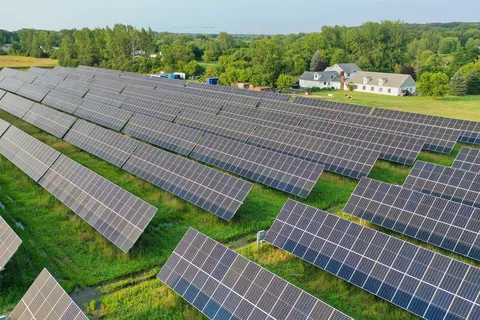
The New York Power Authority used a simple, quick Request for Information (RFI) to identify readily investible clean energy projects in New York, and was then able to financially back many of the identified projects thanks to its strong bond rating and ability to access capital. As Paul Williams, CEO of the Center for Public Enterprise, noted, this powerful approach allowed the Authority to “essentially [pull] a 3.5-gigawatt pipeline out of thin air in less than a year.”
States, cities, and financial institutions are already beginning to provide the support and sustained leadership that federal agencies can no longer guarantee. They’re developing bond-backed financing, joint procurement schemes, rapid permitting pilot zones, and revolving loan funds — not just to fill gaps, but to reimagine what clean energy governance looks like in an era of fragmentation. One compelling example is the Connecticut Green Bank, which has successfully blended public and private capital to deploy over $2 billion in clean energy investments since its founding. Through programs like its Commercial Property Assessed Clean Energy (C-PACE) financing and Solar for All initiative, the bank has reduced emissions, created jobs, and delivered energy savings to underserved communities.
Indeed, this kind of mission-oriented strategy – one that harnesses finance and policy towards societally beneficial outcomes, and that entrepreneurially blends public and private capacities – is in the best American tradition. Key infrastructure and permitting decisions are made at the state and local levels, after all. And state and local governments have always been central to creating and shaping markets and underwriting innovation that ultimately powers new economic engines. The upshot is clear and striking: subnational climate finance isn’t just a workaround. It may be the most politically durable and economically inclusive way to future-proof the clean energy transition.
The Role of Subnational Finance in the Clean Energy Transition
Recent years saw heavy reliance on technocratic federal rules to spur a clean energy transition. But a new political climate has forced a reevaluation of where and how federal regulation works best. While some level of regulation is important for creating certainty, demand, and market and investment structures, it is undeniable that the efficacy and durability of traditional environmental regulatory approaches has waned. There is an acute need to articulate and test new strategies for actually delivering clean energy progress (and a renewed economic paradigm for the country) in an ever-more complex society and dynamic energy landscape.
Affirmatively wedding finance with larger public goals will be a key component of this more expansive, holistic approach. Finance is a powerful tool for policymakers and others working in the public interest to shape the forward course of the green economy in a fair and effective way. In the near term, opportunities for subnational investments are ripe because the now partially paused boom in potential firms and projects generated by recent U.S. industrial policy has generated a rich set of already underwritten, due-diligenced projects for re-investment. In the longer term, the success of redesigned regulatory schema will almost certainly depend on creating profitable firms that can carry forward the energy transition. Public entities can assume an entrepreneurial role in ensuring these new economic entities, to the degree they benefit from public support, advance the public interest. Indeed, financial strategies that connect economic growth to shared prosperity will be important guardrails for an “abundance” approach to environmental policy – an approach that holds significant promise to accelerate necessary societal shifts, but also presents risk that those shifts further enrich and empower concentrated economic interests.
To be sure, subnational actors generally cannot fund at the scale of the federal government. However, they can mobilize existing revenue and debt resources, including via state green and infrastructure banks, bonding tools, and direct investment financing strategies, to seed capital for key projects and to provide a basis for larger capital stacks for key endeavors. They are also particularly well suited to provide “pre-development” support to help projects move through start-up phases and reach construction and development. Subnational entities can engage sectorally and in coalition to scale up financing, to draw in private actors, and to support projects along the whole supply and value chain (including, for instance, multi-state transmission and grid projects, multi-state freight and transportation network improvements, and multi-state industrial hubs for key technologies).
A wide range of financing strategies for clean energy projects already exist. For instance:
- Revolving loan funds can help public entities provide lower-cost debt financing to draw in additional private capital.
- Joint procurements or bundled financing can set technological standards, provide pricing power, and reduce the cost of capital for smaller businesses and make it easier for them to break into the clean energy economy.
- Financing programs for projects with public benefits can be designed in ways that allow government investors to take a small equity stake, sharing both risk and revenue over time.
Strategies like these empower states and other subnational actors to de-risk and drive the clean energy transition. The expanding green banking industry in the United States, and similar institutions globally, further augment subnational capacity. What is needed is rapid scaling and ready capitalization.
There is presently tremendous need and opportunity to deploy flexible financing strategies across projects that are shovel-ready or in progress but may need bridge funding or other investments in the wake of federal cuts. The critical path involves quickly identifying valuable, vetted projects in need of support, followed by targeted provision of financing that leverages the superior capital access of public institutions.
Projects could be identified through simple, quick Requests for Information (RFIs) like the one recently used to great effect by the New York Power Authority to build a multi-gigawatt clean energy pipeline (see Box 1, above). This model, which requires no new legislation, could be adopted by other public entities with bonding authority. Projects could also be identified through existing databases, e.g., of projects funded by, or proposed for funding under, the Inflation Reduction Act (IRA) or Infrastructure Investment and Jobs Act (IIJA).
There is even the possibility of establishing a matchmaking platform that connects projects in need of financing with entities prepared to supply it. Projects could be grouped sectorally (e.g., freight or power sector projects) or by potential to address cross-cutting issues (e.g., cutting pollution burdens or managing increasing power grid load and its potential to electrify new economic areas). As economic mobilization around clean energy gains steam and familiarity with flexible financing strategies grows, such strategies can be extended to new projects in ways that are tailored to community interests, capacity, and needs.
Principles for Effective, Equitable Investment
The path outlined above is open now but will substantially narrow in the coming months without concerted, coordinated action. The following principles can help subnational actors capitalize on the moment effectively and equitably. It is worth emphasizing that equitable investment is not only a moral imperative – it is a strategic necessity for maintaining political legitimacy, ensuring community buy-in, and delivering long-term economic resilience across regions.
Funders must clearly state goals and be proactive in pursuing them – starting now to address near-term instability. Rather than waiting for projects to come to them, subnational governments, financial institutions, and other funders should use their platforms and convening power to lay out a “mission” for their investments – with goals like electrifying the industrial sector, modernizing freight terminals and ports, and accelerating transmission infrastructure with storage for renewables. Funders should then use tools like simple RFIs to actively seek out potential participants in that mission.
Public equity is a key part of the capital stack, and targeted investments are needed now. With significant federal climate investments under litigation and Congressional debates on the Inflation Reduction Act ongoing, other participants in the domestic funding ecosystem must step up. Though not all federal capital can (or should) be replaced, targeted near-term investments coupled with multi-year policy and funding roadmaps by these actors can help stabilize projects that might not otherwise proceed and provide reassurance on the long-term direction of travel.
Information is a surprisingly powerful tool. Deep, shared, information architectures and clarity on policy goals are key for institutional investors and patient capital. Shared information on costs, barriers, and rates of return would substantially help facilitate the clean energy transition – and could be gathered and released by current investors in compiled form. Sharing transparent goals, needs, and financial targets will be especially critical in the coming months. Simple RFIs targeted at businesses and developers can also function as dual-purpose information-gathering and outreach tools for these investors. By asking basic questions through these RFIs (which need not be more than a page!), investors can build the knowledge base for shaping their clean technology and energy plans while simultaneously drawing more potential participants into their investment networks.
States should invest to grow long-term businesses. The clean energy transition can only be self-sustaining if it is profitable and generates firms that can stand on their own. Designing state incentive and investment projects for long-term business growth, and aligning complementary policy, is critical – including by designing incentive programs to partner well with other financing tools, and to produce long-term affordability and deployment gains, especially for entities which may otherwise lack capital access. State strategies, like the one New Mexico recently published, that outline energy-transition and economic plans and timelines are crucial to build certainty and align action across the investment and development ecosystem. Metrics for green programs should assess prospects for long-term business sustainability as well as tons of emissions reduced.
States can finance the clean energy transition while securing long-term returns and other benefits. Many clean technology projects may have higher upfront costs balanced by long-term savings. Debt equity, provided through revolving loan funds, can play a large role in accelerating deployment of these technologies by buying down entry costs and paying back the public investor over time. Moreover, the superior bond ratings of state institutions substantially reduce borrowing costs; sharing these benefits is an important role for public finance. State financial institutions can explore taking equity stakes in some projects they fund that provide substantial public benefits (e.g., mega-charging stations, large-scale battery storage, etc.) and securing a rate of return over time in exchange for buying down upfront risk. Diversified subnational institutions can use cash flows from higher-return portions of their portfolios to de-risk lower-return or higher-risk projects that are ultimately in the public interest. Finally, states with operating carbon market programs can consider expanding their funding abilities by bonding against some portion of carbon market revenues, converting immediate returns to long-term collateral for the green economy.
Financing policy can be usefully combined with procurement policy. As electrification reaches individual communities and smaller businesses, many face capital-access problems. Subnational actors should consider packaging similar businesses together to provide financing for multiple projects at once, and can also consider complementary public procurement policies to pull forward market demand for projects and products (Box 2).
Explore contract mechanisms to protect public benefits. Distributive equity is as important as large-scale investment to ensure a durable economic transition. The Biden-Harris Administration substantially conditioned some investments on the existence of binding community benefit plans to ensure that project benefits were broadly shared and possible harms to communities mitigated. Subnational investors could develop parallel contractual agreements. There may also be potential to use contracts to enable revenue sharing between private and public institutions, partially addressing any impacts of changes to the IRA’s current elective pay and transferability provisions by shifting realized income to the public entities that currently use those programs from the private entities that realize revenue from projects.
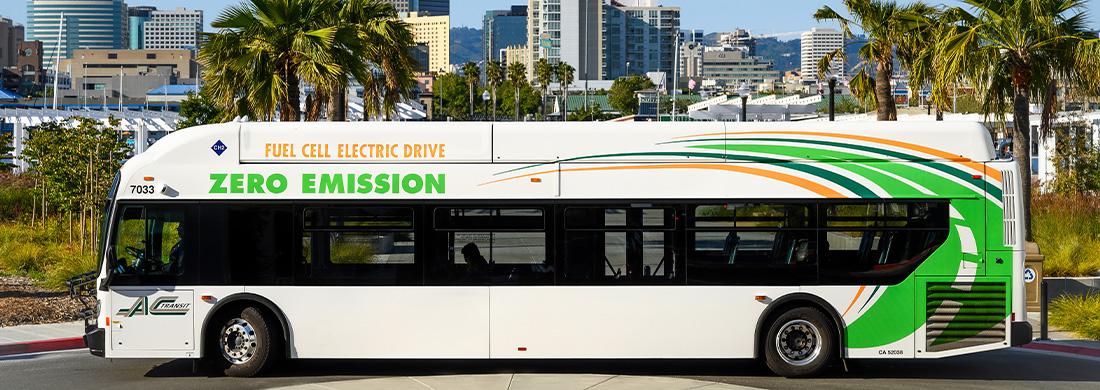
Joint procurements, whereby two or more purchasers enter into a single contract with a vendor, can bring down prices of emerging clean technologies by increasing purchase volume, and can streamline technology acquisition by sharing contracting workload across partners. Joint procurement and other innovative procurement policies have been used successfully to drive deployment of zero-emission buses in Europe and, more recently, the United States. Procurement strategies can be coupled with public financing. For instance, the Federal Transit Agency’s Low or No Emission Grant Program for clean buses preferences applications that utilize joint procurement, thereby helping public grant dollars go further.
The rising importance of the electrical grid across sectors creates new financial product opportunities. As the economy decarbonizes, more previously independent sectors are being linked to the electric grid, with load increasing (AI developments exacerbate this trend). That means that project developers in the green economy can offer a broader set of services, such as providing battery storage for renewables at vehicle charging points, distributed generation of power to supply new demand, and potential access to utility rate-making. Financial institutions should closely track rate-making and grid policy and explore avenues to accelerate beneficial electrification. There is a surprising but potent opportunity to market and finance clean energy and grid upgrades as a national security imperative, in response to the growing threat of foreign cyberattacks that are exploiting “seams” in fragile legacy energy systems.
Global markets can provide ballast against domestic volatility. The United States has an innovative financial services sector. Even though federal institutions may retreat from clean energy finance globally over the next few years, there remains a substantial opportunity for U.S. companies to provide financing and investment to projects globally, generate trade credit, and to bring some of those revenues back into the U.S. economy.
Financial products and strategies for adaptation and resilience must not be overlooked. Growing climate-linked disasters, and associated adaptation costs, impose substantial revenue burdens on state and local governments as well as on insurers and businesses. Competition for funds between adaptation and mitigation (not to mention other government services) may increase with proposed federal cuts. Financial institutions that design products that reduce risk and strengthen resilience (e.g., by helping relocate or strengthen vulnerable buildings and infrastructure) can help reduce these revenue competitions and provide long-term benefits by tapping into the $1.4 trillion market for adaptation and resilience solutions. Improved cost-benefit estimates and valuation frameworks for these interacting systems are critical priorities.
Conclusion: A Defining Window for Subnational Leadership
Leaders from across the country agree: clean energy and clean technology are investable, profitable, and vital to community prosperity. And there is a compelling lane for innovative subnational finance as not just a stopgap or replacement for federal action, but as a central area of policy in its own right.
The federal regulatory state is, increasingly, just a component of a larger economic transition that subnational actors can help drive, and shape for public benefit. Designing financial strategies for the United States to deftly navigate that transition can buffer against regulatory uncertainty and create a conducive environment for improved regulatory designs going forward. Immediate responses to stabilize climate finance, moreover, can build a foundation for a more engaged, and innovative, coalition of subnational financial actors working jointly for the public good.
Active state and private planning is the key to moving down these paths, with governments setting a clear direction of travel and marshaling their convening powers, capital access, and complementary policy tools to rapidly stabilize key projects and de-risk future capital choices.
There is much to do and no time to lose as governments and investors across the country seek to maintain clean technology progress. The Federation of American Scientists (FAS) and its partners will facilitate further development and implementation of approaches and ideas described above, with the goals of (1) directing bridge funding towards valuable and investable, yet at-risk, clean energy projects, and (2) building and demonstrating the capacity of subnational actors to drive continued growth of an equitable clean economy in the United States.
We invite government agencies, green banks and other financial institutions, philanthropic entities, project developers, and others to formally express interest in learning more and joining this work. To do so, contact Zoe Brouns (zbrouns@fas.org).
Acknowledgements
Thank you to the many partners who contributed to this report, including: Dr. Jedidah Isler and Zoë Brouns at the Federation of American Scientists, Sydney Snow at Climate Group, Yakov Feigin, Chirag Lala, and Advait Arun at the Center for Public Enterprise, and Jayni Hein at Covington and Burling LLP.
Federal Climate Policy Is Being Gutted. What Does That Say About How Well It Was Working?
On the left is the Bankside Power Station in 1953. That vast relic of the fossil era once towered over London, oily smoke pouring from its towering chimney. These days, Bankside looks like the right:

The old power plant’s vast turbine hall is now at the heart of the airy Tate Modern Art Museum; sculptures rest where the boilers once churned.
Bankside’s evolution into the Tate illustrates that transformations, both literal and figurative, are possible for our energy and economic systems. Some degree of demolition – if paired with a plan – can open up space for something innovative and durable.
Today, the entire energy sector is undergoing a massive transformation. After years of flat energy demand served by aging fossil power plants, solar energy and battery storage are increasingly dominating energy additions to meet rising load. Global investment in clean energy will be twice as big as investment in fossil fuels this year. But in the United States, the energy sector is also undergoing substantial regulatory demolition, courtesy of a wave of executive and Congressional attacks and sweeping potential cuts to tax credits for clean energy.
What’s missing is a compelling plan for the future. The plan certainly shouldn’t be to cede leadership on modern energy technologies to China, as President Trump seems to be suggesting; that approach is geopolitically unwise and, frankly, economically idiotic. But neither should the plan be to just re-erect the systems that are being torn down. Those systems, in many ways, weren’t working. We need a new plan – a new paradigm – for the next era of climate and clean energy progress in the United States.
Asking Good Questions About Climate Policy Designs
How do we turn demolition into a superior remodel? First, we have to agree on what we’re trying to build. Let’s start with what should be three unobjectionable principles.
Principle 1. Climate change is a problem worth fixing – fast. Climate change is staggeringly expensive. Climate change also wrecks entire cities, takes lives, and generally makes people more miserable. Climate change, in short, is a problem we must fix. Ignoring and defunding climate science is not going to make it go away.
Principle 2. What we do should work. Tackling the climate crisis isn’t just about cleaning up smokestacks or sewer outflows; it’s about shifting a national economic system and physical infrastructure that has been rooted in fossil fuels for more than a century. Our responses must reflect this reality. To the extent possible, we will be much better served by developing fit-for-purpose solutions rather than just press-ganging old institutions, statutes, and technologies into climate service.
Principle 3. What we do should last. The half-life of many climate strategies in the United States has been woefully short. The Clean Power Plan, much touted by President Obama, never went into force. The Trump administration has now turned off California’s clean vehicle programs multiple times. Much of this hyperpolarized back-and-forth is driven by a combination of far-right opposition to regulation as a matter of principle and the fossil fuel industry pushing mass de-regulation for self-enrichment – a frustrating reality, but one that can only be altered by new strategies that are potent enough to displace vocal political constituencies and entrenched legacy corporate interests.
With these principles in mind, the path forward becomes clearer. We can agree that ambitious climate policy is necessary; protecting Americans from climate threats and destabilization (Principle 1) directly aligns with the founding Constitutional objectives of ensuring domestic tranquility, providing for the common defense, and promoting general welfare. We can also agree that the problem in front of us is figuring out which tools we need, not how to retain the tools we had, regardless of their demonstrated efficacy (Principle 2). And we can recognize that achieving progress in the long run requires solutions that are both politically and economically durable (Principle 3).
Below, we consider how these principles might guide our responses to this summer’s crop of regulatory reversals and proposed shifts in federal investment.
Honing Regulatory Approaches
The Trump Administration recently announced that it plans to dismantle the “endangerment finding” – the legal predicate for the Environmental Protection Agency (EPA) to regulate greenhouse gas emissions from power plants and transportation; meanwhile, the Senate revoked permission for California to enforce key car and truck emission standards. It has also proposed to roll back key power plant toxic and greenhouse gas standards. We agree with those who think that these actions are scientifically baseless and likely illegal, and therefore support efforts to counter them. But we should also reckon honestly with how the regulatory tools we are defending have played out so far.
Federal and state pollution rules have indisputably been a giant public-health victory. EPA standards under the Clean Air Act led directly to dramatic reductions in harmful particulate matter and other air pollutants, saving hundreds of thousands of lives and avoiding millions of cases of asthma and other respiratory diseases. Federal regulations similarly caused mercury pollution from coal-fired power plants to drop by 90% in just over a decade. Pending federal rollbacks of mercury rules thus warrant vocal opposition. In the transportation sector, tailpipe emissions standards for traditional combustion vehicles have been impressively effective. These and other rules have indeed delivered some climate benefits by forcing the fossil fuel industry to face pollution clean-up costs and driving development of clean technologies.
But if our primary goal is motivating a broad energy transition (i.e., what needs to happen per Principle 1), then we should think beyond pollution rules as our only tools – and allocate resources beyond immediate defensive fights. Why? The first reason is that, as we have previously written, these rules are poorly equipped to drive that transition. Federal and state environmental agencies can do many things well, but running national economic strategy and industrial policy primarily through pollution statutes is hardly the obvious choice (Principle 2).
Consider the power sector. The most promising path to decarbonize the grid is actually speeding up replacement of old coal and gas plants with renewables by easing unduly complex interconnection processes that would speed adding clean energy to address rising demand, and allow the old plants to retire and be replaced – not bolting pollution-control devices on ancient smokestacks. That’s an economic and grid policy puzzle, not a pollution regulatory challenge, at heart. Most new power plants are renewable- or battery-powered anyway. Some new gas plants might be built in response to growing demand, but the gas turbine pipeline is backed up, limiting the scope of new fossil power, and cheaper clean power is coming online much more quickly wherever grid regulators have their act together. Certainly regulations could help accelerate this shift, but the evidence suggests that they may be complementary, not primary, tools.
The upshot is that economics and subnational policies, not federal greenhouse gas regulation, have largely driven power plant decarbonization to date and therefore warrant our central focus. Indeed, states that have made adding renewable infrastructure easy, like Texas, have often been ahead of states, like California, where regulatory targets are stronger but infrastructure is harder to build. (It’s also worth noting that these same economics mean that the Trump Administration’s efforts to revert back to a wholly fossil fuel economy by repealing federal pollution standards will largely fail – again, wrong tool to substantially change energy trajectories.)
The second reason is that applying pollution rules to climate challenges has hardly been a lasting strategy (Principle 3). Despite nearly two decades of trying, no regulations for carbon emissions from existing power plants have ever been implemented. It turns out to be very hard, especially with the rise of conservative judiciaries, to write legal regulations for power plants under the Clean Air Act that both stand up in Court and actually yield substantial emissions reductions.
In transportation, pioneering electric vehicle (EV) standards from California – helped along by top-down economic leverage applied by the Obama administration – did indeed begin a significant shift and start winning market share for new electric car and truck companies; under the Biden administration, California doubled down with a new set of standards intended to ultimately phase out all sales of gas-powered cars while the EPA issued tailpipe emissions standards that put the industry on course to achieve at least 50% EV sales by 2030. But California’s EV standards have now been rolled back by the Trump administration and a GOP-controlled Congress multiple times; the same is true for the EPA rules. Lest we think that the Republican party is the sole obstacle to a climate-focused regulatory regime that lasts in the auto sector, it is worth noting that Democratic states led the way on rollbacks. Maryland, Massachusetts, Oregon, and Vermont all paused, delayed, or otherwise fuzzed up their plans to deploy some of their EV rules before Congress acted against California. The upshot is that environmental standards, on their own, cannot politically sustain an economic transition at this scale without significant complementary policies.
Now, we certainly shouldn’t abandon pollution rules – they deliver massive health and environmental benefits, while forcing the market to more accurately account for the costs of polluting technologies, But environmental statutes built primarily to reduce smokestack and tailpipe emissions remain important but are simply not designed to be the primary driver of wholesale economic and industrial change. Unsurprisingly, efforts to make them do that anyway have not gone particularly well – so much so that, today, greenhouse gas pollution standards for most economic sectors either do not exist, or have run into implementation barriers. These observations should guide us to double down on the policies that improve the economics of clean energy and clean technology — from financial incentives to reforms that make it easier to build — while developing new regulatory frameworks that avoid the pitfalls of the existing Clean Air Act playbook. For example, we might learn from state regulations like clean electricity standards that have driven deployment and largely withstood political swings.
To mildly belabor the point – pollution standards form part of the scaffolding needed to make climate progress, but they don’t look like the load-bearing center of it.
Refocusing Industrial Policy
Our plan for the future demands fresh thinking on industrial policy as well as regulatory design. Years ago, Nobel laureate Dr. Elinor Ostrom pointed out that economic systems shift not as a result of centralized fiat, from the White House or elsewhere, but from a “polycentric” set of decisions rippling out from every level of government and firm. That proposition has been amply borne out in the clean energy space by waves of technology innovation, often anchored by state and local procurement, regional technology clusters, and pioneering financial institutions like green banks.
The Biden Administration responded to these emerging understandings with the CHIPS and Science Act, Bipartisan Infrastructure Law (BIL), and Inflation Reduction Act (IRA) – a package of legislation intended to shore up U.S. leadership in clean technology through investments that cut across sectors and geographies. These bills included many provisions and programs with top-down designs, but the package as a whole but did engage with, and encourage, polycentric and deep change.
Here again, taking a serious look at how this package played out can help us understand what industrial policies are most likely to work (Principle 2) and to last (Principle 3) moving forward.
We might begin by asking which domestic clean-technology industries need long-term support and which do not in light of (i) the multi-layered and polycentric structure of our economy, and (ii) the state of play in individual economic sectors and firms at the subnational level. IRA revisions that appropriately phase down support for mature technologies in a given sector or region where deployment is sufficient to cut emissions at an adequate pace could be worth exploring in this light – but only if market-distorting supports for fossil-fuel incumbents are also removed. We appreciate thoughtful reform proposals that have been put forward by those on the left and right.
More directly: If the United States wants to phase down, say, clean power tax credits, such changes should properly be phased with removals of support for fossil power plants and interconnection barriers, shifting the entire energy market towards a fair competition to meet increasing load, as well as new durable regulatory structures that ensure a transition to a low-carbon economy at a sufficient pace. Subsidies and other incentives could appropriately be retained for technologies (e.g., advanced battery storage and nuclear) that are still in relatively early stages and/or for which there is a particularly compelling argument for strengthening U.S. leadership. One could similarly imagine a gradual shift away from EV tax credits – if other transportation system spending was also reallocated to properly balance support among highways, EV charging stations, transit, and other types of transportation infrastructure. In short, economic tools have tremendous power to drive climate progress, but must be paired with the systemic reforms needed to ensure that clean energy technologies have a fair pathway to achieving long-term economic durability.
Our analysis can also touch on geopolitical strategy. It is true that U.S. competitors are ahead in many clean technology fields; it is simultaneously true that the United States has a massive industrial and research base that can pivot ably with support. A pure on-shoring approach is likely to be unwise – and we have just seen courts enjoin the administration’s fiat tariff policy that sought that result. That’s a good opportunity to have a more thoughtful conversation (in which many are already engaging) on areas where tariffs, public subsidies, and other on-shoring planning can actually position our nation for long-term economic competition on clean technology. Opportunities that rise to the top include advanced manufacturing, such as for batteries, and critical industries, like the auto sector. There is also a surprising but potent national security imperative to center clean energy infrastructure in U.S. industrial policy, given the growing threat of foreign cyberattacks that are exploiting “seams” in fragile legacy energy systems.
Finally, our analysis suggests that states, which are primarily responsible for economic policy in their jurisdictions, have a role to play in this polycentric strategy that extends beyond simply replicating repealed federal regulations. States have a real opportunity in this moment to wed regulatory initiatives with creative whole-of-the-economy approaches that can actually deliver change and clean economic diversification, positioning them well to outlast this period of churn and prosper in a global clean energy transition.
A successful and “sticky” modern industrial policy must weave together all of the above considerations – it must be intentionally engineered to achieve economic and political durability through polycentric change, rather than relying solely or predominantly on large public subsidies.
Conclusion
The Trump Administration has moved with alarming speed to demolish programs, regulations, and institutions that were intended to make our communities and planet more liveable. Such wholesale demolition is unwarranted, unwise, and should not proceed unchecked. At the same time, it is, as ever, crucial to plan for the future. There is broad agreement that achieving an effective, equitable, and ethical energy transition requires us to do something different. Yet there are few transpartisan efforts to boldly reimagine regulatory and economic paradigms. Of course, we are not naive: political gridlock, entrenched special interests, and institutional inertia are formidable obstacles to overcome. But there is still room, and need, to try – and effort bears better fruit when aimed at the right problems. We can begin by seriously debating which past approaches work, which need to be improved, which ultimately need imaginative recasting to succeed in our ever-more complex world. Answers may be unexpected. After all, who would have thought that the ultimate best future of the vast oil-fired power station south of the Thames with which we began this essay would, a few decades later, be a serene and silent hall full of light and reflection?
Updating the Clean Electricity Playbook: Learning Lessons from the 100% Clean Agenda
Building clean energy faster is the most significant near-term strategy to combat climate change. While the Biden Administration and the advocacy community made significant gains to this end over the past few years, we failed to secure major pieces of the policy agenda, and the pieces we did secure are not resulting in as much progress as projected. As a result, clean energy deployment is lagging behind levels needed to match modeled cost-effective scenarios, let alone to achieve the Paris climate goals. Simultaneously, the Trump Administration is actively dismantling the foundations that have underpinned our existing policy playbook.
Adjusting course to rapidly transform the electricity sector—to cut pollution, reduce costs, and power a changing economy—requires us to upgrade the regulatory frameworks we rely upon, the policy tools we prioritize, and the coalition-building and messaging strategies we use.
After leaving the Biden Administration, I joined FAS as a Senior Fellow to jump into this work. We plan to assess the lessons from the Biden era electricity sector plan, interrogate what is and is not working from the advocacy community’s toolkit, and articulate a new vision for policy and strategy that is durable and effective, while meeting the needs of our modern society. We need a new playbook that starts in the states and builds toward a national mission that can tackle today’s pressing challenges and withstand today’s turbulent politics. And we believe that this work must be transpartisan—we intend to draw from efforts underway in a wide range of local political contexts to build a strategy that appeals to people with diverse political views and levels of political engagement.
This project is part of a larger FAS initiative to reimagine the U.S. environmental regulatory state and build a new system that can address our most pressing challenges.
Betting Big on 100% Clean Electricity
If we are successful in fighting the climate crisis, the largest share of domestic greenhouse gas emissions reductions over the next ten years will come from building massive amounts of new clean energy and in turn reducing pollution from coal- and gas-fired power plants. Electricity will also need to be cheap, clean, and abundant to move away from gasoline vehicles, natural gas appliances in homes, and fossil fuel-fired factories toward clean electric alternatives.
That’s why clean electricity has been the centerpiece of federal and state climate policy. The signature climate initiative of the Obama Administration was the Clean Power Plan. Over the past several decades, states have made the most emissions progress through renewable portfolio standards and clean electricity standards that require power companies to provide increasing amounts of clean electricity. Now 24 (red and blue) states and D.C. have goals or requirements to achieve 100 percent clean electricity. And in the 2020 election, Democratic primary candidates competed over how ambitious their plans were to transform the electricity grid and deploy clean energy.
As a result of that competition and the climate movement’s efforts to put electricity at the center of the strategy, President Biden campaigned on achieving 100 percent clean electricity by 2035. This commitment was very ambitious—it surpassed every state goal except Vermont’s, Rhode Island’s, and D.C.’s. In making such a bold commitment, Biden recognized how essential the power sector is to addressing the climate crisis. He also staked a bet that the right policies—large incentives for companies, worker protections, and support for a diverse mix of low-carbon technologies—would bring together a coalition that would fight for the legislation and regulations needed to make the 2035 goal a reality.
A Mix of Wins and Losses
That bet only partially paid off. We won components of the agenda that made major strides toward 100% clean electricity. New tax credits are accelerating deployment of wind, solar, and battery storage (although the Trump Administration and Republicans in Congress are actively working to repeal these credits). Infrastructure investments are driving grid upgrades to accommodate additional clean energy. And new grant programs and procurement policies are speeding up commercialization of critical technologies such as offshore wind, advanced nuclear, and enhanced geothermal.
But the movement failed to secure the parts of the plan that would have ensured an adequate pace of deployment and pollution reductions, including a federal clean electricity standard, a suite of durable emissions regulations to cover the full sector, and federal and state policies to reduce roadblocks to new infrastructure and align utility incentives with clean energy deployment. We ran into real-world and political headwinds that held us back. For example, deployment was stifled by long timelines to connect projects to the grid and local ordinances and siting practices that block clean energy. Policy initiatives were thwarted by political opposition from perceived reliability impacts and blowback from increasing electricity rates, especially for newer technologies like offshore wind and advanced nuclear. The opposition to clean energy successfully weaponized the rising cost of living to fight climate policies, even where clean energy would make life less expensive. These barriers not only impeded commercialization and deployment but also dampened support from key stakeholders (project developers, utilities, grid operators, and state and local leaders) for more ambitious policies. The necessary coalitions did not come together to support and defend the full agenda.
As a result, we are building clean energy much too slowly. In 2024, the United States built nearly 50 gigawatts of new clean power. This number, while a new record, falls short of the amount needed to address the climate crisis. Analysis from three leading research projects found that, with the tax incentives in the Inflation Reduction Act, the future in which we get within striking distance of the Paris climate goals requires 70 to 125 gigawatts of new clean power per year for the next five years, 40 to 250 percent higher than our record annual buildout.
Where do we go from here?
The climate crisis demands faster and deeper policy change with more staying power. Addressing the obvious obstacles standing in the way of clean energy deployment, like the process to connect power plants to the grid, is necessary but insufficient. We must also develop new policy frameworks and expanded coalitions to facilitate the rapid transformation of the electricity system.
This work requires us to ask and creatively answer an evolving set of questions, including: What processes are holding us back from faster buildout, and how do we address them? How can utility incentives be better aligned with the deployment and infrastructure investment we need and support for the required policies? How can the way we pay for electricity be better designed to protect customers and a livable climate? Where have our coalitional strategies failed to win the policies we need, and how do we adjust? How should we talk about these problems and the solutions to build greater support?
We must develop answers to these questions in a way that leads us to more transformative, lasting policies. We believe that, in the near term, much of this work must happen at the state level, where there is energy to test out new ideas and frameworks and iterate on them. We plan to build out a state-level playbook that is actionable, dynamic, and replicable. And we intend to learn from the experiences of states and municipalities with diverse political contexts to develop solutions that address the concerns of a wide range of audiences.
We cannot do this work on our own. We plan to draw on the expertise of a diverse range of organizations and people who have been working on these problems from many vantage points. If you are working on these issues and are interested, please join us in collaboration and conversation by reaching out to akrishnaswami@fas.org.
Building an Environmental Regulatory System that Delivers for America
The Clean Air Act. The Clean Water Act. The National Environmental Policy Act. These and most of our nation’s other foundational environmental laws were passed decades ago – and they have started to show their age. The Clean Air Act, for instance, was written to cut air pollution, not to drive the whole-of-economy response that the climate crisis now warrants. The Energy Policy and Conservation Act of 1975 was designed to make cars more efficient in a pre-electric vehicle era, and now puts the Department of Transportation in the awkward position of setting fuel economy standards in an era when more and more cars don’t burn gas.
Trying to manage today’s problems with yesterday’s laws results in government by kludge. Legacy regulatory architecture has foundered under a patchwork of legislative amendments and administrative procedures designed to bridge the gap between past needs and present realities. Meanwhile, Congressional dysfunction has made purpose-built updates exceptionally difficult to land. The Inflation Reduction Act, for example, was mostly designed to move money rather than rethink foundational statutes or regulatory processes – because those rethinks couldn’t make it past the filibuster.
As the efficacy of environmental laws has waned, so has their durability. What was once a broadly shared goal – protecting Americans from environmental harm – is now a political football, with rules that whipsaw back and forth depending on who’s in charge.
The second Trump Administration launched the biggest environmental deregulatory campaign in history against this backdrop. But that campaign, coupled with massive reductions in the federal civil service and a suite of landmark court decisions (including Loper Bright) about how federal agencies regulate, risks pushing U.S. regulatory architecture past the point of sensible and much-needed reform and into a state of complete disrepair.
Dismantling old systems has proven surprisingly easy. Building what comes next will be harder. And the work must begin now.
It is time to articulate a long-term vision for a government that can actually deliver in an ever-more complex society. The Federation of American Scientists (FAS) is meeting this moment by launching an ambitious new project to reimagine the U.S. environmental regulatory state, drawing ideas from across ideological lines.
The Beginning of a New Era
Fear of the risks of systemic change often prevent people from entertaining change in earnest. Think of the years of U.S. squabbles over how or whether to reform permitting and environmental review, while other countries simply raced ahead to build clean energy projects and establish dominance in the new world economy. Systemic stagnation, however, comes with its own consequences.
The Inflation Reduction Act (IRA) and the Infrastructure Investment and Jobs Act (IIJA) are a case in point when it comes to climate and the environment. Together, these two pieces of legislation represented the largest global investment in the promise of a healthier, more sustainable, and, yes, cheaper future. Unfortunately, as proponents of the “abundance” paradigm and others have observed, rollout was hampered by inefficient processes and outdated laws. Implementing the IRA and the IIJA via old systems, in short, was like trying to funnel an ocean through a garden hose – and as a result, most Americans experienced only a trickle of real-world impact.
Similar barriers are constraining state progress. For example, the way we govern and pay for electricity has not kept pace with a rapidly changing energy landscape – meaning that the United States risks ceding leadership on energy technologies critical to national security, economic competitiveness, and combating climate change.
But we are perhaps now entering a new era. The United States appears to be on the edge of real political realignments, with transpartisan stakes around the core role of government in economic development that do not match up neatly to current coalitions. This realignment presents a crucial opportunity to catalyze a new era of climate, environmental, and democratic progress.
FAS will leverage this opportunity by providing a forum for debate and engagement on different facets of climate and environmental governance, a platform to amplify insights, and the capacity to drive forward solutions. Examples of topics ripe for exploration include:
- Balancing agility and accountability. As observed, regulatory approaches of the past have struggled to address the interconnected, quickly evolving nature of climate and environmental challenges. At the same time, mechanisms for ensuring accountability have been disrupted by an evolving legal landscape and increasingly muscular executive. There is a need to imagine and test new systems designed to move quickly but responsibly on climate and environmental issues.
- Complementing traditional regulation through novel strategies. There is growing interest in using novel financial, contractual, and other strategies as a complement to regulation for driving climate and environmental progress. There is considerable room to go deeper in this space, identifying both the power of these strategies and their limits.
- Rethinking stakeholder engagement. The effectiveness of regulation depends on its ability to serve diverse stakeholder needs while advancing environmental goals. Public comment and other pipelines for engaging stakeholders and integrating external perspectives and expertise into regulations have been disrupted by technologies such as AI, while the relationship between regulated entities and their regulators has become increasingly adversarial. There is a need to examine synergies and tradeoffs between centering stakeholders and centering outcomes in regulatory processes, as well as examine how stakeholder engagement could be improved to better ensure regulations that are informed, feasible, durable, and distributively fair.
In working through topics like these, FAS seeks to lay out a positive vision of regulatory reconstruction that is substantively superior to either haphazard destruction or incremental change. Our vision is nothing less than to usher in a new paradigm of climate and environmental governance: one that secures a livable world while reinforcing democratic stability, through systems that truly deliver for America.
We will center our focus on the federal government given its important role in climate and environmental issues. However, states and localities do a lot of the work of a federated government day-to-day. We recognize that federal cures are unlikely to fully alleviate the symptoms that Americans are experiencing every day, from decaying infrastructure to housing shortages. We are committed to ensuring that solutions are appropriately matched to the root cause of state capacity problems and that federal climate and environmental regulatory regimes are designed to support successful cooperation with local governments and implementation partners.
FAS is no stranger to ambitious endeavors like these. Since our founding in 1945, we have been committed to tackling the major science policy issues that reverberate through American life. This new FAS workstream will be embedded across our Climate and Environment, Clean Energy, and Government Capacity portfolios. We have already begun engaging and activating the diverse community of scholars, experts, and leaders laying the intellectual groundwork to develop compelling answers to urgent questions surrounding the climate regulatory state, against the backdrop of a broader state capacity movement. True to our nonpartisan commitment, we will build this work on a foundation of cross-ideological curiosity and play on the tension points in existing coalitions that strike us all as most productive.
We invite you to join us in conversation and collaboration. If you want to get involved, contact Zoë Brouns (zbrouns@fas.org).