China Test-Launches New Ballistic Missile
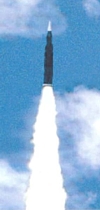
China has test launched a DF-31 long-range ballistic missile, according to a report by the Russian news agency ITAR-TASS. The missile was said to have been launched from the Wuzhai launch site on Monday night.
The DF-31 has been under development since the 1980s and Monday’s flight test appears to be the sixth flight test of the missile since 1999. The U.S. Department of Defense predicted in 2002 that the DF-31 would be deployed “before mid-decade,” but that didn’t happen. The current DOD prediction is that deployment may happen this year. Some web sites erroneously say the missile is already operational.
The DF-31 forms the core of China’s current modernization of long-range nuclear ballistic missiles. Two modifications of the DF-31 are under development. The road-mobile DF-31A has a longer range (possibly up to 12,000 km), and the 8,000+ km range Julang-2 is intended to arm China’s next generation of ballistic missile submarines (Jin-class).
There is considerable confusion and uncertainty about the capability of the DF-31. Early reports predicted a range of at least 8,000 km (4,875 miles), but the latest DOD estimate is 7,250+ km (4,500+ miles). China has not yet tested the DF-31 to the full range reported by the DOD. Tuesday’s test launch impacted in the Takla Makan Desert some 2,500 km west of Wuzhai. If the range is 7,250+, the DF-31 will not be able to target the entire continental United States, only the most northwestern parts. Its main role may be against Russia, India, as well as U.S. facilities in the Pacific including Hawaii and Guam.
Another confusion concerns the payload. Despite widespread speculation among private analysts and media that the new missiles will carry multiple warheads, the U.S. intelligence community anticipates that all three missile types will carry a single warhead each.
Later this month (September), FAS and the Natural Resources Defense Council will publish a joint report about Chinese nuclear forces and U.S. nuclear targeting of China. The report uses high-resolution satellite images and declassified documents to describe the nuclear relationship between China and the United States.
See also: Elusive Chinese Submarine Cave Spotted | Nuclear Notebook on Chinese Nuclear Forces
This is not the first time Google has agreed to censor imagery at the behest of governments, but be warned: obfuscation at this broad level poses a direct threat to the public’s ability to monitor and scrutinize government operations.
As humans expand our geographic reach, encroach on untouched natural territories, and interact more with animal populations, we will encounter novel zoonotic diseases that threaten the human body. The sooner we act to address these risks, the better.
“One thing became increasingly clear: AI doesn’t simply introduce a new category of risk. It changes the speed, scale, complexity, and interaction of risks that already exist.”
In the current environment of declining trust and magnifying strategic competition, banning debris-creating tests is a concrete step towards stability that favors interests of all states seeking to conduct space activities.