
Tracking the DF Express: A Practical Guide to Evaluating Chinese Media and Public Data for Studying Nuclear Forces
Observers of Chinese nuclear politics and force posture are old friends with information challenges. Open-source analysts of China’s nuclear force drew heavily on published Chinese-language writings, footage, and interviews by official Chinese media or private Chinese citizens, as well as commercial satellite imagery. These powerful open-source tools enable scholars to gain insight into some of the Chinese government’s most closely guarded secrets, such as the construction of 119 nuclear missile silos. Reports from well-regarded institutions, such as the PLA Rocket Force Order of Battle report by the James Martin Center for Nonproliferation Studies, offer open-source research that provides concrete data on the Chinese nuclear force, using thoroughly analyzed imagery and Chinese-language materials. Other studies, such as several reports by the RAND Corporation and the Air University’s China Aerospace Studies Institute (CASI), extensively used Chinese military and technical writings to identify patterns in the People’s Liberation Army (PLA)’s strategic thinking in its own words. Combined with the Federation of American Scientists (FAS)’s annual report on nuclear forces, there is a growing and vibrant open-source intellectual community on the People’s Liberation Army Rocket Force (PLARF).
While researchers continue to dissect new information from China, obtaining reliable data has become increasingly difficult for two reasons. First, the Chinese government has curtailed foreign access to sources like academic databases that were previously fair game for scholarly use, complicating the already dense “information fog” over China’s political and military apparatus. Second, unverified, digitally altered, and AI-generated disinformation and misinformation are commonplace on popular social media platforms like X (formerly Twitter). Combined with the multitude of Chinese social media and video websites, weeding out the noise and distraction has become an increasingly challenging task for new researchers in this field.
This essay provides introductory guidance on the usefulness of Chinese social media and video platforms for observers and researchers of China’s nuclear force. This guide may assist researchers in identifying what to look for and on which platform, especially for those who are not advanced or native speakers of Mandarin. In the sections below, I compare a set of popular Chinese social media platforms and discuss the usefulness of each with respect to open-source study of the Chinese nuclear force. I also present a brief glossary of nicknames and vernacular terms related to nuclear matters in Mandarin, along with their translations. I conclude with a brief discussion of the use of AI-enabled translation tools for open-source research on the PLA.
Chinese media and OSINT: What’s good for what?
Sina Weibo (新浪微博)
Weibo is useful for providing timely, authoritative, and chronologically documented information on training exercises, operations, and policy changes that are of propaganda or morale-promoting value. The equivalent of X in China, Weibo is the biggest Chinese-language social media with over 500 million monthly active users as of 2024. It is likely the most influential social media platform in China, as indicated by the vast number of users and a highly agile and effective censorship system. Due to Weibo’s ability to rapidly disseminate information, all major state and military organs, including the PLA Daily, the Ministry of Defense, individual service branches, and all five PLA Theater Commands (战区), maintain official accounts on Weibo (Figure 1). These accounts are directly managed by dedicated propaganda or public affairs teams and authorized to post military content, which sometimes features approved footage and photos of training exercises. Details revealed in the footage or pictures may help researchers identify the unit leadership and the weapon systems used during the exercise. Additionally, Weibo is often the first platform to announce state media PLA news. The People’s Daily, CCTV, and the Xinhua Agency regularly post links to news articles and updates on Weibo to facilitate dissemination.
For researchers, Weibo contains a reasonably reliable search system. Researchers may use the Weibo search bar to look for mentions of “strategic deterrence,” “nuclear force,” or names of nuclear missiles and use the filter function to screen for content released by official accounts. For well-publicized events like a missile exercise, the topic may be included in the trending (热搜) section for real-time updates. However, a significant limitation of Weibo is that scholars must distinguish whether the content posted by the official accounts directly reflects the Party’s policy or simply shows a lower-level interpretation of the policy by individual units. These official accounts are likely managed by young, tech-savvy officers or civilian employees trained in public affairs.
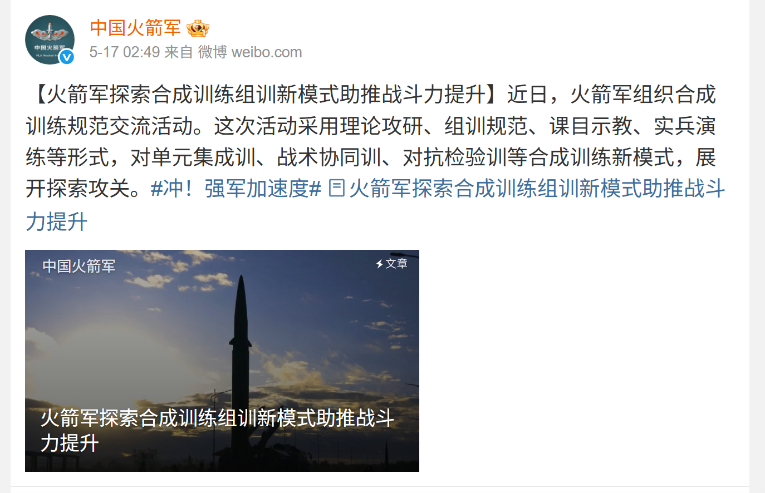
Sometimes, these individuals might improvise and go beyond what they were prescribed. Some more active accounts, such as the Eastern Theater Command official account, have interacted with random Weibo users in the past and have eagerly implied their belligerent stance toward Taiwan. This led many Chinese netizens to interpret the official account’s posts as a sign of imminent military action, which thankfully was not the intention. Additionally, state-run accounts have also taken down content (primarily propaganda material) for reasons other than revealing unapproved or sensitive information. Again, since the accounts are likely managed by younger personnel at the lower level, contents could be removed when it was later found to be too politically sensitive or too unpersuasive. In 2019, the People’s Liberation Army Army (PLAA) official account posted a propaganda article on Weibo aimed at inspiring nationalistic fervor. It quoted a passionate patriotic poem written by Wang Jingwei (汪精卫), whom the Chinese government considered a “traitor (汉奸)” for cooperating with the Imperial Japanese invaders, most likely because the editor had known about the poem but not its authorship. The comment section quickly pointed out this “political mistake (政治错误)”, leading to the content’s prompt removal. As such, researchers should be aware that removed content does not necessarily suggest valuable information worth hiding.
It is also important to note that accessing Weibo sometimes involves more than typing in the URL. Aside from the content available on the front page (e.g., the trending section), the rich content of the platform is only accessible after logging in. One does not need a mainland Chinese phone number to create an account on Weibo. A virtual number from a trusted provider is also sufficient. Even without an account, researchers could still access the Weibo homepage of many accounts by searching the account’s name in a search engine (for instance, here is the direct link to the official PLA Eastern Theater Weibo page). However, Sina Weibo’s search bar will not be available for unregistered users.
CCTV.com (央视网)
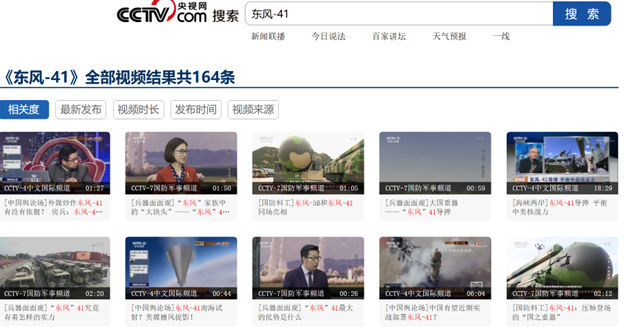
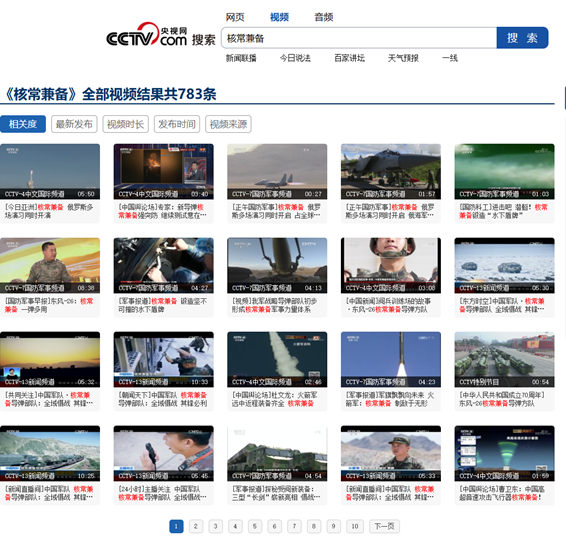
CCTV.com is a webpage that gives scholars access to the state media’s TV programs without a registered account. In addition to live-streamed news stories, the webpage also serves as a large but incomplete archive of past TV programs. CCTV.com has high-definition PLA video footage and interviews, which may be particularly useful for open-source analysis. Some of the CASI reports made clever use of video footage released by Chinese state media to identify key information regarding training exercises and unit deployment, particularly the CCTV-7 channel dedicated to military content. Other open-source intelligence analysts were able to map out key personnel, location, and weapon system information from CCTV news broadcasts and military TV programs. The search bar supports keyword searches and includes government-sponsored TV programs from various channels. The search also returns results from CCTV webpages and the Xinhua Agency. This is the most useful for finding information related to specific missile systems. For instance, among the top results for “DF-26” include footage of a DF-26 missile from a documentary (Figure 2). The search result for “dual-capability” also returned a video by a Chinese military commentator who states that China’s hypersonic vehicle is dual-capable (Figure 3). For open-source analysis, having the ability to revisit footage that might contain useful information on the PLARF is a major advantage of this platform. At the same time, the search function is limited to the titles of the program, not necessarily the content. Furthermore, many of the videos available on CCTV.com are commentaries from Chinese military experts. While the commentary from the Chinese experts may be useful, the visual component may not always be the latest developments. Because of the length requirement of the TV program, the visual element may only have looped videos of known weapon testing or parade footage. Researchers may consider comparing the footage from different programs to remove the repeated material.
Bilibili (哔哩哔哩), Douyin (抖音), Kuaishou (快手)
Bilibili, Douyin, and Kuaishou are among the most used entertainment video-sharing and short-video platforms in China. Bilibili is a video service primarily for animation, comics, and games (ACG) content. It has a “bullet comment (弹幕)” function that allows users to inject text over the video content in real time. The platform attracts over 100 million daily users as of 2024. Douyin (the Chinese mainland version of TikTok) and Kuaishou are short-video platforms with a significantly larger user base than Bilibili, with Douyin content reaching over 1 billion active users monthly. Unsurprisingly, the PLA, the individual Theater Commands, and the Chinese government and Party organs maintain an active presence on these platforms for propaganda, news updates, and publicity programs, often repeating the same message sent across other outlets.
However, despite these platforms’ popularity, they are not great resources for open-source nuclear force research for two reasons. First, there is overwhelming noise from private click-farming content creators who would grossly overstate or fabricate China’s military capabilities to profit from nationalistic sentiments. A researcher may find many videos speculating about the capabilities of the H-20 bomber with no credible source to back up the claims. Private content creators typically have no privileged access to information. In the rare cases where some villagers filmed a rocket booster falling from the sky (some Chinese rocket boosters in the past landed in populated villages), the video is often quickly censored on these closely watched platforms. Second, official government accounts on these platforms almost always repeat information that has been released on Weibo and other traditional news platforms. Some Party organs, such as the Communist Youth League (共青团), which pushes propaganda to the younger generation, would convey the same approved message using CGI videos to boost nationalist sentiment, but the content itself is no more useful than reading the official news release. Overall, there is little added advantage of using the entertainment-based services for potentially useful open-source information.
Combining Sources
While Chinese video and social media platforms could assist OSINT research on China’s nuclear forces, researchers could also combine the visual element of weapon systems with textual data gathered from authoritative Chinese platforms like China Military Online (中国军网), PLA Procurement website (军队采购网), and Qi Cha Cha (企查查). The visual data can help identify many technical aspects of the PLA’s nuclear weapons, but the textual information can greatly inform the acquisition, production, and deployment of the weapon and support systems. Provinces with robust military and heavy industries, such as Heilongjiang, Liaoning, Shandong, and Shaanxi, sometimes release contracting and procurement information locally on provincial and municipal government websites. The information found on local government websites is admittedly sporadic, making broad, systematic collection difficult. Still, such information could serve as valuable first-hand sources for OSINT researchers. For more technical analysis of weapon systems, the China National Intellectual Property Administration (中国国家知识产权局) has a patent database that could be useful to track the development and ownership of certain enabling technologies for nuclear systems. This may be further enhanced by using the China National Knowledge Infrastructure (中国知网CNKI) to locate academic articles on the relevant technology, though access to CNKI articles usually requires an institutional subscription through a university library. Note that many of the Chinese government and military websites do not support a secure HTTPS connection. Some, like Qi Cha Cha, may require the user to access its content from a Chinese mainland IP address. Researchers should deploy cybersecurity tools to take full advantage of these resources.
Nicknames and Vernacular
In addition to the advantages and limitations of different social media platforms, researchers should be aware of the common nicknames and vernacular related to the Chinese nuclear force. Much like how the F-16 is commonly called “viper” instead of the official name “fighting falcon,” there are also nicknames for weapons and systems in the PLA. The table below summarizes several common terms and explains their meaning and primary usage.
A Note on Using AI Translation Services
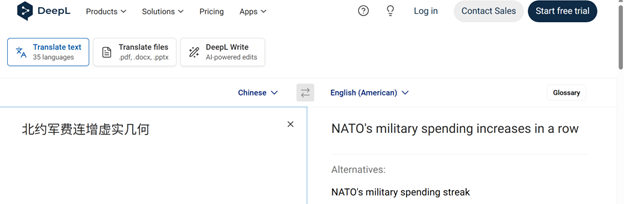
There is little doubt that AI-enabled translation services like DeepL offer convenient and mostly accurate translations of Chinese texts. However, users should exercise caution when asking the AI to translate lengthy or complicated Chinese texts. Since the Chinese written language system is not space-delimited and often contains a mix of recently invented slang words, formal, and classical Chinese (文言文) phrases and quotes, the translation software sometimes cannot adjust properly to the context in which the classical phrases are used. This could easily lead to misinterpretation. For instance, translating and searching for the phrase “nuclear force (核力量)” may return results that contain the phrase “hardcore power (硬核力量)”, which is unrelated to nuclear weapons. In another example, a PLA Daily article uses the phrase “北约军费连增虚实几何” as the title, which mixes the classical grammar with modern Mandarin. DeepL would translate the word “几何” as “geometry” because it is the most used meaning in modern Mandarin, whereas the correct interpretation is “to what extent” or “by how much” in this context (Figure 4).
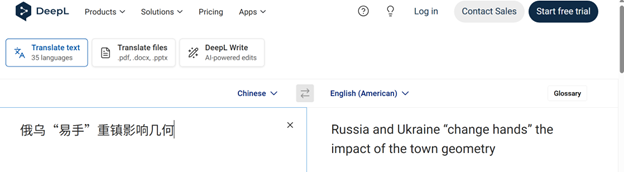
In a similar instance, DeepL entirely fails to translate the part that contains classical grammar and offers an incorrect translation (Figure 5). This is most likely because the software treats the original Chinese phrase as a statement, whereas the classical grammar indicates a question.
Therefore, it is prudent to cross-reference and look up phrases individually when using AI-enabled translation tools. Inserting complete paragraphs is likely less accurate than looking up difficult phrases or individual vocabulary.
Conclusion
This paper provides a preliminary guide on using Chinese social media and video platforms for nuclear-related open-source research by reviewing the usefulness and credibility of the content released by various official and privately owned platforms (Table 2). In sum, there is no singular most useful platform for information on the Chinese nuclear force, but some may help piece together interesting findings upon cautious review and cross-reference. While advanced Chinese language proficiency and cultural familiarity remain irreplaceable skills that can greatly enhance the accuracy and speed of open-source analysis, they are neither necessary nor sufficient for successful open-source analysis on China’s nuclear forces. Researchers can still make effective and efficient use of publicly available information by applying analytical due diligence and having context-specific awareness of Chinese sources.
This publication was made possible by a generous grant from the Carnegie Corporation of New York. The statements made and views expressed are solely the responsibility of the author.
It is difficult to assess from photos whether the Sentinel missile is longer or wider overall than the Minuteman, but the Sentinel clearly has a thicker second stage, which could potentially contribute to the missile’s extended range.
This is not the first time Google has agreed to censor imagery at the behest of governments, but be warned: obfuscation at this broad level poses a direct threat to the public’s ability to monitor and scrutinize government operations.
As humans expand our geographic reach, encroach on untouched natural territories, and interact more with animal populations, we will encounter novel zoonotic diseases that threaten the human body. The sooner we act to address these risks, the better.
“One thing became increasingly clear: AI doesn’t simply introduce a new category of risk. It changes the speed, scale, complexity, and interaction of risks that already exist.”